Logo
  • Balcony Law
  • About us
  • Inspection services
  • FAQ
  • Blog
  • Call us ‪+1 818-806-7885
  • Book now

Month: September 2026

10 Best Practices for Managing Building Safety Audits

Posted on September 19, 2026 by Apex Balcony admin
10 Best Practices for Managing Building Safety Audits

Table of Contents

  • 1. Define Clear Audit Scope and Objectives
  • 2. Understand SB 326 Balcony Inspection Requirements
  • 3. Develop a Building Safety Audit Template
  • 4. Conduct Thorough On-Site Inspections
  • 5. Hire a Licensed Structural Inspector
  • 6. Document Findings and Maintain Audit Trails
  • 7. Create Corrective Action Plans and Track Closeout
  • 8. Build a Safety Culture and Engage Stakeholders
  • Common Mistakes to Avoid
  • Frequently Asked Questions
  • External Resources

Last Updated: September 18, 2026

Building safety audits protect residents and shield property owners from liability. But conducting them effectively requires more than checking boxes. The difference between a cursory inspection and one that actually prevents structural failure comes down to how systematically you approach the process.

This guide covers 10 best practices for managing building safety audits, ensuring you catch problems early, document findings properly, and follow through on repairs.

Quick Overview

PracticeKey FocusOutcome
Define scope and objectivesClarify what you’re inspecting and whyFocused, efficient audit
Understand SB 326 requirementsKnow the legal mandateStay compliant with state law
Create an audit templateStandardize your processConsistent documentation
Conduct thorough inspectionsExamine all elevated exterior elementsCatch structural issues early
Hire licensed inspectorsUse qualified professionalsCredible, defensible findings
Document everythingMaintain audit trailsStrong liability protection
Plan corrective actionsAddress findings systematicallyRepairs get completed
Build safety cultureEngage employees and residentsSustained compliance

1. Define Clear Audit Scope and Objectives

Your building safety audit starts with a critical question: what exactly are you inspecting, and what do you hope to accomplish? Without defined scope, audits become sprawling exercises that waste time and miss important issues.

Identify the specific structures under review (all balconies, specific units, common stairways) and establish measurable objectives: confirm code compliance, identify structural defects, document current conditions, and develop a prioritized repair list.

Document scope and objectives in writing before the audit begins. This audit scope statement keeps the inspection focused and provides evidence you approached it methodically.

Pro Tip
Include the audit date range, the specific buildings or units covered, and the regulatory standard you’re testing against (SB 326, SB 721, or local codes). This clarity prevents scope creep and ensures your inspector doesn’t waste time on areas outside the audit’s purpose.

2. Understand SB 326 Balcony Inspection Requirements

California’s SB 326 and SB 721 mandate inspections of elevated exterior elements in residential buildings with three or more units. SB 326 (effective January 1, 2018) applies to buildings constructed before January 1, 2008. SB 721 (effective January 1, 2020) extends requirements to buildings constructed before January 1, 2015. These are legal mandates with penalties for non-compliance.

A licensed structural engineer or architect must conduct the inspection, examining for dry rot, water intrusion, fastener corrosion, and structural deterioration. Failure to comply can result in fines, permit loss, and liability.

Watch Out
If your building was constructed before January 1, 2015 and has three or more residential units, you likely fall under SB 721 requirements. Delaying this inspection doesn’t make the obligation disappear, it increases your liability exposure. The longer you wait, the more deterioration can occur undetected.

Apex Balcony specializes in these exact inspections, helping property owners understand which regulation applies to their building and ensuring the inspection meets all state requirements.

3. Develop a Building Safety Audit Template

A template ensures every inspector follows the same process and documents findings consistently. Include: property identification, inspector credentials, inspection date, detailed checklists (railings, fasteners, connections, stairs), space for photos and notes, condition ratings, and recommended actions.

The checklist should be specific enough that different inspectors document similar findings. Instead of “inspect railings,” specify: “Check railing height (minimum 42 inches), loose fasteners, rust, wood deterioration, and connections to building structure.”

Digital templates allow inspectors to fill forms on tablets, add photos directly, and sync findings in real time. Include evidence-based findings: photos of corroded fasteners, locations and depth of wood deterioration. This evidence is critical if you need to defend findings later.

Key Takeaway
A well-designed template turns inspection findings into defensible documentation. It ensures compliance with regulatory standards and creates an audit trail that protects you if disputes arise over repair decisions.

4. Conduct Thorough On-Site Inspections

A thorough on-site inspection requires more than a visual walk-around. For each element, include: close visual inspection of all surfaces, tactile testing (probing wood, checking fastener tightness), photographic documentation, measurement of dimensions, and assessment of water intrusion.

Inspect during daylight hours and avoid rainy days when water may mask dry rot. A 50-unit building typically requires a full day or more for thorough inspection.

Record findings in real time using your template. Take photos of defects with close-ups showing extent of damage. Note locations precisely and include measurements and condition ratings. Document any obstacles that prevent full assessment (blocked access, storage) to show you attempted thorough inspection within practical limits.

Pro Tip
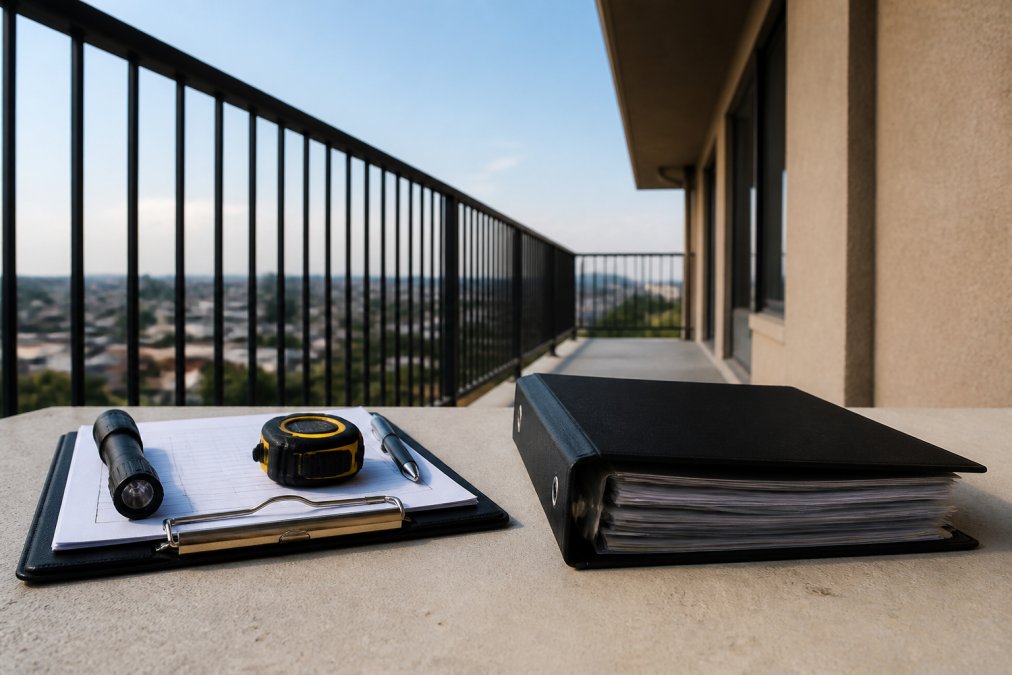
Bring tools: a moisture meter to test for water intrusion, a probe to test wood density, a level to check railing height, a measuring tape, and a camera. These tools transform subjective observations into objective data that holds up under scrutiny.

5. Hire a Licensed Structural Inspector

Your inspector must be a licensed structural engineer or architect with specific experience in balcony and deck inspections. A licensed inspector understands building codes, recognizes early signs of structural failure, and assesses whether deterioration is cosmetic or dangerous.

Ask about experience with your building type and age. Request references from other HOAs. Review past reports for detail and specificity. Verify license with the state and confirm professional liability insurance.
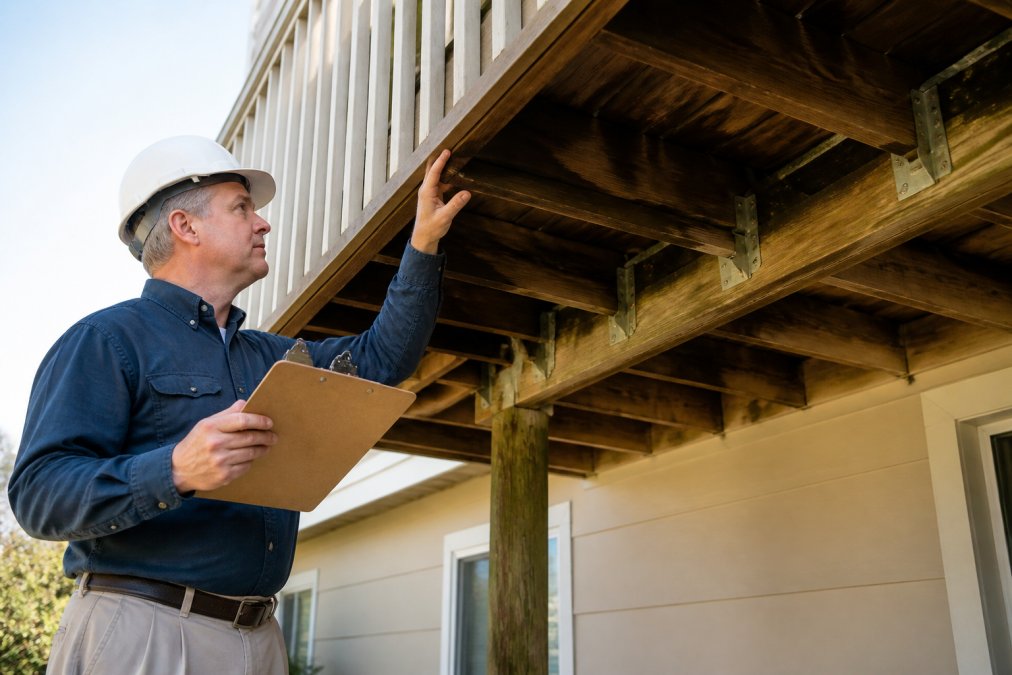
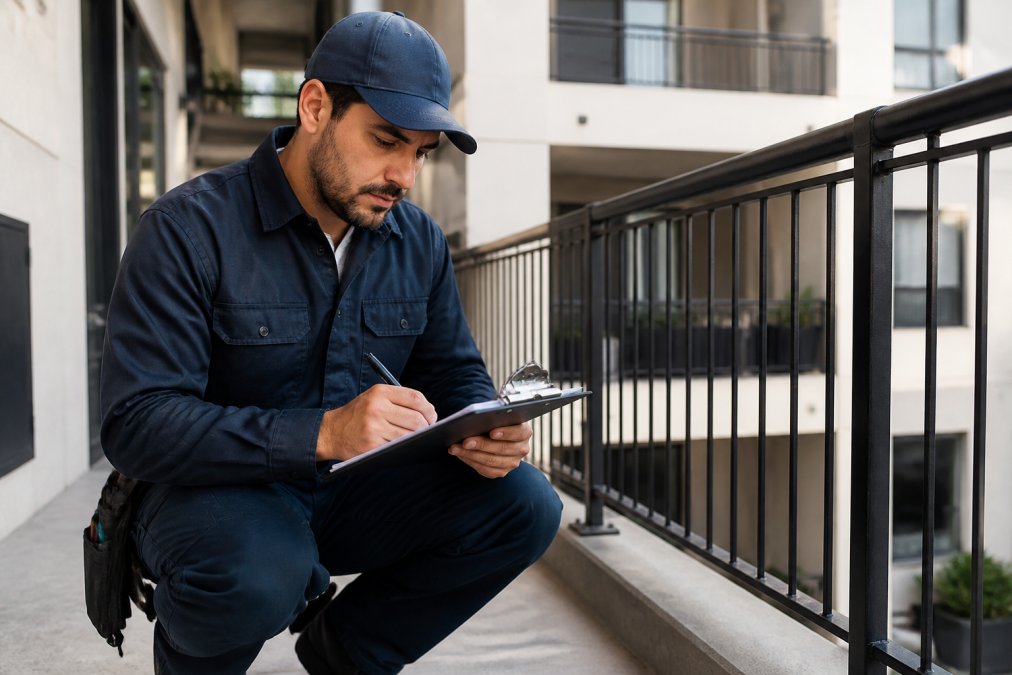
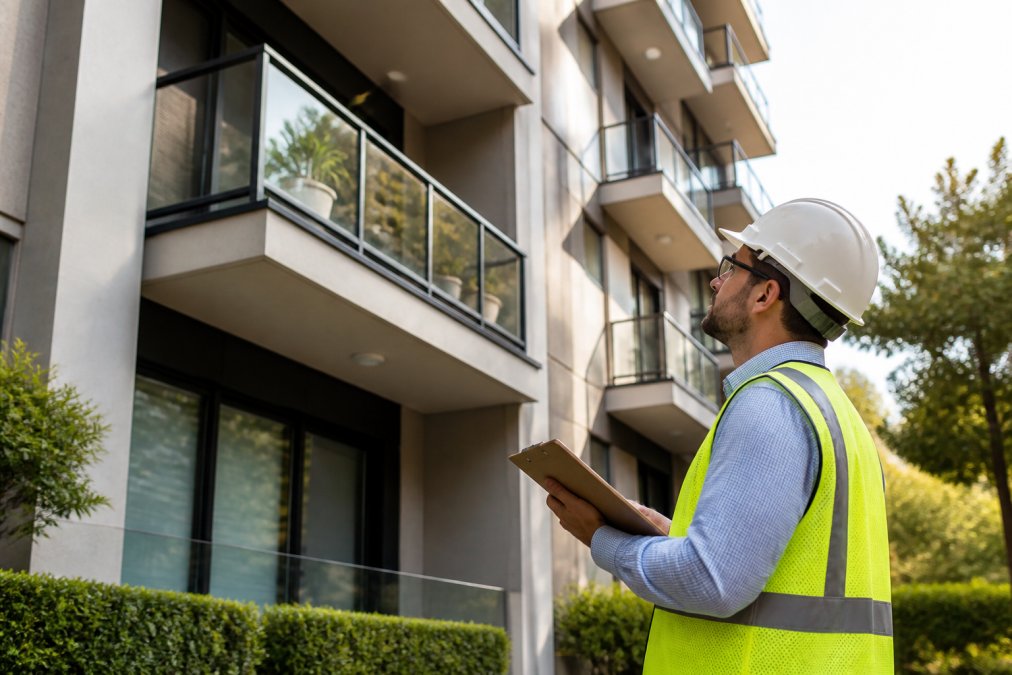
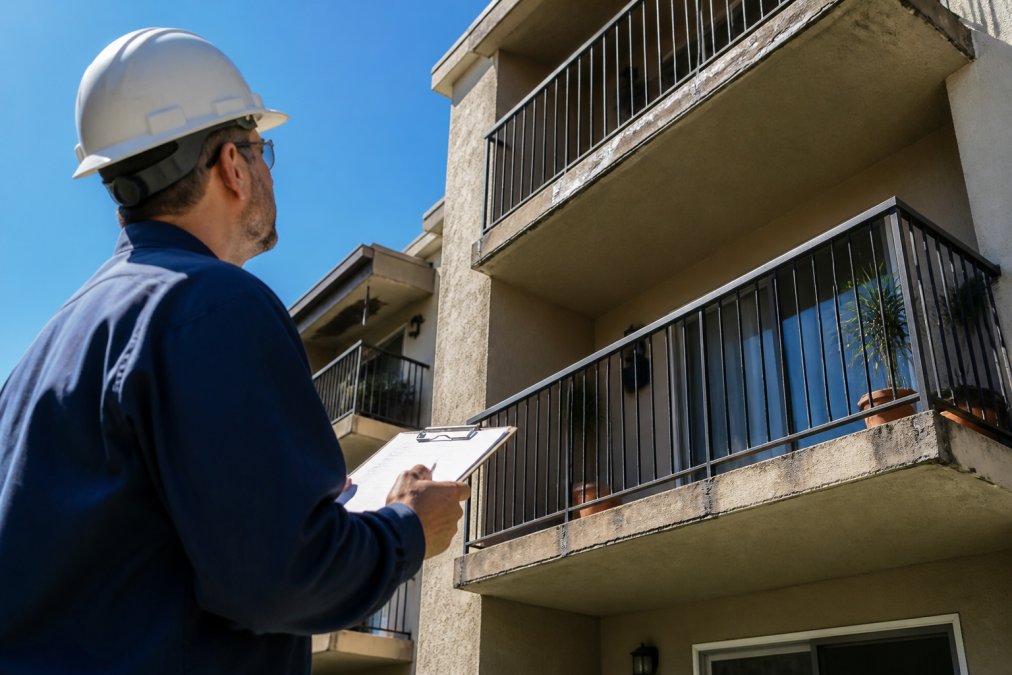
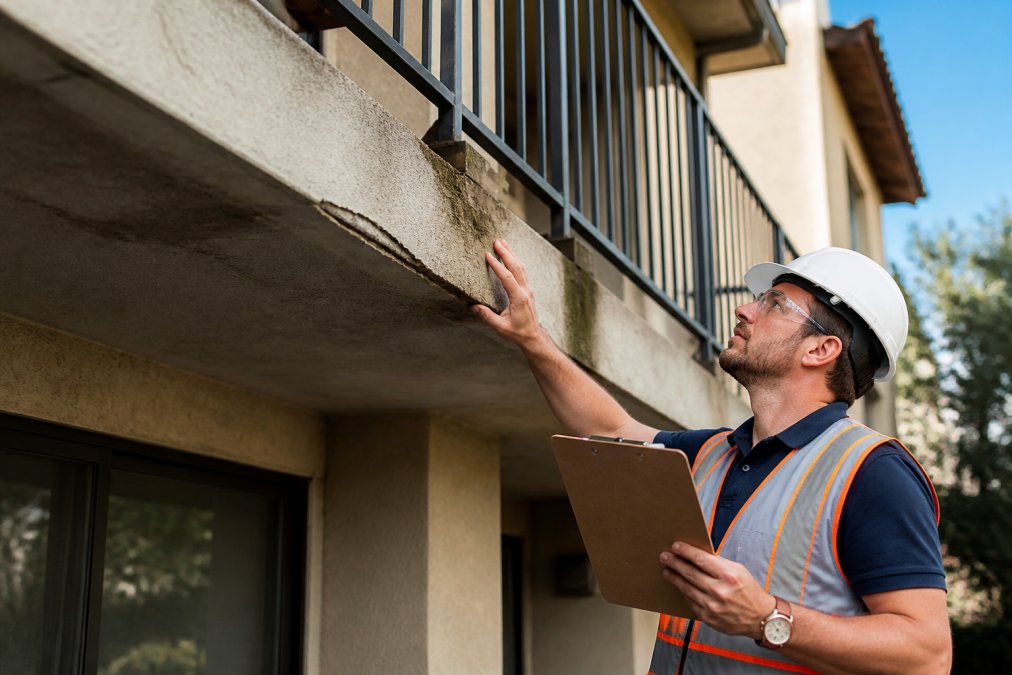
Licensed structural engineer conducting detailed balcony inspection, examining wooden beams and fasteners with professional tools, clipboard in hand, natural daylight illuminating the elevated structure

Professional oversight remains critical because even minor modifications to a building’s load-bearing components require rigorous attention to ensuring structural integrity during home additions.

The cost of a qualified inspector is far less than the cost of a balcony failure, which can result in injuries, fatalities, and massive liability.

Apex Balcony brings decades of combined construction and design experience to every inspection. Our licensed inspectors know exactly what to look for in California buildings and understand the specific requirements of SB 326 and SB 721 compliance.

6. Document Findings and Maintain Audit Trails

Documentation discipline is where many audits fail. You can conduct a thorough inspection, but if your findings aren’t documented clearly and completely, you’ve created liability rather than protection.

Record every finding in writing: what was inspected, when, by whom, condition found, supporting evidence (photos, measurements), and what it means. Include discovery and completion dates. Take photos from multiple angles with close-ups and wider shots. Label each photo with location, date, and subject.

Maintain an audit trail: scope document, inspection checklist, inspector notes, photographs, final report, and communications about findings. Store digital copies in a secure location. Your audit trail proves you conducted a proper inspection and acted reasonably on findings.

Watch Out
Don’t sanitize your audit findings. If the inspection identifies a critical defect, document it clearly. Downplaying findings in hopes of avoiding costly repairs creates massive liability if that defect later causes injury. The honest documentation of a serious problem is far better than a cover-up that gets exposed in discovery.

7. Create Corrective Action Plans and Track Closeout

A corrective action plan translates audit findings into concrete repair work. For each finding, specify: the defect, why repair is needed, what work is required, contractor details, estimated cost, target completion date, and responsible person.

Prioritize repairs by urgency. Critical defects that pose immediate safety risks should be addressed first. Moderate defects that will worsen over time should be scheduled within months. Minor defects can be bundled into longer-term maintenance plans.

Track progress. As repairs are completed, document that completion. This means: inspecting the repair work to confirm it was done correctly, obtaining proof from the contractor (photos, signed work orders), updating your corrective action plan to show the completion date, and verifying that the repair meets building code standards.

Use a corrective action tracking system, a spreadsheet or software tool that shows each finding, the planned repair, the deadline, the actual completion date, and the person responsible. This becomes your evidence that you didn’t just identify problems and ignore them.

Some repairs will take time. Budget constraints, contractor availability, or the complexity of the work may mean repairs extend over months or years.

8. Build a Safety Culture and Engage Stakeholders

Audits aren’t one-time events. Sustained safety requires a culture where residents, staff, and board members all understand why safety matters and take responsibility for it.

Key Takeaway
A strong safety culture means residents feel heard, board members understand their responsibility, and staff know what to watch for. When safety is everyone’s concern, problems get reported earlier and addressed faster.

Common Mistakes to Avoid

Hiring unqualified inspectors to save money. A cheap inspection that misses critical defects creates massive liability. The cost of a qualified inspector is insurance against catastrophic failure.


Frequently Asked Questions

How do SB 326 and SB 721 impact building audit requirements?

SB 326 requires inspection of balconies and elevated exterior elements in buildings with three or more units constructed before January 1, 2008. SB 721 expanded these requirements to include buildings constructed before January 1, 2020. Both laws mandate regular inspections to identify structural defects and non-conformance with safety standards. Building owners must document audit findings and maintain compliance records, making structured building safety audits essential for meeting these regulatory standards.

What documentation is required for a professional building safety inspection?

Professional inspections require comprehensive documentation including a detailed audit checklist covering all elevated exterior elements, photographic evidence of structural conditions, written findings identifying hazards and non-conformance items, and a corrective action plan with timelines. Documentation must include the inspector’s credentials, inspection date, scope of work, and specific locations of defects. This audit trail supports regulatory reporting, demonstrates due diligence, and provides evidence for insurance and legal protection if issues arise.

How often should building safety audits be conducted for compliance?

Under SB 326 and SB 721, initial inspections are required, followed by reinspections every six years for buildings that pass, or sooner if structural issues are identified.

What are the most common mistakes made during building safety audits?

Common mistakes include inadequate audit scope that misses critical areas, poor documentation discipline leading to incomplete audit trails, failing to involve stakeholders in the inspection process, and delaying corrective action closeout. Many property owners also underestimate the complexity of SB 326 and SB 721 requirements, attempt inspections without licensed professionals, and neglect to create a formal safety management system. These errors expose buildings to liability, regulatory fines, and safety risks.


External Resources

For additional guidance on building safety standards and inspection requirements:

  • California Building Standards Commission regulations on structural inspections
  • National Association of Home Inspectors standards for structural assessment
  • American Society of Civil Engineers guidelines for building condition assessment
Book inspection

Posted in BlogTagged 10 best practices for managing building safety audits, building safety audit template, building safety audits, hiring a licensed structural inspector, sb 326 balcony inspection requirements

What to Do If Your HOA Board Ignores Balcony Safety

Posted on September 18, 2026 by Apex Balcony admin
What to Do If Your HOA Board Ignores Balcony Safety

Table of Contents

  • Understanding HOA vs. Homeowner Responsibility for Balcony Safety
  • SB 326 Balcony Inspection Requirements and Your Board’s Legal Obligations
    • What SB 326 Requires
    • What SB 721 Requires
  • Documenting Safety Hazards and Maintenance Requests in Writing
  • Drafting a Sample Letter to HOA Board Regarding Safety Hazards
    • Key Elements Your Letter Must Include
    • Template Framework
  • Steps to Take When the Board Continues to Ignore Safety Concerns
    • Step 1: Send a Written Demand Letter
    • Step 2: Request the CC&Rs and Bylaws
    • Step 3: Hire a Private Balcony Inspector
    • Step 4: File a Complaint with the Building Department
    • Step 5: Escalate to Code Enforcement or Local Authorities
  • Legal Recourse: When to Consult an Attorney
  • Organizing a Homeowner Coalition for Collective Action
  • Frequently Asked Questions

Last Updated: September 17, 2026

Understanding HOA vs. Homeowner Responsibility for Balcony Safety

Your HOA board has clear legal duties when it comes to balcony safety. Understanding where those obligations end and your rights begin is the first step toward getting action when the HOA ignores balcony safety warnings.

Most homeowners assume the board will handle everything. That’s partly true, but only for common areas. A balcony attached to your unit often falls into a gray zone. Some buildings treat balconies as common elements. Others classify them as part of your individual unit. The answer depends on your CC&Rs (Covenants, Conditions, and Restrictions) and state law.

Here’s what matters: even if your balcony is technically your responsibility, the board still has a fiduciary duty to maintain structural integrity across the entire building. Water intrusion, rot, and decay don’t stay in one unit. They spread. A failing balcony on the third floor can damage units below it. That makes balcony safety a shared concern.

The board’s legal obligation is to enforce the bylaws, maintain common areas, and protect residents from life-safety hazards. If the board knows about a structural problem and does nothing, they’re exposing the building to liability. And they’re exposing themselves personally.

SB 326 Balcony Inspection Requirements and Your Board’s Legal Obligations

California law doesn’t leave this to chance. Two statutes govern balcony safety: SB 326 and SB 721. Both create mandatory inspection timelines and reporting requirements. Both shift liability if the board ignores them.

What SB 326 Requires

SB 326 applies to residential buildings with three or more units. It requires the board to conduct visual inspections of all elevated exterior elements, balconies, decks, stairs, and railings, every nine years.

The inspection must be performed by a licensed structural engineer or architect. Not an in-house maintenance person. Not a contractor who’s “done this before.” A licensed professional.

Once the inspection is complete, the board must provide a written report to all residents. The report must detail findings, recommended repairs, and timelines. The board cannot hide problems or minimize them in the report.

If the inspection finds structural issues, the board must take action. They can’t ignore recommendations. They can’t delay repairs indefinitely. State law requires remediation within a specific timeframe based on the severity of the hazard.

What SB 721 Requires

SB 721 is stricter. It applies to any residential building with three or more units and requires inspections of exterior elevated elements every six years, not nine (Bill Text).

SB 721 also requires the board to maintain a reserve fund specifically for balcony repairs and maintenance. This isn’t optional. It’s a legal requirement. The board must set aside money to pay for the repairs the inspection identifies.

If the board hasn’t done a recent inspection under either law, that’s a violation.

This is where your use begins.

Documenting Safety Hazards and Maintenance Requests in Writing

The board ignores verbal complaints. They file them away mentally and move on. Written documentation is different. It creates a paper trail.

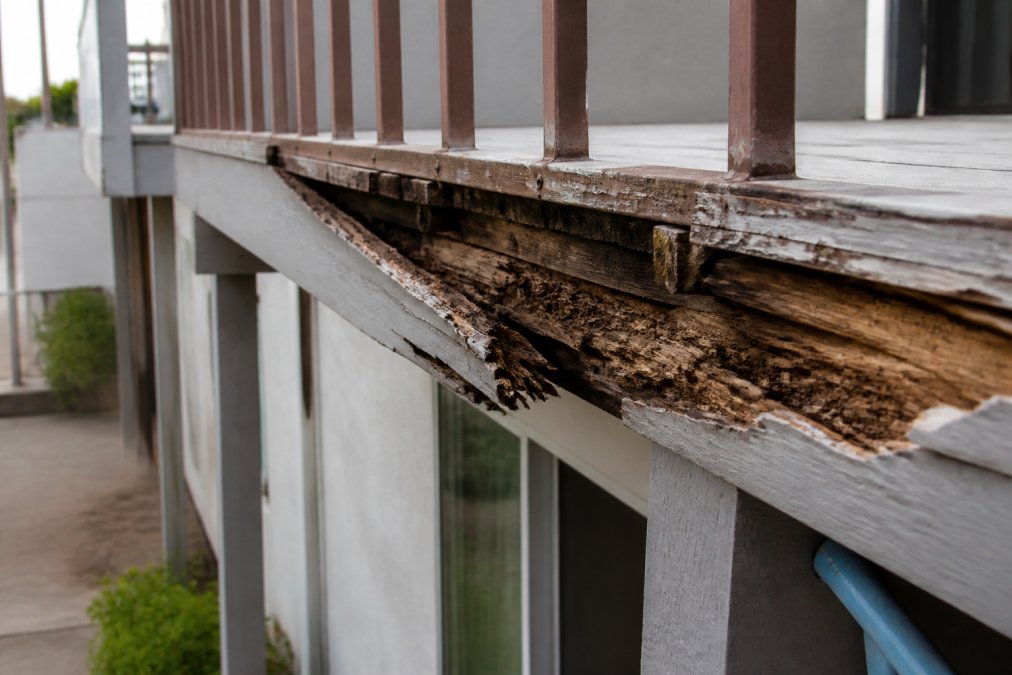
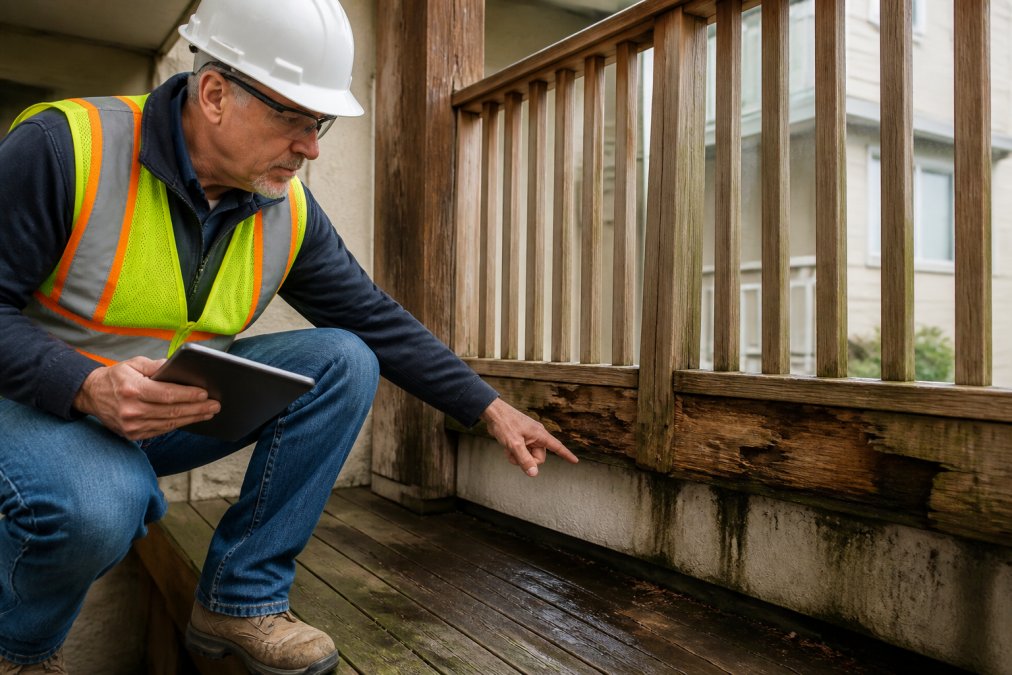
Property owner documenting balcony safety hazards in writing while an HOA ignores balcony safety concerns.
  • The exact location of the hazard
  • What you observed and when
  • Photos or video attached
  • A request for inspection and repair
  • A deadline for response (typically 30 days)

Drafting a Sample Letter to HOA Board Regarding Safety Hazards

A formal letter carries weight. It signals you’re serious. It also creates a legal record the board can’t ignore.

Key Elements Your Letter Must Include

Your letter needs specific components to be effective:

  • Date and recipient details, Address it to the board president and the community manager
  • Clear description of the hazard, Be specific. “Balcony railing is corroded” is better than “the balcony looks bad”
  • Location, Unit number, which balcony, which section
  • Your observations, What you saw, when you saw it, how long it’s been there
  • Reference to CC&Rs or bylaws, Show the board you know their obligations
  • Request for action, Inspection, repair estimate, timeline
  • Deadline, Give them 30 days to respond
  • Your contact information, Make it easy for them to reach you

Template Framework

Here’s a framework you can adapt:


[Your Name]
[Your Address and Unit Number]
[Date]

[Board President Name]
[Community Manager Name]
[HOA Address]

Dear [Board President/Community Manager]:

I am writing to formally notify you of a structural safety concern affecting my balcony at [specific address and unit number]. On [date], I observed [specific hazard: rot, cracks, rust, water damage, etc.] on the [describe location: railing, deck surface, support beam, etc.].

Book inspection →

I request that the board:

  1. Schedule a professional structural inspection within 30 days
  2. Provide a written inspection report to all affected residents
  3. Develop a remediation plan with a specific timeline
  4. Communicate the plan to residents

Sincerely,

[Your Signature]
[Your Printed Name]


Steps to Take When the Board Continues to Ignore Safety Concerns

When the HOA ignores balcony safety and doesn’t respond to your letter, or responds but takes no action, you have options. Each step escalates the pressure.

Step 1: Send a Written Demand Letter

This is different from your initial request. A demand letter is more formal and often comes from an attorney or legal service. It states the board is in violation of state law and gives them a final deadline to act.

A demand letter typically:

  • Cites the specific statute (SB 326 or SB 721)
  • Lists the board’s obligations
  • States the board is in breach of fiduciary duty
  • Demands action by a specific date (often 15 days)
  • Warns of legal consequences if they don’t comply

Step 2: Request the CC&Rs and Bylaws

If you haven’t already, request a copy of your building’s CC&Rs and bylaws. The board must provide these. They contain the board’s specific obligations regarding maintenance and common areas.

Review them carefully. Look for:

  • Definitions of common areas vs. individual unit responsibility
  • Board maintenance obligations
  • Reserve fund requirements
  • Timeline for responding to maintenance requests
  • Procedures for escalating complaints

Step 3: Hire a Private Balcony Inspector

Don’t wait for the board to hire an inspector. Hire one yourself. A licensed structural engineer can document the hazard independently.

Step 4: File a Complaint with the Building Department

Most jurisdictions have a building department that enforces building codes. If your building violates code, and a failing balcony almost certainly does, the building department can force compliance.

File a complaint with specifics:

  • Building address
  • Description of the hazard
  • When you first reported it to the board
  • Evidence the board hasn’t acted (your letters, emails, etc.)
  • Request for code enforcement inspection

Step 5: Escalate to Code Enforcement or Local Authorities

If the building department doesn’t act quickly enough, escalate further. Contact your city council member or county supervisor. They can pressure the building department to prioritize your complaint.

You can also file complaints with:

  • Your state attorney general’s office (for consumer protection violations)
  • Your state’s real estate commissioner (if the building is managed by a professional management company)
  • Local news outlets (public pressure works)

Legal Recourse: When to Consult an Attorney

At some point, you may need a lawyer. Here’s when:

  • The board has ignored multiple written requests
  • The board has acknowledged the hazard but refuses to act
  • You’ve filed complaints with the building department and nothing has happened
  • You want to force the board to take action through the courts

An attorney can:

  • Send a formal demand letter (more weight than one you write)
  • File a lawsuit against the board for breach of fiduciary duty
  • Seek damages for diminished property value
  • Force the board to conduct inspections and make repairs
  • In some cases, recover your legal fees from the board

Organizing a Homeowner Coalition for Collective Action

If multiple units are affected, organize other homeowners. A coalition is more powerful than a single complaint.

Start by:

  • Identifying other residents with the same concern
  • Sharing documentation (photos, inspection reports, letters)
  • Organizing a meeting to discuss the issue
  • Drafting a collective letter to the board signed by multiple residents
  • Coordinating to file complaints simultaneously with the building department

Frequently Asked Questions

What should I do if my HOA board ignores a balcony safety warning from an inspector?

Document the warning in writing immediately, then send a formal demand letter to the board citing the specific safety hazards and relevant building code violations. If the board does not respond within 30 days, file a complaint with your local building department or code enforcement office. You may also hire a private structural engineer to verify the hazard and strengthen your case. If the board continues to ignore the issue, consult an attorney about your legal options, which may include filing a lawsuit for breach of fiduciary duty.

What are SB 326 balcony inspection requirements for California HOAs?

SB 326 requires HOAs managing common area balconies to conduct structural inspections every nine years and document the findings in a written report. The inspection must identify signs of structural failure, water intrusion, rot, decay, and other life-safety hazards. The board must provide copies of the inspection report to homeowners and maintain records of any remedial actions taken. Failure to comply with SB 326 can result in liability for injuries or property damage caused by deferred maintenance.

How do I know if I need to hire a private balcony inspector?

Hire a private balcony inspector if your HOA’s official inspection report is incomplete, if the board refuses to share findings with residents, or if you suspect structural damage that the board’s inspector missed. A licensed structural engineer can provide an independent assessment that holds up in legal proceedings and gives you leverage when demanding repairs. Private inspectors are especially valuable if you are considering legal action or escalating complaints to building authorities.

Can I be held liable if someone is injured on a balcony that the HOA board ignored?

HOA boards have a fiduciary duty to maintain common areas in safe condition. If a board ignores a documented safety hazard and someone is injured, the board and potentially individual board members may face liability. As a homeowner, you are generally not personally liable for board negligence, but you may have grounds to sue the board for breach of duty. Documenting all safety concerns in writing protects you by creating a clear record of the board’s awareness and inaction.

Book inspection

Posted in BlogTagged hoa ignores balcony safety, sample letter to hoa board regarding safety hazards, sb 326 balcony inspection requirements, what to do if your hoa board ignores balcony safety warnings

Balcony Structural Integrity vs Surface Wear: 2026 Guide

Posted on September 17, 2026 by Apex Balcony admin
Balcony Structural Integrity vs Surface Wear: 2026 Guide

Table of Contents

  • What Balcony Structural Integrity vs Surface Wear Actually Means
    • How Load Distribution and Load-Bearing Capacity Work on a Cantilevered Balcony
  • Signs of Balcony Structural Failure You Should Never Ignore
    • Cosmetic Issues: Hairline Cracks, Efflorescence, and Minor Surface Wear
    • Red Flags: Concrete Spalling, Rust Staining, Railing Instability, and Dry Rot
  • A Visual Identification Guide: DIY vs. Professional Assessment
    • The Four-Tier Severity Ladder
    • How to Measure a Crack Without Guessing
    • The DIY Visual Check (Do This Quarterly)
    • When to Stop and Call a Professional
    • What a Professional Assessment Actually Involves
  • SB 326 Balcony Inspection Requirements and When to Call a Structural Engineer
  • Waterproofing, Drainage, and Preventative Maintenance That Protect Structural Integrity
  • The Cost of Balcony Structural Engineering Services and Repair vs. Replacement
  • Insurance, Liability, and Property Valuation: What HOA Boards Need to Know
    • How Insurers Underwrite Balcony Risk
    • The Foreseeable-Hazard Problem
    • What Belongs in the Board’s Records
    • How Structural Condition Affects Valuation
    • HOA Responsibility and the Limits of DIY
  • Frequently Asked Questions

Last Updated: September 16, 2026

What Balcony Structural Integrity vs Surface Wear Actually Means

Balcony structural integrity is the ability of a balcony’s load-bearing components to safely carry their intended loads without failure, while surface wear is cosmetic deterioration that does not compromise that load path. At Apex Balcony, we’ve worked with hundreds of building owners, and confusing these two categories is the single most expensive mistake property owners make. One costs a few hundred dollars.

How Load Distribution and Load-Bearing Capacity Work on a Cantilevered Balcony

A cantilevered balcony carries its load through reinforcement steel embedded in the slab, transferring weight back into the building’s primary structure. When that steel corrodes, the balcony loses load-bearing capacity even if the surface looks fine.

Signs of Balcony Structural Failure You Should Never Ignore

The clearest signs of balcony structural failure are concrete spalling, rust staining, railing instability, and dry rot in wood framing. These indicate the load path is compromised, not just the finish.

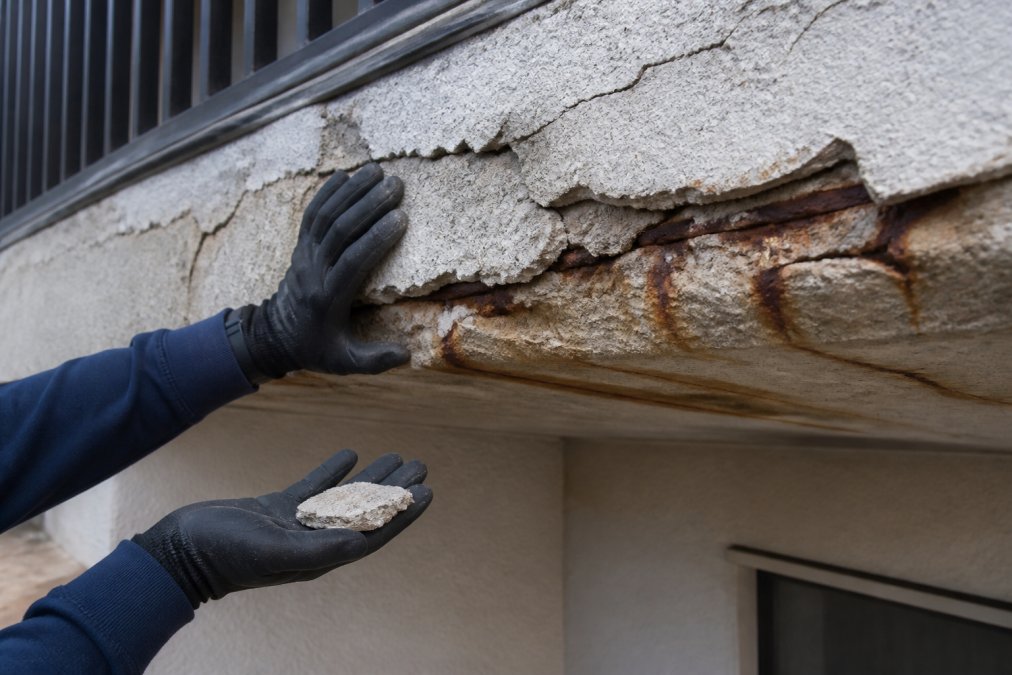
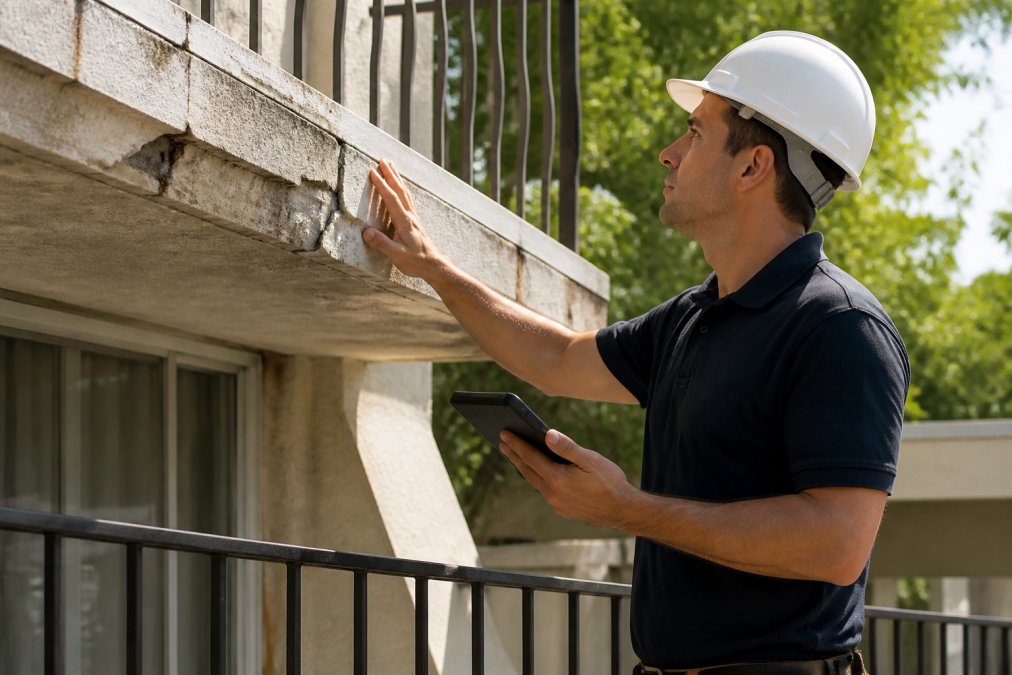
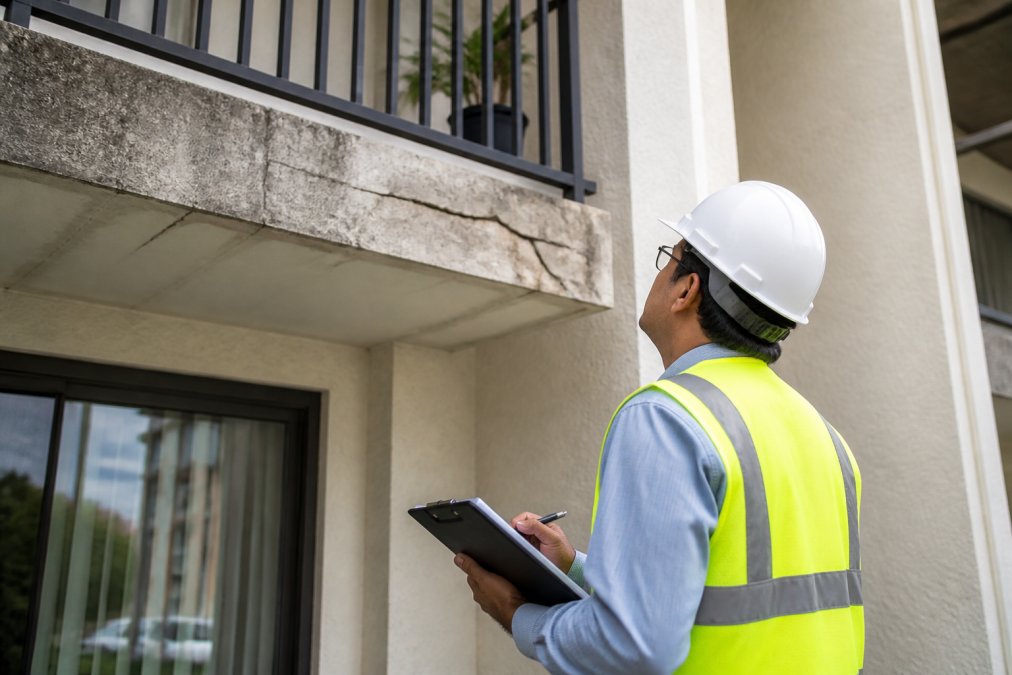
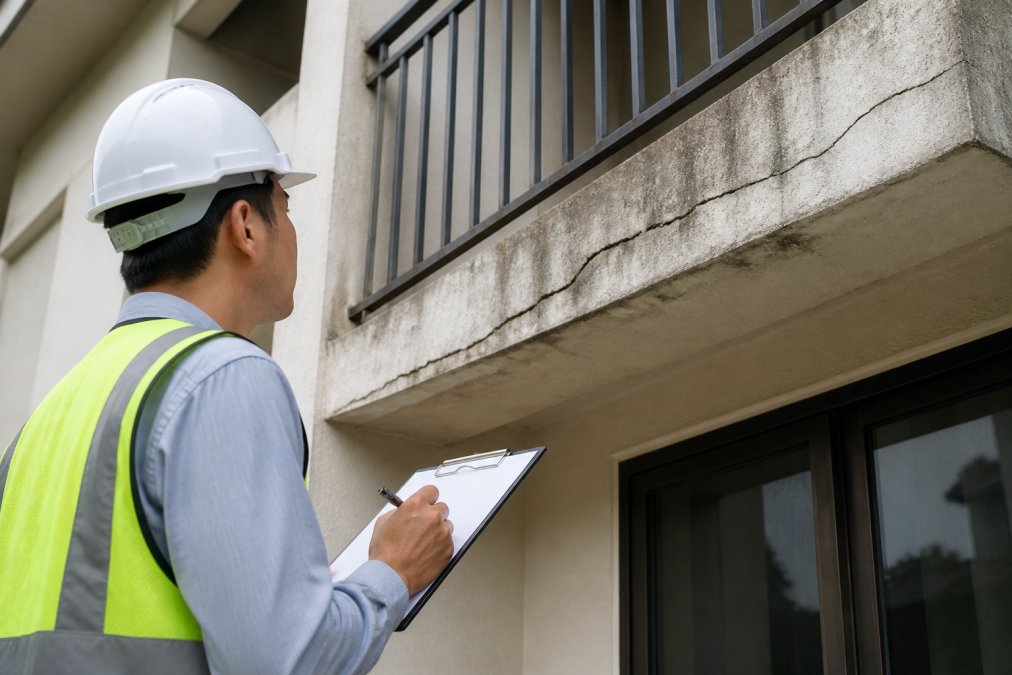
Inspector examining a cracked concrete slab showing signs of poor balcony structural integrity and rust staining

Cosmetic Issues: Hairline Cracks, Efflorescence, and Minor Surface Wear

Hairline cracks under about the width of a credit card, white mineral deposits called efflorescence, and worn sealant are usually cosmetic maintenance items.

Red Flags: Concrete Spalling, Rust Staining, Railing Instability, and Dry Rot

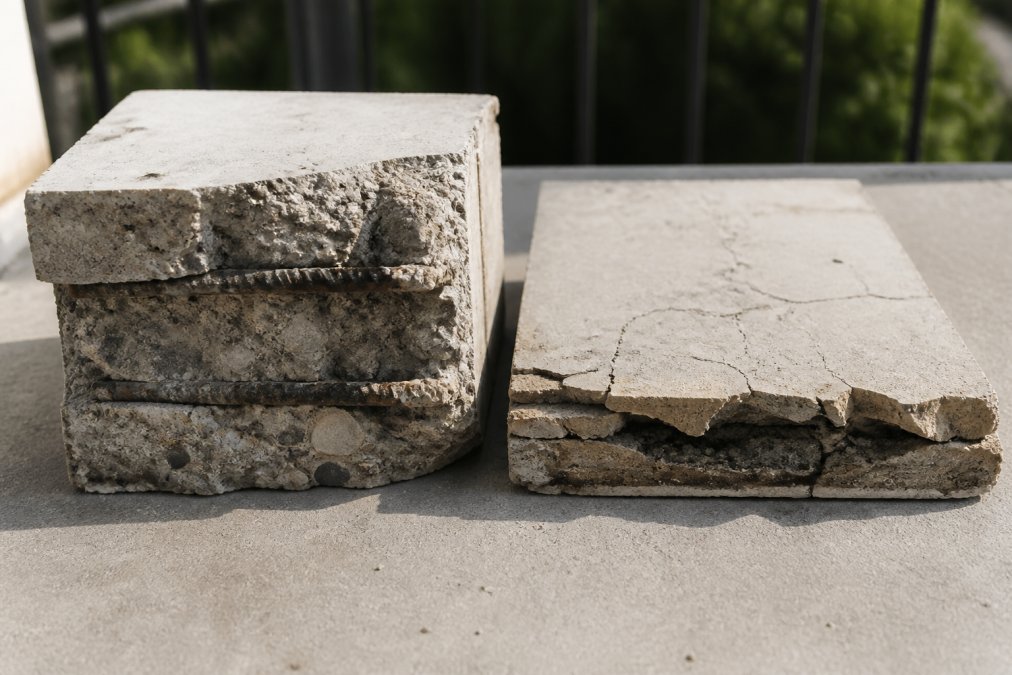
Concrete spalling, rust staining, railing instability, and dry rot are red flags requiring immediate professional assessment. Spalling is when chunks of concrete break away, exposing corroded reinforcement steel beneath.

Watch Out
Ignoring railing instability is the most common fatal mistake. A railing that wobbles under hand pressure has already lost its anchor capacity. Do not host anyone on that balcony until a licensed inspector evaluates it.

A Visual Identification Guide: DIY vs. Professional Assessment

Most owners cannot tell a cosmetic crack from a structural one. This section gives you a usable decision framework: a visual guide, a severity ladder, and a clear line between “monitor it” and “call someone today.”

The Four-Tier Severity Ladder

Every defect you find falls into one of four tiers. The tier determines your next action, not the size of the defect.

TierWhat You SeeWhat It MeansYour Action
1, CosmeticHairline cracks narrower than a credit card, efflorescence, chalking paint, worn sealantFinish-layer deterioration; load path intactClean, seal, re-inspect in 6 months
2, WatchCracks wider than a credit card but under 1/8 inch, isolated rust staining, minor water poolingMoisture is reaching embedded steel or framingDocument with dated photos, schedule a licensed inspection within 30 days
3, ActSpalling concrete, exposed reinforcement steel, railing post movement, soft wood at anchor pointsLoad path is compromised or actively degradingRestrict access, call a licensed inspector within days
4, EmergencySagging or deflecting slab, diagonal cracks radiating from corners, water staining on the ceiling below, railing that moves under hand pressureFailure is possible under normal useClose the balcony, call a structural engineer immediately

How to Measure a Crack Without Guessing

Eyeballing a crack is unreliable. Use a credit card as your gauge: a standard card is about 1/32 inch thick. Narrower than the card is typically cosmetic; if the card slips in with room to spare, treat it as Tier 2 or higher.

The DIY Visual Check (Do This Quarterly)

  • Walk the full perimeter of every balcony; look up at the underside of the slab
  • Check for cracks wider than a credit card
  • Look for rust stains on concrete, stucco, or the ceiling below
  • Push each railing post firmly in two directions; note any movement
  • Look for water pooling or staining after rain
  • Check for soft, spongy, or crumbling wood at the base of railings and at ledger connections
  • Confirm drains and scuppers are clear of debris
  • Photograph anything new and date the file

When to Stop and Call a Professional

Stop your DIY assessment and call a licensed inspector or structural engineer the moment you see any of the following:

  • Spalling concrete with exposed reinforcement steel
  • Railing movement of any kind, in any direction
  • Sagging, deflection, or a visible slope in the slab
  • Diagonal cracks running from a corner or from a column
  • Water stains on the ceiling or wall below the balcony
  • A crack that has widened since your last check
  • Soft or crumbling wood at any structural connection
Watch Out
A wobbling railing is not a cosmetic issue and it is not a maintenance item. It means the anchor or the framing that holds the post has already lost capacity. Do not host anyone on that balcony until a licensed inspector evaluates it.

What a Professional Assessment Actually Involves

A licensed inspector documents conditions: crack widths and locations, spall dimensions, corrosion extent, railing anchor condition, waterproofing and drainage function. A structural engineer goes further, evaluating whether remaining load-bearing capacity is adequate using the original design’s load assumptions.

Pro Tip
Ask your inspector to photograph every defect with a scale reference in the frame. Boards that submit photo-documented reports to their insurers and legal counsel face far fewer disputes when a claim arises.

SB 326 Balcony Inspection Requirements and When to Call a Structural Engineer

SB 326 balcony inspection requirements apply to specified buildings with three or more dwelling units, mandating periodic structural inspections by licensed professionals. SB 721 covers similar requirements for certain other residential buildings.

Waterproofing, Drainage, and Preventative Maintenance That Protect Structural Integrity

Waterproofing membrane condition, drainage function, and sealing most directly protect structural integrity. Moisture intrusion is the leading cause of reinforcement steel corrosion.

The Cost of Balcony Structural Engineering Services and Repair vs. Replacement

The cost of balcony structural engineering services depends on the number of balconies, the extent of defects, and whether engineering calculations are required. Pricing depends on quantity, dates, and delivery. Contact Apex Balcony for current prices or a quote.

Insurance, Liability, and Property Valuation: What HOA Boards Need to Know

Most articles stop at “get an inspection” and skip what boards actually lose sleep over: what happens to insurance coverage, legal exposure, and property value when a balcony fails, or when records are missing. This section covers the mechanisms, not just the warnings.

How Insurers Underwrite Balcony Risk

Carriers writing policies on buildings with elevated exterior elements increasingly treat inspection records as an underwriting input, not a courtesy. At renewal, the carrier may ask for the most recent structural inspection report, the scope of completed repairs, and evidence recommended work was done.

Three outcomes are common:

  • Records present and current: the policy renews on standard terms.
  • Records missing or stale: the carrier may non-renew, exclude balcony-related losses, or apply a surcharge.
  • Known defect not addressed: the carrier may deny a claim tied to that defect on the grounds that the loss was foreseeable.

The Foreseeable-Hazard Problem

Liability exposure turns on one question: did the board know, or should it have known, about a hazard and fail to act? A documented inspection flagging a defect that the board ignores is the worst combination, it converts an unknown risk into a known one.

Key Takeaway
Inspection records are not just a compliance checkbox. They are the evidence that protects your board, your insurance coverage, and your property value in the event of an incident.

What Belongs in the Board’s Records

A defensible record set includes:

  • The most recent structural inspection report, signed and dated
  • Photographs of every defect noted, with scale references
  • Repair scopes, permits, and completion documentation
  • A log of when each recommendation was addressed
  • Meeting minutes showing the board reviewed the report and acted on it

If a recommendation was deferred, the minutes should say why and when it will be revisited. A deferral with a documented reason is defensible. A deferral with no record is not.

How Structural Condition Affects Valuation

Appraisers and lenders treat documented structural condition as a proxy for risk. A building with current inspections and completed repairs supports a higher valuation than an identical building with unknown condition, because the buyer isn’t pricing in an unknown repair liability.

HOA Responsibility and the Limits of DIY

Boards sometimes assume a handyman walkthrough or a member’s informal inspection satisfies their obligation. It does not: the inspection must be performed by a qualified, licensed professional, and findings must be documented and acted on.

Pro Tip
Before renewal season, pull the last three years of inspection reports and repair records into a single indexed file. When the carrier asks, you answer in an afternoon instead of a month.

Frequently Asked Questions

What is the difference between surface wear and structural damage on a balcony?

Surface wear affects only the outer layer of concrete or coating, showing up as hairline cracks, faded paint, or light efflorescence. Structural damage reaches the load-bearing capacity of the balcony, visible through concrete spalling, exposed reinforcement steel, rust staining, or railing instability. Surface issues are cosmetic and can usually be sealed or patched. Structural defects compromise safety and require a licensed structural engineer to assess repair or replacement before the balcony is used again.

Does SB 326 require inspections for surface-level balcony damage?

SB 326 requires inspections of elevated exterior elements regardless of visible damage. The law applies to buildings with three or more multifamily dwelling units, and inspectors must examine balconies, decks, stairways, and walkways for signs of structural distress. Surface wear alone may not trigger repairs, but the inspection itself is mandatory by January 1, 2025, and every nine years after. Skipping the inspection because damage looks cosmetic leaves the HOA exposed to fines and liability.

How can I tell if my balcony has structural integrity issues?

Start with the signs of balcony structural failure: concrete spalling, rust staining around reinforcement steel, water pooling that never drains, railing instability, or a spongy feel underfoot. Hairline cracks that stay narrow are usually surface wear. Cracks wider than a credit card, horizontal cracking along the slab edge, or any sagging in a cantilevered balcony point to structural problems. A licensed inspector can confirm what you are seeing and document it for compliance.

How much do balcony structural engineering services typically cost, and what affects the price?

The cost of balcony structural engineering services depends on the number of units, the extent of accessible damage, the type of report required for SB 326 or SB 721 compliance, and whether destructive testing is needed. Pricing depends on quantity, dates, and delivery. Contact Apex Balcony directly for a quote tailored to your building and inspection scope.


Balcony safety comes down to knowing the difference between cosmetic wear and structural failure, and acting on the right one. Apex Balcony provides licensed inspections for HOAs and multifamily owners, with specialized expertise in SB 326 and SB 721 compliance, comprehensive evaluation of balconies, decks, and stairways, and a clear path to necessary repairs. Get started with Apex Balcony and protect your residents, your board, and your building’s value.

Book inspection

Posted in BlogTagged balcony structural integrity, balcony structural integrity vs surface wear, sb 326 balcony inspection requirements, signs of balcony structural failure

How to Streamline Maintenance Scheduling for Apartments

Posted on September 16, 2026 by Apex Balcony admin
How to Streamline Maintenance Scheduling for Apartments

Table of Contents

  • Why Apartment Maintenance Scheduling Breaks Down (and What It Costs You)
  • Step 1: Build a Preventative Maintenance Checklist for Apartments
    • What Belongs on a Quarterly and Annual Checklist
  • Step 2: Standardize Maintenance Work Order Templates
  • Step 3: Choose Apartment Maintenance Software Features That Actually Help
    • Must-Have vs. Nice-to-Have Features
    • A Vendor-Neutral Evaluation Framework
    • Pricing Models and What Drives Cost
    • What to Weigh Before You Buy
  • Step 4: Automate Work Orders and Dispatch to Cut Response Times
  • Step 5: Coordinate Unit Turnover Scheduling Without Bottlenecks
  • Step 6: Track Maintenance KPIs and Prevent Technician Burnout
  • Budgeting for Preventative Maintenance and Legal Liability Considerations
    • A Simple Cost-Benefit Framework
    • Documentation as Your Legal Defense
  • Frequently Asked Questions

Last Updated: September 16, 2026

Why Apartment Maintenance Scheduling Breaks Down (and What It Costs You)

Learning how to streamline maintenance scheduling for apartments starts with admitting that most failures are organizational, not technical. Work orders get lost in text threads, routine inspections get postponed until they become emergency repairs, and nobody can say which unit was last serviced or when. The result is a maintenance backlog that grows quietly until a single failure forces an expensive, unplanned fix.

In many buildings, elevated exterior elements go uninspected for years. The fix is a system: a preventative maintenance plan, standardized work orders, and software that automates dispatching so nothing depends on memory. Below, we walk through six steps that property teams use to cut response times and control costs.

Step 1: Build a Preventative Maintenance Checklist for Apartments

A preventative maintenance checklist for apartments is a recurring list of inspections and repairs scheduled before equipment or structures fail, grouped by daily, quarterly, and annual frequency. It replaces reactive maintenance with planned work.

Start with what breaks most often: HVAC filters, plumbing fixtures, smoke detectors, and common-area lighting. Then layer in structural items that carry legal weight, such as balconies, decks, and stairways.

What Belongs on a Quarterly and Annual Checklist

Quarterly items cover wear-prone systems. Annual items cover structural and safety-critical elements, including a professional inspection of elevated exterior elements where required by state law. The California Department of Consumer Affairs balcony inspection guidance outlines what those inspections must cover for affected buildings. A preventative maintenance plan built this way keeps small repairs from becoming capital expenditure surprises.

Watch Out
Skipping structural items on your checklist is the most expensive shortcut in apartment maintenance. Deferred balcony and stairway inspections can turn a minor repair into a full replacement, and in some cases into a safety incident.

Step 2: Standardize Maintenance Work Order Templates

Maintenance work order templates are pre-built forms that capture the same fields every time: unit number, issue category, priority, assigned technician, parts needed, and completion notes. Standard templates eliminate the vague requests that stall dispatching.

Top 10 Smart Maintenance Tips for Multi-Unit Property Managers.

SANGAU Property Management & Rental Services

A common mistake is letting requests arrive in whatever format the tenant prefers. A photo and a sentence in a group chat tells your technician almost nothing. A template forces the details you need to schedule the job correctly the first time.

Work Order FieldWhy It MattersExample Entry
Unit and locationRoutes the right technicianUnit 204, rear balcony
Issue categorySets priority and skill matchStructural, water intrusion
Priority levelDrives scheduling orderUrgent, 24-hour response
Access notesPrevents wasted tripsTenant home after 5 PM
Repair history linkShows repeat failuresThird leak this year

Step 3: Choose Apartment Maintenance Software Features That Actually Help

Apartment maintenance software features fall into two groups: must-haves that run daily operations and nice-to-haves that add polish later. Buy for the first group and you avoid paying for tools your team never opens.

Must-Have vs. Nice-to-Have Features

Must-haves include a maintenance request portal for tenants, work order management, automated notifications, and repair history tied to each unit. These four cover the core maintenance workflow from request to close-out.

Nice-to-haves include predictive maintenance scoring, IoT sensor integration for smart home devices, and vendor performance dashboards. They add value once your basics are consistent. A computerized maintenance management system with a clean mobile interface beats a feature-heavy platform your technicians find confusing.

A Vendor-Neutral Evaluation Framework

Most software comparisons stop at a feature checklist. That checklist tells you what a platform can do, not whether your team will use it. Score each candidate against the workflow you actually run, not the workflow the sales demo shows.

Book inspection →

Evaluation CriterionWhat to TestRed Flag
Tenant request intakeSubmit a test request as a resident on mobilePortal requires app download or login to report a leak
Technician mobile flowClose a work order on a phone in under 60 secondsMore than five taps to log parts and notes
Dispatch rule flexibilityBuild a skill + location + priority ruleRules limited to one variable per queue
Reporting exportPull a backlog and first-visit-fix report to CSVReports locked behind an add-on tier
Data portabilityExport full work order history on demandVendor owns your repair history
Integration surfaceConfirm API or webhook access for accounting and access controlNo documented API

Pricing Models and What Drives Cost

Per-unit-per-month subscription pricing is the dominant model for apartment portfolios, with tiers usually gated by unit count, number of admin seats, and whether tenant-facing features are included. Implementation, data migration, and training are frequently billed separately from the subscription. Before you sign, ask three questions in writing: what happens to the per-unit rate at renewal, what the offboarding data-export process looks like, and whether after-hours support is included or metered.

What to Weigh Before You Buy

  • Portfolio size. Small portfolios often get more value from a lightweight work order tool plus a shared calendar than from a full CMMS with modules they will never configure.
  • In-house vs. outsourced techs. If most work goes to vendors, prioritize vendor scheduling and invoice matching over technician routing.
  • Existing stack. A platform that does not talk to your accounting or access-control system creates a second place to update the same data.
  • Migration cost. Moving years of paper and spreadsheet history is the hidden line item. Budget staff hours for it, not just the vendor fee.
Pro Tip
Run a 30-day pilot with one property and two technicians before committing the portfolio. The features that matter in a demo rarely match the features your team touches on a Tuesday afternoon.

Step 4: Automate Work Orders and Dispatch to Cut Response Times

Automation routes each incoming request to the right technician based on skill, location, and current workload, then sends the tenant an automated notification with an arrival window. Manual dispatching cannot match that speed at scale.

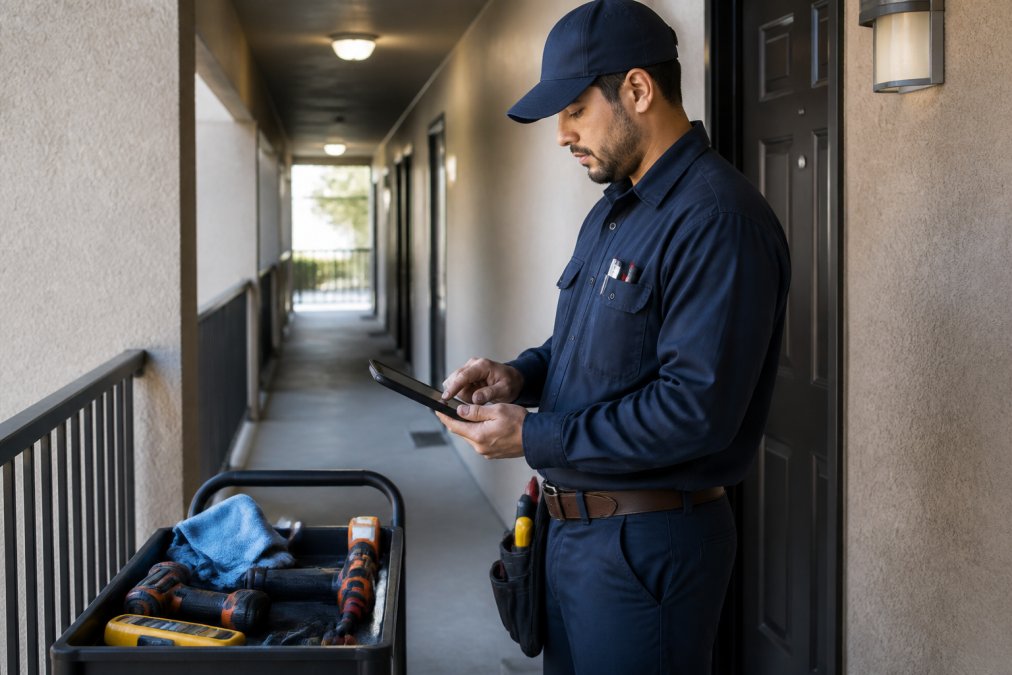
A maintenance technician in uniform reviewing a digital work order on a tablet inside an apartment hallway, with tools visible on a cart nearby

Set rules once and the system handles the routine: urgent plumbing goes to the on-call technician, routine turnover work queues for the next business day, and every status change triggers a tenant update. This is where maintenance automation removes the phone calls that eat a property manager’s morning.

Pro Tip
Build a dispatch rule for after-hours emergencies only. If everything is urgent, nothing is, and your on-call technician burns out within a season.

Step 5: Coordinate Unit Turnover Scheduling Without Bottlenecks

Knowing how to streamline maintenance scheduling for apartments pays off in turnover, where every task runs best on a shared timeline rather than a chain of phone calls.

Step 6: Track Maintenance KPIs and Prevent Technician Burnout

Maintenance KPIs tell you whether the system works, and the most useful ones are simple: average response time, first-visit fix rate, backlog size, and preventative-versus-reactive work ratio.

Budgeting for Preventative Maintenance and Legal Liability Considerations

Budgeting for preventative maintenance means reserving a fixed share of operating funds for scheduled inspections and repairs each year, rather than absorbing unpredictable emergency costs.

A Simple Cost-Benefit Framework

  1. Current reactive spend. Total emergency repair invoices over the last 12 months, including after-hours premiums and overtime.
  2. Deferred work backlog. The dollar value of known repairs you have postponed. This is a liability, not a savings.
  3. Turnover cost per unit. Cleaning, paint, make-ready labor, and vacancy days between tenants.
  4. Administrative hours. Time property staff spend dispatching, chasing vendors, and reconciling invoices.

Documentation as Your Legal Defense

  • Date of inspection and name of the inspector or firm
  • Scope of what was inspected and the method used
  • Findings, with photos or measurements where relevant
  • Recommended repairs and the date they were scheduled
  • Completion date and who signed off
Watch Out
A verbal inspection that was never written down is nearly impossible to defend. If your records live in a text thread or a technician’s memory, treat that as an open liability, not a filing gap.

A maintenance workflow that documents inspections, schedules preventative work, and tracks repairs protects residents, budgets, and the owner’s legal position at the same time.

Frequently Asked Questions

What are 5 items that regularly scheduled apartment maintenance will check?

A solid preventative maintenance checklist for apartments covers these five areas: HVAC filters and coils, plumbing fixtures and shutoff valves, electrical panels and outlets, exterior elements like balconies and stairways, and smoke and carbon monoxide detectors. Checking these on a quarterly or annual rotation catches small issues before they become emergency repairs. For buildings with elevated exterior elements, balcony and stairway inspections should follow the schedule set by your state or local requirements.

How do you prioritize apartment maintenance requests when everything feels urgent?

Use a three-tier system: emergency (no heat, flooding, gas smell, structural concerns), urgent (broken appliance, slow drain, non-working outlet), and routine (cosmetic repairs, minor leaks). Route emergencies to on-call technicians immediately, schedule urgent items within 24 to 48 hours, and batch routine work into weekly routes. Documenting priority levels in your maintenance work order templates keeps everyone aligned and prevents the loudest tenant from jumping the queue.

What apartment maintenance software features matter most for scheduling?

Prioritize automated work order creation, calendar-based scheduling with technician availability, mobile access for techs in the field, and automated notifications to tenants. Asset tracking and repair history features help you spot recurring problems before they escalate. Reporting dashboards that show maintenance KPIs like average response time and backlog size let you adjust staffing and budgets with real data instead of guesswork.

Can streamlining maintenance scheduling help reduce emergency repair costs?

Yes. When preventative maintenance runs on a fixed schedule, smaller problems get caught during routine visits rather than after hours. That means fewer weekend call-outs, less overtime, and fewer emergency vendor invoices. A documented preventative maintenance plan also extends the life of major systems like HVAC and plumbing, which pushes back capital expenditure on replacements. The savings compound over time, especially across a portfolio of buildings.

Book inspection

Posted in BlogTagged apartment maintenance software features, how to streamline maintenance scheduling for apartments, maintenance work order templates, preventative maintenance checklist for apartments

Balcony1 vs EmpireWorks Inspection Services: 2026 Guide

Posted on September 15, 2026 by Apex Balcony admin
Balcony1 vs EmpireWorks Inspection Services: 2026 Guide

Table of Contents

  • Balcony1 vs EmpireWorks Inspection Services: Quick Comparison
    • Side-by-Side Overview
    • What the Table Does Not Tell You
  • SB 326 Inspection Requirements: What HOAs Must Verify
    • Who Can Legally Perform the Inspection
  • SB 721 Balcony Inspection Cost: What Drives the Price
    • The Four Cost Drivers
    • Realistic Price Ranges
    • Cost Transparency Benchmarks
    • Why Bundled Pricing Hides the Real Number
  • Structural Engineering Services California: When You Need More Than an Inspection
  • Conflict of Interest: Why Bundled Inspection and Repair Providers Raise Red Flags
    • The Mechanism, Step by Step
    • How to Mitigate It Without Slowing the Project
    • Accreditation Verification Guide
  • Post-Inspection Documentation: What Your Report Must Include
  • Frequently Asked Questions

Last Updated: September 14, 2026

Balcony1 vs EmpireWorks Inspection Services: Quick Comparison

Choosing between balcony1 vs empireworks inspection services comes down to a single question most comparison charts never ask: who is financially motivated to find problems? At Apex Balcony, we’ve watched HOA boards wrestle with this decision for years, and the answer rarely fits a simple feature grid. Both providers offer SB 326 and SB 721 inspections, but the structural difference lies in whether inspection and repair revenue flow to the same company.

Side-by-Side Overview

FactorBalcony1EmpireWorks
Primary focusInspection servicesInspection plus reconstruction
Repair relationshipInspection-first modelBundled inspection and repair
Report ownershipDelivered to HOADelivered to HOA
Conflict-of-interest riskLower when repair is separateHigher when repair is in-house
Best forBoards wanting neutral findingsBoards wanting one-stop project delivery
A licensed inspector in a safety vest and hard hat examining a multi-story apartment building balcony with a clipboard, warm morning light, focused expression

What the Table Does Not Tell You

A grid can compare service categories. It cannot compare incentives. When a company that inspects balconies also profits from repairing them, the scope of recommended work deserves closer scrutiny. That’s not an accusation; it’s a structural reality of bundled service models. The California Legislature’s SB 326 text explicitly separates inspection duties from repair work for this reason.

SB 326 Inspection Requirements: What HOAs Must Verify

SB 326 inspection requirements mandate that associations with three or more multifamily dwelling units have elevated exterior elements inspected by a licensed professional. The inspection covers balconies, decks, stairways, and walkways, and it must be performed by a qualified engineer or architect, not a general contractor.

Who Can Legally Perform the Inspection

The law limits who can sign off. A licensed structural engineer or architect must conduct the visual inspection and certify the findings. A common mistake is accepting a report from a handyman or unlicensed contractor, which can leave the board exposed if a failure occurs later. The California Contractors State License Board maintains a free lookup tool to verify credentials before you sign anything.

California Civil Code [balcony inspection(/balcony-inspection-liability-property-managers/) statute | leginfo.legislature.ca.gov]

SB 721 Balcony Inspection Cost: What Drives the Price

SB 721 balcony inspection cost varies widely because pricing depends on unit count, building height, accessibility, and the number of elevated elements in scope. A 12-unit building with two balconies per unit costs less to inspect than a 200-unit complex with exterior corridors and multiple stair towers. But “it depends” is not a budget. Here is how the numbers actually break down.

The Four Cost Drivers

Most inspection firms price SB 326 and SB 721 work using some combination of these four variables:

  1. Elevated element count, not unit count. A 40-unit building with one balcony per unit is a smaller inspection than a 20-unit building with wraparound decks and three exterior stair towers. Ask each bidder how many individual elevated elements they counted in their scope.
  2. Access method. Ground-level visual inspection is the cheapest. Inspections that require ladders, roof access, drone photography, or swing-stage access add labor and equipment time. Buildings over three stories almost always cost more per element.
  3. Report complexity. A single-page certification letter is not the same deliverable as a photo-documented, element-by-element report with condition ratings. The second takes longer to produce and costs more, and it is the one that protects the board.
  4. Travel and mobilization. Firms with a local crew charge less than firms driving in from another region. This is the one line item where a lower bid is genuinely a lower bid.

Realistic Price Ranges

Pricing for SB 326 or SB 721 visual inspections varies based on the property’s size and complexity. Rather than quote a single number, ask each provider for a cost-per-elevated-element figure. That is the only apples-to-apples metric when comparing bids across buildings of different sizes.

Watch Out
If a quote is dramatically lower than every other bid, ask what is excluded. Common omissions: drone footage, follow-up site visits, written certification by a licensed engineer, and photo documentation. A cheap inspection that produces an unusable report is the most expensive inspection you can buy.

Cost Transparency Benchmarks

When you compare quotes, ask each provider to break the estimate into these line items:

  • Number of units and elevated elements inspected
  • Access method and any equipment surcharges
  • Whether the quote includes a written certified report
  • Whether repair recommendations are priced separately
  • Whether the inspector is a licensed engineer or architect
  • Whether the fee includes any follow-up documentation or re-inspection
  • Cost-per-elevated-element figure

If a provider won’t itemize, treat that as a red flag. Apex Balcony recommends requesting a written scope before comparing any two bids, and refusing to sign anything that bundles inspection and repair into one line item.

Why Bundled Pricing Hides the Real Number

When a company quotes inspection and repair together, the inspection fee stops being a real number. It becomes a customer-acquisition cost that gets recovered on the back end. That is why bundled providers can sometimes quote inspections below market rate, the repair contract is the actual product. A standalone inspection quote has to stand on its own, which is exactly why it is easier to compare.

California Contractors State License Board

Structural Engineering Services California: When You Need More Than an Inspection

Structural engineering services in California go beyond a visual walkthrough when an inspector finds dry rot, corrosion, or compromised load-bearing components. A visual inspection identifies visible distress; a structural assessment determines whether the building envelope can safely carry its design load.

Book inspection →

If your report flags deferred maintenance on railing systems or waterproofing, an engineer may need to open wall sections for closer examination. That’s a different engagement from the initial inspection, and it should be quoted as such.

Conflict of Interest: Why Bundled Inspection and Repair Providers Raise Red Flags

Bundled inspection and repair providers raise red flags because the same company that diagnoses a problem also profits from fixing it. This isn’t unique to balconies; it’s a known tension in construction and property maintenance. The safest model separates the inspector from the contractor. But “separate them” is advice, not a mechanism. Here is what actually happens inside a bundled model, and how a board can neutralize it.

The Mechanism, Step by Step

  1. The inspector is also the estimator. In a bundled firm, the person who writes the deficiency report often hands it to the same company’s repair division. The report becomes a sales document.
  2. Scope creep is invisible. A neutral inspector might flag a railing as “monitor.” A bundled inspector with a repair backlog might flag the same railing as “repair now.” Both are defensible engineering calls, which is exactly why the incentive matters.
  3. The board loses its second opinion. In a separated model, the HOA can take the inspection report to three repair contractors and bid the work. In a bundled model, there is no competitive bid because the repair scope was written by the company that wants the job.
  4. Reserve studies get distorted. Repair recommendations feed directly into reserve funding. Inflated scopes force boards to raise assessments or delay other maintenance, a real cost to every owner.

How to Mitigate It Without Slowing the Project

You do not have to distrust your inspector to protect your board. You have to build a process that makes the incentive irrelevant:

  • Separate the contracts. Award the inspection as a standalone engagement with its own scope, fee, and deliverable. Award repair work through a separate competitive bid process.
  • Require a written no-steering clause. Ask the inspection firm to confirm in writing that it will not bid on the repair work it recommends. Firms that refuse are telling you something.
  • Get a second read on any repair over a threshold your board sets. A single structural engineer’s review of a large repair scope is cheap insurance.
  • Document the decision. Minutes should record that the board considered the conflict and chose a separated model. That record protects directors if a repair decision is later challenged.
Key Takeaway
Separating inspection from repair is not an accusation against any provider. It is a governance control, the same reason auditors do not also keep the books they audit.

Accreditation Verification Guide

Before hiring any inspector, verify three things:

  • Active license with the state licensing board
  • Professional affiliation with a recognized engineering or architectural body
  • Written confirmation that inspection and repair are billed as separate services

A third-party verification step protects the board from liability reduction claims that don’t hold up. If an inspection misses a defect and someone is injured, the HOA’s exposure depends heavily on whether it hired a properly credentialed professional, and whether the board can show it managed the conflict of interest deliberately rather than accidentally. Documenting compliance through a professional fire door inspection provides the necessary evidence to demonstrate that the board exercised due diligence in maintaining safety standards across common areas.

California Civil Code balcony inspection statute

Post-Inspection Documentation: What Your Report Must Include

Post-inspection documentation is what protects your board if a dispute or audit follows. The report should list every elevated exterior element inspected, the condition observed, and a clear recommendation for each finding. Photos, dates, and the inspector’s license number belong in the document.

Keep the original report, any follow-up structural assessments, and repair invoices together. If a future board inherits the property, that paper trail is the difference between a defensible record and a liability gap.


HOA boards face real pressure: tight reserve funds, nervous residents, and a legal deadline that doesn’t move. Apex Balcony exists to make that decision simpler, with licensed inspectors who specialize in SB 326 and SB 721 compliance and who inspect balconies, decks, and stairways without steering you toward a repair contract. Our team brings decades of combined construction and design experience to every walkthrough, and we deliver a clear, documented path from inspection to compliance. Book an inspection with Apex Balcony and give your board a report it can stand behind.

Frequently Asked Questions

What is the difference between SB 326 and SB 721 inspections?

SB 326 applies to homeowners associations (HOAs) and requires inspection of balconies, decks, stairways, and walkways every nine years. SB 721 applies to apartment buildings with three or more units and requires inspection every six years. Both laws require a licensed professional to assess structural integrity, waterproofing, and load-bearing components. The key difference is the type of property covered and the inspection frequency.

How much does a balcony inspection cost in California?

Costs vary based on property size, number of elevated elements, and inspector credentials. Apex Balcony provides transparent quotes based on your property’s specific needs. Request a quote directly to get accurate pricing for your building.

What qualifications should I look for in a balcony inspector?

Look for a licensed professional engineer or architect, as required by SB 326 and SB 721. Verify their state license, check for errors and omissions insurance, and ask if they have specific experience with elevated exterior elements. A qualified inspector will provide a detailed report with photographic evidence and repair recommendations. Accreditation verification ensures the inspector meets California’s standards.

How do I avoid conflict of interest when choosing an inspection service?

Choose an inspection provider that does not also perform repairs. This separation prevents the inspector from recommending unnecessary work. Ask if the company has any financial relationship with repair contractors. A neutral third-party inspector like Apex Balcony focuses solely on assessment, giving you an unbiased report to guide your maintenance decisions.

Book inspection

Posted in BlogTagged balcony1 vs empireworks inspection services, sb 326 inspection requirements, sb 721 balcony inspection cost, structural engineering services california

Why Property Management Compliance Is Critical for Safety

Posted on September 15, 2026 by Apex Balcony admin
Why Property Management Compliance Is Critical for Safety

Table of Contents

  • What Property Management Compliance Means for Building Safety
  • SB 326 Balcony Inspection Requirements Every HOA Must Know
  • SB 721 Inspection Deadlines for Apartment Owners
  • Property Management Risk Mitigation Strategies That Prevent Liability
    • Start with a property-type compliance checklist
    • The audit trail is the asset
    • Post-incident compliance recovery: what to do in the first 72 hours
    • Where technology changes the math
    • The ESG overlap nobody is talking about
  • How Compliance Protects Tenant Safety and Asset Value
    • Tenant safety is a set of enforceable standards, not a feeling
    • Why insurers and lenders price compliance into the deal
    • The reserve-fund connection
    • The honest limitation
  • The Real Cost of Non-Compliance: Penalties, Lawsuits, and Reputation
  • Conclusion
  • Frequently Asked Questions

Last Updated: September 15, 2026

What Property Management Compliance Means for Building Safety

Property management compliance is the practice of meeting every legal, regulatory, and safety standard that applies to a residential building and its shared structures. For owners and HOA boards, that means inspections, documentation, maintenance schedules, and the paper trail that proves all of it happened. This guide from Apex Balcony explains where the real risk sits.

The stakes are not abstract. In June 2015, six people died when a balcony collapsed in Berkeley, California (Exterior Elevated Elements Inspection Program (E3)). In May 2021, a Malibu balcony failure injured multiple people. Both incidents led to lawsuits, emergency inspections, and permanent changes to state law.

That is the throughline here: compliance is not paperwork for its own sake. It is the mechanism that keeps residents alive and keeps boards out of court.

Watch Out
Treating an inspection as a one-time event is the most common and most expensive mistake. A passing report from three years ago proves nothing about the condition of a balcony today, and auditors and plaintiff attorneys both know it.

SB 326 Balcony Inspection Requirements Every HOA Must Know

SB 326 requires HOAs to inspect exterior elevated elements, including balconies, decks, stairways, and walkways, on a recurring cycle (Bill Text). The law covers buildings with three or more dwelling units and targets the structural components that carry people: supports, framing, and waterproofing.

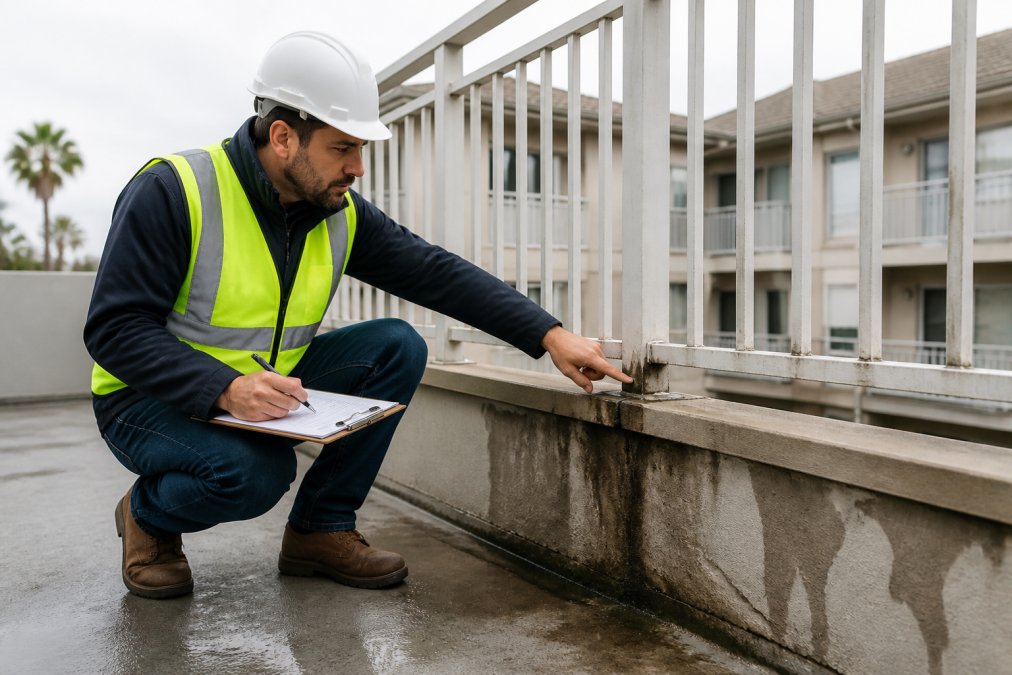
A licensed inspector in a safety vest examining a residential balcony railing and deck surface with a clipboard, focusing on structural connections and visible water damage, overcast daylight

What most board members miss is the scope. SB 326 is not a visual walk-by. Inspectors must assess load-bearing components and watertightness, because water intrusion is what quietly rots the framing behind a sound-looking surface. The official requirements are set out in the California legislature’s SB 326 text.

A common mistake is waiting for the board to agree on a vendor before starting the clock. Deadlines do not pause for internal debate.

SB 721 Inspection Deadlines for Apartment Owners

SB 721 applies to apartment buildings with three or more dwelling units, not just HOAs. It requires inspection of exterior elevated elements, including balconies, decks, and stairways, that are more than six feet above ground and rely on wood or wood-based structural members.

Owners often assume SB 721 and SB 326 are interchangeable. They are not. One governs rental apartment buildings, the other governs common-interest developments. Some properties fall under both, and the inspection obligations stack rather than cancel out.

Pro Tip
If you are unsure which statute applies, check the ownership structure of the building, not its size. A 12-unit building can be either, and the wrong assumption is what triggers penalties.

Property Management Risk Mitigation Strategies That Prevent Liability

Risk mitigation starts with a compliance calendar, not a repair budget. Boards and owners that schedule inspections, log every finding, and close out repairs on a documented timeline are the ones that survive litigation intact. But the calendar alone is not the strategy, the strategy is matching the right controls to the right property type, because the obligations stack differently for a common-interest development than they do for a rental apartment building.

Start with a property-type compliance checklist

Generic advice fails because a 12-unit building can be governed by one statute or the other depending on its ownership structure, not its size. Build the checklist around what the property actually is.

Multifamily and common-interest developments (HOAs and condos):

Book inspection →

  • Confirm governing documents, CC&Rs, and any recorded inspection obligations
  • Identify every exterior elevated element: balconies, decks, stairways, walkways, and landings
  • Verify which structural statute applies based on ownership structure, not unit count
  • Schedule recurring inspections on the statutory cycle rather than a one-time event
  • Document load-bearing components and watertightness, not just surface condition
  • Track reserve-study funding against the repair schedule

Single-family rentals and small apartment buildings:

  • Confirm which inspection statute applies to wood-framed elevated elements above the height threshold
  • Verify smoke and carbon monoxide alarm placement and function under state and local codes
  • Check habitability items: heating, plumbing, weatherproofing, and pest exclusion
  • Confirm fair housing practices in advertising, screening, and reasonable-accommodation handling
  • Maintain a written maintenance log with dates, vendors, and receipts
Pro Tip
If you are unsure which statute applies, check the ownership structure of the building, not its size. A 12-unit building can be either, and the wrong assumption is what triggers penalties.

The audit trail is the asset

A practical sequence for any property type looks like this:

  • Assign one board member or manager as compliance owner
  • Confirm which statute applies to each building
  • Book inspections before deadlines, not after
  • Log every finding with photos and dates
  • Track repairs to completion with receipts
  • Store the audit trail where it can be produced on request

That audit trail is the single most valuable document a board or owner holds. When a dispute or code enforcement action arrives, the question is rarely “did you know” but “can you prove what you did.”

Post-incident compliance recovery: what to do in the first 72 hours

Most guidance stops at prevention. The gap is what happens after a violation, failed inspection, or safety incident. A common pattern among managers who recover cleanly is a fixed sequence:

  1. Secure the site. Restrict access to the affected element and any structure that shares its load path. Document the restriction with photos and a written notice to residents.
  2. Preserve the record. Do not discard inspection reports, repair invoices, or correspondence. Spoliation of evidence turns a defensible position into an indefensible one.
  3. Notify the right parties. Insurer, counsel, and, where the statute or local ordinance requires it, the enforcing agency. Late notice is a coverage problem, not just a paperwork problem.
  4. Commission an independent assessment. A second opinion from a licensed professional establishes the scope of the problem and separates a localized defect from a systemic one.
  5. Remediate on a documented timeline. Every repair gets a date, a vendor, a receipt, and a sign-off. The remediation record becomes the new compliance baseline.
  6. Close the loop with residents. Written communication about what happened, what was fixed, and what changes going forward reduces turnover and reputational damage.

Where technology changes the math

Compliance monitoring is shifting from calendar-based to condition-based. Predictive maintenance tools that track water intrusion, drainage, and sealant degradation can flag elevated-element risk before it becomes a visible defect, the same way building automation systems flag HVAC and life-safety faults. The practical value is not the software; it is the earlier repair date and the timestamped record that the repair happened. A maintenance ticket generated by a sensor is evidence. A memory of a phone call is not.

The ESG overlap nobody is talking about

Environmental, Social, and Governance reporting is moving from a voluntary exercise to an expectation for institutional owners and larger portfolios. Safety compliance sits squarely inside the “S”, resident health and well-being, and the “G”, documented governance of risk. A board that can produce inspection records, remediation timelines, and resident communication logs has most of the safety narrative an ESG report needs. The reverse is also true: an incident with no paper trail is an ESG disclosure problem, not just a legal one. Treating compliance records as ESG inputs is a low-cost way to get ahead of where reporting requirements are heading. Rigorous attention to smoke alarm compliance serves as a primary indicator of this operational maturity, demonstrating that a property owner prioritizes life safety as a fundamental component of their broader risk management strategy.

Watch Out
Treating an inspection as a one-time event is the most common and most expensive mistake. A passing report from three years ago proves nothing about the condition of a balcony today, and auditors and plaintiff attorneys both know it.

How Compliance Protects Tenant Safety and Asset Value

Compliance protects two things at once: people and property value.

Tenant safety is a set of enforceable standards, not a feeling

Why insurers and lenders price compliance into the deal

The reserve-fund connection

The honest limitation

Key Takeaway
Safety compliance is not a cost center. It is the input that determines your insurance premium, your financing terms, your reserve accuracy, and your legal exposure, all at once.

The Real Cost of Non-Compliance: Penalties, Lawsuits, and Reputation

Key Takeaway
The cost of compliance is a scheduled expense. The cost of non-compliance is an unscheduled catastrophe with legal, financial, and human consequences attached.

Conclusion

Frequently Asked Questions

Why is compliance critical for property safety?

Compliance with safety codes prevents structural failures that can injure or kill residents. The 2015 Berkeley balcony collapse killed six people and injured seven, leading to California’s SB 326 and SB 721. These laws require inspections to catch dry rot, corrosion, and other issues before they cause tragedy. Property management compliance also protects owners from lawsuits, fines, and reputational damage. Regular inspections and maintenance keep balconies, decks, and stairways safe for everyone.

What are the legal consequences of non-compliance in property management?

Non-compliance can result in fines, lawsuits, and criminal charges. Local code enforcement may issue citations with daily penalties. If a resident is injured, the property owner faces negligence claims and potentially millions in damages. Insurance premiums can rise or coverage may be denied. HOAs and landlords may also be required to fund emergency repairs under court order. In California, failing to meet SB 326 or SB 721 deadlines can lead to personal liability for board members and owners.

How does SB 326 differ from SB 721 for balcony inspections?

SB 326 applies to HOAs and condominium associations, requiring inspections of exterior elevated elements by January 1, 2025, and every nine years after. SB 721 applies to apartment buildings with three or more units, with deadlines based on certificate of occupancy dates. Both require inspections by licensed professionals and repairs if needed. SB 326 focuses on common-interest developments, while SB 721 covers rental properties. Knowing which law applies is the first step to compliance.

What should property managers look for in a balcony inspection report?

A compliant inspection report must identify each elevated element, describe its condition, and note any unsafe conditions. It should include photos, repair recommendations, and a timeline for action. The inspector must be licensed and experienced with California balcony laws. Reports should also document the inspection date and method. This documentation serves as your audit trail if questions arise. Apex Balcony provides detailed reports that meet SB 326 and SB 721 requirements, helping you prioritize repairs and protect residents.

Book inspection

Posted in BlogTagged property management compliance, property management risk mitigation strategies, sb 326 balcony inspection requirements, why property management compliance is critical for safety

5 Best Property Management Software for Compliance Tracking

Posted on September 13, 2026 by Apex Balcony admin
5 Best Property Management Software for Compliance Tracking

Table of Contents

  • Why Compliance Tracking Software Matters for Property Managers
  • Quick Comparison: 5 Best Property Management Software for Compliance Tracking
  • 1. AppFolio: Best for Large Multifamily Portfolios
  • 2. Buildium: Best All-in-One for Small and Mid-Sized Portfolios
  • 3. Yardi Voyager: Best for Enterprise-Level Compliance and Risk
  • 4. Jones: Best for Automated Vendor Insurance Tracking Software
  • 5. SmartCompliance: Best for High-Volume COI Management
  • SB 326 and SB 721 Inspection Tracking: What to Look For in a Platform
  • What to Look For Before You Buy
    • The buying checklist, in priority order
    • Compliance ROI: the math most buyers skip
    • Implementation roadmap: migrating legacy compliance data
  • Frequently Asked Questions

Last Updated: September 13, 2026

Why Compliance Tracking Software Matters for Property Managers

Compliance tracking is the practice of monitoring, documenting, and renewing every regulatory obligation a property carries, from building safety inspections to vendor insurance certificates. For property managers, it is the difference between a clean audit and a liability claim. This guide from Apex Balcony examines the 5 best property management software for compliance tracking, so you can match a platform to your portfolio instead of guessing. Maintaining these rigorous standards often requires integrating specific operational protocols, such as implementing gas safety best practices to mitigate the most critical risks associated with residential heating systems.

The stakes are highest where structural safety is involved. California’s SB 326 and SB 721 balcony inspection mandates exist because of preventable tragedies, including the 2015 Berkeley balcony collapse and the 2021 Malibu balcony collapse (leginfo.legislature.ca.gov). Those incidents reshaped how HOAs and owners document elevated exterior elements. A platform that stores inspection dates in a spreadsheet will not protect you when an auditor asks for a five-year paper trail.

Below, we break down five platforms by portfolio size and compliance focus, then show you exactly what to demand before you sign a contract.

Quick Comparison: 5 Best Property Management Software for Compliance Tracking

The best compliance tracking software depends on where your risk sits: broad operational compliance, vendor insurance, or inspection documentation. Use this table to shortlist before reading the full reviews.

PlatformBest ForStandout Compliance FeaturePricing
AppFolioLarge multifamily portfoliosAutomated compliance documentation trackingContact for pricing
BuildiumSmall and mid-sized portfoliosRegulatory reporting and tenant document portalContact for pricing
Yardi VoyagerEnterprise-level riskEnterprise COI management and risk assessmentContact for pricing
JonesAutomated vendor insuranceAutomated COI verification and monitoringContact for pricing
SmartComplianceHigh-volume COI managementCentralized COI dashboard with automated alertsContact for pricing

A property management compliance checklist built inside any of these tools beats one kept in email threads. The difference is how much manual follow-up each platform still leaves on your desk.

1. AppFolio: Best for Large Multifamily Portfolios

AppFolio is a cloud-based platform built for multifamily managers who need automation across hundreds of units. Its AI-driven leasing assistant and unified accounting modules reduce the manual work that causes compliance gaps, and the mobile-first interface lets site staff log issues from the field.

Where it earns its place: automated compliance documentation tracking keeps inspection records, vendor documents, and audit trails in one searchable system. In practice, that means when a site manager uploads a fire-inspection report or a vendor’s certificate of insurance, the platform timestamps it, ties it to the property and unit, and makes it retrievable by date range, the format auditors and insurers actually request. For portfolio oversight across multiple buildings, that centralization matters more than any single feature.

The honest limitation is transparency. AppFolio does not publish pricing, so small portfolios often cannot predict cost without a sales conversation. Industry convention is that AppFolio quotes on a per-unit, per-month basis with a minimum unit threshold, and the total scales with which value-add modules you enable. If you manage fewer than 50 units, the automation you are paying for may exceed what you actually use.

A second trade-off worth flagging: AppFolio’s compliance strength is operational (leases, inspections, vendor docs), not statutory. It will not interpret SB 326 or SB 721 for you, and it will not tell you which buildings fall under which mandate. You still need a licensed inspector and a manager who knows the statute. Treat AppFolio as the system of record, not the system of judgment.

Screenshot of appfolio.com interface
AppFolio: Move Beyond Property Management Software
Key Takeaway
AppFolio fits portfolios large enough to justify per-unit pricing and complex enough to need centralized document retrieval. Below roughly 50 units, the compliance ROI rarely clears the subscription cost.

2. Buildium: Best All-in-One for Small and Mid-Sized Portfolios

Buildium suits managers who want accounting, maintenance, and compliance in a single subscription. Integrated rent collection and bookkeeping sit alongside maintenance request tracking and vendor management, so a small team does not need three separate logins.

Its tenant portal doubles as a document management hub, which simplifies sharing inspection notices and compliance disclosures. Reporting covers regulatory obligations well enough for most mid-sized portfolios.

The tradeoff: advanced compliance features often sit behind higher-tier plans. Budget for the upgrade if you need deeper audit trail functionality, or you will hit a ceiling in year two.

Screenshot of buildium.com interface
Buildium: Property Management Software

3. Yardi Voyager: Best for Enterprise-Level Compliance and Risk

Yardi Voyager is enterprise-grade software with modules designed for complex, multi-entity portfolios. Enterprise-level COI management, advanced risk assessment tools, and customizable compliance reporting make it the choice for organizations juggling statutory requirements across dozens of properties.

Scalability is its strength. So is depth: full-cycle accounting integration means compliance data and financial data live in the same system, which simplifies regulatory reporting.

The learning curve is steep. Expect real onboarding time before your team is productive. For a 12-unit building, that overhead is not worth it. For a 2,000-unit enterprise, it is table stakes.

4. Jones: Best for Automated Vendor Insurance Tracking Software

Jones focuses narrowly on vendor insurance tracking software, and that focus is the point. It automates certificate of insurance (COI) verification, monitors vendor compliance continuously, and pushes everything into a centralized document dashboard.

If your biggest exposure is an uninsured contractor working on site, Jones closes that gap faster than a general platform. It integrates with major property management systems, so you keep your existing accounting stack.

Book inspection →

The constraint is scope. Jones handles insurance and vendor compliance, not building safety codes or inspection scheduling. You will still need another system for those obligations.

Screenshot of getjones.com interface
Jones: Insurance Compliance at Scale for the Built World

5. SmartCompliance: Best for High-Volume COI Management

SmartCompliance targets managers drowning in vendor insurance documents. Its centralized COI dashboard, automated compliance alerts, and real-time status reporting replace the manual chase that eats hours every month.

For high-volume operations, automated alerts are the feature that matters. A certificate expiring in 30 days triggers a workflow instead of a forgotten calendar reminder, which is how most liability gaps actually happen.

The limitation is integration. SmartCompliance requires pairing with other software for full property management, so treat it as a compliance layer rather than a complete platform.

SB 326 and SB 721 Inspection Tracking: What to Look For in a Platform

Inspection tracking is the one compliance category most general platforms handle poorly, and it carries the highest liability. SB 326 governs balcony inspections for certain HOAs, while SB 721 covers specified residential buildings with three or more units. Confirm which applies to your property with the California Legislature’s SB 721 text and SB 326 statutory language before you buy software.

A property manager in a hard hat examining a multi-story apartment building balcony with a clipboard, inspecting exterior railings and structural elements on a sunny day

Your platform should store inspection dates, inspector credentials, report PDFs, and repair timelines in one audit trail. It should trigger escalation workflows when a deadline approaches. And it should export a clean report if a regulator or attorney requests records.

Software tracks the paperwork. It does not inspect the structure. That work requires licensed inspectors with construction and design experience, which is where Apex Balcony operates: hundreds of building owners rely on our team for comprehensive inspection of balconies, decks, and stairways, with a clear path to any necessary repairs.

Watch Out
Storing inspection reports in email folders is the most common compliance failure. When an auditor requests records and you cannot produce a dated, complete trail, the missing documentation itself becomes the violation.

What to Look For Before You Buy

Most buying guides hand you a feature checklist and stop. That is the easy part. The harder question, and the one no competitor answers, is what happens between signing the contract and running your first clean audit. Below is a buying framework plus the two things the SERP ignores: a compliance ROI model and a legacy-data migration roadmap.

The buying checklist, in priority order

  • Does it store dated inspection reports with an exportable audit trail?
  • Does it send automated alerts before a certificate or inspection deadline?
  • Does it support vendor credentialing and COI verification?
  • Does it integrate with your accounting or maintenance system via API?
  • Does it offer mobile access for field staff?
  • Does it produce audit-ready reporting on demand?

For a small portfolio, prioritize automated alerts and document storage. For an enterprise, prioritize integration and customizable reporting. Either way, verify the platform handles the specific statutory requirements that apply to your buildings, not just generic compliance categories.

Compliance ROI: the math most buyers skip

Compliance software is usually sold as a cost center. It is better understood as insurance against a specific, quantifiable downside. Build a simple model before you buy:

  1. Estimate your annual compliance labor. Count the hours your team spends chasing COIs, logging inspection dates, and assembling audit packets. Multiply by a loaded hourly rate. For many mid-sized portfolios, that number alone approaches or exceeds the software subscription.
  2. Estimate your exposure per lapse. An uninsured vendor working on site, an expired fire inspection, or a missing balcony report each creates a distinct liability. You do not need a precise figure, you need a defensible order of magnitude from your insurance broker or attorney.
  3. Compare subscription cost to (labor saved + exposure reduced). If the software costs less than the labor it replaces, the decision is already made. The exposure reduction is the upside.

A common pattern practitioners report: the first audit after implementation is where the ROI becomes obvious, because the platform surfaces gaps that were previously invisible in spreadsheets and email threads.

Implementation roadmap: migrating legacy compliance data

The step competitors skip entirely. Budget four to eight weeks for a mid-sized portfolio:

  1. Inventory. List every compliance obligation by property: inspection type, renewal cadence, responsible party, and where the current record lives (spreadsheet, shared drive, email, filing cabinet).
  2. Triage. Separate records into three buckets: current and complete, current but incomplete, and expired or missing. The third bucket is your first work queue, not a data-entry task.
  3. Standardize. Agree on one naming convention and one date format before you upload anything. Retrofitting consistency after migration is far more expensive than enforcing it during.
  4. Upload in waves. Migrate one property type or one compliance category at a time, and verify the audit export after each wave. Do not attempt a single bulk import.
  5. Set the alert cadence. Configure lead times (30, 60, 90 days) to match how long each renewal actually takes. A 30-day alert on a permit that takes 90 days to renew is a false sense of security.
  6. Run a mock audit. Before your first real one, pull a full compliance report for one property and check it against your source records. Fix discrepancies while they are cheap.
Pro Tip
Ask vendors for a sample audit export before you buy. A platform that can produce a clean, dated compliance report in under five minutes will hold up under scrutiny. One that requires manual assembly will not.
Watch Out
The most common migration failure is treating legacy data as a data-entry project. It is a triage project. If you upload expired and missing records without flagging them, you have digitized your liability instead of reducing it.

Frequently Asked Questions

What is property management compliance software?

Property management compliance software centralizes regulatory requirements, inspection records, vendor documents, and audit trails in one platform. Instead of tracking certificates of insurance, building safety codes, and inspection deadlines in spreadsheets, managers get automated alerts when documents expire or inspections come due. Tools like AppFolio, Buildium, and Yardi Voyager handle broad compliance needs, while Jones and SmartCompliance specialize in vendor insurance and COI tracking. The right choice depends on portfolio size and which compliance tasks consume the most staff time.

Why is automated compliance tracking important for HOAs and property owners?

Manual tracking fails when portfolios grow. A missed COI renewal or lapsed inspection can expose an HOA to liability, fines, and in worst cases, injury claims. Automated compliance tracking sends alerts before deadlines pass, stores audit-ready documentation, and creates a clear record of due diligence. For properties subject to SB 326 and SB 721, this means inspection reports, repair timelines, and structural assessments stay organized and accessible if a regulator or attorney requests them.

How does software help with balcony inspection compliance like SB 326 and SB 721?

SB 326 requires HOAs to inspect elevated exterior elements like balconies and stairways, while SB 721 applies to apartment buildings with three or more units. Compliance tracking software helps by scheduling inspection reminders, storing inspector reports and repair documentation, and flagging deadlines for follow-up assessments. Some platforms let you attach photos, structural reports, and contractor invoices directly to the property record, creating a centralized database that supports regulatory reporting and protects the board if questions arise later.

Can property management software track vendor insurance and COI compliance?

Yes, but the depth varies. General platforms like Buildium and AppFolio store vendor documents and send basic expiration reminders. Dedicated vendor insurance tracking software like Jones and SmartCompliance goes further, automating certificate requests, verifying coverage limits, and flagging non-compliant vendors before work begins. If your portfolio relies on contractors for repairs or preventative maintenance, a tool with automated COI verification reduces the risk of uninsured vendors working on your property and strengthens your liability protection.

What features should I look for in compliance management software?

Prioritize automated alerts for document expiration and inspection deadlines, a centralized database for certificates and reports, and audit trail functionality that logs every change. Look for API integration with your existing accounting or maintenance tools, real-time reporting dashboards, and mobile access for field staff. If you manage California properties, confirm the platform can track SB 326 and SB 721 inspection dates and store structural reports. Escalation workflows matter too, so non-compliant vendors or overdue inspections trigger action, not just a notification.

Book inspection

Posted in BlogTagged 5 best property management software for compliance tracking, compliance tracking, property management compliance checklist, vendor insurance tracking software

SB 326 Inspection Cost: What California HOAs Pay in 2026

Posted on September 12, 2026 by Apex Balcony admin
SB 326 Inspection Cost: What California HOAs Pay in 2026

Table of Contents

  • What Drives SB 326 Inspection Cost
    • Per-Unit vs. Per-Balcony Pricing Models
  • SB 326 Inspection Requirements: What the Law Mandates
    • Visual vs. Comprehensive Inspection Scope
  • SB 326 Inspection Timeline: Deadlines and Compliance
  • Hiring a Licensed Balcony Inspector: Qualifications That Matter
  • Sampling Protocol and What Inspectors Actually Examine
  • Cost-Saving Strategies for Small HOAs and Tight Budgets
  • Post-Inspection: Budgeting for Repairs and Maintenance
  • Frequently Asked Questions

Last Updated: September 12, 2026

What Drives SB 326 Inspection Cost

There is no single figure for how much an SB 326 inspection costs. Pricing depends on unit count, elevated exterior elements per unit, building age, and how much of the structure is reachable without invasive testing. At Apex Balcony, we’ve walked hundreds of properties, so any quote should be tied to a specific scope of work, not a flat per-building number.

SB 326 inspection cost is driven by two variables: the inspector’s pricing model and your property’s physical characteristics. Most firms charge by unit count, balcony count, or a hybrid.

Several property-specific factors push a quote up or down:

  • Number of elevated exterior elements per unit, including balconies, decks, stairways, and walkways
  • Building age and visible wear, since older structures with dry rot or corrosion take longer to document
  • Accessibility, because balconies blocked by furniture, planters, or locked gates slow the inspection
  • Report complexity, since a condominium association may need documentation formatted for board records and legal review

A 12-unit building with stacked balconies is not the same job as a 60-unit complex with varied elements. Ask any inspector which factors changed your number.

Per-Unit vs. Per-Balcony Pricing Models

Per-unit pricing charges a flat fee per residence regardless of balcony count; per-balcony pricing charges for each elevated exterior element inspected.

Per-unit pricing suits buildings with identical layouts: simpler to budget and explain to members, but a unit with four balconies pays the same as a unit with one.

Per-balcony pricing is more precise and reflects actual work, which matters on irregular or mixed-use properties. Ask which model each inspector uses before comparing totals, since per-unit and per-balcony quotes are not directly comparable.

Pro Tip
When you request bids, ask every inspector to submit a scope of work alongside the price. A quote that lists unit count, element count, and inspection method lets you compare apples to apples. A single number with no scope is not a bid, it’s a guess.

SB 326 Inspection Requirements: What the Law Mandates

SB 326 requires a qualified inspector to examine elevated exterior elements of covered buildings and certify their safety. It applies to condominium associations and common interest developments with three or more units, and sets who may inspect, what must be examined, and how results are documented.

The California Legislature’s text of SB 326 sets out the statutory requirements, and the California Department of Consumer Affairs maintains licensing information for the professionals who perform this work. Boards should read the statute directly rather than relying on summaries.

The core requirements include:

  • Inspection of balconies, decks, stairways, and other elevated exterior elements
  • A report documenting the condition of each element and any safety hazards found
  • Certification by a licensed architect, structural engineer, or other qualified inspector
  • Retention of inspection records for the association’s files

Boards frequently confuse SB 326 with SB 721. SB 721 covers certain multifamily rental properties; SB 326 covers condominium associations and common interest developments. Some buildings fall under one, some the other, some both. Confirm which applies before commissioning anything.

Visual vs. Comprehensive Inspection Scope

A visual inspection examines accessible elevated exterior elements without removing finishes or opening walls. A comprehensive inspection may include invasive testing, such as probing structural members or opening sections for hidden deterioration.

Visual inspection is faster and less disruptive, identifying visible hazards like loose railings, cracked concrete, corrosion, and water damage, but it cannot confirm the condition of elements hidden behind stucco, siding, or waterproofing membranes.

Comprehensive inspection costs more because it takes longer and requires patching afterward. It’s warranted when a visual inspection finds problems, when hidden deterioration is likely, or when the association needs certainty about load-bearing components.

Watch Out
An inspector who only performs visual inspections may miss dry rot or corrosion hidden behind waterproofing. If your building is over 30 years old and has never had an invasive inspection, a visual-only report may give the board false confidence. Ask directly what the scope covers before signing.

SB 326 Inspection Timeline: Deadlines and Compliance

Compliance deadlines for SB 326 have already passed for most covered buildings, and inspections must now recur on a set cycle. Associations that missed the initial deadline are not exempt, they are late. The California Legislative Information portal publishes the statutory timeline, and boards should confirm their specific obligations there.

The statute set an initial inspection deadline of January 1, 2025 for buildings whose elevated exterior elements were constructed before January 1, 2019; newer elements fall on a different track. After the first inspection, re-inspection recurs on a cycle tied to construction and the inspector’s findings. A one-time inspection does not close the file.

The practical timeline breaks down into five phases, and the scheduling phase is where most associations lose time:

PhaseWhat HappensWho’s ResponsibleTypical Duration
BudgetingBoard reserves funds for inspection and anticipated repairsHOA board1-3 board meetings
SchedulingBoard requests bids and selects an inspectorHOA board2-8 weeks
InspectionInspector examines all elevated exterior elementsQualified inspector1 day to several weeks, depending on unit count
ReportingWritten report delivered with findings and photosQualified inspector1-4 weeks after field work
ActionBoard reviews findings and budgets for repairsHOA board1-2 board meetings

Most associations find scheduling takes longest, especially when boards delay out of fear over repair costs. That fear is understandable, but delays compound: a problem found early is almost always cheaper to fix than one found after a structural failure.

The consequences of missing a deadline go beyond legal. A board that skips or delays inspection can face:

  • Statutory penalties and enforcement. The statute authorizes local enforcement and civil penalties for non-compliance, and the amount can escalate with continued delay.
  • Personal liability exposure for board members. Directors who knowingly defer a required safety inspection can face claims that they breached their fiduciary duty to the association.
  • Insurance complications. Carriers increasingly ask for proof of inspection. A lapse can affect coverage or trigger a reservation of rights after a loss.
  • Disclosure problems at sale. A missing or expired inspection report can delay or derail unit sales, since buyers and lenders now ask for it.
  • Accelerated repair costs. Deferred maintenance on elevated exterior elements tends to compound, so the repair bill after a delay is usually larger than the inspection bill would have been.
Watch Out
A missed deadline does not reset the clock. The association still owes the inspection, and the longer it waits, the more likely the report will document advanced deterioration that costs far more to repair. Treat the deadline as a floor, not a target.
Best For
Boards that are already past the initial deadline and need a realistic catch-up plan rather than a compliance lecture.

Hiring a Licensed Balcony Inspector: Qualifications That Matter

Hiring a licensed balcony inspector means verifying credentials before you sign a contract. SB 326 specifies who may perform the inspection, and a general contractor or handyman is not automatically qualified. The California Board for Professional Engineers, Land Surveyors, and Geologists maintains license lookups you can check in minutes.

Book inspection →

A licensed inspector in a hard hat and safety vest examining a residential balcony railing with a clipboard, standing on an elevated walkway of a multi-story apartment building on a clear day

The statute names no single license type, pointing instead to a “licensed architect, licensed structural engineer, or other licensed professional” who can certify elevated exterior elements. Boards see three common categories, each with a different scope of authority:

  • Licensed architect. Can certify the overall condition of exterior elevated elements and produce a report suitable for board records and legal review. Best fit for buildings with mixed construction types or complex envelopes.
  • Licensed structural engineer. Can certify load-bearing components and evaluate whether a deficiency affects structural capacity. Best fit when a prior report flagged structural concerns or the building is over 30 years old.
  • Certified inspector or specialty firm. May perform the field work, but the certification on the report must still be signed by a licensed architect or structural engineer. Ask who signs.

A common mistake is assuming the person who walks the property certifies the report. On many jobs those are two different people, and the certification signature is what satisfies the statute. Confirm the certifying professional’s name and license number before signing.

Ask every candidate for these four things:

  • License verification. Pull the license number from the state lookup and confirm it is active, not expired or suspended. Match the license type to the scope of work you need.
  • Insurance documentation. Ask for a certificate of insurance showing both general liability and errors and omissions (E&O) coverage. E&O is the policy that responds if the inspection misses a defect. General liability alone does not cover professional errors.
  • Sample report. Request a redacted example. A report that lists findings without photographs, element-by-element condition notes, or repair priorities will not hold up if the association is audited or sued.
  • Scope of work in writing. The bid should state the number of units, the number of elevated exterior elements, the inspection method (visual or comprehensive), and whether any invasive testing is included. A single number with no scope is not a bid.
Pro Tip
When you request bids, ask every inspector to submit a scope of work alongside the price. A quote that lists unit count, element count, and inspection method lets you compare apples to apples. A single number with no scope is not a bid, it’s a guess.

A common mistake is choosing the lowest bid without checking what the inspector can certify; the cheapest report is worthless if it doesn’t meet statutory requirements. Another is accepting a scope that quietly excludes stairways or walkways, which are elevated exterior elements under the statute. Read the scope line by line and confirm every element type is listed.

Key Takeaway
The four qualifications that actually matter are license type, insurance coverage (including E&O), report quality, and a written scope of work. Price is fifth. A board that saves money on an unqualified inspector often pays far more later in re-inspections and legal exposure.

Sampling Protocol and What Inspectors Actually Examine

Sampling protocol determines how many units an inspector must examine for a statistically valid certification. Under the statute, inspectors generally must examine a sufficient sample to achieve a 95 percent confidence level with a 5 percent margin of error, unless conditions warrant examining every unit.

In practice, an inspector rarely examines every balcony in a large complex. They select a representative sample, inspect those elements thoroughly, and extrapolate findings to the whole building. If the sample reveals widespread problems, the scope may expand.

What inspectors actually examine includes:

  • Balcony and deck surfaces, checking for cracking, delamination, and water intrusion
  • Railings and guardrails, testing for stability, height compliance, and corrosion at attachment points
  • Load-bearing components, looking for dry rot, corrosion, and deterioration in structural members
  • Waterproofing and flashing, since failed waterproofing is a leading cause of hidden structural damage
  • Stairways and walkways, which are elevated exterior elements under the statute

The building envelope matters: water entering through failed waterproofing reaches structural elements and starts deterioration long before anything is visible. That’s why sampling and thorough documentation go together.

Cost-Saving Strategies for Small HOAs and Tight Budgets

Small associations face the same compliance obligation as large complexes but with a smaller reserve fund. A 12-unit building in San Diego has fewer units to spread the cost across, and boards often worry the inspection fee alone will strain reserves.

Several strategies reduce total cost without cutting corners:

  • Bundle inspections. If your property needs both SB 326 and SB 721 work, commission them together. One mobilization costs less than two.
  • Prepare the property first. Clear balconies of furniture, planters, and stored items before the inspector arrives. Access delays cost money.
  • Coordinate with neighboring associations. Some inspection firms offer reduced rates when multiple nearby properties book in the same window, since travel and setup are shared.
  • Fix minor issues before inspection. Replacing a loose railing bolt or clearing a blocked drain is cheaper than having it documented as a deficiency requiring follow-up.
  • Request a phased scope. If your budget is tight, ask whether the inspection can be scheduled in phases rather than all at once.
Best For
Small associations under 20 units that need to spread compliance costs across multiple budget cycles without falling behind on statutory deadlines.

Post-Inspection: Budgeting for Repairs and Maintenance

The inspection report begins the financial conversation. Once findings are documented, the board needs a repair plan with realistic cost estimates and a maintenance schedule that prevents recurrence.

Start by sorting findings into three tiers:

PriorityFinding TypeTypical Response
ImmediateSafety hazards, unstable railingsRepair or restrict access now
Near-termActive water intrusion, early dry rotBudget for repair within the year
MonitorMinor surface wear, no structural impactAdd to preventative maintenance plan

A maintenance plan is what keeps a one-time inspection from becoming a recurring emergency. Schedule annual visual checks of waterproofing and drainage, and budget for re-inspection on the statutory cycle. The Federal Emergency Management Agency’s building science resources offer useful guidance on water intrusion and building envelope maintenance that applies to residential structures.

The Berkeley balcony collapse in 2015 and the Malibu balcony collapse in 2021 both followed years of undetected water damage to structural elements. Neither association set out to neglect its buildings. Both lacked a maintenance plan that would have caught the deterioration early.


The hardest part of SB 326 compliance isn’t the inspection itself, it’s the uncertainty about what the report will reveal and what repairs will cost. Apex Balcony helps boards move through that uncertainty with licensed inspectors who have decades of combined construction and design experience, specialized expertise in SB 326 and SB 721 compliance, and a reporting process that gives your board a clear path to necessary repairs. We handle properties of every size, including small associations larger firms overlook. Book an inspection with Apex Balcony and get a compliance report your board can actually act on.

Frequently Asked Questions

What factors influence the cost of an SB 326 inspection?

SB 326 inspection cost depends on several variables: the number of units and balconies, building age, accessibility of elevated elements, whether the inspection is visual or comprehensive, and the qualifications of the inspector. Buildings with complex layouts, limited access points, or visible deterioration typically require more time and may need invasive testing. Pricing also varies by region and inspector availability. Apex Balcony recommends requesting a detailed scope of work before comparing quotes so you understand exactly what is included.

Are there penalties for failing to complete an SB 326 inspection?

Yes. Under California Civil Code, condominium associations that miss the SB 326 inspection timeline face potential legal liability if a balcony failure causes injury or death. While the statute itself does not impose automatic fines, failure to comply can result in lawsuits, increased insurance premiums, and personal liability for HOA board members. The 2015 Berkeley balcony collapse and 2021 Malibu incident underscore the real-world consequences. Compliance protects both residents and the association’s financial standing.

Does the cost of an SB 326 inspection include repairs?

No. Inspection fees cover only the assessment and report. Repairs are separate and can range significantly depending on what inspectors find. Common issues include dry rot, corrosion of load-bearing components, waterproofing failures, and structural degradation. Apex Balcony provides detailed repair estimates in the inspection report so HOA boards can plan budgets and prioritize work. Some associations phase repairs over multiple years to manage reserve fund impact.

Who is qualified to perform an SB 326 inspection?

SB 326 inspection requirements specify that inspectors must be licensed architects, structural engineers, or civil engineers with relevant experience. Hiring a licensed balcony inspector with documented SB 326 experience is critical because the report must hold up under legal scrutiny. Apex Balcony’s team includes licensed professionals with decades of construction and design experience specific to California balcony compliance.

Book inspection

Posted in BlogTagged hiring a licensed balcony inspector, how much does an sb 326 inspection typically cost?, sb 326 inspection cost, sb 326 inspection requirements, sb 326 inspection timeline

Hiring Structural Engineers for Inspections: 2026 Guide

Posted on September 11, 2026 by Apex Balcony admin
Hiring Structural Engineers for Inspections: 2026 Guide

Table of Contents

  • When to Hire a Structural Engineer for an Inspection
    • SB 326 and SB 721 Triggers for Multi-Unit Buildings
    • Warning Signs That Justify a Site Investigation
  • Home Inspector vs. Structural Engineer: What’s the Difference?
  • SB 326 Balcony Inspection Requirements Every HOA Board Should Know
  • How to Find and Vet a Qualified Professional Engineer (PE)
    • Verifying Licensure and Insurance Before You Sign
    • Red Flags in Engineer Contracts
  • Structural Inspection Report Checklist: What Your Report Must Include
    • Post-Inspection Remediation Roadmap
    • Insurance and Liability Implications
  • Structural Engineering Services Cost: What Drives the Fee
    • The Four Cost Drivers
    • What Keeps the Fee Reasonable
    • What Pushes the Fee Up
    • How to Compare Two Proposals
  • After the Inspection: Remediation, Insurance, and Liability
    • Post-Inspection Remediation Roadmap
    • Insurance and Liability Implications
  • Frequently Asked Questions

Last Updated: September 11, 2026

When to Hire a Structural Engineer for an Inspection

Hiring structural engineers for inspections means bringing a licensed professional engineer onto a property to evaluate the load-bearing capacity, framing, and foundation of elevated or aging structures before they fail.

A common mistake is assuming a contractor’s repair quote counts as an evaluation. Contractors price work; engineers determine whether the structure is safe and what the building code requires.

SB 326 and SB 721 Triggers for Multi-Unit Buildings

Two California statutes force the issue for most multi-unit properties. SB 326 requires HOAs to have balconies, decks, stairways, and other elevated exterior elements inspected by a licensed structural engineer on a recurring cycle (leginfo.legislature.ca.gov). SB 721 applies to apartment buildings of three or more units and requires similar inspections (leginfo.legislature.ca.gov).

If your building falls under either law, the trigger is the calendar, not a visible crack.

Warning Signs That Justify a Site Investigation

Get an engineer on site when you notice any of the following:

  • Settlement cracks wider than a hairline, especially at the base of posts or where a balcony meets the wall
  • Rust staining, bubbling paint, or soft spots on a concrete surface
  • A railing that flexes or moves when pushed
  • Water pooling near footings or evidence of poor grading and drainage
  • Sagging or springy deck surfaces
Watch Out
Ignoring a soft spot or flexing railing is how minor water intrusion becomes a structural failure. By the time a surface visibly deflects, the framing underneath has usually been compromised for years.

Home Inspector vs. Structural Engineer: What’s the Difference?

A home inspector documents general condition for a buyer. A structural engineer analyzes specific load paths and issues a sealed opinion on whether a structure is safe and code-compliant.

That distinction matters legally. A home inspection report carries no engineering certification and won’t satisfy SB 326 or SB 721. Only a licensed professional engineer (PE) can stamp a report a building department or court will accept (ncees.org).

If you’re buying a property with elevated exterior elements, treat the home inspection as a starting point, not a verdict.

SB 326 Balcony Inspection Requirements Every HOA Board Should Know

SB 326 balcony inspection requirements are specific, and boards get tripped up on the details more than the deadline. The law requires inspection of balconies, decks, stairways, and other elevated exterior elements by a licensed structural engineer, with findings reported to the board and membership.

Three things boards consistently miss:

  1. The inspection is not a one-time event. It recurs on a statutory cycle.
  2. The engineer’s report must be distributed, not just filed.
  3. Repairs identified in the report create a documented obligation. Ignoring them shifts liability squarely onto the board.
Pro Tip
Ask your engineer to flag which findings are safety-critical versus cosmetic before the report is finalized. Boards that get this split upfront can sequence repairs against their reserve fund instead of panicking over the full list.

How to Find and Vet a Qualified Professional Engineer (PE)

Finding a qualified structural engineer starts with licensure verification, not price shopping. Any engineer you hire should hold an active PE license in the state where the building sits, confirmed independently before you sign anything.

A licensed structural engineer in a hard hat and safety vest reviewing balcony construction drawings on a tablet while standing on a residential walkway, with a multi-unit building visible behind him

The best candidates combine design experience with field inspection work. Someone who has only drafted structural drawings may struggle to read what a weathered balcony is telling them.

Verifying Licensure and Insurance Before You Sign

Before you commit, confirm three things: an active PE license, professional liability coverage, and general liability coverage. Ask for the certificates directly. A reputable engineer provides them without hesitation.

Red Flags in Engineer Contracts

Watch for these in any proposal:

  • No named engineer on the contract, only a firm
  • Vague scope that doesn’t specify which elements get inspected
  • No mention of what the report will and won’t cover
  • Pressure to bundle inspection with a specific contractor’s repairs
  • Refusal to provide proof of insurance
Key Takeaway
The scope language in the contract determines what you actually get. If it doesn’t name the specific elements, inspection method, and deliverable, you’re buying an open-ended promise.

Structural Inspection Report Checklist: What Your Report Must Include

A structural inspection report checklist keeps you from accepting a thin document. The real value is knowing what each item should contain and what to do with it. Here is the checklist with the substance behind each line.

  • Engineer’s name, license number, and signature or seal. The seal is what makes the report legally meaningful. A report without a seal is an opinion, not an engineering document, and it will not satisfy a building department, an insurer, or a court.
  • Date and scope of the site visit. The scope statement should name every element inspected and, just as important, every element excluded. If the report is silent on what was not inspected, assume nothing was.
  • Description of each element inspected. Balconies, decks, stairways, railings, and their attachment points should each be listed individually. A blanket statement like “elevated exterior elements were reviewed” is not a description.
  • Findings organized by severity. Look for a clear split between safety-critical, repair-needed, and monitor-only findings. If everything is listed at the same priority, the report is not telling you what to fix first.
  • Photographic documentation of each issue. Photos should be dated and tied to a specific finding. Undated photos with no location reference are hard to act on later.
  • Recommended remediation for each finding. Recommendations should be specific enough that a contractor can bid from them, not “repair as needed,” but the element, the method, and the standard the repair must meet.
  • Clear statement of what was not inspected. This protects both you and the engineer, and it tells you where the next inspection scope should expand.

If any of these are missing, ask for a revised report before you pay.

Post-Inspection Remediation Roadmap

Most guides end at the report. The report is the beginning of the work, not the end, and the sequence matters as much as the repairs themselves.

  1. Triage findings by severity. Separate safety-critical items from repair-needed and monitor-only items. Safety-critical findings should be addressed before anything cosmetic, even if the cosmetic items are more visible.
  2. Get engineering-reviewed repair scopes. Have the engineer translate each finding into a written scope that contractors can bid against. This is the single most effective way to prevent contractors from bidding different jobs and producing incomparable numbers.
  3. Sequence repairs against your budget and any statutory deadlines. If your building falls under a recurring inspection cycle, the repair timeline may be tied to the next reporting date. Build the schedule backward from that date.
  4. Document everything. Photos before, during, and after each repair. Retain the engineer’s report, the contractor bids, and the closeout documentation together. If a claim ever arises, this file is your defense.
  5. Schedule the next inspection before the current cycle closes. The next cycle starts the day the current one ends. Putting it on the calendar now prevents the gap that creates liability.

Insurance and Liability Implications

A sealed engineering report is your strongest defense if an incident occurs; failing to act on a report you commissioned does the opposite, and insurers and plaintiffs treat documented, ignored findings as negligence. A clean report can support a favorable insurance renewal and, in some cases, a premium credit for documented maintenance. A report with unaddressed safety-critical findings can become the centerpiece of a liability claim, because the owner had written notice and chose not to act. The Berkeley balcony collapse in 2015 and the Malibu collapse in 2021 both reshaped how courts and carriers view owner responsibility for elevated exterior elements. The lesson is consistent: documented awareness without action is worse than no inspection at all.

Book inspection →

If your report identifies a safety-critical finding, do not wait for the next inspection cycle to act. The report itself creates a record of notice, and that record is what insurers and plaintiffs will point to if something fails.

The report is a liability document as much as a maintenance document. Treat the remediation roadmap and the insurance file as part of the same deliverable, not as separate afterthoughts.

Structural Engineering Services Cost: What Drives the Fee

Structural engineering services cost is not a flat rate, and any engineer who quotes one without seeing the property is guessing. The fee is built from four inputs: the number of elevated elements in scope, the access conditions at each one, the depth of reporting required, and whether follow-up site visits are included. Understanding those inputs lets you compare proposals on equal footing.

The Four Cost Drivers

1. Element count and type. A single balcony on a two-story building is a different engagement than forty walkways across three buildings. Engineers typically price per element or per building, so the count is the first thing that moves the number. Stairways and railings are usually bundled with adjacent balconies; detached structures are often priced separately.

2. Access conditions. A ground-floor patio can be inspected from grade. A fourth-floor balcony with no adjacent roof access may require a lift, rope access, or tenant coordination. Each adds labor, scheduling complexity, and sometimes equipment rental. Buildings with locked units or no tenant cooperation cost more because the engineer has to return.

3. Depth of reporting. A visual condition assessment is the baseline. A report with moisture readings, probe openings, or destructive testing costs more because it takes longer on site and generates more documentation. If your building authority or HOA attorney expects a specific format, say so upfront, reformatting after the fact is billed as a second deliverable.
4. Follow-up visits. Findings that require a second look (a soft spot that needs a probe, a repair that needs verification) are typically billed as additional site visits. Ask whether the proposal includes a set number of follow-ups or bills them hourly.

What Keeps the Fee Reasonable

A tight scope is the single biggest lever. Naming the specific elements, inspection method, and deliverable format in the contract prevents the engineer from padding the proposal defensively. Batching multiple buildings into one mobilization also reduces per-building cost.

What Pushes the Fee Up

  • Multi-building portfolios with staggered access windows
  • Historic or non-standard construction that requires research into original drawings
  • Limited access requiring lifts, rope access, or after-hours scheduling
  • Findings that trigger structural calculations or repair design as a separate scope
  • Rush timelines that force the engineer to reshuffle other work

Ask for a proposal that breaks the fee into site visit, report, and any optional follow-up. A single lump sum hides which line item is driving the number, and it makes it harder to negotiate scope down if the budget is tight.

How to Compare Two Proposals

Two engineers can quote very different numbers for the same building because they scoped different work. Before you compare, line up three things: the elements each proposal covers, the inspection method, and the deliverable. A lower quote that inspects half the elements or delivers a letter instead of a sealed report is not a lower price, it is a smaller job.

Direct any pricing question to Apex Balcony for a property-specific quote.

After the Inspection: Remediation, Insurance, and Liability

Post-Inspection Remediation Roadmap

  1. Triage findings by severity, separating safety-critical items from cosmetic ones.
  2. Get engineering-reviewed repair scopes so contractors bid against the same specification.
  3. Sequence repairs against your reserve fund and statutory deadlines.
  4. Document everything, including photos before, during, and after.
  5. Schedule the next inspection before the current cycle closes.

Insurance and Liability Implications

The Berkeley balcony collapse in 2015 and the Malibu collapse in 2021 both reshaped how courts and carriers view owner responsibility for elevated exterior elements. The lesson is consistent: documented awareness without action is worse than no inspection at all.


Owners who delay inspections usually do so because they fear the repair number. The better move is to get a clear, engineered picture of your building now, while you still control the timeline. Apex Balcony provides licensed balcony inspectors with decades of combined construction and design experience, specialized SB 326 and SB 721 compliance expertise, and a comprehensive review of every elevated exterior element, from balconies and decks to stairways. Get started with Apex Balcony and turn an unknown liability into a documented, manageable plan.

Frequently Asked Questions

When is it necessary to hire a structural engineer for an inspection?

You need a structural engineer when a balcony, deck, or stairway shows warning signs such as settlement cracks, sagging, or separation from the building, or when SB 326 or SB 721 requires an inspection. California law mandates inspections for multifamily buildings with three or more units. A licensed PE can assess structural integrity, load path, and framing that a general contractor cannot legally certify.

How much does a structural engineer inspection cost?

Pricing depends on building size, number of elevated elements, access requirements, and whether destructive testing is needed. Apex Balcony does not publish flat rates because every property is different. Request a quote based on your unit count and balcony inventory. Compare bids on scope, not just price: a low quote that skips load-bearing wall checks or omits a stamped report may cost more later.

What should I look for in a structural engineer’s report?

A complete structural inspection report checklist includes the engineer’s PE license number and signature, date and scope of the site visit, photographs of every inspected element, structural analysis notes, load path evaluation, building code compliance findings, and a clear remediation roadmap. The report should also list any limitations or areas not inspected. If it lacks a stamped certification, it will not satisfy SB 326 or hold up in a building department audit.

Are structural inspections required for multi-family buildings?

Yes. SB 326 requires HOAs to inspect balconies, decks, stairways, and other elevated exterior elements by January 1, 2025, and every nine years after. SB 721 applies to apartment buildings with three or more units. Both laws require a licensed professional engineer or architect to perform the inspection and issue a stamped report. Missing the deadline exposes the owner or HOA to liability and potential fines.

Book inspection

Posted in BlogTagged hiring structural engineers for inspections, sb 326 balcony inspection requirements, structural engineering services cost, structural engineers, structural inspection report checklist

Is Balcony Wood Decay Covered by Insurance?

Posted on September 10, 2026 by Apex Balcony admin
Is Balcony Wood Decay Covered by Insurance?

Table of Contents

  • Why Balcony Wood Decay Rarely Qualifies as a Covered Peril
    • Sudden Damage vs. Gradual Deterioration: The Line Insurers Draw
  • When Accidental Water Damage Leads to a Successful Claim
  • SB 326 Balcony Law Compliance and Your Insurance Obligations
    • How Code Compliance and Coverage Interact
    • What the Inspection Report Does for a Future Claim
  • Signs of Structural Failure in Decks That Adjusters Look For
    • The Cosmetic vs. Structural Distinction
    • How an Adjuster Determines Cause of Loss
    • Documentation and Mitigation After Discovery
  • Hiring a Licensed Balcony Inspector: What to Expect and Why It Matters
  • Documentation, Mitigation, and Your Responsibilities After Discovery
  • Conclusion
  • Frequently Asked Questions

Last Updated: September 10, 2026

Why Balcony Wood Decay Rarely Qualifies as a Covered Peril

The short answer is that balcony wood decay is almost never covered, because homeowners insurance is built to pay for sudden, accidental events, not the slow breakdown of materials over time. This guide from Apex Balcony walks through where that line sits, why claims fail, and how to protect your building either way.

Rot is a process, not an event. It starts with a small moisture infiltration point, a failed sealant joint or a hairline crack in the stucco, and it works inward for years before anyone notices. By the time a board feels soft underfoot, the damage has usually been developing for a long time, and that timeline is exactly what sinks most claims.

A common mistake is assuming that because the balcony is attached to an insured structure, everything on it is covered. It isn’t. Policies cover the structure against named perils, and gradual deterioration is not one of them.

Sudden Damage vs. Gradual Deterioration: The Line Insurers Draw

The dividing line is time and cause, not severity. A windstorm that tears a railing loose on a Tuesday afternoon is a sudden event. Fungal growth that has been quietly consuming a floor joist for six years is gradual deterioration, and it is excluded in standard policies.

ScenarioHow Insurers Classify ItTypical Outcome
Windstorm rips off railing and flashingSudden, accidentalCovered, subject to deductible
Pipe bursts and soaks the deck boardsSudden, accidentalOften covered
Rot from a failed sealant jointGradual deteriorationDenied
Termite damage discovered during inspectionPest-related exclusionDenied
Rot spreading from an unrepaired leakMaintenance negligenceDenied
Watch Out
The single most expensive mistake is delaying repairs after a small leak. Once water has been allowed to sit, insurers can point to maintenance negligence, and that denial follows the property into future claims.

When Accidental Water Damage Leads to a Successful Claim

Accidental water damage is the one path where a decay-related claim can succeed, provided the water event itself was sudden and the damage was reported promptly. A supply line that fails behind a wall, a washing machine hose that bursts on an upper floor, or a blocked drain that overflows onto a deck all qualify as sudden and accidental.

What makes these claims work is a clean chain of causation. You need to show that the water event happened at a specific time, that it was not the result of neglect, and that the resulting damage was discovered and reported without unreasonable delay. Photographs, a plumber’s invoice with a date, and a written timeline do more for a claim than any amount of explanation.

The moment you know about a leak and do nothing, the classification shifts. Insurers call this failure to mitigate, and it converts a covered event into a denied one. If you find water damage, stop the source, document everything, and start drying immediately.

SB 326 Balcony Law Compliance and Your Insurance Obligations

For buildings with three or more multifamily dwelling units in California, SB 326 balcony law compliance is not optional, and it intersects with insurance in ways most boards don’t anticipate (leginfo.legislature.ca.gov). The statute requires periodic inspection of exterior elevated elements, balconies, decks, stairways, and walkways, by a licensed professional, on a recurring cycle tied to the building’s original certificate of occupancy (leginfo.legislature.ca.gov). SB 721 applies a similar inspection duty to certain residential buildings outside the common-interest development structure. If you are unsure which statute applies, that determination depends on building type, ownership structure, and unit count, so confirm it with the agency that administers the requirement rather than guessing.

Here is the part that catches people off guard: compliance and coverage are separate questions. Passing an inspection does not guarantee a claim will be paid, and failing to inspect does not automatically void your policy. What non-compliance does is hand an insurer a ready-made argument about maintenance negligence if something fails later. In practice, the inspection report becomes evidence, either that you exercised reasonable care, or that you had notice of a condition and did nothing.

How Code Compliance and Coverage Interact

A frequent misconception is that because a repair is required by code, insurance must pay for it. Standard homeowners and commercial property forms generally separate the cost to repair covered damage from the cost to bring the undamaged portion up to current code. Many policies include some ordinance-or-law coverage, but the limit is often a small percentage of the dwelling limit, and it typically applies only when a covered peril caused the loss in the first place. If the underlying cause is gradual decay, the code-upgrade question is moot, there is no covered loss to attach it to.

A common pattern is that a wind claim tears flashing loose, water enters, and the resulting rot is discovered during the repair. The sudden wind event is the covered peril; the rot that predated it is not. The carrier may pay to repair the wind damage and the code-required reconstruction of that specific area, while denying the broader decay remediation. That split is why the cause-of-loss determination matters more than the size of the repair.

What the Inspection Report Does for a Future Claim

The role of home inspections in future claims is worth understanding now. If you sell the property, or if a future claim arises, a documented inspection history demonstrates that you exercised reasonable care. An absence of records does the opposite, and insurers read silence as neglect. A report that notes a condition and recommends repair is not automatically fatal, what matters is whether you acted on it. A dated repair invoice following a flagged finding is strong evidence of maintenance; a flagged finding with no follow-up is the fact pattern that supports a denial.

Key Takeaway
Inspection compliance protects you legally. Documentation protects you at claim time. You need both, and one does not substitute for the other.

state agency that administers exterior elevated element inspection requirements

Signs of Structural Failure in Decks That Adjusters Look For

Adjusters and inspectors look for the same things, and most of them are visible before a probe ever touches the wood. Soft or spongy decking underfoot, a railing that moves when you lean on it, rusted or pulling fasteners, and dark staining around the base of posts are the classic early indicators. What separates a paid claim from a denial is not how bad the damage looks, it is how the adjuster classifies the cause and whether the damage is structural or cosmetic.

A licensed inspector in safety gear examining a residential wooden balcony, pointing at visible rot and water staining on the deck boards and railing base

The Cosmetic vs. Structural Distinction

The distinction that matters most is between structural integrity and cosmetic rot. Surface discoloration on a fascia board or a weathered handrail is a cosmetic issue, and cosmetic rot is almost never covered because it is gradual deterioration. Rot that has reached a ledger board, a floor joist, or a post base is a structural one, and it is the difference between a repair and a replacement. Even then, coverage turns on cause: structural rot from a sudden, accidental water event may be covered, while structural rot from years of failed sealant is excluded.

  • Decking and trim: soft spots, cupping, and visible fungal growth
  • Fascia and railing bases: staining, peeling paint, and crumbling edges
  • Fasteners: rust streaks, backing-out screws, and loose connections
  • Post bases: standing water, soil contact, and splitting
  • Attachment points: gaps at the ledger board and movement in the framing

How an Adjuster Determines Cause of Loss

When a claim is filed, the adjuster’s job is to answer one question: what peril caused this loss, and is that peril covered? The mechanism usually works backward from the damage. Water staining that radiates from a single point suggests a sudden event; staining that follows a joint line or spreads evenly across a surface suggests long-term intrusion. Probing with a moisture meter and an awl lets the adjuster map the boundary between sound and decayed wood, and that boundary often reveals how long the moisture has been present.

Book inspection →

A common pattern is that the adjuster finds the rot, then looks for the source. If the source is a failed sealant joint or a clogged drain that was never cleared, the file trends toward maintenance negligence. If the source is a burst supply line or a storm-driven breach, the file trends toward a covered accidental water loss. The same rotted joist can land on either side of that line depending on the documented cause.

Documentation and Mitigation After Discovery

Once decay is discovered, your obligations start immediately, and how you handle the next two weeks shapes everything that follows. Mitigation means preventing further damage, not fixing the balcony. Tarp the affected area, stop any active water intrusion, restrict access if the structure is compromised, and keep the receipts. Failure to mitigate converts a potentially covered event into a denied one.

Documentation is the other half. Build a file that includes dated photographs from multiple angles, moisture readings, the inspector’s report, contractor estimates, and a written timeline of when you noticed the problem and what you did about it. If a claim or a lawsuit follows, this file is your defense. Photograph the same locations every six months from the same angles, a dated progression series showing stable conditions is powerful evidence of responsible maintenance, and it takes ten minutes per inspection cycle.

Watch Out
The single most expensive mistake is delaying repairs after a small leak. Once water has been allowed to sit, insurers can point to maintenance negligence, and that denial follows the property into future claims.

Hiring a Licensed Balcony Inspector: What to Expect and Why It Matters

Hiring a licensed balcony inspector gives you a documented, defensible record of your building’s condition, which is the asset that holds up in an audit, a lawsuit, or a claim dispute. The inspection itself should be non-destructive wherever possible, using moisture meters, probes at suspect locations, and photographic documentation rather than wholesale tear-out.

What most guides miss is that the report is the deliverable, not the visit. A useful report identifies each elevated exterior element, records its condition with dated photographs, distinguishes cosmetic from structural findings, and recommends a repair priority. That document is what you hand to your insurer, your board, and your contractor.

This is where Apex Balcony operates. Our licensed inspectors bring decades of combined construction and design experience to each property, and we specialize in SB 326 and SB 721 compliance across balconies, decks, and stairways. We’ve worked with hundreds of building owners, and the pattern is consistent: the buildings that document early are the ones that avoid emergency spending later.

Pricing for an inspection depends on the number of units, the number of elevated elements, and site access, so we quote per property rather than publishing a flat figure. Request a quote and you’ll get a scope before anyone shows up.

Documentation, Mitigation, and Your Responsibilities After Discovery

Once decay is discovered, your obligations start immediately, and how you handle the next two weeks shapes everything that follows. Mitigation means preventing further damage, not fixing the balcony. Tarp the affected area, stop any active water intrusion, restrict access if the structure is compromised, and keep the receipts.

Documentation is the other half. Build a file that includes dated photographs from multiple angles, moisture readings, the inspector’s report, contractor estimates, and a written timeline of when you noticed the problem and what you did about it. If a claim or a lawsuit follows, this file is your defense.

Pro Tip
Photograph the same locations every six months from the same angles. A dated progression series showing stable conditions is powerful evidence that you maintained the property responsibly, and it takes ten minutes per inspection cycle.

The role of home inspections in future claims is worth understanding now. If you sell the property, or if a future claim arises, a documented inspection history demonstrates that you exercised reasonable care. An absence of records does the opposite, and insurers read silence as neglect.

Conclusion

Balcony wood decay sits squarely in the gap between what insurance covers and what buildings actually need, and closing that gap is a documentation and maintenance problem more than a coverage problem. Apex Balcony helps California property owners meet SB 326 and SB 721 requirements with licensed inspectors who identify early signs of structural failure before they become emergencies. Book an inspection with Apex Balcony and get a clear, defensible record of your building’s condition, a documented path to necessary repairs, and the compliance evidence your board needs.

Frequently Asked Questions

Will insurance cover rotting wood on a balcony?

Standard homeowners insurance policies almost never cover balcony wood decay. Insurers classify rot as gradual deterioration, which is a policy exclusion. The exception is when rot results directly from a sudden, accidental event like a burst pipe or storm damage that created moisture infiltration. In that scenario, the resulting water damage may be covered, but the rot itself typically is not. Document the original event thoroughly to support any claim.

Is wood rot considered structural damage by insurance companies?

Insurance companies generally treat wood rot as a maintenance issue, not structural damage, even when it affects floor joists or load-bearing elements. This distinction matters because policies cover sudden structural damage from covered perils, not deterioration from neglect. However, if a covered peril caused the moisture that led to rot, the structural repair might qualify. An insurance adjuster will determine the cause of loss before deciding.

Does negligence affect insurance coverage for deck repairs?

Yes. If an insurer determines that maintenance negligence allowed wood rot to develop or worsen, they can deny the claim outright. Policies require homeowners to perform reasonable upkeep. Documented maintenance records, inspection reports, and prompt repairs strengthen your position. California’s SB 326 and SB 721 inspection requirements for multi-unit buildings add another layer, since non-compliance can also affect liability and coverage decisions.

What are the mandatory inspection requirements for elevated exterior elements?

In California, SB 326 requires HOAs to inspect elevated exterior elements like balconies, decks, and stairways every nine years by a licensed inspector. SB 721 requires owners of buildings with three or more dwelling units to inspect similar elements every six years. Both laws mandate that inspectors identify signs of structural failure and report findings. Compliance helps prevent claim denials tied to deferred maintenance and protects residents from preventable accidents.

Book inspection

Posted in BlogTagged balcony wood decay, hiring a licensed balcony inspector, is balcony wood decay covered by insurance, sb 326 balcony law compliance, signs of structural failure in decks

Posts navigation

Older posts
Newer posts

Recent Posts

  • Cost of Balcony Structural Repairs in California
  • Hiring a Structural Engineer for Deck Safety: 2026 Guide
  • Balcony Maintenance Tips for California Homeowners
  • How to Choose a Structural Engineer for Home Renovation
  • Structural Engineering for Hillside Homes: A Complete Guide

Recent Comments

No comments to show.

Archives

  • October 2026
  • September 2026
  • August 2026
  • July 2026
  • June 2026

Categories

  • Blog
Logo
Created by Unilime.Group
  • Balcony Law
  • About us
  • Inspection services
  • FAQ
  • Blog

Call us ‪+1 818-806-7885‬
License: CSLB #1101305

Apex Balcony Inspection
‪+1 818-806-7885‬
[email protected]
4645 Van Nuys Blvd #201
Sherman Oaks CA 91403

Created by Unilime.Group