
Logo
  • Balcony Law
  • About us
  • Inspection services
  • FAQ
  • Blog
  • Call us ‪+1 818-806-7885
  • Book now

Tag: hiring a licensed balcony inspector

SB 326 Inspection Cost: What California HOAs Pay in 2026

Posted on September 12, 2026 by Apex Balcony admin
SB 326 Inspection Cost: What California HOAs Pay in 2026

Table of Contents

  • What Drives SB 326 Inspection Cost
    • Per-Unit vs. Per-Balcony Pricing Models
  • SB 326 Inspection Requirements: What the Law Mandates
    • Visual vs. Comprehensive Inspection Scope
  • SB 326 Inspection Timeline: Deadlines and Compliance
  • Hiring a Licensed Balcony Inspector: Qualifications That Matter
  • Sampling Protocol and What Inspectors Actually Examine
  • Cost-Saving Strategies for Small HOAs and Tight Budgets
  • Post-Inspection: Budgeting for Repairs and Maintenance
  • Frequently Asked Questions

Last Updated: September 12, 2026

What Drives SB 326 Inspection Cost

There is no single figure for how much an SB 326 inspection costs. Pricing depends on unit count, elevated exterior elements per unit, building age, and how much of the structure is reachable without invasive testing. At Apex Balcony, we’ve walked hundreds of properties, so any quote should be tied to a specific scope of work, not a flat per-building number.

SB 326 inspection cost is driven by two variables: the inspector’s pricing model and your property’s physical characteristics. Most firms charge by unit count, balcony count, or a hybrid.

Several property-specific factors push a quote up or down:

  • Number of elevated exterior elements per unit, including balconies, decks, stairways, and walkways
  • Building age and visible wear, since older structures with dry rot or corrosion take longer to document
  • Accessibility, because balconies blocked by furniture, planters, or locked gates slow the inspection
  • Report complexity, since a condominium association may need documentation formatted for board records and legal review

A 12-unit building with stacked balconies is not the same job as a 60-unit complex with varied elements. Ask any inspector which factors changed your number.

Per-Unit vs. Per-Balcony Pricing Models

Per-unit pricing charges a flat fee per residence regardless of balcony count; per-balcony pricing charges for each elevated exterior element inspected.

Per-unit pricing suits buildings with identical layouts: simpler to budget and explain to members, but a unit with four balconies pays the same as a unit with one.

Per-balcony pricing is more precise and reflects actual work, which matters on irregular or mixed-use properties. Ask which model each inspector uses before comparing totals, since per-unit and per-balcony quotes are not directly comparable.

Pro Tip
When you request bids, ask every inspector to submit a scope of work alongside the price. A quote that lists unit count, element count, and inspection method lets you compare apples to apples. A single number with no scope is not a bid, it’s a guess.

SB 326 Inspection Requirements: What the Law Mandates

SB 326 requires a qualified inspector to examine elevated exterior elements of covered buildings and certify their safety. It applies to condominium associations and common interest developments with three or more units, and sets who may inspect, what must be examined, and how results are documented.

The California Legislature’s text of SB 326 sets out the statutory requirements, and the California Department of Consumer Affairs maintains licensing information for the professionals who perform this work. Boards should read the statute directly rather than relying on summaries.

The core requirements include:

  • Inspection of balconies, decks, stairways, and other elevated exterior elements
  • A report documenting the condition of each element and any safety hazards found
  • Certification by a licensed architect, structural engineer, or other qualified inspector
  • Retention of inspection records for the association’s files

Boards frequently confuse SB 326 with SB 721. SB 721 covers certain multifamily rental properties; SB 326 covers condominium associations and common interest developments. Some buildings fall under one, some the other, some both. Confirm which applies before commissioning anything.

Visual vs. Comprehensive Inspection Scope

A visual inspection examines accessible elevated exterior elements without removing finishes or opening walls. A comprehensive inspection may include invasive testing, such as probing structural members or opening sections for hidden deterioration.

Visual inspection is faster and less disruptive, identifying visible hazards like loose railings, cracked concrete, corrosion, and water damage, but it cannot confirm the condition of elements hidden behind stucco, siding, or waterproofing membranes.

Comprehensive inspection costs more because it takes longer and requires patching afterward. It’s warranted when a visual inspection finds problems, when hidden deterioration is likely, or when the association needs certainty about load-bearing components.

Watch Out
An inspector who only performs visual inspections may miss dry rot or corrosion hidden behind waterproofing. If your building is over 30 years old and has never had an invasive inspection, a visual-only report may give the board false confidence. Ask directly what the scope covers before signing.

SB 326 Inspection Timeline: Deadlines and Compliance

Compliance deadlines for SB 326 have already passed for most covered buildings, and inspections must now recur on a set cycle. Associations that missed the initial deadline are not exempt, they are late. The California Legislative Information portal publishes the statutory timeline, and boards should confirm their specific obligations there.

The statute set an initial inspection deadline of January 1, 2025 for buildings whose elevated exterior elements were constructed before January 1, 2019; newer elements fall on a different track. After the first inspection, re-inspection recurs on a cycle tied to construction and the inspector’s findings. A one-time inspection does not close the file.

The practical timeline breaks down into five phases, and the scheduling phase is where most associations lose time:

PhaseWhat HappensWho’s ResponsibleTypical Duration
BudgetingBoard reserves funds for inspection and anticipated repairsHOA board1-3 board meetings
SchedulingBoard requests bids and selects an inspectorHOA board2-8 weeks
InspectionInspector examines all elevated exterior elementsQualified inspector1 day to several weeks, depending on unit count
ReportingWritten report delivered with findings and photosQualified inspector1-4 weeks after field work
ActionBoard reviews findings and budgets for repairsHOA board1-2 board meetings

Most associations find scheduling takes longest, especially when boards delay out of fear over repair costs. That fear is understandable, but delays compound: a problem found early is almost always cheaper to fix than one found after a structural failure.

The consequences of missing a deadline go beyond legal. A board that skips or delays inspection can face:

  • Statutory penalties and enforcement. The statute authorizes local enforcement and civil penalties for non-compliance, and the amount can escalate with continued delay.
  • Personal liability exposure for board members. Directors who knowingly defer a required safety inspection can face claims that they breached their fiduciary duty to the association.
  • Insurance complications. Carriers increasingly ask for proof of inspection. A lapse can affect coverage or trigger a reservation of rights after a loss.
  • Disclosure problems at sale. A missing or expired inspection report can delay or derail unit sales, since buyers and lenders now ask for it.
  • Accelerated repair costs. Deferred maintenance on elevated exterior elements tends to compound, so the repair bill after a delay is usually larger than the inspection bill would have been.
Watch Out
A missed deadline does not reset the clock. The association still owes the inspection, and the longer it waits, the more likely the report will document advanced deterioration that costs far more to repair. Treat the deadline as a floor, not a target.
Best For
Boards that are already past the initial deadline and need a realistic catch-up plan rather than a compliance lecture.

Hiring a Licensed Balcony Inspector: Qualifications That Matter

Hiring a licensed balcony inspector means verifying credentials before you sign a contract. SB 326 specifies who may perform the inspection, and a general contractor or handyman is not automatically qualified. The California Board for Professional Engineers, Land Surveyors, and Geologists maintains license lookups you can check in minutes.
Book inspection →

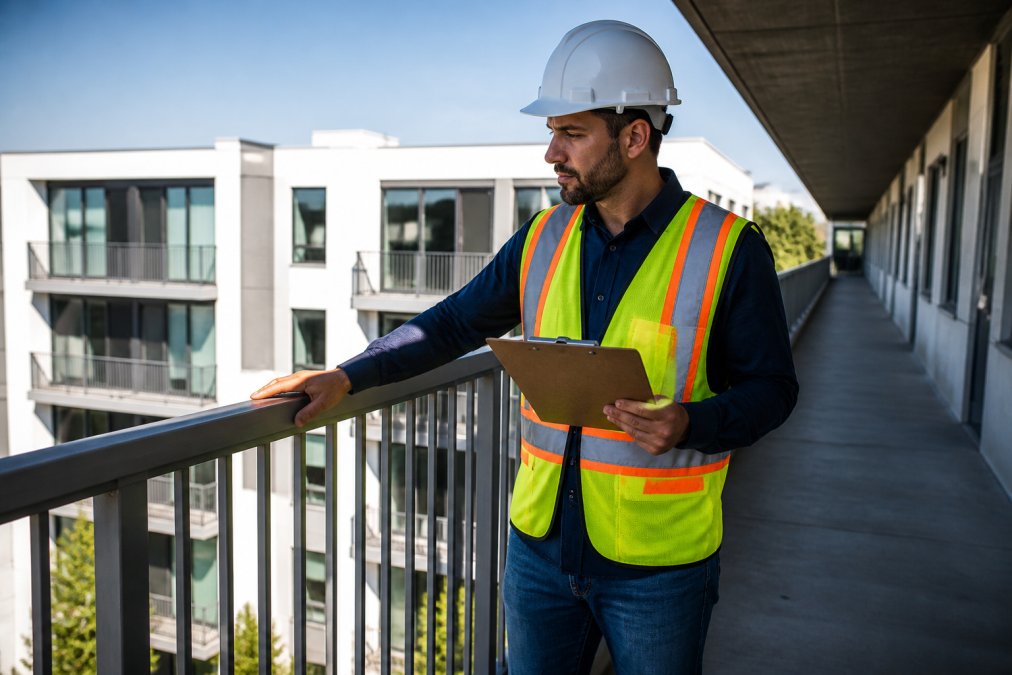
A licensed inspector in a hard hat and safety vest examining a residential balcony railing with a clipboard, standing on an elevated walkway of a multi-story apartment building on a clear day

The statute names no single license type, pointing instead to a “licensed architect, licensed structural engineer, or other licensed professional” who can certify elevated exterior elements. Boards see three common categories, each with a different scope of authority:

  • Licensed architect. Can certify the overall condition of exterior elevated elements and produce a report suitable for board records and legal review. Best fit for buildings with mixed construction types or complex envelopes.
  • Licensed structural engineer. Can certify load-bearing components and evaluate whether a deficiency affects structural capacity. Best fit when a prior report flagged structural concerns or the building is over 30 years old.
  • Certified inspector or specialty firm. May perform the field work, but the certification on the report must still be signed by a licensed architect or structural engineer. Ask who signs.

A common mistake is assuming the person who walks the property certifies the report. On many jobs those are two different people, and the certification signature is what satisfies the statute. Confirm the certifying professional’s name and license number before signing.

Ask every candidate for these four things:

  • License verification. Pull the license number from the state lookup and confirm it is active, not expired or suspended. Match the license type to the scope of work you need.
  • Insurance documentation. Ask for a certificate of insurance showing both general liability and errors and omissions (E&O) coverage. E&O is the policy that responds if the inspection misses a defect. General liability alone does not cover professional errors.
  • Sample report. Request a redacted example. A report that lists findings without photographs, element-by-element condition notes, or repair priorities will not hold up if the association is audited or sued.
  • Scope of work in writing. The bid should state the number of units, the number of elevated exterior elements, the inspection method (visual or comprehensive), and whether any invasive testing is included. A single number with no scope is not a bid.
Pro Tip
When you request bids, ask every inspector to submit a scope of work alongside the price. A quote that lists unit count, element count, and inspection method lets you compare apples to apples. A single number with no scope is not a bid, it’s a guess.

A common mistake is choosing the lowest bid without checking what the inspector can certify; the cheapest report is worthless if it doesn’t meet statutory requirements. Another is accepting a scope that quietly excludes stairways or walkways, which are elevated exterior elements under the statute. Read the scope line by line and confirm every element type is listed.

Key Takeaway
The four qualifications that actually matter are license type, insurance coverage (including E&O), report quality, and a written scope of work. Price is fifth. A board that saves money on an unqualified inspector often pays far more later in re-inspections and legal exposure.

Sampling Protocol and What Inspectors Actually Examine

Sampling protocol determines how many units an inspector must examine for a statistically valid certification. Under the statute, inspectors generally must examine a sufficient sample to achieve a 95 percent confidence level with a 5 percent margin of error, unless conditions warrant examining every unit.

In practice, an inspector rarely examines every balcony in a large complex. They select a representative sample, inspect those elements thoroughly, and extrapolate findings to the whole building. If the sample reveals widespread problems, the scope may expand.

What inspectors actually examine includes:

  • Balcony and deck surfaces, checking for cracking, delamination, and water intrusion
  • Railings and guardrails, testing for stability, height compliance, and corrosion at attachment points
  • Load-bearing components, looking for dry rot, corrosion, and deterioration in structural members
  • Waterproofing and flashing, since failed waterproofing is a leading cause of hidden structural damage
  • Stairways and walkways, which are elevated exterior elements under the statute

The building envelope matters: water entering through failed waterproofing reaches structural elements and starts deterioration long before anything is visible. That’s why sampling and thorough documentation go together.

Cost-Saving Strategies for Small HOAs and Tight Budgets

Small associations face the same compliance obligation as large complexes but with a smaller reserve fund. A 12-unit building in San Diego has fewer units to spread the cost across, and boards often worry the inspection fee alone will strain reserves.

Several strategies reduce total cost without cutting corners:

  • Bundle inspections. If your property needs both SB 326 and SB 721 work, commission them together. One mobilization costs less than two.
  • Prepare the property first. Clear balconies of furniture, planters, and stored items before the inspector arrives. Access delays cost money.
  • Coordinate with neighboring associations. Some inspection firms offer reduced rates when multiple nearby properties book in the same window, since travel and setup are shared.
  • Fix minor issues before inspection. Replacing a loose railing bolt or clearing a blocked drain is cheaper than having it documented as a deficiency requiring follow-up.
  • Request a phased scope. If your budget is tight, ask whether the inspection can be scheduled in phases rather than all at once.
Best For
Small associations under 20 units that need to spread compliance costs across multiple budget cycles without falling behind on statutory deadlines.

Post-Inspection: Budgeting for Repairs and Maintenance

The inspection report begins the financial conversation. Once findings are documented, the board needs a repair plan with realistic cost estimates and a maintenance schedule that prevents recurrence.

Start by sorting findings into three tiers:

PriorityFinding TypeTypical Response
ImmediateSafety hazards, unstable railingsRepair or restrict access now
Near-termActive water intrusion, early dry rotBudget for repair within the year
MonitorMinor surface wear, no structural impactAdd to preventative maintenance plan

A maintenance plan is what keeps a one-time inspection from becoming a recurring emergency. Schedule annual visual checks of waterproofing and drainage, and budget for re-inspection on the statutory cycle. The Federal Emergency Management Agency’s building science resources offer useful guidance on water intrusion and building envelope maintenance that applies to residential structures.

The Berkeley balcony collapse in 2015 and the Malibu balcony collapse in 2021 both followed years of undetected water damage to structural elements. Neither association set out to neglect its buildings. Both lacked a maintenance plan that would have caught the deterioration early.


The hardest part of SB 326 compliance isn’t the inspection itself, it’s the uncertainty about what the report will reveal and what repairs will cost. Apex Balcony helps boards move through that uncertainty with licensed inspectors who have decades of combined construction and design experience, specialized expertise in SB 326 and SB 721 compliance, and a reporting process that gives your board a clear path to necessary repairs. We handle properties of every size, including small associations larger firms overlook. Book an inspection with Apex Balcony and get a compliance report your board can actually act on.

Frequently Asked Questions

What factors influence the cost of an SB 326 inspection?

SB 326 inspection cost depends on several variables: the number of units and balconies, building age, accessibility of elevated elements, whether the inspection is visual or comprehensive, and the qualifications of the inspector. Buildings with complex layouts, limited access points, or visible deterioration typically require more time and may need invasive testing. Pricing also varies by region and inspector availability. Apex Balcony recommends requesting a detailed scope of work before comparing quotes so you understand exactly what is included.

Are there penalties for failing to complete an SB 326 inspection?

Yes. Under California Civil Code, condominium associations that miss the SB 326 inspection timeline face potential legal liability if a balcony failure causes injury or death. While the statute itself does not impose automatic fines, failure to comply can result in lawsuits, increased insurance premiums, and personal liability for HOA board members. The 2015 Berkeley balcony collapse and 2021 Malibu incident underscore the real-world consequences. Compliance protects both residents and the association’s financial standing.

Does the cost of an SB 326 inspection include repairs?

No. Inspection fees cover only the assessment and report. Repairs are separate and can range significantly depending on what inspectors find. Common issues include dry rot, corrosion of load-bearing components, waterproofing failures, and structural degradation. Apex Balcony provides detailed repair estimates in the inspection report so HOA boards can plan budgets and prioritize work. Some associations phase repairs over multiple years to manage reserve fund impact.

Who is qualified to perform an SB 326 inspection?

SB 326 inspection requirements specify that inspectors must be licensed architects, structural engineers, or civil engineers with relevant experience. Hiring a licensed balcony inspector with documented SB 326 experience is critical because the report must hold up under legal scrutiny. Apex Balcony’s team includes licensed professionals with decades of construction and design experience specific to California balcony compliance.
Book inspection

Posted in BlogTagged hiring a licensed balcony inspector, how much does an sb 326 inspection typically cost?, sb 326 inspection cost, sb 326 inspection requirements, sb 326 inspection timeline

Is Balcony Wood Decay Covered by Insurance?

Posted on September 10, 2026 by Apex Balcony admin
Is Balcony Wood Decay Covered by Insurance?

Table of Contents

  • Why Balcony Wood Decay Rarely Qualifies as a Covered Peril
    • Sudden Damage vs. Gradual Deterioration: The Line Insurers Draw
  • When Accidental Water Damage Leads to a Successful Claim
  • SB 326 Balcony Law Compliance and Your Insurance Obligations
    • How Code Compliance and Coverage Interact
    • What the Inspection Report Does for a Future Claim
  • Signs of Structural Failure in Decks That Adjusters Look For
    • The Cosmetic vs. Structural Distinction
    • How an Adjuster Determines Cause of Loss
    • Documentation and Mitigation After Discovery
  • Hiring a Licensed Balcony Inspector: What to Expect and Why It Matters
  • Documentation, Mitigation, and Your Responsibilities After Discovery
  • Conclusion
  • Frequently Asked Questions

Last Updated: September 10, 2026

Why Balcony Wood Decay Rarely Qualifies as a Covered Peril

The short answer is that balcony wood decay is almost never covered, because homeowners insurance is built to pay for sudden, accidental events, not the slow breakdown of materials over time. This guide from Apex Balcony walks through where that line sits, why claims fail, and how to protect your building either way.

Rot is a process, not an event. It starts with a small moisture infiltration point, a failed sealant joint or a hairline crack in the stucco, and it works inward for years before anyone notices. By the time a board feels soft underfoot, the damage has usually been developing for a long time, and that timeline is exactly what sinks most claims.

A common mistake is assuming that because the balcony is attached to an insured structure, everything on it is covered. It isn’t. Policies cover the structure against named perils, and gradual deterioration is not one of them.

Sudden Damage vs. Gradual Deterioration: The Line Insurers Draw

The dividing line is time and cause, not severity. A windstorm that tears a railing loose on a Tuesday afternoon is a sudden event. Fungal growth that has been quietly consuming a floor joist for six years is gradual deterioration, and it is excluded in standard policies.

ScenarioHow Insurers Classify ItTypical Outcome
Windstorm rips off railing and flashingSudden, accidentalCovered, subject to deductible
Pipe bursts and soaks the deck boardsSudden, accidentalOften covered
Rot from a failed sealant jointGradual deteriorationDenied
Termite damage discovered during inspectionPest-related exclusionDenied
Rot spreading from an unrepaired leakMaintenance negligenceDenied
Watch Out
The single most expensive mistake is delaying repairs after a small leak. Once water has been allowed to sit, insurers can point to maintenance negligence, and that denial follows the property into future claims.

When Accidental Water Damage Leads to a Successful Claim

Accidental water damage is the one path where a decay-related claim can succeed, provided the water event itself was sudden and the damage was reported promptly. A supply line that fails behind a wall, a washing machine hose that bursts on an upper floor, or a blocked drain that overflows onto a deck all qualify as sudden and accidental.

What makes these claims work is a clean chain of causation. You need to show that the water event happened at a specific time, that it was not the result of neglect, and that the resulting damage was discovered and reported without unreasonable delay. Photographs, a plumber’s invoice with a date, and a written timeline do more for a claim than any amount of explanation.

The moment you know about a leak and do nothing, the classification shifts. Insurers call this failure to mitigate, and it converts a covered event into a denied one. If you find water damage, stop the source, document everything, and start drying immediately.

SB 326 Balcony Law Compliance and Your Insurance Obligations

For buildings with three or more multifamily dwelling units in California, SB 326 balcony law compliance is not optional, and it intersects with insurance in ways most boards don’t anticipate (leginfo.legislature.ca.gov). The statute requires periodic inspection of exterior elevated elements, balconies, decks, stairways, and walkways, by a licensed professional, on a recurring cycle tied to the building’s original certificate of occupancy (leginfo.legislature.ca.gov). SB 721 applies a similar inspection duty to certain residential buildings outside the common-interest development structure. If you are unsure which statute applies, that determination depends on building type, ownership structure, and unit count, so confirm it with the agency that administers the requirement rather than guessing.

Here is the part that catches people off guard: compliance and coverage are separate questions. Passing an inspection does not guarantee a claim will be paid, and failing to inspect does not automatically void your policy. What non-compliance does is hand an insurer a ready-made argument about maintenance negligence if something fails later. In practice, the inspection report becomes evidence, either that you exercised reasonable care, or that you had notice of a condition and did nothing.

How Code Compliance and Coverage Interact

A frequent misconception is that because a repair is required by code, insurance must pay for it. Standard homeowners and commercial property forms generally separate the cost to repair covered damage from the cost to bring the undamaged portion up to current code. Many policies include some ordinance-or-law coverage, but the limit is often a small percentage of the dwelling limit, and it typically applies only when a covered peril caused the loss in the first place. If the underlying cause is gradual decay, the code-upgrade question is moot, there is no covered loss to attach it to.

A common pattern is that a wind claim tears flashing loose, water enters, and the resulting rot is discovered during the repair. The sudden wind event is the covered peril; the rot that predated it is not. The carrier may pay to repair the wind damage and the code-required reconstruction of that specific area, while denying the broader decay remediation. That split is why the cause-of-loss determination matters more than the size of the repair.

What the Inspection Report Does for a Future Claim

The role of home inspections in future claims is worth understanding now. If you sell the property, or if a future claim arises, a documented inspection history demonstrates that you exercised reasonable care. An absence of records does the opposite, and insurers read silence as neglect. A report that notes a condition and recommends repair is not automatically fatal, what matters is whether you acted on it. A dated repair invoice following a flagged finding is strong evidence of maintenance; a flagged finding with no follow-up is the fact pattern that supports a denial.

Key Takeaway
Inspection compliance protects you legally. Documentation protects you at claim time. You need both, and one does not substitute for the other.

state agency that administers exterior elevated element inspection requirements

Signs of Structural Failure in Decks That Adjusters Look For

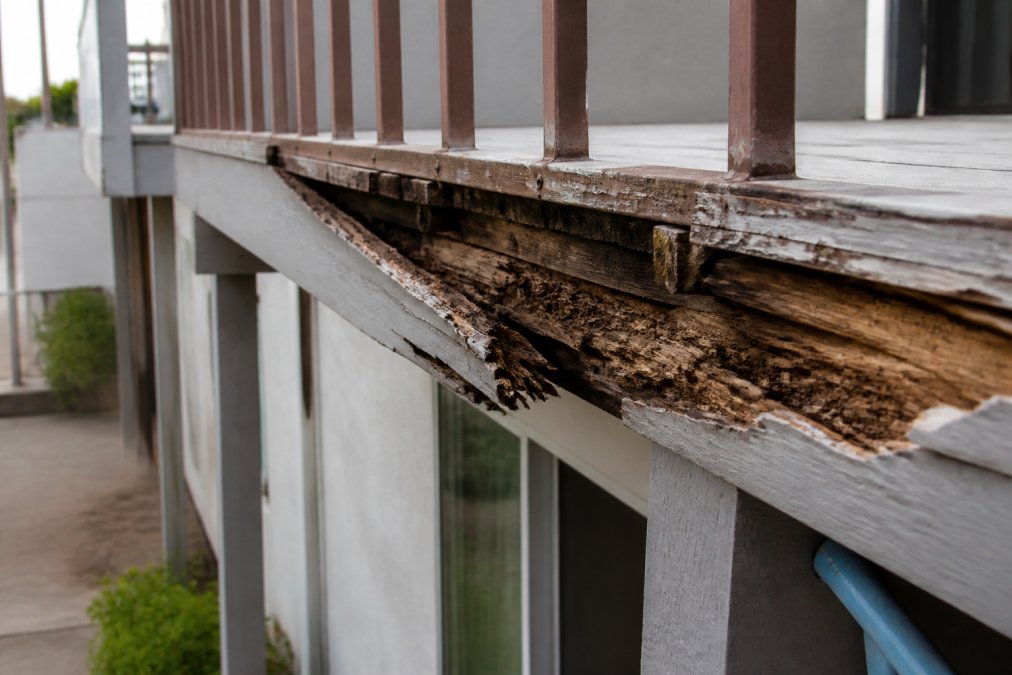
Adjusters and inspectors look for the same things, and most of them are visible before a probe ever touches the wood. Soft or spongy decking underfoot, a railing that moves when you lean on it, rusted or pulling fasteners, and dark staining around the base of posts are the classic early indicators. What separates a paid claim from a denial is not how bad the damage looks, it is how the adjuster classifies the cause and whether the damage is structural or cosmetic.

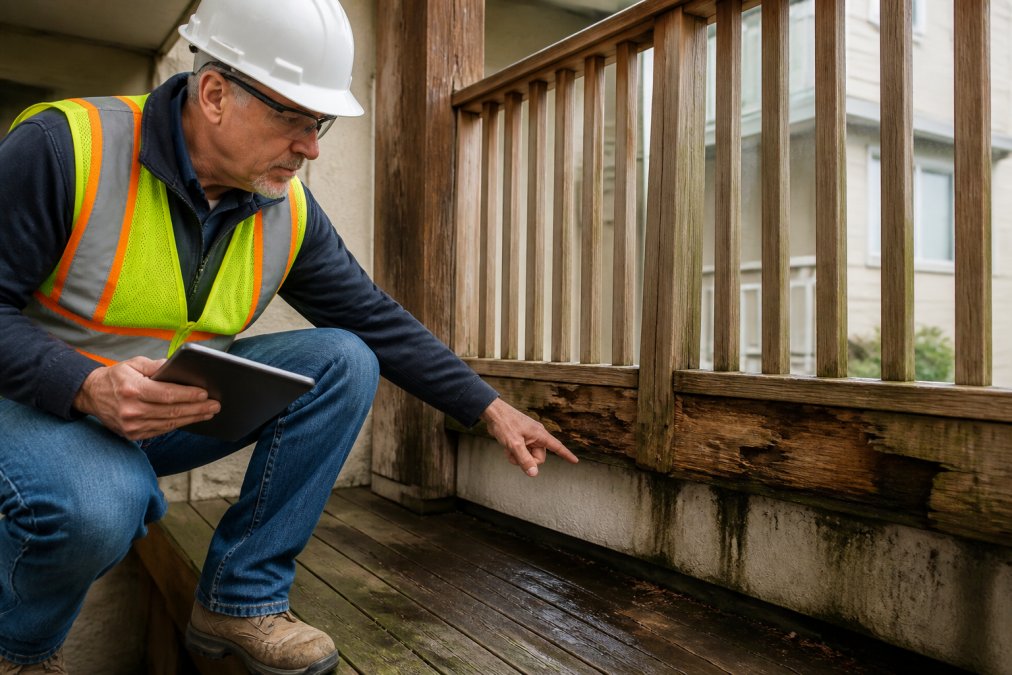
A licensed inspector in safety gear examining a residential wooden balcony, pointing at visible rot and water staining on the deck boards and railing base

The Cosmetic vs. Structural Distinction

The distinction that matters most is between structural integrity and cosmetic rot. Surface discoloration on a fascia board or a weathered handrail is a cosmetic issue, and cosmetic rot is almost never covered because it is gradual deterioration. Rot that has reached a ledger board, a floor joist, or a post base is a structural one, and it is the difference between a repair and a replacement. Even then, coverage turns on cause: structural rot from a sudden, accidental water event may be covered, while structural rot from years of failed sealant is excluded.

  • Decking and trim: soft spots, cupping, and visible fungal growth
  • Fascia and railing bases: staining, peeling paint, and crumbling edges
  • Fasteners: rust streaks, backing-out screws, and loose connections
  • Post bases: standing water, soil contact, and splitting
  • Attachment points: gaps at the ledger board and movement in the framing

How an Adjuster Determines Cause of Loss

When a claim is filed, the adjuster’s job is to answer one question: what peril caused this loss, and is that peril covered? The mechanism usually works backward from the damage. Water staining that radiates from a single point suggests a sudden event; staining that follows a joint line or spreads evenly across a surface suggests long-term intrusion. Probing with a moisture meter and an awl lets the adjuster map the boundary between sound and decayed wood, and that boundary often reveals how long the moisture has been present.

Book inspection →

A common pattern is that the adjuster finds the rot, then looks for the source. If the source is a failed sealant joint or a clogged drain that was never cleared, the file trends toward maintenance negligence. If the source is a burst supply line or a storm-driven breach, the file trends toward a covered accidental water loss. The same rotted joist can land on either side of that line depending on the documented cause.

Documentation and Mitigation After Discovery

Once decay is discovered, your obligations start immediately, and how you handle the next two weeks shapes everything that follows. Mitigation means preventing further damage, not fixing the balcony. Tarp the affected area, stop any active water intrusion, restrict access if the structure is compromised, and keep the receipts. Failure to mitigate converts a potentially covered event into a denied one.

Documentation is the other half. Build a file that includes dated photographs from multiple angles, moisture readings, the inspector’s report, contractor estimates, and a written timeline of when you noticed the problem and what you did about it. If a claim or a lawsuit follows, this file is your defense. Photograph the same locations every six months from the same angles, a dated progression series showing stable conditions is powerful evidence of responsible maintenance, and it takes ten minutes per inspection cycle.

Watch Out
The single most expensive mistake is delaying repairs after a small leak. Once water has been allowed to sit, insurers can point to maintenance negligence, and that denial follows the property into future claims.

Hiring a Licensed Balcony Inspector: What to Expect and Why It Matters

Hiring a licensed balcony inspector gives you a documented, defensible record of your building’s condition, which is the asset that holds up in an audit, a lawsuit, or a claim dispute. The inspection itself should be non-destructive wherever possible, using moisture meters, probes at suspect locations, and photographic documentation rather than wholesale tear-out.

What most guides miss is that the report is the deliverable, not the visit. A useful report identifies each elevated exterior element, records its condition with dated photographs, distinguishes cosmetic from structural findings, and recommends a repair priority. That document is what you hand to your insurer, your board, and your contractor.

This is where Apex Balcony operates. Our licensed inspectors bring decades of combined construction and design experience to each property, and we specialize in SB 326 and SB 721 compliance across balconies, decks, and stairways. We’ve worked with hundreds of building owners, and the pattern is consistent: the buildings that document early are the ones that avoid emergency spending later.

Pricing for an inspection depends on the number of units, the number of elevated elements, and site access, so we quote per property rather than publishing a flat figure. Request a quote and you’ll get a scope before anyone shows up.

Documentation, Mitigation, and Your Responsibilities After Discovery

Once decay is discovered, your obligations start immediately, and how you handle the next two weeks shapes everything that follows. Mitigation means preventing further damage, not fixing the balcony. Tarp the affected area, stop any active water intrusion, restrict access if the structure is compromised, and keep the receipts.

Documentation is the other half. Build a file that includes dated photographs from multiple angles, moisture readings, the inspector’s report, contractor estimates, and a written timeline of when you noticed the problem and what you did about it. If a claim or a lawsuit follows, this file is your defense.

Pro Tip
Photograph the same locations every six months from the same angles. A dated progression series showing stable conditions is powerful evidence that you maintained the property responsibly, and it takes ten minutes per inspection cycle.

The role of home inspections in future claims is worth understanding now. If you sell the property, or if a future claim arises, a documented inspection history demonstrates that you exercised reasonable care. An absence of records does the opposite, and insurers read silence as neglect.

Conclusion

Balcony wood decay sits squarely in the gap between what insurance covers and what buildings actually need, and closing that gap is a documentation and maintenance problem more than a coverage problem. Apex Balcony helps California property owners meet SB 326 and SB 721 requirements with licensed inspectors who identify early signs of structural failure before they become emergencies. Book an inspection with Apex Balcony and get a clear, defensible record of your building’s condition, a documented path to necessary repairs, and the compliance evidence your board needs.

Frequently Asked Questions

Will insurance cover rotting wood on a balcony?

Standard homeowners insurance policies almost never cover balcony wood decay. Insurers classify rot as gradual deterioration, which is a policy exclusion. The exception is when rot results directly from a sudden, accidental event like a burst pipe or storm damage that created moisture infiltration. In that scenario, the resulting water damage may be covered, but the rot itself typically is not. Document the original event thoroughly to support any claim.

Is wood rot considered structural damage by insurance companies?

Insurance companies generally treat wood rot as a maintenance issue, not structural damage, even when it affects floor joists or load-bearing elements. This distinction matters because policies cover sudden structural damage from covered perils, not deterioration from neglect. However, if a covered peril caused the moisture that led to rot, the structural repair might qualify. An insurance adjuster will determine the cause of loss before deciding.

Does negligence affect insurance coverage for deck repairs?

Yes. If an insurer determines that maintenance negligence allowed wood rot to develop or worsen, they can deny the claim outright. Policies require homeowners to perform reasonable upkeep. Documented maintenance records, inspection reports, and prompt repairs strengthen your position. California’s SB 326 and SB 721 inspection requirements for multi-unit buildings add another layer, since non-compliance can also affect liability and coverage decisions.

What are the mandatory inspection requirements for elevated exterior elements?

In California, SB 326 requires HOAs to inspect elevated exterior elements like balconies, decks, and stairways every nine years by a licensed inspector. SB 721 requires owners of buildings with three or more dwelling units to inspect similar elements every six years. Both laws mandate that inspectors identify signs of structural failure and report findings. Compliance helps prevent claim denials tied to deferred maintenance and protects residents from preventable accidents.

Book inspection

Posted in BlogTagged balcony wood decay, hiring a licensed balcony inspector, is balcony wood decay covered by insurance, sb 326 balcony law compliance, signs of structural failure in decks

Recent Posts

  • 10 Best Practices for Managing Building Safety Audits
  • What to Do If Your HOA Board Ignores Balcony Safety
  • Balcony Structural Integrity vs Surface Wear: 2026 Guide
  • How to Streamline Maintenance Scheduling for Apartments
  • Balcony1 vs EmpireWorks Inspection Services: 2026 Guide

Recent Comments

No comments to show.

Archives

  • September 2026
  • August 2026
  • July 2026
  • June 2026

Categories

  • Blog
Logo
Created by Unilime.Group
  • Balcony Law
  • About us
  • Inspection services
  • FAQ
  • Blog

Call us ‪+1 818-806-7885‬
License: CSLB #1101305

Apex Balcony Inspection
‪+1 818-806-7885‬
[email protected]
4645 Van Nuys Blvd #201
Sherman Oaks CA 91403

Created by Unilime.Group