Signs of Balcony Structural Decay: A Safety Guide
Spot signs of balcony structural decay before disaster strikes. Learn what to look for, when to act, and how to stay compliant. Book an inspection today.
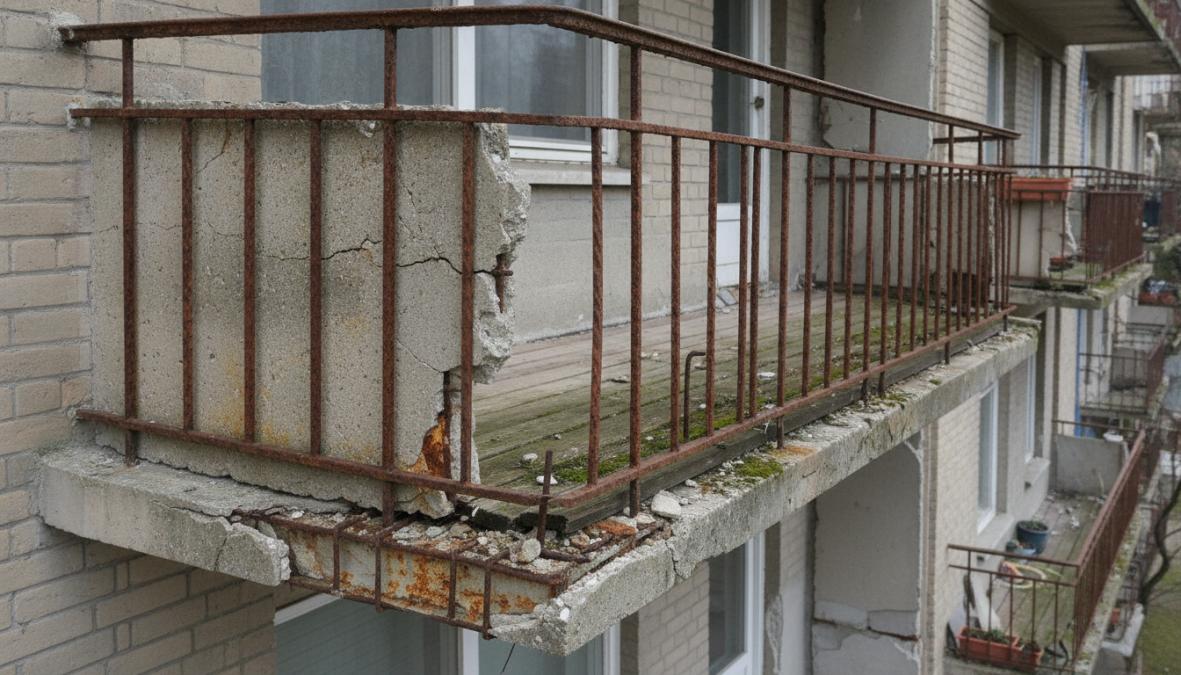
Table of Contents
- Why Recognizing Signs of Balcony Structural Decay Can Save Lives
- How to Tell If a Wood Balcony Is Rotting
- Signs of Concrete Spalling and Rebar Corrosion to Watch For
- Waterproofing Failures, Drainage Issues, and Water Infiltration
- Structural Deflection, Sagging, and Guardrail Instability
- Climate-Specific Decay Patterns and Insurance Liability Risks
- Balcony Inspection Checklist: DIY vs. Professional Assessment
- Hiring a Structural Engineer for Balcony Inspection
Last Updated: June 12, 2026
Balcony collapses rarely happen without warning. The signs of structural decay are almost always present weeks, months, or years before failure occurs, most property owners simply don’t know what to look for. This guide from Apex Balcony covers every major warning sign, from rotting wood and concrete spalling to drainage failures and guardrail instability, so you can catch problems before they become tragedies.
Surface cracks and rust stains look minor, but they’re often the visible expression of deep structural compromise. Below, we show you how to read those signals, what they mean for structural integrity, and when to call a licensed engineer.
Balcony structural decay is the progressive deterioration of load-bearing and non-load-bearing elements of an elevated exterior structure, caused by moisture intrusion, material fatigue, biological growth, or corrosion. According to the U.S. Consumer Product Safety Commission’s guidance on deck and balcony safety, thousands of injuries occur annually from deck and balcony failures, the majority involving preventable structural deterioration.
Why Recognizing Signs of Balcony Structural Decay Can Save Lives
A balcony that looks functional can be structurally compromised to the point of catastrophic failure under normal load. Structural failure typically follows a predictable pattern: moisture infiltrates a vulnerable point, material strength degrades, and the load path becomes compromised. The structure appears stable right up until it isn’t.
The throughline in nearly every balcony collapse investigation is deferred maintenance, not a single catastrophic event, but a series of ignored warning signs. Efflorescence gets painted over. A soft spot gets covered with furniture. Each dismissed sign is one more step toward failure.
Property managers and homeowners in California face additional accountability. Under SB 326 and SB 721, building owners are legally required to conduct periodic inspections of elevated exterior elements. Ignoring visible decay creates direct landlord liability exposure.
Balconies showing sagging, visible cracking in load-bearing members, or guardrail movement should be treated as immediately unsafe. Restrict access and contact a structural engineer before the next use.
How to Tell If a Wood Balcony Is Rotting
Wood rot is the single most common cause of balcony structural failure in residential buildings. Fungal decay often progresses from the inside out, a board can look intact while its interior fiber structure is already compromised.
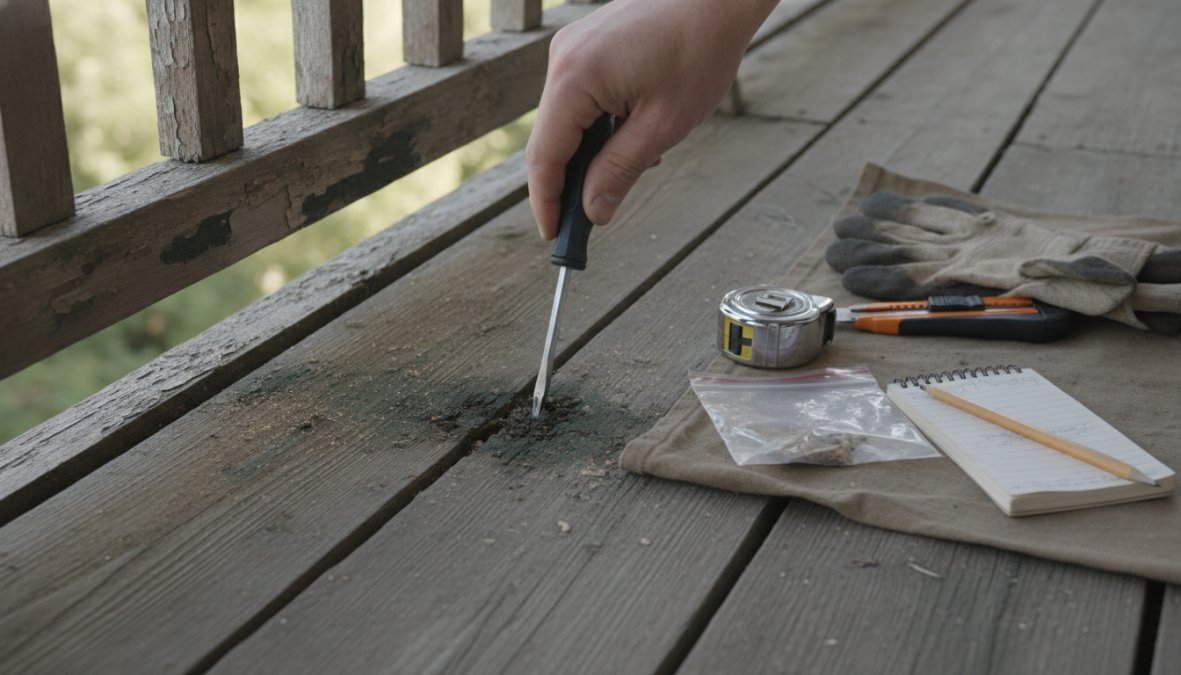
The most reliable field test: press a screwdriver or awl firmly into suspected areas. Sound wood resists penetration; decayed wood yields or crumbles. This test works best on joists, ledger boards, posts, and decking boards near drainage points.
Soft spots, discoloration (gray, black, or orange tones), and visible fungal growth are the primary surface signs. Location matters as much as symptom, rot near fastener penetrations, post bases, or the ledger board connection signals structural-level decay, not just surface weathering.
Checking the Ledger Board and Fastener Connections
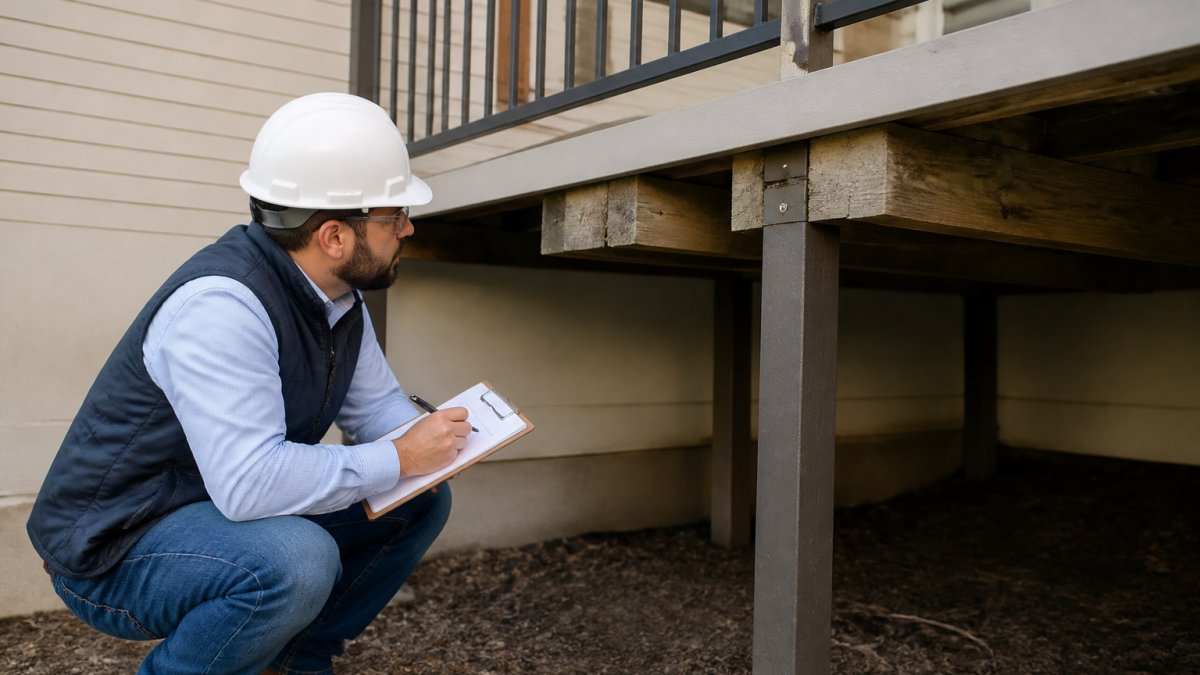
The ledger board is the most critical connection on a wood-framed balcony, the horizontal member attaching the balcony to the building’s rim joist, carrying the entire transferred load. Corroded lag bolts or joist hangers lose tensile strength progressively and invisibly until the connection fails. Look for rust staining around fastener heads, gaps between the ledger and the house wall, and any visible separation.
Flashing failures at the ledger are equally dangerous. When waterproofing at this junction fails, water infiltrates directly into the rim joist behind it. By the time rot is visible on the ledger face, structural members behind it are often severely compromised, this is where a DIY visual check has real limits and probing is warranted.
Soft Spots, Fungal Decay, and Surface Discoloration
Soft spots on a wood deck surface directly indicate advanced fungal decay in the decking boards or joists beneath. A board that flexes abnormally underfoot or produces a hollow sound when tapped should be probed immediately.
Surface discoloration alone doesn’t confirm rot, but it’s a reliable trigger for closer inspection. Gray weathering is normal on unfinished wood. Black or dark brown staining near fasteners, joints, or low points indicates moisture retention and probable fungal activity beneath.
Signs of Concrete Spalling and Rebar Corrosion to Watch For
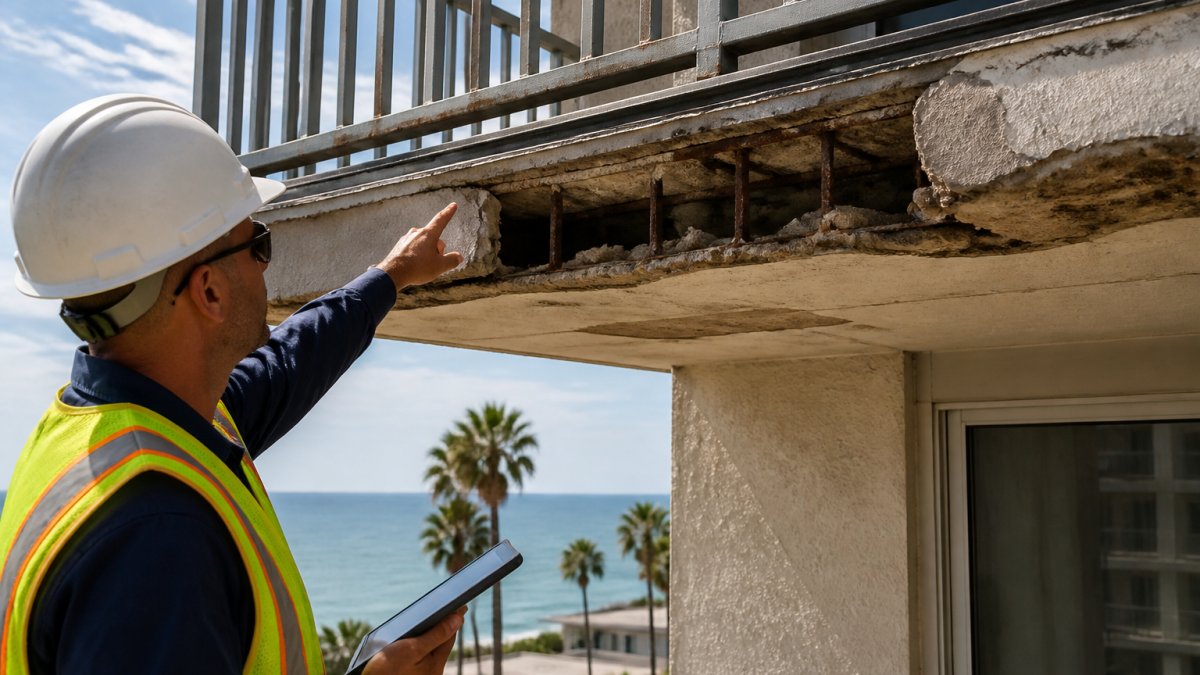
Concrete balconies present a different failure profile than wood, but no less dangerous. Spalling, the fracturing and detachment of concrete surface layers, is caused by moisture infiltration, freeze-thaw cycling, and concrete carbonation, which removes the passive protection around embedded rebar.
Once rebar begins to corrode, rust products occupy significantly more volume than the original steel. This expansion creates internal pressure that fractures surrounding concrete from within, reducing both rebar cross-section and the bond between steel and concrete.
Efflorescence, Rust Stains, and Delamination
Efflorescence, white, chalky deposits on concrete, forms when water moves through the concrete and deposits dissolved salts on the surface. It signals active water infiltration but is not itself structurally dangerous.
Rust stains are more serious. Brown or orange streaking on a concrete soffit or edge means embedded rebar has already begun to corrode and the protective alkaline environment around the steel has broken down.
Delamination is the separation of a concrete surface layer from the substrate. Identify it by tapping with a hammer or coin, a hollow, drum-like sound indicates a delaminated section. Delaminated concrete can fall without warning, creating a falling hazard below in addition to the structural concern above.
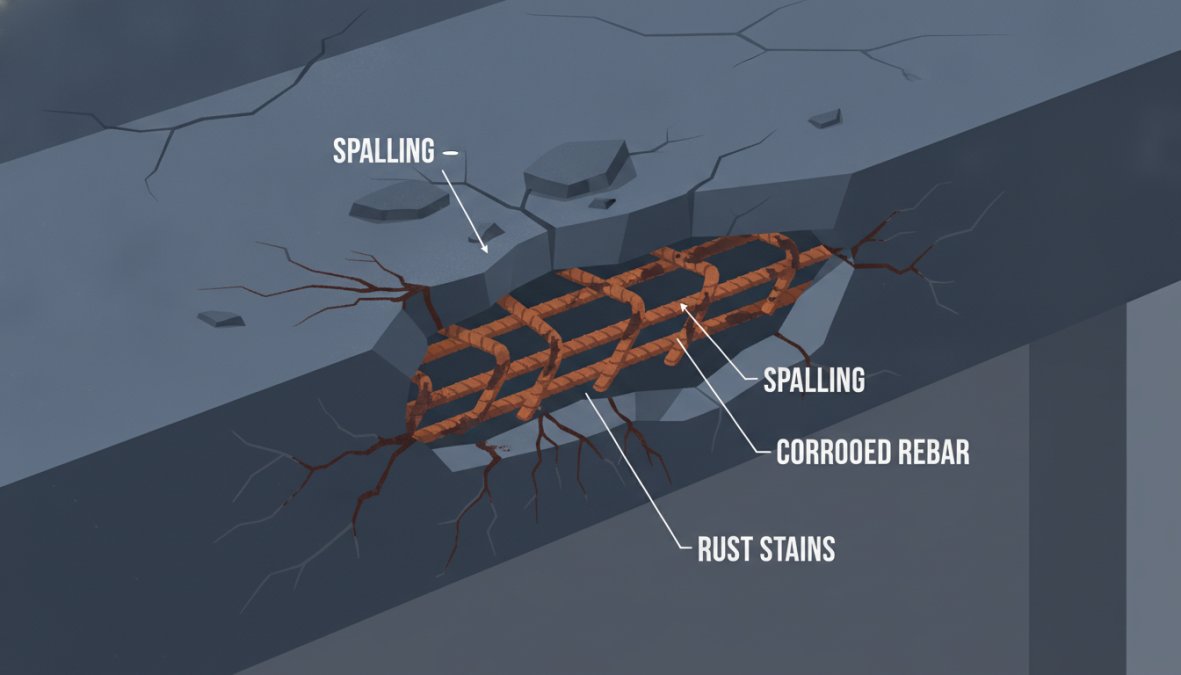
Rust stains on a concrete balcony surface are not cosmetic. They indicate active rebar corrosion inside the concrete section and require professional evaluation, not paint.
Waterproofing Failures, Drainage Issues, and Water Infiltration
Water is the root cause of nearly every form of balcony structural decay. The waterproofing membrane, flashing details, and drainage slope are the three systems that keep water out of the structural assembly. When any one fails, the deterioration clock starts.
A properly designed balcony deck slopes toward drains or the open edge at a minimum gradient, typically around 1/8 inch per foot, to prevent ponding. Standing water accelerates membrane degradation, promotes biological growth, and increases hydrostatic pressure against cracks and seams.
Waterproofing membrane failures are often invisible from above until significant damage has occurred below. Look for cracks or bubbling in the deck coating, failed caulk at wall-to-deck transitions, and separation at flashings around drains, posts, or wall penetrations. Clogged deck drains or scuppers compound the problem by forcing water against the most infiltration-vulnerable points.
As documented in the International Building Code guidance on waterproofing for exterior decks, proper flashing and waterproofing at deck-to-wall transitions are code requirements, not optional upgrades, and failures here are among the most common deficiencies found during professional inspections.
Structural Deflection, Sagging, and Guardrail Instability
Visible deflection demands immediate professional evaluation. A balcony that sags at mid-span or has developed a noticeable slope toward the outer edge has experienced material failure or settlement in its support system. In cantilevered balconies, excessive deflection indicates a loosening connection, members that have lost section due to rot or corrosion, or an inadequate original design.
Guardrail stability is a life-safety issue. Guardrails must resist both vertical and lateral loads. A guardrail that wobbles or feels loose under pressure is structurally deficient regardless of visual appearance. Check posts by applying firm lateral force at the top rail, any perceptible movement is a deficiency. Then inspect each post base, typically the first point of corrosion on metal railings and the first point of rot on wood.
According to OSHA’s standards for guardrail systems and fall protection, guardrails must withstand a minimum lateral load without failure. A railing that moves under hand pressure does not meet this standard and represents an active fall hazard.
Climate-Specific Decay Patterns and Insurance Liability Risks
Climate is an underappreciated variable in balcony deterioration. In coastal California environments, salt air accelerates corrosion of metal fasteners, rebar, and guardrail hardware dramatically, fastener corrosion that might take decades inland can reach structural significance within a few years at the coast. In freeze-thaw climates, water infiltrating cracks then freezing expands and widens openings over multiple cycles, fracturing concrete and destroying sealant continuity. High-UV environments cut waterproofing membrane service lives significantly below the typical 5-10 year rating.
The liability dimension is equally important. A property owner who ignores visible decay and a subsequent injury occurs faces significant exposure. In California, SB 326 and SB 721 create a documented inspection obligation, failure to comply means a property owner cannot credibly argue they exercised reasonable care. Apex Balcony has worked with hundreds of building owners navigating this intersection of safety and legal compliance.
Document every inspection with dated photographs, even informal walk-through checks. This creates a maintenance record that demonstrates reasonable care and can be critical in any liability dispute.
Balcony Inspection Checklist: DIY vs. Professional Assessment
The most useful thing a property owner can do is understand exactly where their own inspection capability ends and where professional evaluation becomes necessary.
What Homeowners Can Check Themselves
A systematic DIY visual inspection covers observable surface conditions. Work through the following checklist methodically, ideally twice a year and after any significant weather event.
DIY Balcony Inspection Checklist:
- Check deck surface for pooling water, cracks, or bubbling in the coating
- Probe wood decking boards and visible joists with a screwdriver for soft spots
- Look for surface discoloration: black, gray, or orange staining on wood or concrete
- Inspect all visible fastener heads for rust or corrosion
- Check caulk and sealant at wall-to-deck transitions for cracking or separation
- Clear deck drains and scuppers; confirm water flows freely
- Apply lateral force to guardrail posts and top rail; note any movement
- Inspect guardrail post bases for rust, rot, or loose connections
- Look at the balcony soffit from below for rust stains, efflorescence, or spalling
- Check for any visible sagging or deflection in the deck surface
- Note any new cracks in concrete or masonry, especially at edges and corners
- Inspect the ledger board connection area for gaps, rust, or moisture staining
Any concerning finding should be escalated to a professional inspector. A DIY check is a screening tool, not a structural assessment.
When Non-Destructive Evaluation Is Not Enough
Visual inspection and probing cannot assess concealed structural members, waterproofing integrity beneath a finished surface, or the extent of corrosion within a concrete section. Non-destructive evaluation (NDE) techniques, including ground-penetrating radar, infrared thermography, and impact-echo testing, can reveal subsurface conditions without opening up the structure, and are appropriate when surface signs suggest deeper problems.
Destructive testing, where small sections of deck surface or concrete cover are removed to expose structural members, is warranted when NDE is inconclusive or when the stakes justify direct confirmation. A licensed structural engineer determines when this threshold is reached.
Hiring a Structural Engineer for Balcony Inspection
Some inspections require more than a general contractor or home inspector can provide. A licensed structural engineer can evaluate load-bearing capacity, assess connection adequacy, interpret cracking patterns, and determine whether deterioration has compromised structural integrity.
Hire a structural engineer when you observe significant deflection or sagging, guardrail connections show active corrosion or movement, concrete spalling has exposed rebar, or any member shows decay at a primary structural connection. The inspection process typically involves a visual survey, probing and tapping, review of available drawings, and a written report with findings and recommendations.
For California properties subject to SB 326 or SB 721, the inspection must be conducted by a licensed architect or structural engineer meeting specific documentation requirements. Apex Balcony provides compliant inspections covering all elevated exterior elements, balconies, decks, and stairways, with a clear path to necessary repairs.
According to California’s SB 326 and SB 721 legislative guidance on balcony inspection requirements, inspections must be completed on a defined schedule with documentation retained by the building owner. Non-compliance extends beyond safety to direct legal liability.
| Warning Sign | Likely Cause | DIY Detectable | Requires Engineer |
|---|---|---|---|
| Soft spots in wood decking | Fungal decay | Yes | If at structural members |
| Rust stains on concrete soffit | Rebar corrosion | Yes | Always |
| Pooling water on deck surface | Drainage failure or deflection | Yes | If deflection suspected |
| Guardrail movement | Fastener corrosion or rot | Yes | Always |
| Visible sagging | Structural deflection | Yes | Always |
| Efflorescence on concrete | Water infiltration | Yes | If persistent |
| Delaminating concrete | Bond failure | Yes (tap test) | Always |
| Ledger board gap | Connection failure | Yes | Always |
Balcony deterioration follows a predictable path, and the warning signs are readable if you know what to look for. Apex Balcony’s team of licensed inspectors brings decades of construction and design experience to exactly this problem, conducting comprehensive inspections that meet California’s SB 326 and SB 721 requirements. Book an inspection with Apex Balcony and get a clear, documented picture of your property’s condition before a minor deficiency becomes a structural failure.
Frequently Asked Questions
How do I know if my balcony is structurally sound?
Look for visible signs of balcony structural decay such as soft or spongy wood, rust stains on concrete, loose railings, visible sagging or deflection, pooling water, and cracks in the deck surface. While a basic visual check can flag obvious problems, only a licensed structural engineer or certified inspector can confirm load-bearing capacity and overall structural integrity through a proper safety inspection. In California, SB 326 and SB 721 mandate formal inspections for many properties.
What are the warning signs of concrete balcony failure?
Key signs of concrete spalling and balcony failure include flaking or pitting concrete surfaces, white powdery efflorescence indicating moisture intrusion, rust-colored stains from rebar corrosion beneath the surface, visible cracks, and delamination of the concrete layer. Concrete carbonation can accelerate rebar corrosion over time, weakening the entire load path. If you notice any of these warning signs, schedule a professional inspection immediately to assess structural integrity and prevent a balcony collapse.
How often should a balcony be inspected for safety?
For most residential properties in California, SB 326 requires HOA-governed buildings to inspect elevated exterior elements every nine years, while SB 721 requires inspections for multifamily buildings with three or more units every six years. However, regardless of legal requirements, property owners should conduct a basic visual balcony inspection checklist review annually and after major storms. Any visible signs of structural decay, water infiltration, or guardrail instability warrant an immediate professional inspection.
Who is responsible for balcony maintenance in an apartment complex?
In most cases, the property owner or landlord carries primary responsibility for balcony maintenance and safety compliance in an apartment complex. Failure to address known signs of balcony structural decay can expose landlords to significant insurance and liability risks, including negligence claims if a structural failure causes injury. California's SB 721 law places explicit inspection and repair obligations on building owners. Property management companies acting on behalf of owners may also share liability depending on their management agreement.
Can a rotting wood balcony be repaired or does it need full replacement?
Whether a rotting wood balcony can be repaired depends on the extent of fungal decay and structural compromise. Minor surface rot caught early through a balcony inspection checklist review may be treatable by replacing isolated boards and resealing. However, if rot has reached the ledger board, joists, or fastener connections, compromising the load path, partial or full replacement is typically required. Hiring a structural engineer for balcony inspection is the only reliable way to determine whether repair or replacement is the safer option.