Balcony Structural Integrity vs Surface Wear: 2026 Guide
Balcony structural integrity vs surface wear: learn to spot the difference, meet SB 326 rules, and know when to call an engineer. Book your inspection.
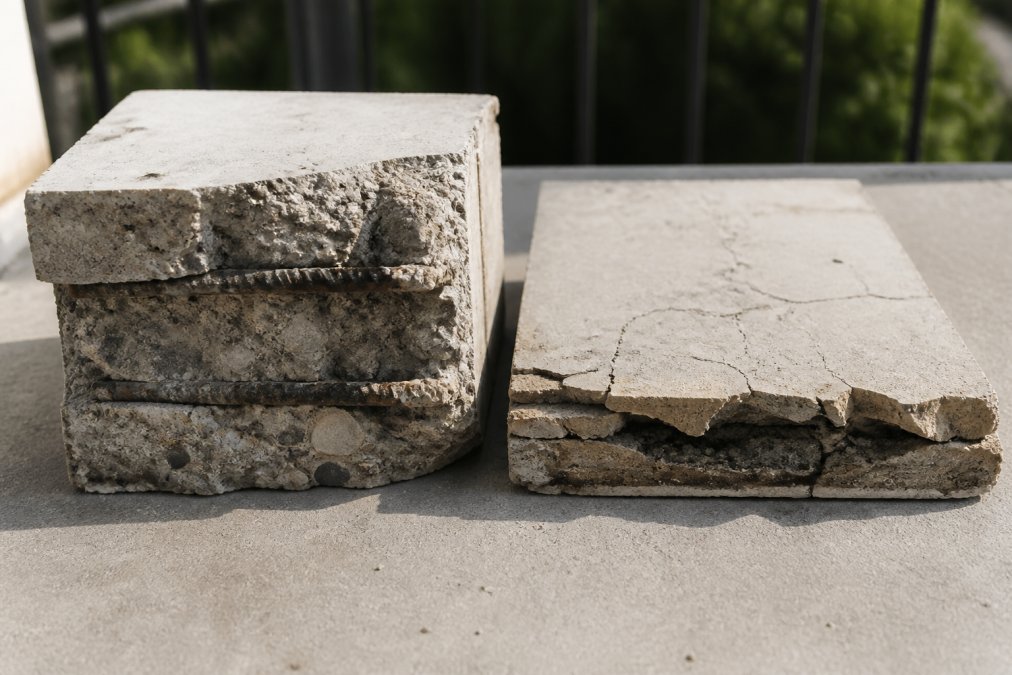
Table of Contents
- What Balcony Structural Integrity vs Surface Wear Actually Means
- Signs of Balcony Structural Failure You Should Never Ignore
- A Visual Identification Guide: DIY vs. Professional Assessment
- SB 326 Balcony Inspection Requirements and When to Call a Structural Engineer
- Waterproofing, Drainage, and Preventative Maintenance That Protect Structural Integrity
- The Cost of Balcony Structural Engineering Services and Repair vs. Replacement
- Insurance, Liability, and Property Valuation: What HOA Boards Need to Know
- Frequently Asked Questions
Last Updated: September 16, 2026
What Balcony Structural Integrity vs Surface Wear Actually Means
Balcony structural integrity is the ability of a balcony’s load-bearing components to safely carry their intended loads without failure, while surface wear is cosmetic deterioration that does not compromise that load path. At Apex Balcony, we’ve worked with hundreds of building owners, and confusing these two categories is the single most expensive mistake property owners make. One costs a few hundred dollars.
How Load Distribution and Load-Bearing Capacity Work on a Cantilevered Balcony
A cantilevered balcony carries its load through reinforcement steel embedded in the slab, transferring weight back into the building’s primary structure. When that steel corrodes, the balcony loses load-bearing capacity even if the surface looks fine.
Signs of Balcony Structural Failure You Should Never Ignore
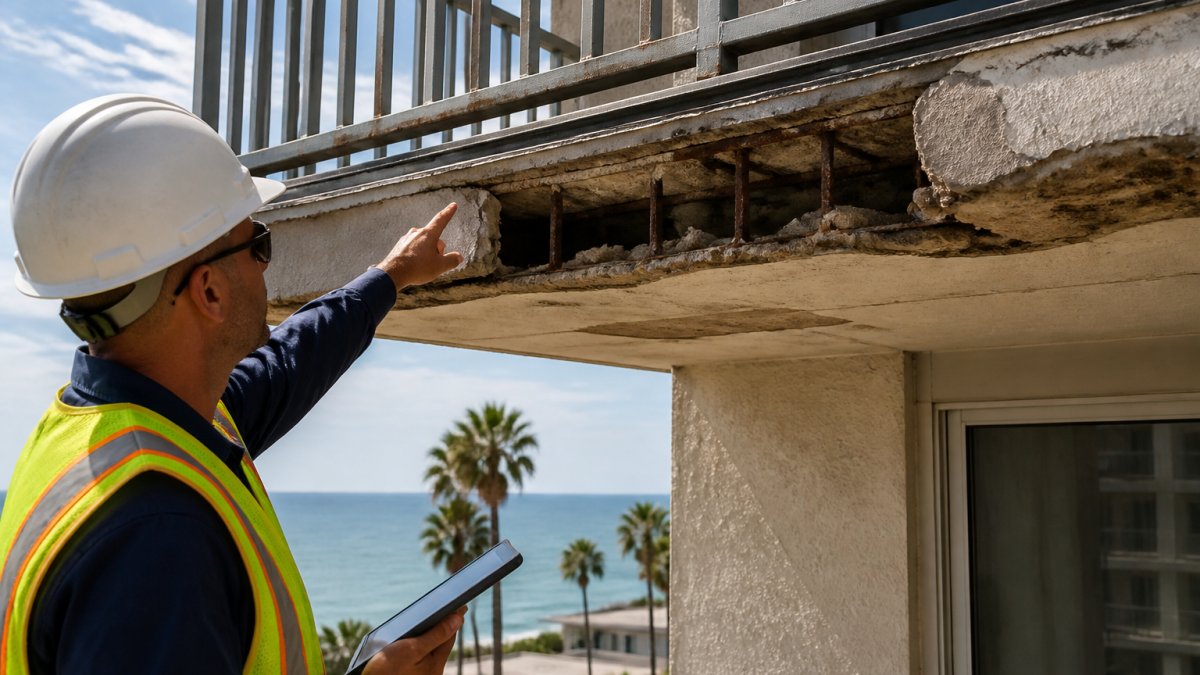
The clearest signs of balcony structural failure are concrete spalling, rust staining, railing instability, and dry rot in wood framing. These indicate the load path is compromised, not just the finish.
Cosmetic Issues: Hairline Cracks, Efflorescence, and Minor Surface Wear
Hairline cracks under about the width of a credit card, white mineral deposits called efflorescence, and worn sealant are usually cosmetic maintenance items.
Red Flags: Concrete Spalling, Rust Staining, Railing Instability, and Dry Rot
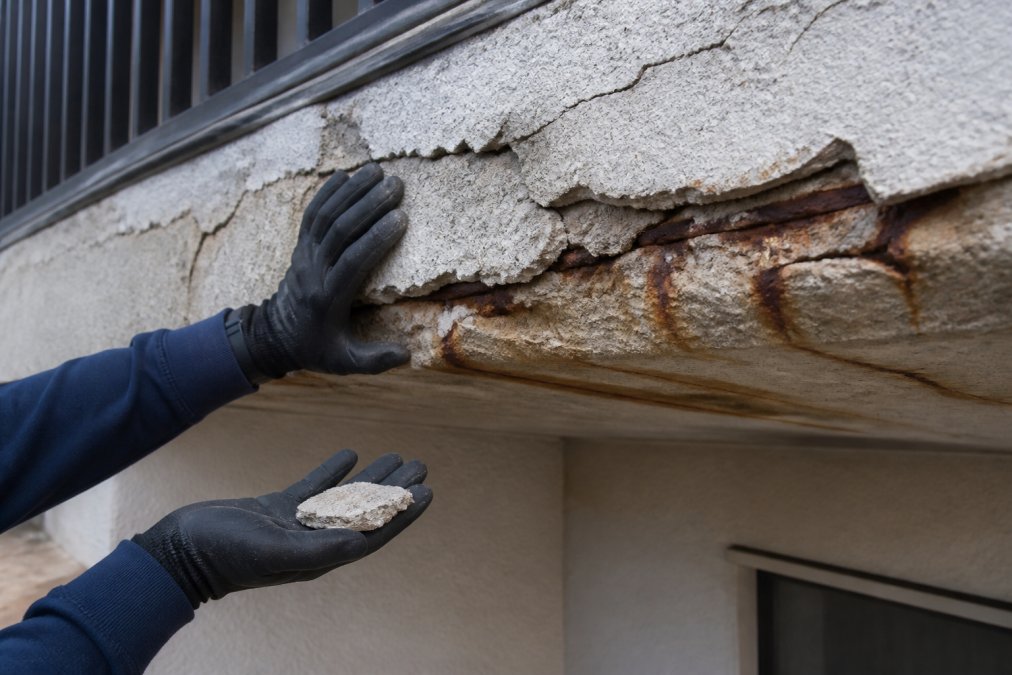
Concrete spalling, rust staining, railing instability, and dry rot are red flags requiring immediate professional assessment. Spalling is when chunks of concrete break away, exposing corroded reinforcement steel beneath.
Ignoring railing instability is the most common fatal mistake. A railing that wobbles under hand pressure has already lost its anchor capacity. Do not host anyone on that balcony until a licensed inspector evaluates it.
A Visual Identification Guide: DIY vs. Professional Assessment
Most owners cannot tell a cosmetic crack from a structural one. This section gives you a usable decision framework: a visual guide, a severity ladder, and a clear line between “monitor it” and “call someone today.”
The Four-Tier Severity Ladder
Every defect you find falls into one of four tiers. The tier determines your next action, not the size of the defect.
| Tier | What You See | What It Means | Your Action |
|---|---|---|---|
| 1, Cosmetic | Hairline cracks narrower than a credit card, efflorescence, chalking paint, worn sealant | Finish-layer deterioration; load path intact | Clean, seal, re-inspect in 6 months |
| 2, Watch | Cracks wider than a credit card but under 1/8 inch, isolated rust staining, minor water pooling | Moisture is reaching embedded steel or framing | Document with dated photos, schedule a licensed inspection within 30 days |
| 3, Act | Spalling concrete, exposed reinforcement steel, railing post movement, soft wood at anchor points | Load path is compromised or actively degrading | Restrict access, call a licensed inspector within days |
| 4, Emergency | Sagging or deflecting slab, diagonal cracks radiating from corners, water staining on the ceiling below, railing that moves under hand pressure | Failure is possible under normal use | Close the balcony, call a structural engineer immediately |
How to Measure a Crack Without Guessing
Eyeballing a crack is unreliable. Use a credit card as your gauge: a standard card is about 1/32 inch thick. Narrower than the card is typically cosmetic; if the card slips in with room to spare, treat it as Tier 2 or higher.
The DIY Visual Check (Do This Quarterly)
- Walk the full perimeter of every balcony; look up at the underside of the slab
- Check for cracks wider than a credit card
- Look for rust stains on concrete, stucco, or the ceiling below
- Push each railing post firmly in two directions; note any movement
- Look for water pooling or staining after rain
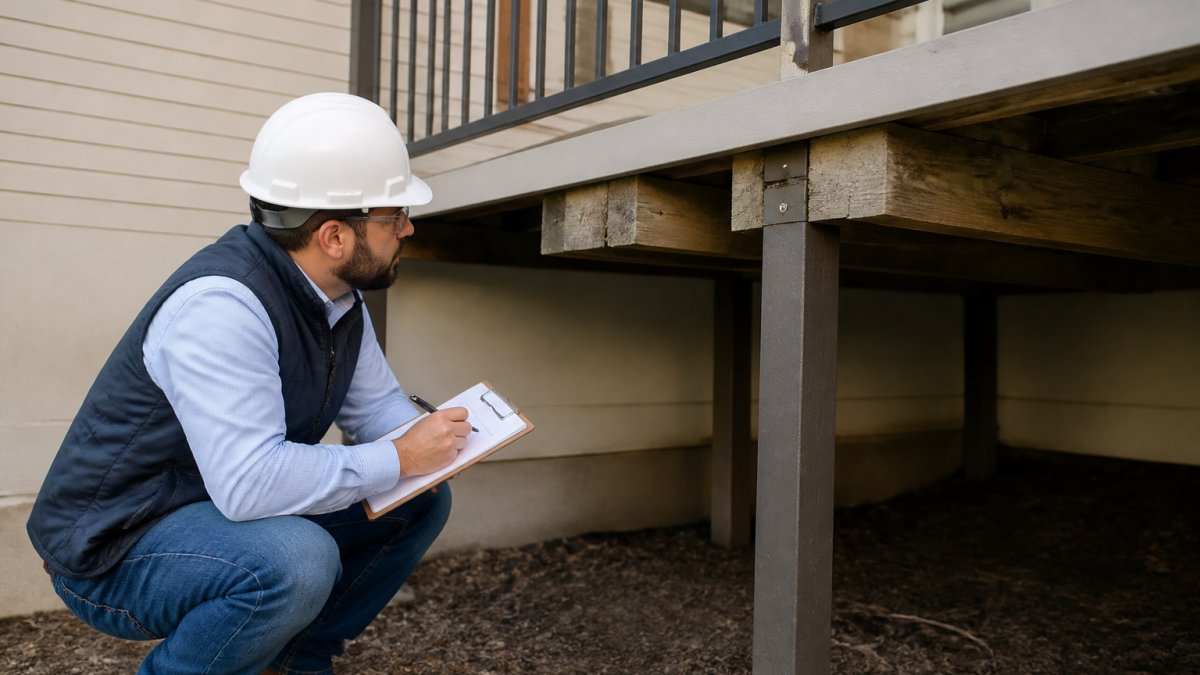
- Check for soft, spongy, or crumbling wood at the base of railings and at ledger connections
- Confirm drains and scuppers are clear of debris
- Photograph anything new and date the file
When to Stop and Call a Professional
Stop your DIY assessment and call a licensed inspector or structural engineer the moment you see any of the following:
- Spalling concrete with exposed reinforcement steel
- Railing movement of any kind, in any direction
- Sagging, deflection, or a visible slope in the slab
- Diagonal cracks running from a corner or from a column
- Water stains on the ceiling or wall below the balcony
- A crack that has widened since your last check
- Soft or crumbling wood at any structural connection
A wobbling railing is not a cosmetic issue and it is not a maintenance item. It means the anchor or the framing that holds the post has already lost capacity. Do not host anyone on that balcony until a licensed inspector evaluates it.
What a Professional Assessment Actually Involves
A licensed inspector documents conditions: crack widths and locations, spall dimensions, corrosion extent, railing anchor condition, waterproofing and drainage function. A structural engineer goes further, evaluating whether remaining load-bearing capacity is adequate using the original design’s load assumptions.
Ask your inspector to photograph every defect with a scale reference in the frame. Boards that submit photo-documented reports to their insurers and legal counsel face far fewer disputes when a claim arises.
SB 326 Balcony Inspection Requirements and When to Call a Structural Engineer
SB 326 balcony inspection requirements apply to specified buildings with three or more dwelling units, mandating periodic structural inspections by licensed professionals. SB 721 covers similar requirements for certain other residential buildings.
Waterproofing, Drainage, and Preventative Maintenance That Protect Structural Integrity
Waterproofing membrane condition, drainage function, and sealing most directly protect structural integrity. Moisture intrusion is the leading cause of reinforcement steel corrosion.
The Cost of Balcony Structural Engineering Services and Repair vs. Replacement
The cost of balcony structural engineering services depends on the number of balconies, the extent of defects, and whether engineering calculations are required. Pricing depends on quantity, dates, and delivery. Contact Apex Balcony for current prices or a quote.
Insurance, Liability, and Property Valuation: What HOA Boards Need to Know
Most articles stop at “get an inspection” and skip what boards actually lose sleep over: what happens to insurance coverage, legal exposure, and property value when a balcony fails, or when records are missing. This section covers the mechanisms, not just the warnings.
How Insurers Underwrite Balcony Risk
Carriers writing policies on buildings with elevated exterior elements increasingly treat inspection records as an underwriting input, not a courtesy. At renewal, the carrier may ask for the most recent structural inspection report, the scope of completed repairs, and evidence recommended work was done.
Three outcomes are common:
- Records present and current: the policy renews on standard terms.
- Records missing or stale: the carrier may non-renew, exclude balcony-related losses, or apply a surcharge.
- Known defect not addressed: the carrier may deny a claim tied to that defect on the grounds that the loss was foreseeable.
The Foreseeable-Hazard Problem
Liability exposure turns on one question: did the board know, or should it have known, about a hazard and fail to act? A documented inspection flagging a defect that the board ignores is the worst combination, it converts an unknown risk into a known one.
Inspection records are not just a compliance checkbox. They are the evidence that protects your board, your insurance coverage, and your property value in the event of an incident.
What Belongs in the Board’s Records
A defensible record set includes:
- The most recent structural inspection report, signed and dated
- Photographs of every defect noted, with scale references
- Repair scopes, permits, and completion documentation
- A log of when each recommendation was addressed
- Meeting minutes showing the board reviewed the report and acted on it
If a recommendation was deferred, the minutes should say why and when it will be revisited. A deferral with a documented reason is defensible. A deferral with no record is not.
How Structural Condition Affects Valuation
Appraisers and lenders treat documented structural condition as a proxy for risk. A building with current inspections and completed repairs supports a higher valuation than an identical building with unknown condition, because the buyer isn’t pricing in an unknown repair liability.
HOA Responsibility and the Limits of DIY
Boards sometimes assume a handyman walkthrough or a member’s informal inspection satisfies their obligation. It does not: the inspection must be performed by a qualified, licensed professional, and findings must be documented and acted on.
Before renewal season, pull the last three years of inspection reports and repair records into a single indexed file. When the carrier asks, you answer in an afternoon instead of a month.
Frequently Asked Questions
What is the difference between surface wear and structural damage on a balcony?
Surface wear affects only the outer layer of concrete or coating, showing up as hairline cracks, faded paint, or light efflorescence. Structural damage reaches the load-bearing capacity of the balcony, visible through concrete spalling, exposed reinforcement steel, rust staining, or railing instability. Surface issues are cosmetic and can usually be sealed or patched. Structural defects compromise safety and require a licensed structural engineer to assess repair or replacement before the balcony is used again.
Does SB 326 require inspections for surface-level balcony damage?
SB 326 requires inspections of elevated exterior elements regardless of visible damage. The law applies to buildings with three or more multifamily dwelling units, and inspectors must examine balconies, decks, stairways, and walkways for signs of structural distress. Surface wear alone may not trigger repairs, but the inspection itself is mandatory by January 1, 2025, and every nine years after. Skipping the inspection because damage looks cosmetic leaves the HOA exposed to fines and liability.
How can I tell if my balcony has structural integrity issues?
Start with the signs of balcony structural failure: concrete spalling, rust staining around reinforcement steel, water pooling that never drains, railing instability, or a spongy feel underfoot. Hairline cracks that stay narrow are usually surface wear. Cracks wider than a credit card, horizontal cracking along the slab edge, or any sagging in a cantilevered balcony point to structural problems. A licensed inspector can confirm what you are seeing and document it for compliance.
How much do balcony structural engineering services typically cost, and what affects the price?
The cost of balcony structural engineering services depends on the number of units, the extent of accessible damage, the type of report required for SB 326 or SB 721 compliance, and whether destructive testing is needed. Pricing depends on quantity, dates, and delivery. Contact Apex Balcony directly for a quote tailored to your building and inspection scope.
Balcony safety comes down to knowing the difference between cosmetic wear and structural failure, and acting on the right one. Apex Balcony provides licensed inspections for HOAs and multifamily owners, with specialized expertise in SB 326 and SB 721 compliance, comprehensive evaluation of balconies, decks, and stairways, and a clear path to necessary repairs. Get started with Apex Balcony and protect your residents, your board, and your building’s value.