Logo
  • Balcony Law
  • About us
  • Inspection services
  • FAQ
  • Blog
  • Call us ‪+1 818-806-7885
  • Book now

Month: June 2026

Balcony Structural Failure Warning Signs: 2026 Guide

Posted on June 13, 2026 by Apex Balcony admin
Balcony Structural Failure Warning Signs: 2026 Guide

Table of Contents

  • Why Recognizing Balcony Structural Failure Warning Signs Can Save Lives
  • Signs of Balcony Water Damage You Should Never Ignore
    • Waterproofing Membrane Failures and Pooling Water
    • Efflorescence, Rust Stains, and Concrete Spalling
  • Structural Warning Signs: Wood Rot, Deflection, and Railing Instability
    • Fungal Decay and Soft Spots in Wood-Framed Balconies
    • Sagging, Deflection, and Compromised Load-Bearing Capacity
    • Loose Guardrails and Fastener Corrosion
  • Climate-Specific Decay Patterns and Material Warning Signs
  • Insurance, Liability, and the Cost of Missing Warning Signs
  • Balcony Inspection Checklist: DIY vs. Professional Assessment
    • What Homeowners and Property Managers Can Check Themselves
    • What Only a Licensed Inspector Can Evaluate
  • When to Schedule a Structural Engineer Balcony Inspection
  • Conclusion: Act on Balcony Structural Failure Warning Signs Early

Last Updated: June 13, 2026

Balcony structural failure warning signs announce themselves through cracked concrete, soft wood, rusting fasteners, and railings that shift underfoot. Most property owners don’t know what they’re looking at until something fails. At Apex Balcony, we’ve worked with hundreds of building owners across California, and the pattern is consistent: the warning signs were visible months, sometimes years, before a collapse. Below, we’ll show you how to read those signs, what separates a cosmetic issue from a structural emergency, and when to call a licensed engineer.

According to the Consumer Product Safety Commission’s deck and balcony safety data, deck and balcony failures injure thousands of people annually in the United States. Structural integrity depends on interconnected components: waterproofing membranes, load-bearing connections, drainage slopes, and fastener integrity. When one degrades, it accelerates failure in the others. Balcony deterioration is cumulative and systemic.

Why Recognizing Balcony Structural Failure Warning Signs Can Save Lives

A structurally compromised balcony doesn’t always look dangerous. The surface may appear intact while the ledger board connection, fasteners, or waterproofing membrane have already begun to fail.

The stakes are highest on cantilevered balconies, which carry their entire load through the connection point at the building wall. When that connection corrodes or the ledger board rots, the load path is severed, resulting in sudden, progressive collapse with no warning to occupants.

California recognized this risk with SB 326 and SB 721, laws requiring mandatory inspections of elevated exterior elements in multifamily buildings. Property managers and HOAs face direct liability if they ignore documented warning signs and a failure occurs.

Watch Out
Ignoring early balcony structural failure warning signs does not just risk safety. In California, documented negligence under SB 326 or SB 721 can expose property owners and HOAs to significant legal and financial liability. A warning sign that goes unaddressed becomes evidence in a lawsuit.

Every visible warning sign represents a process that started earlier, deeper, and less visibly. Catching it at the surface stage is far less expensive and far less dangerous than waiting for structural failure.

Signs of Balcony Water Damage You Should Never Ignore

Water is the primary driver of balcony structural failure. Most failures begin not with sudden overload but with years of unchecked water infiltration silently degrading every material in the assembly. Concrete slabs, wood-framed decks, and composite surfaces all share one vulnerability: they rely on intact waterproofing to keep moisture away from structural components.

Close-up photograph of a concrete balcony surface showing visible spalling, rust stains bleeding from rebar, and white efflorescence deposits along the edges of the slab, taken in harsh afternoon sunlight

Waterproofing Membrane Failures and Pooling Water

A failed waterproofing membrane is the most common precursor to serious structural damage. When it cracks, blisters, or separates at seams, water bypasses the surface and enters the structural assembly.

Signs of membrane failure include:

  • Standing or pooling water after rain, indicating inadequate drainage slope (minimum acceptable slope is typically 1/8 inch per foot toward drains)
  • Bubbling or blistering of the surface coating, signaling delamination from the substrate
  • Visible cracks at the junction between the balcony slab and the building wall, where flashing is most likely to fail
  • Damp ceilings or staining on the soffit directly below the balcony

Standing water accelerates carbonation of concrete, feeds fungal decay in wood components, and corrodes fasteners and rebar simultaneously.

Pro Tip
Run a hose on your balcony surface for two minutes and watch where the water goes. Water that pools near the building wall or at the center of the slab rather than draining toward the outer edge is a clear sign of failed drainage slope. This takes five minutes and costs nothing.

Efflorescence, Rust Stains, and Concrete Spalling

Efflorescence, the white, chalky deposit on concrete surfaces, confirms water is moving through the concrete regularly. It’s not a structural failure by itself, but it’s a reliable early indicator.

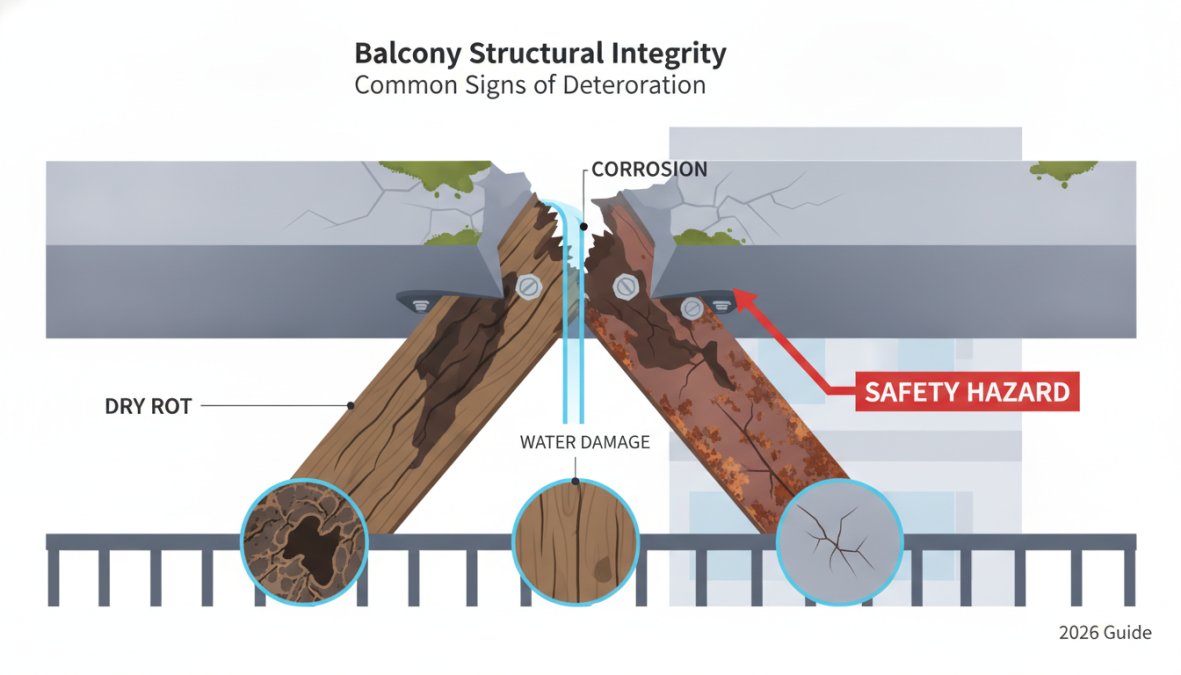
Rust stains are more serious. When rebar corrodes inside a concrete slab, the iron oxide byproduct expands and exerts pressure on the surrounding concrete, causing spalling: the progressive fracturing and separation of concrete from its surface layer. Once spalling begins, exposed rebar corrodes rapidly and load-bearing capacity is directly compromised.

According to the American Concrete Institute’s guidance on concrete durability, carbonation depth increases with age and exposure, making older balconies significantly more vulnerable.

Structural Warning Signs: Wood Rot, Deflection, and Railing Instability

The most dangerous structural failures in wood-framed balconies are often the least visible. Surface boards may look fine while the framing beneath has lost most of its structural integrity.

Fungal Decay and Soft Spots in Wood-Framed Balconies

Fungal decay requires only moisture and organic material, conditions balconies provide constantly, especially at the ledger board connection. The ledger board is the single most critical component in a wood-framed balcony: it transfers the entire deck load to the building structure. When it decays, failure is typically sudden and complete.

Signs of fungal decay include:

  • Soft spots underfoot, particularly near the building wall or around fastener locations
  • Discoloration ranging from gray weathering to dark brown or black staining
  • Wood that crumbles or compresses when probed with a screwdriver or awl
  • Visible fungal growth in sheltered areas

A common mistake is testing only the visible surface boards. The joists, beams, and ledger board below carry the load, surface testing tells you almost nothing about structural framing unless you can access the underside.

Sagging, Deflection, and Compromised Load-Bearing Capacity

Visible deflection, the kind you can see by standing back and looking along the edge of a balcony, is not normal. A balcony that sags at its outer edge or feels springy underfoot shows signs of compromised load-bearing capacity, resulting from joist decay, fastener corrosion, building settlement, or overloading.

Visible deflection in a cantilevered balcony is a structural emergency. Restrict access immediately and do not wait for a scheduled inspection.

Loose Guardrails and Fastener Corrosion

Guardrail failures typically originate at base connections where posts attach to deck framing or the slab edge. Fastener corrosion reduces tensile strength over time; the railing may appear solid until lateral force is applied, at which point corroded fasteners fail without warning.

Test every guardrail by applying firm lateral pressure at the top rail. Any movement beyond minimal flex is a failure condition, a railing that visibly moves under hand pressure does not meet code.

Climate-Specific Decay Patterns and Material Warning Signs

The decay pattern on a balcony in coastal California looks nothing like failure in the mountain west or Pacific Northwest. Matching your inspection focus to your climate is how you find problems before they become failures.

Coastal environments accelerate fastener corrosion dramatically. Salt-laden air attacks steel fasteners, rebar, and metal connectors at several times the rate of inland conditions. Rust staining at fastener locations on a coastal property warrants immediate investigation.

High-rainfall climates produce conditions most favorable to fungal decay. Extended wet seasons keep wood moisture content elevated for months, making ledger board connections especially vulnerable and requiring robust flashing details and annual inspection.

Desert and inland climates present a different risk: thermal cycling. Extreme temperature swings widen existing cracks and create new water infiltration pathways. Spalling often appears suddenly after the first seasonal rains because damage accumulates invisibly during dry periods.

According to the International Code Council’s guidance on climate-specific building durability, material selection and maintenance intervals should be adjusted based on local exposure categories. A maintenance schedule appropriate for an inland property is insufficient for a coastal one.

Insurance, Liability, and the Cost of Missing Warning Signs

Most property insurance policies contain exclusions for damage resulting from neglected maintenance. A balcony failure after documented warning signs have been observed and not addressed can result in a denied claim, leaving the property owner to absorb full structural repair costs, medical liability, and legal defense.

California’s SB 326 and SB 721 compound this exposure. A property owner who receives an inspection report identifying structural concerns and fails to act has created a documented record of negligence that is difficult to overcome in litigation.

The cost difference is substantial. Early-stage repairs, addressing a failed waterproofing membrane or replacing corroded fasteners before structural damage occurs, typically cost a fraction of full structural remediation. Waiting until deflection, spalling, or ledger board decay is visible multiplies the repair scope significantly.

Key Takeaway
The financial case for early intervention is straightforward: catching balcony structural failure warning signs at the waterproofing or fastener stage costs a fraction of what structural repair costs after framing or concrete damage has progressed. Insurance exclusions for neglected maintenance make early action a financial necessity, not just a safety one.

Balcony Inspection Checklist: DIY vs. Professional Assessment

Property managers and homeowners can identify many warning signs through a structured visual check. Knowing what you can assess yourself helps you prioritize and act faster.

What Homeowners and Property Managers Can Check Themselves

Use this checklist for a preliminary self-assessment seasonally, or after any significant storm or seismic event.

Surface and Drainage:

  • Water drains away from the building wall within 30 seconds of application
  • No standing pools visible 24 hours after rain
  • No visible cracks wider than 1/8 inch in the deck surface or at wall junctions
  • No blistering, bubbling, or delamination of the surface coating

Concrete Condition:

  • No white efflorescence deposits along slab edges or at cracks
  • No rust staining on the slab surface or at slab edges
  • No visible spalling or flaking of concrete from the underside of the slab

Wood Components (if applicable):

  • No soft spots underfoot, especially near the building wall
  • No visible discoloration or staining of decking boards
  • No crumbling or compression when probing with a screwdriver at board ends and fastener locations

Railings and Guardrails:

  • No visible movement when firm lateral pressure is applied to the top rail
  • No rust staining or visible corrosion at post base connections
  • No loose or missing fasteners at post bases

Underside (if accessible):

  • No visible staining, efflorescence, or moisture on the soffit
  • No visible rust staining below fastener or rebar locations
A licensed inspector wearing a hard hat and safety vest crouching on a balcony, pressing a moisture meter against a wooden ledger board while taking handwritten notes on a clipboard in bright afternoon sunlight

What Only a Licensed Inspector Can Evaluate

DIY assessment identifies surface-level indicators. It cannot confirm structural integrity. The following require a licensed inspector or structural engineer:

  • Moisture content measurement using calibrated meters to assess wood framing moisture levels below the surface
  • Non-destructive evaluation of concrete using hammer sounding or cover meter scanning to locate delamination and rebar depth
  • Destructive testing where core samples assess carbonation depth and rebar condition
  • Ledger board connection assessment, requiring access from inside the building or below the deck
  • Load path analysis to confirm the structural system is performing as designed
  • Building code compliance review against current standards, including California’s SB 326 and SB 721 requirements

Visual observation from the surface is within reach of any attentive property manager. Anything involving structural components, hidden framing, or quantitative material assessment requires a licensed professional.

When to Schedule a Structural Engineer Balcony Inspection

A structural engineer balcony inspection is warranted in specific circumstances. Schedule one when:

  1. A licensed inspection has identified deflection, visible sagging, or movement in the structural frame
  2. Spalling has exposed rebar and the extent of corrosion cannot be assessed visually
  3. The balcony is cantilevered and the ledger board connection shows any signs of decay or corrosion
  4. The property has experienced seismic activity and guardrail connections or slab cracks have appeared or widened
  5. A balcony failure has occurred on an adjacent or similar structure in the same building
  6. The building is approaching or has passed the inspection intervals required under SB 326 or SB 721

A structural engineer provides a formal assessment with documented findings, repair specifications, and an opinion on whether the structure can remain in service, essential for insurance purposes, California law compliance, and contractor bidding on remediation work. The Apex Balcony team works with licensed inspectors who have decades of combined construction and design experience and coordinates engineer referrals directly when warranted.

According to California’s SB 326 and SB 721 inspection requirements overview, multifamily properties must have elevated exterior elements inspected on a defined schedule by qualified inspectors. Non-compliance carries direct legal consequences for building owners and HOAs.

Conclusion: Act on Balcony Structural Failure Warning Signs Early

The throughline of every section in this guide is the same: balcony structural failure warning signs are visible before catastrophic failure occurs. The question is whether someone is looking for them with the right knowledge.


Balcony deterioration follows predictable patterns, and catching it early is entirely achievable with structured inspection and the right expertise. Apex Balcony provides licensed inspectors with decades of construction and design experience, specializing in California SB 326 and SB 721 compliance for multifamily buildings, HOAs, and individual property owners. Our team inspects balconies, decks, and stairways comprehensively, identifies early-stage failure indicators before they become structural emergencies, and provides a clear path to necessary repairs. Book an inspection with Apex Balcony and protect your residents, your property, and your legal standing before the next inspection deadline.

Frequently Asked Questions

What are the most common causes of balcony collapse?

Balcony collapses are most commonly caused by water infiltration that goes undetected over time. Moisture penetrates the waterproofing membrane, reaches the structural framing or concrete slab, and accelerates wood rot, rebar corrosion, and delamination. Ledger board failure, fastener corrosion, and neglected preventative maintenance are also leading contributors. In many cases, the structural damage is hidden beneath surface finishes, making professional inspection essential for identifying the true load-bearing capacity of the structure.

How do I know if my balcony is structurally sound?

Look for balcony structural failure warning signs such as visible cracking patterns in concrete, soft spots or spongy areas underfoot, rust stains, efflorescence, sagging or deflection, and any movement in guardrails when pressure is applied. However, many critical failures, including rebar corrosion, fungal decay inside framing, and moisture barrier failures, are not visible to the untrained eye. A licensed structural engineer or certified balcony inspector using non-destructive evaluation tools can give you a definitive assessment of structural integrity.

How often should balconies be inspected for structural integrity?

In California, SB 326 requires inspections of balconies in multifamily buildings with three or more units every nine years. SB 721 sets a similar requirement for apartment buildings with three or more units. Outside of mandatory timelines, property managers and homeowners should conduct a basic visual balcony inspection checklist review annually, especially after severe weather events. Buildings in coastal or high-humidity climates may warrant more frequent professional inspections due to accelerated fastener corrosion and moisture-related decay.

Who is responsible for balcony maintenance in an apartment building?

Responsibility typically falls on the building owner or property management company. Under California's SB 721 and SB 326 laws, building owners are legally required to maintain elevated exterior elements in safe condition and schedule periodic structural engineer balcony inspections. Failure to do so can result in significant landlord liability if a balcony collapse or injury occurs. Tenants should report any signs of balcony water damage, loose railings, or soft spots to management promptly and in writing to create a documented record.

What are the signs of concrete balcony deterioration?

Key signs of concrete balcony deterioration include spalling, where chunks of concrete break away from the surface, along with rust stains indicating rebar corrosion beneath the slab, efflorescence (white mineral deposits), visible cracking patterns, and concrete carbonation. Delamination, where layers of concrete separate, may produce a hollow sound when tapped. These are serious balcony structural failure warning signs that suggest the load path has been compromised and a structural engineer balcony inspection should be scheduled without delay.

Posted in BlogLeave a Comment on Balcony Structural Failure Warning Signs: 2026 Guide

Signs of Balcony Structural Decay: A Safety Guide

Posted on June 12, 2026 by Apex Balcony admin
Signs of Balcony Structural Decay: A Safety Guide

Table of Contents

  • Why Recognizing Signs of Balcony Structural Decay Can Save Lives
  • How to Tell If a Wood Balcony Is Rotting
    • Checking the Ledger Board and Fastener Connections
    • Soft Spots, Fungal Decay, and Surface Discoloration
  • Signs of Concrete Spalling and Rebar Corrosion to Watch For
    • Efflorescence, Rust Stains, and Delamination
  • Waterproofing Failures, Drainage Issues, and Water Infiltration
  • Structural Deflection, Sagging, and Guardrail Instability
  • Climate-Specific Decay Patterns and Insurance Liability Risks
  • Balcony Inspection Checklist: DIY vs. Professional Assessment
    • What Homeowners Can Check Themselves
    • When Non-Destructive Evaluation Is Not Enough
  • Hiring a Structural Engineer for Balcony Inspection

Last Updated: June 12, 2026

Balcony collapses rarely happen without warning. The signs of structural decay are almost always present weeks, months, or years before failure occurs, most property owners simply don’t know what to look for. This guide from Apex Balcony covers every major warning sign, from rotting wood and concrete spalling to drainage failures and guardrail instability, so you can catch problems before they become tragedies.

Surface cracks and rust stains look minor, but they’re often the visible expression of deep structural compromise. Below, we show you how to read those signals, what they mean for structural integrity, and when to call a licensed engineer.

Balcony structural decay is the progressive deterioration of load-bearing and non-load-bearing elements of an elevated exterior structure, caused by moisture intrusion, material fatigue, biological growth, or corrosion. According to the U.S. Consumer Product Safety Commission’s guidance on deck and balcony safety, thousands of injuries occur annually from deck and balcony failures, the majority involving preventable structural deterioration.


Why Recognizing Signs of Balcony Structural Decay Can Save Lives

A balcony that looks functional can be structurally compromised to the point of catastrophic failure under normal load. Structural failure typically follows a predictable pattern: moisture infiltrates a vulnerable point, material strength degrades, and the load path becomes compromised. The structure appears stable right up until it isn’t.

The throughline in nearly every balcony collapse investigation is deferred maintenance, not a single catastrophic event, but a series of ignored warning signs. Efflorescence gets painted over. A soft spot gets covered with furniture. Each dismissed sign is one more step toward failure.

Property managers and homeowners in California face additional accountability. Under SB 326 and SB 721, building owners are legally required to conduct periodic inspections of elevated exterior elements. Ignoring visible decay creates direct landlord liability exposure.

Watch Out
Balconies showing sagging, visible cracking in load-bearing members, or guardrail movement should be treated as immediately unsafe. Restrict access and contact a structural engineer before the next use.

How to Tell If a Wood Balcony Is Rotting

Wood rot is the single most common cause of balcony structural failure in residential buildings. Fungal decay often progresses from the inside out, a board can look intact while its interior fiber structure is already compromised.

The most reliable field test: press a screwdriver or awl firmly into suspected areas. Sound wood resists penetration; decayed wood yields or crumbles. This test works best on joists, ledger boards, posts, and decking boards near drainage points.

Soft spots, discoloration (gray, black, or orange tones), and visible fungal growth are the primary surface signs. Location matters as much as symptom, rot near fastener penetrations, post bases, or the ledger board connection signals structural-level decay, not just surface weathering.

Checking the Ledger Board and Fastener Connections

The ledger board is the most critical connection on a wood-framed balcony, the horizontal member attaching the balcony to the building’s rim joist, carrying the entire transferred load. Corroded lag bolts or joist hangers lose tensile strength progressively and invisibly until the connection fails. Look for rust staining around fastener heads, gaps between the ledger and the house wall, and any visible separation.

Flashing failures at the ledger are equally dangerous. When waterproofing at this junction fails, water infiltrates directly into the rim joist behind it. By the time rot is visible on the ledger face, structural members behind it are often severely compromised, this is where a DIY visual check has real limits and probing is warranted.

Soft Spots, Fungal Decay, and Surface Discoloration

Soft spots on a wood deck surface directly indicate advanced fungal decay in the decking boards or joists beneath. A board that flexes abnormally underfoot or produces a hollow sound when tapped should be probed immediately.

Surface discoloration alone doesn’t confirm rot, but it’s a reliable trigger for closer inspection. Gray weathering is normal on unfinished wood. Black or dark brown staining near fasteners, joints, or low points indicates moisture retention and probable fungal activity beneath.

A licensed inspector in a hard hat crouching down to probe a weathered wooden balcony deck with a screwdriver near the ledger board connection, checking for soft spots and fungal decay in afternoon natural light

Signs of Concrete Spalling and Rebar Corrosion to Watch For

Concrete balconies present a different failure profile than wood, but no less dangerous. Spalling, the fracturing and detachment of concrete surface layers, is caused by moisture infiltration, freeze-thaw cycling, and concrete carbonation, which removes the passive protection around embedded rebar.

Once rebar begins to corrode, rust products occupy significantly more volume than the original steel. This expansion creates internal pressure that fractures surrounding concrete from within, reducing both rebar cross-section and the bond between steel and concrete.

Efflorescence, Rust Stains, and Delamination

Efflorescence, white, chalky deposits on concrete, forms when water moves through the concrete and deposits dissolved salts on the surface. It signals active water infiltration but is not itself structurally dangerous.

Rust stains are more serious. Brown or orange streaking on a concrete soffit or edge means embedded rebar has already begun to corrode and the protective alkaline environment around the steel has broken down.

Delamination is the separation of a concrete surface layer from the substrate. Identify it by tapping with a hammer or coin, a hollow, drum-like sound indicates a delaminated section. Delaminated concrete can fall without warning, creating a falling hazard below in addition to the structural concern above.

Close-up photograph of a concrete balcony soffit showing visible spalling, orange rust stains bleeding through the concrete surface, and sections of chipped concrete revealing corroded rebar underneath, shot in direct natural light
Key Takeaway
Rust stains on a concrete balcony surface are not cosmetic. They indicate active rebar corrosion inside the concrete section and require professional evaluation, not paint.

Waterproofing Failures, Drainage Issues, and Water Infiltration

Water is the root cause of nearly every form of balcony structural decay. The waterproofing membrane, flashing details, and drainage slope are the three systems that keep water out of the structural assembly. When any one fails, the deterioration clock starts.

A properly designed balcony deck slopes toward drains or the open edge at a minimum gradient, typically around 1/8 inch per foot, to prevent ponding. Standing water accelerates membrane degradation, promotes biological growth, and increases hydrostatic pressure against cracks and seams.

Waterproofing membrane failures are often invisible from above until significant damage has occurred below. Look for cracks or bubbling in the deck coating, failed caulk at wall-to-deck transitions, and separation at flashings around drains, posts, or wall penetrations. Clogged deck drains or scuppers compound the problem by forcing water against the most infiltration-vulnerable points.

As documented in the International Building Code guidance on waterproofing for exterior decks, proper flashing and waterproofing at deck-to-wall transitions are code requirements, not optional upgrades, and failures here are among the most common deficiencies found during professional inspections.


Structural Deflection, Sagging, and Guardrail Instability

Visible deflection demands immediate professional evaluation. A balcony that sags at mid-span or has developed a noticeable slope toward the outer edge has experienced material failure or settlement in its support system. In cantilevered balconies, excessive deflection indicates a loosening connection, members that have lost section due to rot or corrosion, or an inadequate original design.

Guardrail stability is a life-safety issue. Guardrails must resist both vertical and lateral loads. A guardrail that wobbles or feels loose under pressure is structurally deficient regardless of visual appearance. Check posts by applying firm lateral force at the top rail, any perceptible movement is a deficiency. Then inspect each post base, typically the first point of corrosion on metal railings and the first point of rot on wood.

According to OSHA’s standards for guardrail systems and fall protection, guardrails must withstand a minimum lateral load without failure. A railing that moves under hand pressure does not meet this standard and represents an active fall hazard.


Climate-Specific Decay Patterns and Insurance Liability Risks

Climate is an underappreciated variable in balcony deterioration. In coastal California environments, salt air accelerates corrosion of metal fasteners, rebar, and guardrail hardware dramatically, fastener corrosion that might take decades inland can reach structural significance within a few years at the coast. In freeze-thaw climates, water infiltrating cracks then freezing expands and widens openings over multiple cycles, fracturing concrete and destroying sealant continuity. High-UV environments cut waterproofing membrane service lives significantly below the typical 5-10 year rating.

The liability dimension is equally important. A property owner who ignores visible decay and a subsequent injury occurs faces significant exposure. In California, SB 326 and SB 721 create a documented inspection obligation, failure to comply means a property owner cannot credibly argue they exercised reasonable care. Apex Balcony has worked with hundreds of building owners navigating this intersection of safety and legal compliance.

Pro Tip
Document every inspection with dated photographs, even informal walk-through checks. This creates a maintenance record that demonstrates reasonable care and can be critical in any liability dispute.

Balcony Inspection Checklist: DIY vs. Professional Assessment

The most useful thing a property owner can do is understand exactly where their own inspection capability ends and where professional evaluation becomes necessary.

What Homeowners Can Check Themselves

A systematic DIY visual inspection covers observable surface conditions. Work through the following checklist methodically, ideally twice a year and after any significant weather event.

DIY Balcony Inspection Checklist:

  • Check deck surface for pooling water, cracks, or bubbling in the coating
  • Probe wood decking boards and visible joists with a screwdriver for soft spots
  • Look for surface discoloration: black, gray, or orange staining on wood or concrete
  • Inspect all visible fastener heads for rust or corrosion
  • Check caulk and sealant at wall-to-deck transitions for cracking or separation
  • Clear deck drains and scuppers; confirm water flows freely
  • Apply lateral force to guardrail posts and top rail; note any movement
  • Inspect guardrail post bases for rust, rot, or loose connections
  • Look at the balcony soffit from below for rust stains, efflorescence, or spalling
  • Check for any visible sagging or deflection in the deck surface
  • Note any new cracks in concrete or masonry, especially at edges and corners
  • Inspect the ledger board connection area for gaps, rust, or moisture staining

Any concerning finding should be escalated to a professional inspector. A DIY check is a screening tool, not a structural assessment.

When Non-Destructive Evaluation Is Not Enough

Visual inspection and probing cannot assess concealed structural members, waterproofing integrity beneath a finished surface, or the extent of corrosion within a concrete section. Non-destructive evaluation (NDE) techniques, including ground-penetrating radar, infrared thermography, and impact-echo testing, can reveal subsurface conditions without opening up the structure, and are appropriate when surface signs suggest deeper problems.

Destructive testing, where small sections of deck surface or concrete cover are removed to expose structural members, is warranted when NDE is inconclusive or when the stakes justify direct confirmation. A licensed structural engineer determines when this threshold is reached.


Hiring a Structural Engineer for Balcony Inspection

Some inspections require more than a general contractor or home inspector can provide. A licensed structural engineer can evaluate load-bearing capacity, assess connection adequacy, interpret cracking patterns, and determine whether deterioration has compromised structural integrity.

Hire a structural engineer when you observe significant deflection or sagging, guardrail connections show active corrosion or movement, concrete spalling has exposed rebar, or any member shows decay at a primary structural connection. The inspection process typically involves a visual survey, probing and tapping, review of available drawings, and a written report with findings and recommendations.

For California properties subject to SB 326 or SB 721, the inspection must be conducted by a licensed architect or structural engineer meeting specific documentation requirements. Apex Balcony provides compliant inspections covering all elevated exterior elements, balconies, decks, and stairways, with a clear path to necessary repairs.

According to California’s SB 326 and SB 721 legislative guidance on balcony inspection requirements, inspections must be completed on a defined schedule with documentation retained by the building owner. Non-compliance extends beyond safety to direct legal liability.

Warning SignLikely CauseDIY DetectableRequires Engineer
Soft spots in wood deckingFungal decayYesIf at structural members
Rust stains on concrete soffitRebar corrosionYesAlways
Pooling water on deck surfaceDrainage failure or deflectionYesIf deflection suspected
Guardrail movementFastener corrosion or rotYesAlways
Visible saggingStructural deflectionYesAlways
Efflorescence on concreteWater infiltrationYesIf persistent
Delaminating concreteBond failureYes (tap test)Always
Ledger board gapConnection failureYesAlways

Balcony deterioration follows a predictable path, and the warning signs are readable if you know what to look for. Apex Balcony’s team of licensed inspectors brings decades of construction and design experience to exactly this problem, conducting comprehensive inspections that meet California’s SB 326 and SB 721 requirements. Book an inspection with Apex Balcony and get a clear, documented picture of your property’s condition before a minor deficiency becomes a structural failure.

Frequently Asked Questions

How do I know if my balcony is structurally sound?

Look for visible signs of balcony structural decay such as soft or spongy wood, rust stains on concrete, loose railings, visible sagging or deflection, pooling water, and cracks in the deck surface. While a basic visual check can flag obvious problems, only a licensed structural engineer or certified inspector can confirm load-bearing capacity and overall structural integrity through a proper safety inspection. In California, SB 326 and SB 721 mandate formal inspections for many properties.

What are the warning signs of concrete balcony failure?

Key signs of concrete spalling and balcony failure include flaking or pitting concrete surfaces, white powdery efflorescence indicating moisture intrusion, rust-colored stains from rebar corrosion beneath the surface, visible cracks, and delamination of the concrete layer. Concrete carbonation can accelerate rebar corrosion over time, weakening the entire load path. If you notice any of these warning signs, schedule a professional inspection immediately to assess structural integrity and prevent a balcony collapse.

How often should a balcony be inspected for safety?

For most residential properties in California, SB 326 requires HOA-governed buildings to inspect elevated exterior elements every nine years, while SB 721 requires inspections for multifamily buildings with three or more units every six years. However, regardless of legal requirements, property owners should conduct a basic visual balcony inspection checklist review annually and after major storms. Any visible signs of structural decay, water infiltration, or guardrail instability warrant an immediate professional inspection.

Who is responsible for balcony maintenance in an apartment complex?

In most cases, the property owner or landlord carries primary responsibility for balcony maintenance and safety compliance in an apartment complex. Failure to address known signs of balcony structural decay can expose landlords to significant insurance and liability risks, including negligence claims if a structural failure causes injury. California's SB 721 law places explicit inspection and repair obligations on building owners. Property management companies acting on behalf of owners may also share liability depending on their management agreement.

Can a rotting wood balcony be repaired or does it need full replacement?

Whether a rotting wood balcony can be repaired depends on the extent of fungal decay and structural compromise. Minor surface rot caught early through a balcony inspection checklist review may be treatable by replacing isolated boards and resealing. However, if rot has reached the ledger board, joists, or fastener connections, compromising the load path, partial or full replacement is typically required. Hiring a structural engineer for balcony inspection is the only reliable way to determine whether repair or replacement is the safer option.

Posted in BlogLeave a Comment on Signs of Balcony Structural Decay: A Safety Guide

How to Prepare for a Balcony Inspection: 2026 Guide

Posted on June 11, 2026June 11, 2026 by Apex Balcony admin
How to Prepare for a Balcony Inspection: 2026 Guide

Table of Contents

  • How to Prepare for a Balcony Inspection: A Step-by-Step Overview
    • Step 1: Review Applicable Regulations (SB 326 and SB 721)
    • Step 2: Clear and Secure All Access Points
    • Step 3: Gather Documented History and Prior Repair Records
    • Step 4: Complete Pre-Inspection Maintenance Tasks
  • Signs of Balcony Water Damage Every Property Owner Should Know
    • Visual Identification Guide for Non-Experts
  • Your Balcony Safety Inspection Checklist Before the Inspector Arrives
  • How Long Does a Balcony Inspection Take?
  • Hiring a Balcony Inspector: What to Look for in California
  • What Happens After the Inspection: Remediation, Costs, and Next Steps
    • Post-Inspection Remediation Workflow
    • Budgeting and Cost Estimation for Balcony Repairs
  • How to Prepare for a Balcony Inspection: Tenant Communication Templates
  • Conclusion

Last Updated: June 11, 2026

Knowing how to prepare for balcony inspection is the difference between a smooth compliance process and a costly scramble. At Apex Balcony, we’ve guided hundreds of California building owners and HOAs through this process, and the pattern is consistent: properties that prepare systematically pass faster, cost less to remediate, and carry far less legal exposure.

A balcony inspection is a formal structural safety assessment of exterior elevated elements (EEEs), including balconies, decks, stairways, and walkways, conducted by a licensed inspector to verify compliance with California building code and safety standards.

The properties that sail through inspections have been maintaining documented records, addressing moisture intrusion proactively, and keeping access points clear long before any inspector shows up.

How to Prepare for a Balcony Inspection: A Step-by-Step Overview

Preparing for a balcony inspection requires four distinct actions, each building on the last. Skip one and you risk a failed inspection or a surprise remediation bill.

Step 1: Review Applicable Regulations (SB 326 and SB 721)

California law draws a clear line between two inspection regimes, and confusing them is a common and expensive mistake.

SB 326 applies to condominium associations governed by an HOA. It requires inspection of all EEEs more than six feet above grade and supported by wood or wood-based products, at least once every nine years (first deadline: January 2025). The inspector must be a licensed architect or structural or civil engineer.

SB 721 applies to multi-family residential buildings with three or more units not governed by an HOA. Inspector qualifications are broader: licensed contractors, architects, civil or structural engineers, or building inspectors with specific credentials all qualify.

According to California Legislative Information on SB 721, property owners who fail to complete required inspections face mandatory repair orders and potential civil liability. Knowing which law governs your property determines your timeline, inspector qualifications, and reporting obligations.

Pro Tip
Pull your building’s original permit records before the inspector arrives. If your property was built before 2000, the deck framing details may not match current code, knowing this in advance lets you address it proactively.

Step 2: Clear and Secure All Access Points

Inspectors need unobstructed access to every EEE on the property. Clear all furniture, planters, grills, and storage from balcony surfaces at least 48 hours before the inspection, anything blocking access delays the assessment and can force a return visit. For multi-family dwellings, coordinate access with every tenant unit; California law typically requires a minimum 24-hour written notice before entry.

Step 3: Gather Documented History and Prior Repair Records

A documented maintenance history is one of the strongest signals of due diligence you can present. Gather the following before the inspection:

  • Original construction permits and approved plans
  • Any prior inspection reports
  • Records of waterproofing applications and dates
  • Receipts and scopes of work for balcony or deck repairs
  • HOA maintenance logs (if applicable)
  • Manufacturer warranties for decking materials or waterproofing membranes

If records are incomplete, note the gaps honestly. A complete paper trail demonstrates active property management and matters in any subsequent liability review.

Step 4: Complete Pre-Inspection Maintenance Tasks

The week before an inspection is not the time for major repairs, significant structural work immediately beforehand can complicate the assessment, since inspectors need to evaluate actual conditions, not freshly patched surfaces. Do address obvious cosmetic and drainage issues: clear debris from drains, remove standing water, clean visible mold or mildew, and tighten loose railing hardware.

Signs of Balcony Water Damage Every Property Owner Should Know

Moisture intrusion is the leading cause of structural failure in exterior elevated elements. Understanding what to look for before the inspector arrives gives you a head start on remediation.

Close-up photograph of a weathered balcony surface showing visible water staining, peeling paint, and early signs of wood rot along the deck framing and railing base, taken in natural daylight on a residential multi-family building

Visual Identification Guide for Non-Experts

Staining and discoloration: Dark streaks or rust-colored stains on the deck surface or the ceiling below a balcony indicate water moving through the assembly, often the first sign of flashing failure.

Soft or spongy spots underfoot: Any area that flexes or feels soft when pressed suggests dry rot in the substructure. This is a structural concern, not a cosmetic one.

Peeling paint or bubbling coatings: Bubbling or peeling waterproofing membranes signal that moisture is trapped beneath them and the membrane has already been breached.

Rust stains at fastener locations: Rust streaks around screws, bolts, or post bases indicate water is reaching structural connections, directly affecting railing safety.

Gaps or cracks in caulking and flashing: Flashing at the ledger board is the most critical waterproofing point on any deck. Any visible gap or missing caulk at this junction should be flagged immediately.

Efflorescence on concrete decks: White chalky deposits indicate water is moving through the slab, carrying salts to the surface as it evaporates.

Watch Out
Do not attempt to seal over active water damage with caulk or deck coating before an inspection. Covering deteriorated material without addressing the underlying cause will not pass a non-invasive inspection and may be flagged as an attempt to conceal defects.

Your Balcony Safety Inspection Checklist Before the Inspector Arrives

Use this checklist to confirm your property is ready. This balcony safety inspection checklist covers the most common preparation gaps that cause re-inspections.

Documentation:

  • Confirm which law applies: SB 326 (HOA/condo) or SB 721 (multi-family rental)
  • Locate original building permits and approved construction drawings
  • Compile all prior repair records, waterproofing logs, and inspection reports
  • Confirm inspector credentials match the requirements for your property type

Physical Preparation:

  • Remove all furniture, planters, and personal items from all balcony surfaces
  • Clear debris from all deck drains and scuppers
  • Confirm underside access is unobstructed (ladders, hatches, or crawl spaces)
  • Tighten any visibly loose railing hardware
  • Document visible water staining, soft spots, or flashing gaps with photos

Tenant Coordination:

  • Deliver written 24-hour (minimum) notice to all affected units
  • Confirm inspection date and access window with tenants
  • Provide tenants with a brief written explanation of the inspection purpose

Post-Inspection Readiness:

  • Identify a licensed contractor for potential remediation work
  • Have a preliminary budget range ready for common repair scenarios
  • Confirm your property insurance covers structural repair claims

How Long Does a Balcony Inspection Take?

A balcony inspection typically takes one to four hours for a standard multi-family property. A single building with six to twelve units and straightforward access usually runs one to two hours; larger complexes with multiple buildings or limited underside access can take a full day or require multiple visits.

The timeline also depends on whether the inspector is conducting a non-invasive visual assessment or invasive probing of suspect areas. Under SB 326 and SB 721, the initial inspection is non-invasive; if concerns arise, the inspector may recommend targeted invasive testing, which requires a separate appointment and additional cost. Plan for roughly 15-30 minutes per balcony or deck element.

Hiring a Balcony Inspector: What to Look for in California

The inspector you hire determines the quality of your compliance documentation, and not all inspectors are equal.

A licensed inspector wearing a safety vest and hard hat examining the underside of a residential balcony with a flashlight, checking structural connections and flashing details on a multi-family apartment building in California, afternoon sunlight

California law specifies who can conduct EEE inspections. For SB 721 properties, eligible inspectors include licensed general contractors (B license), architects, civil or structural engineers, and building inspectors with specific certifications. For SB 326 properties, only licensed architects or licensed structural or civil engineers qualify.

Beyond legal credentials, look for:

  • Specific EEE experience: Ask how many SB 326 or SB 721 inspections the inspector has completed.
  • Familiarity with local building codes: An inspector who regularly works in your county will know local amendments and enforcement patterns.
  • Clear written reporting: Ask for a sample report before hiring to confirm it meets legal documentation standards.
  • Insurance and licensing verification: Confirm the inspector’s license is current through the California Contractors State License Board license lookup.

Apex Balcony’s licensed inspectors bring decades of combined construction and design experience focused on California EEE compliance, handling the full inspection scope for both SB 326 and SB 721 properties and delivering reports that satisfy legal requirements and provide a direct path to any necessary repairs.

What Happens After the Inspection: Remediation, Costs, and Next Steps

The inspection report is not the end of the process, for many properties, it’s the beginning of a repair workflow that needs careful management to stay compliant and cost-effective.

Post-Inspection Remediation Workflow

A structured remediation workflow prevents the most common post-inspection mistake: rushing into repairs without a clear scope of work, which leads to incomplete fixes and repeat failures.

Follow this sequence:

  1. Review the inspection report in detail. Categorize findings into three buckets: immediate safety hazards (emergency action required), code deficiencies (repair within the legally mandated timeline), and maintenance recommendations (best-practice improvements without a legal deadline).
  2. Obtain multiple repair bids. For any structural repair involving load-bearing capacity, deck framing, or waterproofing, get at least three bids from licensed contractors using the same scope of work.
  3. Prioritize by safety, then by legal deadline. Address immediate hazards first, then sequence remaining repairs by statutory deadline under SB 326 or SB 721.
  4. Document all repairs with permits and inspections. Structural repairs to EEEs typically require a building permit. Unpermitted repairs can void compliance documentation and create liability exposure.
  5. Schedule a follow-up inspection if required. Under SB 721, if the inspector identifies a condition requiring repair, owners must complete repairs and have the work inspected within 120 days. Track this deadline precisely.
Key Takeaway
The remediation workflow is where most property owners lose time and money. Treating the inspection report as a prioritized repair schedule, not just a list of problems, keeps the process on track and on budget.

Budgeting and Cost Estimation for Balcony Repairs

Low-severity findings (surface coating failure, minor caulking gaps, hardware tightening): Maintenance-level costs handled by a property maintenance contractor, typically without a structural permit.

Moderate-severity findings (waterproofing membrane replacement, flashing repair, localized dry rot): Require a licensed contractor and building permit. Scope expands if dry rot has spread into deck framing or the ledger board connection.

High-severity findings (significant structural failure, compromised load-bearing capacity, widespread dry rot): Major repair projects that may require partial or full deck replacement, scaling with the size of the affected area.

Budget conservatively, experienced property managers generally allocate a 20-30% contingency above the initial repair bid for EEE work, because moisture damage rarely stops exactly where it appears on the surface.

According to California Department of Housing and Community Development guidance on building maintenance, property owners who address structural deficiencies proactively face significantly lower total repair costs than those who defer maintenance until a mandatory inspection forces action.

How to Prepare for a Balcony Inspection: Tenant Communication Templates

Tenant communication is one of the most overlooked parts of inspection preparation. Done poorly, it creates confusion and delays access. California law requires written notice to tenants before an inspector accesses a unit or its associated balcony, the minimum is 24 hours, but 48-72 hours is better practice for multi-unit properties.

Use these templates as a starting point:

Template 1: Initial Inspection Notice

Dear [Resident Name],

We are writing to inform you that [Property Name] will be undergoing a mandatory balcony and exterior elevated element safety inspection required under California law (SB 326/SB 721). This inspection is scheduled for [Date] between [Time] and [Time].

To complete the inspection, the inspector will need access to your balcony/deck area. No entry into your living space is required. Please remove all furniture, planters, and personal items from your balcony surface before [Date/Time].

If you have questions or scheduling concerns, please contact [Property Manager Name] at [Contact Information].

Thank you for your cooperation.
[Property Management Name]

Template 2: Reminder Notice (24 Hours Before)

Dear [Resident Name],

This is a reminder that the mandatory balcony safety inspection is scheduled for tomorrow, [Date], between [Time] and [Time].

Please ensure your balcony is cleared of all personal items before the inspector arrives. If you have not yet done so, please complete this today.

Contact [Property Manager Name] at [Contact Information] with any questions.

[Property Management Name]

Template 3: Post-Inspection Update (if repairs are required)

Dear [Resident Name],

Thank you for your cooperation during the recent balcony safety inspection. The inspection has been completed, and [we are pleased to report no significant deficiencies were found / we have identified repairs that are required to ensure continued safety and compliance].

[If repairs are needed:] We will be scheduling repair work beginning [estimated date]. We will provide advance notice before any work begins that affects your unit or balcony access.

We are committed to maintaining safe conditions for all residents. Please contact [Property Manager Name] at [Contact Information] with any questions.

[Property Management Name]

Pro Tip
Keep copies of all tenant notices with delivery confirmation (email read receipts, certified mail, or signed acknowledgment). This documentation is part of your due diligence record and protects you in any subsequent liability dispute.

For property managers handling inspections across multiple buildings, the California Apartment Association’s tenant notice resources offers additional guidance on notice requirements and best practices for multi-family dwellings.


Balcony inspections under SB 326 and SB 721 carry real legal and safety consequences, and preparation is not optional. Apex Balcony works with building owners and HOAs across California to handle the full inspection process: from initial compliance review through licensed EEE inspection to a clear, documented path for any required repairs. Our team’s decades of combined construction and design experience means we identify early signs of structural failure that generalist inspectors miss. Book your inspection with Apex Balcony and get the compliance documentation your property needs, backed by inspectors who know California law and structural failure modes in equal measure.

Frequently Asked Questions

What do inspectors look for during a balcony inspection?

During a balcony inspection, licensed inspectors assess exterior elevated elements for structural integrity, moisture intrusion, dry rot, waterproofing failures, railing safety, and load-bearing capacity. They examine deck framing, flashing, and connections between the balcony and the main structure. Under California law (SB 326 and SB 721), the inspection must evaluate whether the EEE can safely support expected loads and identify any conditions that pose a risk of structural failure.

How often are balcony inspections required in California?

Under SB 721, inspections of exterior elevated elements on multi-family dwellings with three or more units are required every six years. SB 326 applies to HOA-governed common interest developments and mandates inspections every nine years. Property owners should track their documented history of inspections carefully to remain in HOA compliance and meet California law deadlines, as missed inspections can create significant liability exposure.

What are common balcony safety violations found during inspections?

Common violations include inadequate waterproofing, deteriorated flashing, dry rot in deck framing, loose or unstable railings, and compromised load-bearing capacity. Moisture intrusion is one of the most frequent issues because it often goes undetected until structural damage is advanced. Inspectors also flag missing or improper drainage, corroded fasteners, and gaps in building code compliance. Addressing these issues early through preventative maintenance is far less costly than emergency repairs after structural failure.

How long does a balcony inspection take, and do I need to be present?

A standard balcony safety inspection typically takes between one and three hours per building, depending on the number of exterior elevated elements, their accessibility, and the complexity of the structure. Larger multi-family dwellings with many units may take longer. Property managers or owners are not required to be present for every element, but ensuring all access points are cleared and unlocked in advance helps the licensed inspector complete a thorough, non-invasive inspection efficiently.

What happens if my balcony fails inspection?

If an exterior elevated element fails inspection, California law requires the property owner to restrict access immediately and begin repairs within a specified timeframe. Your licensed inspector will provide a written report detailing each deficiency. From there, you should obtain contractor bids, prioritize repairs by severity, and document all remediation work. Once repairs are complete, a follow-up inspection confirms the structure meets safety certification standards. Notifying tenants promptly and in writing is both a legal requirement and a liability reduction best practice.

How much does a balcony inspection cost in California?

Balcony inspection costs vary based on building size, number of exterior elevated elements, and location. While specific pricing depends on the inspector and scope of work, property managers should budget separately for the inspection itself and any subsequent repairs. Getting multiple quotes from licensed inspectors, reviewing their experience with SB 326 and SB 721 compliance, and factoring in potential repair costs during annual budgeting cycles are all part of sound due diligence and preventative maintenance planning.

Posted in BlogLeave a Comment on How to Prepare for a Balcony Inspection: 2026 Guide

Structural Engineer for Balcony Inspection: 2026 Guide

Posted on June 11, 2026June 11, 2026 by Apex Balcony admin
Structural Engineer for Balcony Inspection: 2026 Guide

Table of Contents

  • Why You Need a Structural Engineer for Balcony Inspection
    • What a Licensed PE Actually Evaluates
    • How Balcony Inspections Differ from General Home Inspections
  • Balcony Safety Regulations Every California Owner Must Know
    • SB 326 Requirements for HOAs and Condominiums
    • SB 721 Requirements for Multifamily Rental Properties
    • California Seismic Retrofit and Building Code Compliance
  • Warning Signs of Balcony Structural Damage to Watch For
    • Surface-Level vs. Hidden Structural Failure
  • What to Expect in a Structural Engineer Balcony Report
    • Key Sections of a Professional Inspection Report
    • How to Use the Report for Permits and Repairs
  • Balcony Inspection Cost: What to Budget in California
    • Factors That Affect Inspection Pricing
    • Cost of Ignoring Structural Issues vs. Early Intervention
  • ADU and Elevated Deck Inspections: A Specialized Need
  • Step-by-Step Checklist for Hiring a Structural Engineer for Balcony Inspection
    • Questions to Ask Before You Book
  • Conclusion

Last Updated: June 10, 2026

Balcony collapses remain one of the most preventable structural failures in California, yet they continue to occur because owners delay professional evaluation. Hiring a structural engineer for balcony inspection is the single most effective step a property owner can take to identify hidden deterioration before it becomes catastrophic. The properties that avoid costly emergencies are the ones that schedule inspections proactively, not reactively.

A balcony inspection is not the same as a general home inspection. Most home inspectors are not licensed professional engineers (PE) and cannot perform the structural analysis or sign off on the engineering calculations that California law mandates under SB 326 and SB 721, which impose specific compliance deadlines and require inspections by licensed professionals.

Why You Need a Structural Engineer for Balcony Inspection

Deferred balcony maintenance is not a cost-saving strategy. It is a liability transfer to future residents, owners, and emergency responders.

A balcony that looks fine from street level can harbor concealed wood rot, corroded steel connections, or compromised load-bearing walls beneath a fresh coat of paint. Visual checks by untrained observers miss these failure modes entirely. California’s building codes now reflect this reality: state legislation explicitly requires that inspections of elevated exterior elements be conducted by licensed structural engineers or architects with relevant experience.

What a Licensed PE Actually Evaluates

A professional engineer conducting a structural engineer for balcony inspection examines far more than surface condition. The evaluation covers:

  • Structural calculations: Verifying the balcony’s design load capacity against current California building standards
  • Load-bearing connections: Steel connections, ledger attachments, and post bases where failure is most common
  • Waterproofing and drainage: Failures here cause the hidden wood rot that leads to sudden collapse
  • Foundation and support conditions: Whether the structure transferring balcony loads to the building is performing as designed
  • Shoring needs: Whether temporary support is required during repairs
  • Geotechnical factors: Soil movement or settlement affecting elevated structures on hillside properties

The engineer produces structural calculations and a written report usable for obtaining building permits for required repairs.

How Balcony Inspections Differ from General Home Inspections

A general home inspector follows a visual checklist. A licensed PE performs a structural analysis. Only a licensed structural engineer can certify that a balcony meets California building standards, sign construction documents, and provide the engineering documentation required by local building departments for permit approval. For balcony compliance under SB 326 or SB 721, home inspectors are not a substitute.

Balcony Safety Regulations Every California Owner Must Know

California leads the country in elevated exterior element legislation, and non-compliance exposes building owners and HOAs to civil liability and regulatory penalties.

According to California Legislative Information on SB 326 and SB 721, both laws establish mandatory inspection timelines and specify the qualifications of inspectors who can certify compliance.

SB 326 Requirements for HOAs and Condominiums

SB 326 applies to common interest developments, primarily condominium associations governed by HOAs. It requires inspection of all elevated exterior elements, including balconies, decks, stairways, and walkways, more than six feet above ground and supported by wood or wood-based products. Inspections must be performed by a licensed structural engineer or architect. The first deadline was January 1, 2025, with subsequent inspections every nine years.

Watch Out
HOAs that rely on general contractors or home inspectors to satisfy SB 326 requirements are not in compliance. Only a licensed structural engineer or architect can certify these inspections under the law. Non-compliant associations face civil liability if a failure occurs.

SB 721 Requirements for Multifamily Rental Properties

SB 721 covers multifamily rental buildings with three or more units. Requirements parallel SB 326 but apply to landlords rather than HOAs. Inspections must be completed by a licensed structural engineer, architect, or contractor with specific experience in elevated exterior elements. The initial deadline was January 1, 2025. Properties that have not yet completed inspections should treat this as an urgent compliance matter.

California Seismic Retrofit and Building Code Compliance

California’s seismic environment adds complexity that most other states don’t face. Balconies attached to older buildings may not meet current seismic retrofitting requirements, particularly in high-seismic zones across the Bay Area, Los Angeles, and San Diego. A structural engineer for balcony inspection must evaluate whether existing connections and framing meet current seismic design standards, often requiring review of original blueprints and comparison against California building standards.

As documented in California Seismic Safety Commission guidance on retrofit requirements, older wood-frame buildings with soft-story conditions are among the highest-risk structures in the state.

Warning Signs of Balcony Structural Damage to Watch For

Most balcony failures don’t happen without warning. The problem is that warnings are often misread or ignored.

Close-up photograph of a weathered concrete balcony surface showing wide cracks running through the deck, rust staining bleeding from corroded rebar below the surface, and peeling waterproof membrane at the perimeter edge, photographed in direct afternoon sunlight

Surface-Level vs. Hidden Structural Failure

Surface-level warning signs are visible to any observer:

  • Cracking or spalling concrete on the deck surface
  • Rust staining, indicating corroded rebar or steel connections beneath
  • Peeling or bubbling waterproof coating
  • Standing water after rain (drainage failure)
  • Loose or wobbly railings
  • Visible gaps between the balcony and the building facade

Hidden structural failure is the more dangerous category. Wood rot behind cladding, corroded ledger bolts concealed by flashing, and deteriorated sheathing beneath tile finishes produce no visible surface signal until the structure is near failure. This is why a structural engineer for balcony inspection goes beyond visual assessment, using probing, moisture meters, and borescope cameras to evaluate concealed framing.

Pro Tip
If you see rust staining on a concrete balcony, treat it as a structural alert, not a cosmetic issue. Rust staining means reinforcing steel inside the concrete is corroding and expanding, fracturing the concrete from within. By the time staining is visible on the surface, the internal damage is already significant.

A small breach in the deck membrane allows water into the framing, where wood rot and steel corrosion proceed year-round, invisible from outside. A balcony that passes a visual check can be structurally compromised within two or three years of undetected water intrusion.

What to Expect in a Structural Engineer Balcony Report

A structural engineer balcony report is a formal document that property owners, HOA boards, and local building departments use to assess compliance and plan repairs.

Key Sections of a Professional Inspection Report

A complete report from a licensed PE should include:

  • Property and element identification: Address, unit numbers, and specific elements inspected
  • Methodology: How the inspection was conducted, including any destructive or non-destructive testing
  • Condition assessment: Element-by-element findings with photographs
  • Structural analysis: Whether each element meets current load requirements and California building standards
  • Deficiency classification: Items ranked by severity, from immediate safety hazards to deferred maintenance
  • Recommendations: Specific repair scope with enough detail to obtain contractor bids
  • Engineer’s stamp and signature: Required for permit applications

Reports lacking engineer stamps or providing only general recommendations are not adequate for SB 326 or SB 721 compliance.

How to Use the Report for Permits and Repairs

The structural engineer balcony report is the starting document for the repair process. Building departments require engineering documentation before issuing permits for structural balcony repairs. Property owners who skip the engineering report and hire contractors directly often discover mid-project that the building department requires engineering sign-off anyway, adding cost and delay. Starting with a licensed PE’s inspection eliminates that friction.

Balcony Inspection Cost: What to Budget in California

Balcony inspection cost varies based on property type, size, and complexity. The factors that drive pricing are consistent and predictable.

Factors That Affect Inspection Pricing

FactorLower CostHigher Cost
Property typeSingle-family homeLarge multifamily complex
Number of elements1-2 balconies20+ balconies, decks, stairways
Access difficultyGround-level access availableRequires scaffolding or lift
Report complexityStandard condition reportFull structural calculations required
LocationInland areasCoastal or high-seismic zones
UrgencyStandard schedulingEmergency inspection

The cost of a professional inspection is a fraction of the cost of emergency repairs following a failure, which typically involve structural repair, insurance claims, and potential litigation.

Cost of Ignoring Structural Issues vs. Early Intervention

Early intervention is almost always more economical. A minor waterproofing repair caught during a routine inspection costs a fraction of full structural rehabilitation after years of hidden water damage. Inspection cost plus early repair cost is consistently lower than deferred repair cost plus liability exposure.

According to Insurance Information Institute guidance on property liability, property owners who can demonstrate proactive inspection and maintenance records are in a materially stronger position in liability claims than those who cannot.

Key Takeaway
The balcony inspection cost should be evaluated against the full cost of non-compliance: deferred repair expenses, regulatory penalties, and civil liability in the event of a failure. Framed correctly, inspection is not an expense but a risk management investment.

ADU and Elevated Deck Inspections: A Specialized Need

Accessory dwelling units (ADUs) represent one of the fastest-growing segments of California’s housing stock, and many incorporate elevated decks, exterior stairways, and second-floor balconies, creating a specialized inspection need that general home inspectors are not equipped to address.

ADU design frequently involves tight site constraints, non-standard framing configurations, and connections to existing structures not originally engineered for added load. A structural engineer must evaluate not just the new elevated elements but also the existing structure’s capacity to support them. California’s ADU permitting process requires structural calculations and construction documents stamped by a licensed PE for any elevated exterior elements.

The Apex Balcony team has specific experience with elevated deck and stairway inspections on ADU structures across California, including assessments of ledger connections to existing buildings and compliance with current California building standards for new construction attached to older structures.

Step-by-Step Checklist for Hiring a Structural Engineer for Balcony Inspection

The hiring process is straightforward when you know what to verify. Most property owners make the mistake of selecting based on price alone, without confirming the credentials California law actually requires.

A licensed structural inspector wearing a hard hat and yellow safety vest using a flashlight to examine the underside of a residential balcony, with a property owner in casual clothing standing nearby on a concrete patio in afternoon light

Use this checklist before booking any inspection:

  • Verify the engineer holds an active California PE license through the California Board for Professional Engineers and Land Surveyors license lookup
  • Confirm the engineer has specific experience with elevated exterior elements, not just general civil engineering
  • Ask whether the report will include an engineer’s stamp, required for permit applications
  • Confirm the scope covers all elements required under SB 326 or SB 721 for your property type
  • Request a sample report to evaluate the level of detail provided
  • Confirm the timeline: when will the report be delivered after inspection?
  • Ask whether the engineer can provide repair specifications if deficiencies are found
  • Verify the engineer carries professional liability (errors and omissions) insurance
  • Confirm pricing includes all elements or clarify what additional elements cost
  • Ask whether the engineer has experience with local building department requirements in your jurisdiction

Questions to Ask Before You Book

“Does your report satisfy SB 326 or SB 721 requirements?” Any engineer who hesitates on this answer is not the right choice for a compliance inspection.

“Will you perform probing or non-destructive testing on concealed framing?” Visual-only inspections miss the hidden deterioration that causes failures. A thorough inspection requires some access to concealed conditions.

“Can you provide structural calculations if our building department requires them?” Some jurisdictions require engineering calculations as part of the permit application for repairs. Confirm upfront whether this is included or billed separately.

“How many similar properties have you inspected in California?” Experience with California-specific seismic retrofitting requirements and local building department processes is not transferable from other states.


Balcony safety compliance in California is not a paperwork exercise. It is a genuine structural safety obligation that requires qualified professionals and documented engineering analysis. Apex Balcony provides licensed inspection services specifically designed for California’s SB 326 and SB 721 requirements, with decades of combined construction and design experience applied to every elevated exterior element assessment. Our team identifies early signs of structural failure that visual inspections miss and delivers reports that satisfy building department requirements for permit applications. Book an inspection with Apex Balcony and get the engineering documentation your property needs to stay compliant and protect the people who use it.

Frequently Asked Questions

How much does a structural engineer charge for a balcony inspection?

Balcony inspection costs in California typically vary based on property size, number of elevated elements, and the complexity of the structural analysis required. A single-unit residential inspection generally costs less than a multi-unit building inspection under SB 721 or SB 326. Additional fees may apply for written structural calculations, construction documents, or follow-up assessments. Getting multiple quotes from licensed professional engineers (PEs) is advisable to ensure competitive and transparent pricing.

What does a structural engineer look for during a balcony inspection?

During a structural engineer balcony inspection, the PE evaluates load-bearing connections, ledger boards, joists, posts, and railings for signs of rot, corrosion, or deterioration. They assess structural integrity, waterproofing failure, concrete spalling, and any compromised steel connections. The engineer also checks compliance with California building standards, reviews foundation support conditions, and identifies any safety hazards that could lead to structural failure. The findings are documented in a formal structural engineer balcony report.

How often should balconies be inspected for structural integrity?

Under California’s SB 326, HOA-governed condominium balconies must be inspected every nine years. SB 721 requires multifamily rental properties with three or more units to complete inspections by January 1, 2025, and every six years thereafter. Beyond legal requirements, property owners should consider scheduling a structural engineer for balcony inspection after any significant weather event, visible signs of balcony structural damage, or before listing a property for sale.

Do I need a structural engineer to inspect my balcony before selling my home?

While not always legally mandated for single-family home sales, having a structural engineer for balcony inspection before listing can prevent costly surprises during escrow. Buyers increasingly request proof of structural integrity, especially in California where seismic retrofitting and balcony safety regulations are closely scrutinized. A clean structural engineer balcony report can strengthen your listing, reduce liability, and demonstrate compliance with California building codes to prospective buyers and their inspectors.

What are the signs of structural failure in a balcony?

Key signs of balcony structural damage include visible cracks in concrete or stucco, rust staining indicating corroded rebar or steel connections, soft or spongy decking surfaces, sagging or uneven floors, loose or wobbly railings, water stains on ceilings below the balcony, and gaps between the balcony and the main structure. Any of these warning signs warrant an immediate structural engineer for balcony inspection to assess whether rehabilitation, shoring, or full replacement is required.

Posted in BlogLeave a Comment on Structural Engineer for Balcony Inspection: 2026 Guide

Structural Engineering Services California: 2026 Guide

Posted on June 11, 2026June 11, 2026 by Apex Balcony admin
Structural Engineering Services California: 2026 Guide

Table of Contents

  • What Structural Engineering Services in California Actually Cover
    • Residential Structural Engineering
    • Commercial Structural Engineering
    • Building Additions, Renovations, and ADU Design
  • Top Structural Engineering Firms Offering Services in California
  • Seismic Retrofit Services California: What Property Owners Must Know
    • California-Specific Seismic Requirements and Building Codes
    • Structural Inspections, Assessments, and Permitting Compliance
  • Structural Engineer Cost California: What to Budget in 2026
    • Factors That Drive Fees Up or Down
  • Hiring a Structural Engineer Checklist: A Step-by-Step Process
  • Balcony and Elevated Element Inspections Under California Law
  • Conclusion

Last Updated: June 9, 2026

California property owners face a uniquely demanding environment for structural engineering services california: seismic activity, strict state building codes, and a housing shortage driving unprecedented construction complexity. This guide from Apex Balcony covers which firms to consider, what seismic compliance demands, and how to avoid costly mistakes. The throughline is simple but often ignored: structural engineering in California is not a commodity service. Local expertise is non-negotiable.

What Structural Engineering Services in California Actually Cover

Structural engineering services california encompass far more than stamped blueprints. A licensed PE or SE analyzes loads, materials, and site conditions to ensure structural integrity across a building’s lifespan, while also accounting for seismic forces, geotechnical conditions, and building standards that exceed federal minimums. The scope typically includes structural analysis, schematic design, construction documents, structural calculations, and construction administration, often coordinated with civil engineering teams on site safety, drainage, and foundation inspection.

Residential Structural Engineering

Residential structural engineering covers single-family homes, multi-unit buildings, hillside construction, and ADUs. Common services include load-bearing wall analysis, foundation inspection and rehabilitation, shoring design, and seismic retrofitting. Any work affecting load-bearing walls, foundations, or lateral force-resisting systems requires stamped structural calculations for building permits.

Watch Out
Attempting to pull permits for load-bearing wall removal without licensed structural calculations will trigger a stop-work order in virtually every California jurisdiction. The delay typically costs more than the engineering fee itself.

Commercial Structural Engineering

Commercial projects demand a broader scope: feasibility study, schematic design, full construction documents, steel connection design, and construction administration. California’s commercial building codes require compliance with the current California Building Standards, which incorporate seismic design categories that vary by location. For tenant improvements, structural engineers must assess whether the existing structure can accommodate new loads before renovation begins, especially critical in older buildings where original blueprints may be incomplete.

Building Additions, Renovations, and ADU Design

ADU design has become one of the fastest-growing segments of residential structural engineering in California. State law strongly encourages ADU construction, but each ADU still requires permit-ready structural plans, foundation design, and compliance with local zoning overlays. For additions, engineers must evaluate existing foundation capacity, lateral load path continuity, and connections between old and new framing. Renovation projects often uncover deferred maintenance, substandard materials, or unpermitted work that affects the structural design approach.

According to California Department of Housing and Community Development ADU resources, California has seen a dramatic increase in ADU permit applications statewide, making structural engineering for these projects increasingly specialized.


Top Structural Engineering Firms Offering Services in California

The California structural engineering market ranges from large multi-disciplinary firms handling billion-dollar infrastructure to boutique practices focused on residential remodels. Matching firm size and specialty to your project type matters more than name recognition.

A licensed structural engineer in a hard hat reviewing large-format blueprints at a California construction site, with a partially framed wood-framed building structure visible in the background under bright afternoon sunlight
FirmBest ForSpecialtyRegion
Apex BalconyBalcony/deck inspections, SB 326/721 complianceElevated exterior elementsStatewide
KPFF Consulting EngineersLarge commercial and urban infrastructureSeismic design, civil engineeringStatewide
Lee & Lee Structural EngineeringCommercial, residential, adaptive reuseMulti-material systems, permit docsStatewide
Degenkolb EngineersHealthcare, institutional seismic retrofitsEarthquake engineeringStatewide
CYS Structural EngineersPublic sector, education, commercialSustainable design, Northern CA codesNorthern CA
Forell/Elsesser EngineersHistoric preservation, seismic isolationBase isolation, BIM modelingSan Francisco
Kobe Structural & Civil EngineeringResidential remodels, custom homesQuick-turnaround permit plansStatewide
Lawson-Burke Structural EngineersHillside and complex-site residentialSouthern CA terrain, seismic codesSouthern CA
Zenith Engineers Inc.Industrial, infrastructure, commercialTanks, bridges, equipment anchorageStatewide

1. Apex Balcony
For property owners and HOAs dealing with elevated exterior elements, Apex Balcony is the clear first call. The firm specializes in California SB 326 and SB 721 compliance inspections for balconies, decks, and stairways. Their exclusive focus on elevated exterior elements means they know exactly what building departments and courts look for in inspection reports, and they provide a clear path to necessary repairs rather than just identifying problems.

2. KPFF Consulting Engineers
KPFF is one of the largest multi-disciplinary engineering firms in California, with deep experience in large-scale urban infrastructure and high-profile commercial developments. Their structural practice integrates protective design, surveying, and mapping. The honest limitation: KPFF is built for complexity and scale, making them less accessible and likely more expensive than most residential or small commercial projects warrant.

3. Lee & Lee Structural Engineering Inc.
Over 35 years in the California market gives Lee & Lee a practical advantage: they know what local building departments actually want in permit documentation. The firm works across wood, steel, concrete, and masonry systems using ETABS, SAFE, and SAP2000, making them a strong choice for commercial and adaptive reuse projects.

4. Degenkolb Engineers
Degenkolb has a nationally recognized reputation for seismic engineering, with particular depth in healthcare, higher education, and mission-critical facilities. Their forensic engineering capabilities are exceptional for post-earthquake assessments. The trade-off is that their focus on large institutional work makes them less suited for standard residential or small commercial projects.

5. Forell/Elsesser Engineers, Inc.
San Francisco-based Forell/Elsesser pioneered seismic base isolation technology in California and remains a leader in performance-based seismic design. Their expertise in historic rehabilitation and adaptive reuse is unmatched for landmark structures. Smaller residential projects are outside their core practice.

6. Kobe Structural & Civil Engineering
Kobe is the practical choice for individual homeowners and small developers. They specialize in residential remodels, additions, and custom homes, with quick turnaround times for permit-ready structural plans. Their integrated civil and structural engineering capability simplifies land development projects.

7. Lawson-Burke Structural Engineers, LLC
Orange County-based Lawson-Burke brings specific expertise in hillside construction and challenging soil conditions, directly relevant to large portions of Southern California. Their services span new construction, remodels, historical rehabilitation, structural assessment, and expert witness services for construction disputes.

8. CYS Structural Engineers
With over 60 years of experience, CYS has built a strong portfolio in public works, education, and commercial buildings across Northern California. Their focus on sustainable structural design and deep knowledge of Northern California regulatory landscapes makes them a reliable choice for public sector clients in the Sacramento region.

9. Zenith Engineers Inc.
Zenith covers structural design for non-building structures including tanks, bridges, dams, and water treatment plants, alongside conventional commercial work. Their construction administration support, site visits, RFI management, shop drawing review, is a genuine differentiator for clients who need engineering presence during construction.


Seismic Retrofit Services California: What Property Owners Must Know

Seismic retrofitting is not optional for many California property owners. It’s the part most guides underplay.

California-Specific Seismic Requirements and Building Codes

Older buildings built before the 1980 adoption of modern seismic codes often lack adequate lateral force-resisting systems. Soft-story apartment buildings, unreinforced masonry structures, and cripple-wall wood-frame homes represent the highest-risk categories. Several California cities have enacted mandatory retrofit ordinances, Los Angeles requires soft-story and non-ductile concrete building owners to retrofit or face penalties, and San Francisco has similar programs.

According to California Seismic Safety Commission guidance on retrofit programs, thousands of vulnerable buildings remain unretrofitted despite known seismic risk. The cost of retrofitting is consistently lower than the cost of post-earthquake repair or rebuilding.

Seismic retrofit services california typically involve a structural engineer performing a seismic evaluation, identifying deficiencies, designing a retrofit scheme, preparing construction documents, and providing construction administration. Common approaches include steel moment frames, shear wall additions, foundation bolting, and cripple wall bracing.

Structural Inspections, Assessments, and Permitting Compliance

Every seismic retrofit project in California requires building permits, involving structural calculations, construction documents, and often a geotechnical report. Most major California cities now offer expedited review for seismic retrofit projects. Special inspection requirements, mandated by the California Building Code for certain structural systems, require a third-party inspector to observe and document critical work including concrete placement, welding, and high-strength bolting.

Pro Tip
Request a pre-application meeting with the local building department before submitting permit documents for a complex seismic retrofit. Many jurisdictions offer this service, and it can identify plan check issues before they cause costly resubmittal delays.

Structural Engineer Cost California: What to Budget in 2026

Structural engineer cost california varies more than most clients expect, and the range is wide enough that getting multiple proposals is essential.

Factors That Drive Fees Up or Down

Several variables determine where a project lands on the fee spectrum:

  • Project type and complexity: A simple residential addition costs far less than a commercial tenant improvement in a seismically deficient building.
  • Document deliverables: Permit-ready construction documents with full structural calculations cost more than a preliminary feasibility study or letter report.
  • Firm size and reputation: Larger, nationally recognized firms charge premium rates. Smaller regional firms with equivalent local expertise often deliver comparable quality at lower fees.
  • Geotechnical requirements: Projects on challenging soils, hillsides, or near fault zones require geotechnical engineer coordination, adding to total cost.
  • Construction administration scope: Firms providing active construction-phase support charge more than those providing design documents only.

Many residential projects involve hourly fees for assessments and letter reports, with fixed fees for full permit document sets. Commercial projects more commonly use percentage-of-construction-cost or negotiated fixed fee structures. The thing nobody tells you: the cheapest proposal is rarely the best value. Incomplete structural documents lead to plan check rejections and field changes that cost far more than the fee difference.


Hiring a Structural Engineer Checklist: A Step-by-Step Process

A hiring a structural engineer checklist prevents the most common and expensive mistakes. Use this before signing any agreement.

  • Verify the engineer holds a current California PE or SE license through the California Board for Professional Engineers, Land Surveyors, and Geologists license lookup
  • Confirm the firm has direct experience with your specific project type (residential, commercial, seismic retrofit, ADU, etc.)
  • Request references from similar California projects completed within the last three years
  • Clarify exactly what deliverables are included: structural calculations, construction documents, permit support, construction administration
  • Confirm the fee structure: hourly, fixed fee, or percentage-based, and what triggers additional charges
  • Ask specifically about their experience with your local building department’s plan check process
  • Verify professional liability (errors and omissions) insurance coverage
  • Confirm the licensed engineer of record will personally oversee the work, not delegate entirely to junior staff
  • Get a clear timeline for deliverables, including plan check resubmittal support
  • For seismic retrofit projects: confirm the firm is familiar with any applicable local mandatory retrofit ordinance

The real difference between a smooth project and a frustrating one often comes down to that last point about the engineer of record. At smaller firms, the principal engineer handles your project directly. At larger firms, junior engineers may do most of the work with minimal senior oversight. Ask directly.


Balcony and Elevated Element Inspections Under California Law

California law creates a specific and urgent obligation for building owners with elevated exterior elements. This is not a gray area.

A professional inspector in a safety vest closely examining the underside of a residential balcony railing and deck surface with a flashlight and clipboard, on a sunny California property with palm trees visible in the background

SB 326 and SB 721 require periodic inspections of balconies, decks, stairways, and other elevated exterior elements on multifamily residential buildings. SB 326 applies to condominiums and HOA-governed buildings; SB 721 applies to apartment buildings with three or more units. Both laws mandate inspections by licensed professionals and set deadlines for completing initial inspections and any required repairs. Structural failure of elevated exterior elements has caused deaths and serious injuries in California, the laws exist because deferred maintenance and concealed water intrusion damage are common, and visible inspection from the ground is insufficient to detect deteriorating load-bearing elements.

Apex Balcony specializes exclusively in this compliance space. Their licensed inspectors assess structural integrity of all elevated exterior elements, identify early signs of failure before they become safety emergencies, and provide documentation structured to meet exactly what the law requires. What most building owners get wrong: they wait until the compliance deadline is close, then discover significant repair needs that require additional time to address. Inspections should be scheduled well in advance of statutory deadlines.

According to California Civil Code sections governing balcony inspection requirements, the inspection obligations apply regardless of the apparent condition of the building. Visible good condition does not substitute for a documented professional inspection.


Staying compliant with California’s evolving structural and balcony inspection requirements is genuinely complex, and the consequences of non-compliance range from building department citations to catastrophic liability. Apex Balcony provides professional, affordable inspection services with licensed inspectors who carry decades of construction and design experience, specialized expertise in SB 326 and SB 721, and a track record with hundreds of California building owners. Book an inspection with Apex Balcony and get a clear, legally compliant assessment of your property’s elevated exterior elements before your next compliance deadline.

Frequently Asked Questions

When do I need a structural engineer in California?

You typically need a structural engineer in California when removing or modifying load-bearing walls, adding a room or ADU, performing a seismic retrofit, addressing foundation problems, or constructing a new building. California building codes also require a licensed professional engineer (PE) or structural engineer (SE) to stamp construction documents for most permitted work. If your project involves structural analysis, shoring, or changes to the building’s framing system, hiring a licensed engineer is both legally required and essential for safety.

How much do structural engineering services cost in California?

Structural engineer costs in California vary widely by project type. A basic residential consultation or feasibility study may run a few hundred dollars, while full structural calculations and permit-ready construction documents for a home addition can range from $1,500 to $5,000 or more. Seismic retrofit designs and large commercial projects are priced on a project basis and can reach tens of thousands of dollars. Complexity, location, and the engineer’s experience level are the primary cost drivers. Always request itemized proposals from multiple firms before committing.

What are California’s seismic requirements for structural engineering?

California enforces some of the strictest seismic design standards in the world through the California Building Standards Code (Title 24). Structural engineers must design buildings to resist earthquake forces based on the site’s seismic hazard zone, soil type determined by geotechnical analysis, and the building’s occupancy category. Older soft-story buildings in many California cities are subject to mandatory seismic retrofit ordinances. Seismic retrofitting typically involves adding steel connections, shear walls, or base isolation systems to improve structural integrity and meet current California building standards.

Do I need a structural engineer for a home remodel in California?

Not every remodel requires a structural engineer, but many do. In California, any work involving load-bearing walls, foundation modifications, significant roof changes, or the addition of heavy loads like a rooftop deck typically requires stamped structural calculations from a licensed PE or SE. ADU construction almost always requires structural engineering services. Even if your local building department does not explicitly require it, hiring a structural engineer for a renovation protects you from liability and ensures long-term structural integrity. When in doubt, consult your local building department.

How do I find a licensed structural engineer in California?

Start by searching the California Board for Professional Engineers, Land Surveyors, and Geologists (BPELSG) license verification tool to confirm credentials. The CA SE Directory also lists BPELSG-verified structural engineers filterable by location and specialty. Ask your architect, general contractor, or local building department for referrals. When evaluating candidates, verify their license type (SE vs. PE), review relevant project experience, confirm they carry professional liability insurance, and request references from similar California projects before signing any agreement.


Posted in BlogLeave a Comment on Structural Engineering Services California: 2026 Guide

Recent Posts

  • Balcony Structural Failure Warning Signs: 2026 Guide
  • Signs of Balcony Structural Decay: A Safety Guide
  • How to Prepare for a Balcony Inspection: 2026 Guide
  • Structural Engineer for Balcony Inspection: 2026 Guide
  • Structural Engineering Services California: 2026 Guide

Recent Comments

No comments to show.

Archives

  • June 2026

Categories

  • Blog
Logo
Created by Unilime.Group
  • Balcony Law
  • About us
  • Inspection services
  • FAQ
  • Blog

Call us ‪+1 818-806-7885‬
License: CSLB #1101305

Apex Balcony Inspection
‪+1 818-806-7885‬
[email protected]
4645 Van Nuys Blvd #201
Sherman Oaks CA 91403

Created by Unilime.Group