Logo
  • Balcony Law
  • About us
  • Inspection services
  • FAQ
  • Blog
  • Call us ‪+1 818-806-7885
  • Book now

Month: July 2026

8 Steps to Balcony Structural Compliance in California

Posted on July 21, 2026 by Apex Balcony admin
8 Steps to Balcony Structural Compliance in California

Table of Contents

  • Understanding SB 721 and SB 326: The Legal Framework for Balcony Structural Compliance
    • Which Law Applies to Your Property
    • Mandatory Inspection Cycles and Deadlines
  • Step 1: Determine if Your Property Requires Inspection
  • Step 2: Hire a Licensed Professional Engineer for Structural Assessment
    • What to Expect During the Inspection
  • Step 3: Conduct a Comprehensive Balcony Inspection Checklist
    • Key Areas to Evaluate
  • Step 4: Assess Waterproofing and Drainage Requirements for Long-Term Safety
    • Common Waterproofing Failures and Solutions
  • Step 5: Understand Balcony Safety Regulations and Load-Bearing Requirements
    • Railing Safety and Anchorage Standards
  • Step 6: Obtain Permits and Submit Your Inspection Report
    • Permit Application Essentials
  • Step 7: Complete Repairs and Structural Remediation
    • Budgeting for Repairs and Post-Inspection Maintenance

8 Steps to Balcony Structural Compliance in California

Last Updated: July 21, 2026

California’s SB 721 and SB 326 laws mandate that residential buildings with three or more units conduct mandatory inspections of all exterior elevated elements, balconies, decks, stairways, and similar structures. Understanding the 8 steps to balcony structural compliance is now a legal requirement that protects residents and shields property owners from substantial liability. The stakes are real: California Building Standards Commission documentation on SB 721 requirements outlines strict timelines and penalties for non-compliance. Property owners who miss inspection deadlines face fines, loss of insurance coverage, and in worst-case scenarios, forced building closures.

Below, we’ll walk you through each of the 8 steps to balcony structural compliance, from determining whether your property is subject to these laws through repair completion and ongoing maintenance.

Understanding SB 721 and SB 326: The Legal Framework for Balcony Structural Compliance

In 2021, a balcony collapse in Malibu killed six people and sparked urgent legislative action. These tragedies revealed that many building owners had no systematic way to identify deteriorating balconies before failure occurred.

SB 721 applies to residential buildings with three or more units constructed before January 1, 2020. SB 326, enacted later, extended similar requirements to buildings constructed after that date. Both laws require inspections of Exterior Elevated Elements (EEEs), any part of a building that extends beyond the main structure and is more than 6 feet above grade.

Which Law Applies to Your Property

If your property has three or more residential units and was built before January 1, 2020, SB 721 applies. If it was built after that date, SB 326 governs the inspection requirements. Single-family homes and duplexes are exempt, as are commercial buildings. The distinction matters because inspection timelines differ slightly between the two laws.

Mandatory Inspection Cycles and Deadlines

Once an initial inspection is completed, properties must undergo a comprehensive balcony structural assessment every nine years. Missing this deadline triggers penalties and potential enforcement action from local building departments. Properties that completed their initial SB 721 inspection in 2022 must schedule their next inspection by 2031.

Step 1: Determine if Your Property Requires Inspection

Your property requires inspection if it meets ALL of these criteria: three or more residential units, located in California, and either constructed before January 1, 2020 (SB 721) or after that date (SB 326). Single-family homes, duplexes, and commercial properties are exempt from these specific requirements.

However, exemption from state law doesn’t mean your balconies are safe. Many property owners choose to conduct voluntary inspections even when not legally required, especially for older buildings showing visible signs of deterioration like soft wood, rust stains, or cracked concrete.

Pro Tip
Contact your local building department or city planning office to confirm your property’s status. They maintain records of which buildings are subject to SB 721 and SB 326 and can tell you whether your initial inspection deadline has passed.

Step 2: Hire a Licensed Professional Engineer for Structural Assessment

You cannot conduct a compliant balcony structural assessment yourself. California law requires that inspections be performed by a licensed structural engineer or architect with specific expertise in building envelope evaluation. The licensed professional engineer understands load-bearing capacity calculations, material degradation patterns, and the subtle signs of structural failure that untrained eyes miss.
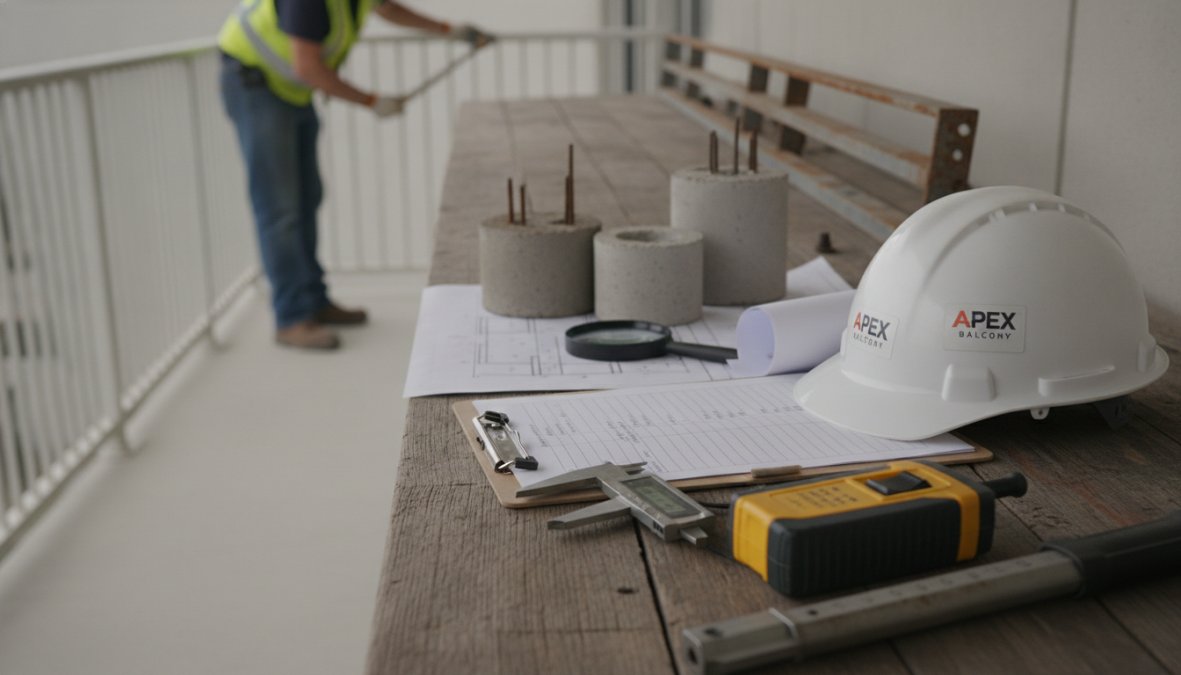
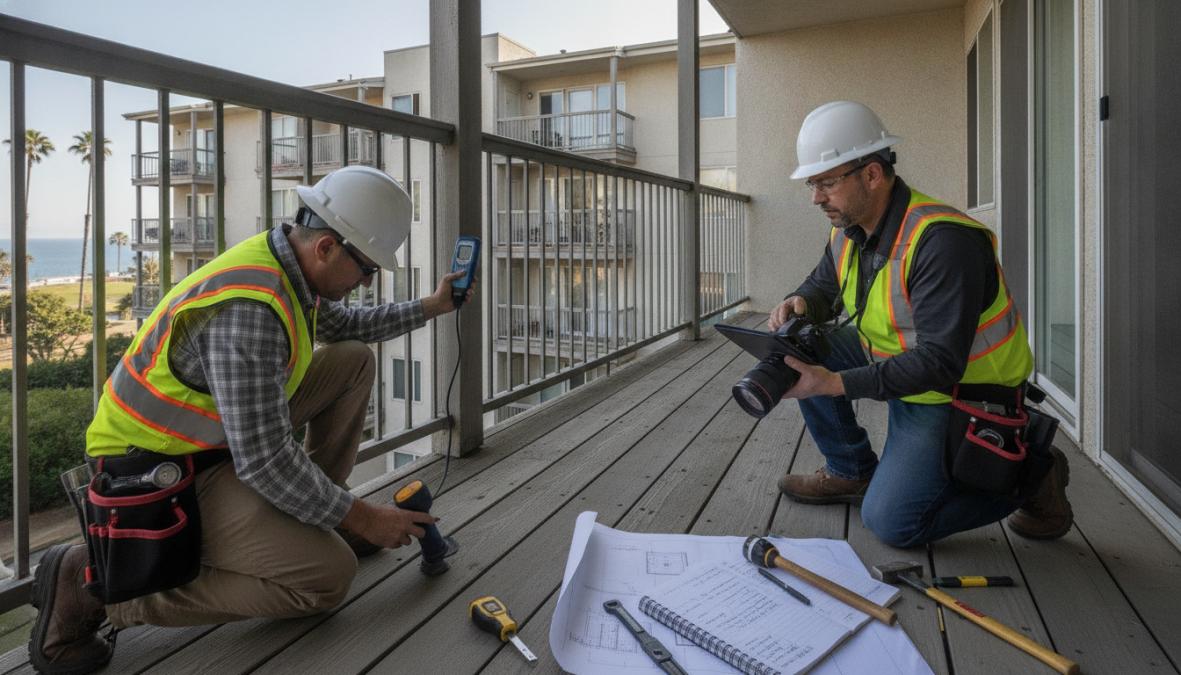
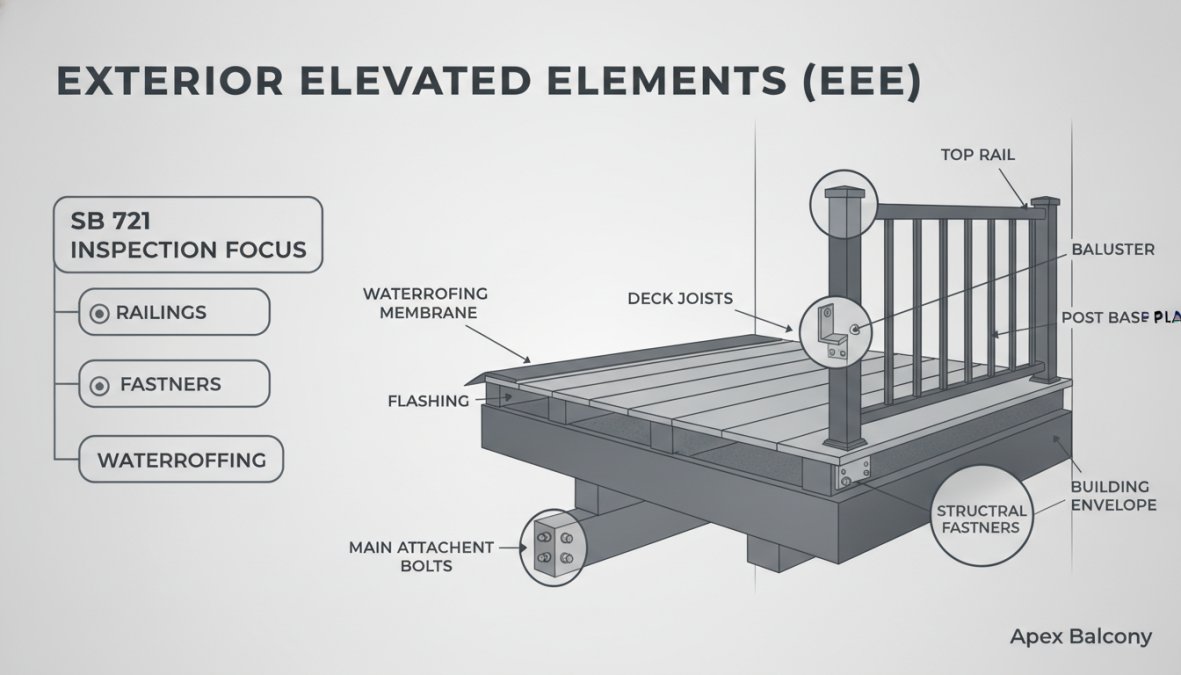
Process diagram showing steps for licensed and structural and engineer concepts for balcony structural compliance

What to Expect During the Inspection

A comprehensive structural assessment takes time. For a typical 30-unit building, expect the inspection to span 3-5 days, depending on balcony complexity and accessibility. The engineer will examine every exterior elevated element, including decks, stairways, and any cantilevered slabs.

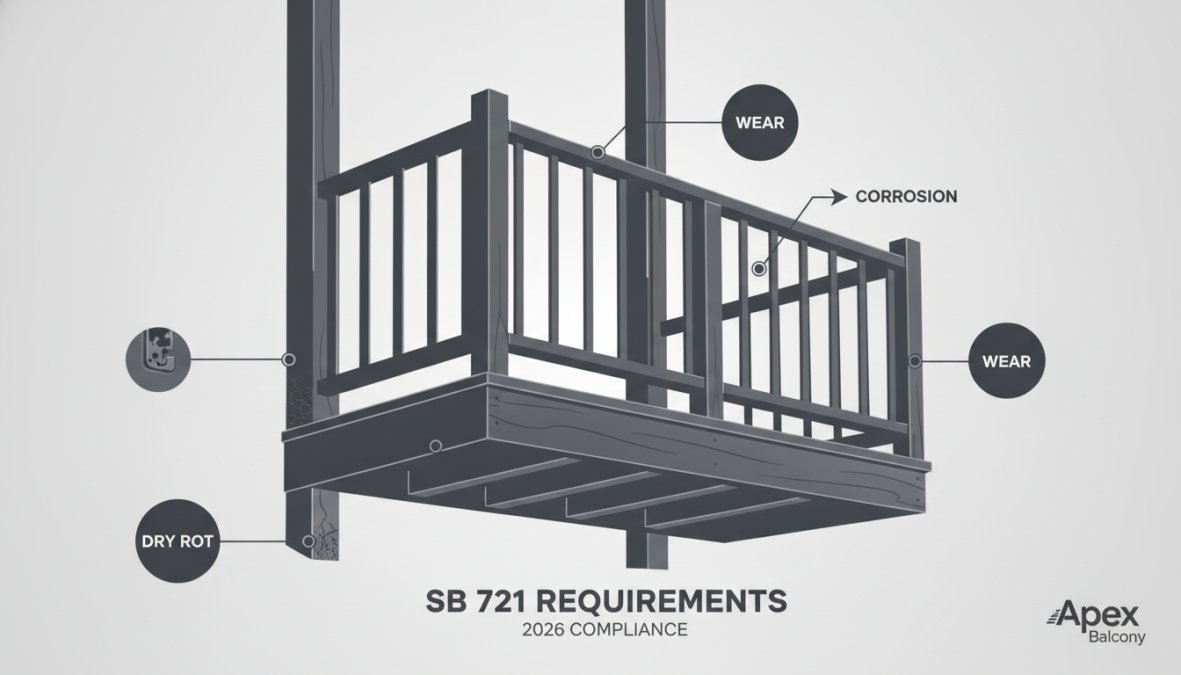
The inspection process includes both visual assessment and often subsurface testing. The engineer will look for visible signs of deterioration: dry rot in wood framing, corrosion on steel reinforcement, delamination in concrete, and failed waterproofing. They’ll measure concrete cover over rebar using specialized equipment, assess railing safety, and evaluate anchorages where balconies connect to the main structure.

Watch Out
Some inspectors use invasive testing methods that leave exposed framing and water damage. Ask your engineer upfront about their approach to subsurface testing. Non-destructive testing methods like ultrasonic pulse echo and cover meters can assess structural integrity without creating new problems.

The engineer will document findings in a detailed inspection report that becomes your compliance record and roadmap for repairs.

Step 3: Conduct a Comprehensive Balcony Inspection Checklist

While the licensed engineer handles the technical assessment, a structured checklist ensures nothing gets missed. A comprehensive balcony inspection checklist should cover every component of the exterior elevated element system.

Key Areas to Evaluate

Start with the structural framing, the beams, joists, and connections that carry the load. These must be free of dry rot, corrosion, and cracking. Next, examine the concrete slab itself for cracks, spalling, delamination, and loss of bearing capacity.

Waterproofing and drainage are critical. Water infiltration is the single most common cause of balcony failure. Check the membrane, flashing, and drainage systems for standing water, staining, or evidence of water penetration into the structure below.

Railings and guardrails must meet current code requirements, withstanding 200 pounds of force applied horizontally at any point. Check connections, structural integrity, and whether the railing height and spacing comply with current building codes.

Anchorages, where the balcony connects to the building, are essential to evaluate. These connections transfer all the load from the balcony to the main structure. Corrosion, loose bolts, or failed welds represent serious structural hazards.

A practical inspection checklist should document concrete condition, rebar exposure or rust staining, waterproofing membrane condition, drainage system functionality, railing safety and code compliance, connection integrity at anchorages, and evidence of water intrusion in units below.

Step 4: Assess Waterproofing and Drainage Requirements for Long-Term Safety

Waterproofing is where most balcony failures originate. Water infiltration causes rebar corrosion, concrete deterioration, and wood rot. A balcony with perfect structural design but failed waterproofing will fail within years.

California’s wet climate makes waterproofing non-negotiable. The waterproofing system must be continuous, with no breaks or gaps. Common waterproofing methods include liquid-applied membranes, sheet membranes, and traffic-rated coatings.

Common Waterproofing Failures and Solutions

Deteriorated membranes are the most common failure. Older balconies often have tar-based or asphalt membranes that have hardened and cracked over decades. These need replacement with modern, flexible membranes that accommodate structural movement.

Failed flashing, the thin metal transitions at edges and penetrations, allows water to bypass the main membrane. Improper flashing installation or corrosion compromises the entire waterproofing system.

Inadequate drainage creates standing water that accelerates deterioration. The balcony slab must slope toward drains or edges so water doesn’t pool. Many balcony failures trace back to simple drainage neglect, clogged drains that allowed water to sit on the slab.

Key Takeaway
The best waterproofing system is useless if drainage fails. Even a properly installed membrane will fail if water sits on the balcony instead of flowing away. Slope and drainage design are as important as membrane selection.

Modern waterproofing systems, when properly installed, should last 15-20 years before needing replacement.

Step 5: Understand Balcony Safety Regulations and Load-Bearing Requirements

Balcony safety regulations exist because structural failure kills people. California Building Code establishes specific requirements for load-bearing capacity, railing strength, and material standards. Your balcony must meet these requirements regardless of its age.

Residential balconies must support a minimum live load of 40 pounds per square foot. The balcony must safely handle not just the average load, but worst-case scenarios. Structural integrity means the balcony can support these loads without excessive deflection or failure. Material degradation, corrosion, rot, and cracking reduce capacity.

Railing Safety and Anchorage Standards

Railings must be at least 42 inches high and capable of resisting 200 pounds of horizontal force applied at any point. The vertical spacing of balusters must not allow a 4-inch sphere to pass through, preventing child entrapment.

Anchorages, the connections between the balcony and the building, must transfer all structural loads safely. Bolts must be properly sized and tightened. Welds must be inspected for cracks or incomplete fusion. Corrosion at anchorages is particularly dangerous because it reduces connection strength without being immediately visible.

California Building Code requirements for exterior elevated elements and railings specifies exact standards for these components. Your inspector will verify compliance with current code, not just the code that existed when the building was constructed.

Step 6: Obtain Permits and Submit Your Inspection Report

Once your inspection is complete, you have a detailed report identifying deficiencies. The next step is submitting this report to your local building department and obtaining permits for any required repairs.

The inspection report serves as your compliance documentation. It must include specific findings about structural condition, code compliance, and recommendations for repairs.

Permit Application Essentials

Building permits for balcony repairs require submitting the inspection report along with repair plans prepared by a licensed engineer or architect. Plans must demonstrate that repairs will bring the balcony into compliance with current building code.

The permit application process generally includes the completed inspection report, repair plans with engineer stamp, contractor information and licensing, cost estimate for repairs, timeline for completion, and notice of violation response if applicable. Processing times range from two weeks to two months depending on your local building department’s workload.

Pro Tip
Many building departments now accept digital permit applications. Submitting online can accelerate the process by 1-2 weeks compared to in-person submission.

Once permits are issued, you can begin repairs.

Step 7: Complete Repairs and Structural Remediation

Repairs range from minor waterproofing touch-ups to complete balcony reconstruction, depending on what the inspection revealed. Common repairs include waterproofing membrane replacement, railing upgrades, rebar corrosion mitigation, concrete repair or replacement, and connection reinforcement. Each repair must be performed according to the approved plans and current building code standards.

The contractor performing repairs must be licensed and experienced in balcony work. Specialized balcony contractors understand the nuances of waterproofing, load paths, and code compliance.

Repair timelines depend on scope. Minor waterproofing work might take one week. Complete balcony replacement can take 4-8 weeks. Weather impacts the schedule; waterproofing and coating work cannot be done in rain.

Budgeting for Repairs and Post-Inspection Maintenance

Repair costs vary dramatically based on what the inspection reveals. A building with well-maintained balconies might need only waterproofing touch-ups costing a few thousand dollars per unit. A building with widespread structural deterioration could require $15,000-$40,000 per unit in repairs.

Post-inspection maintenance is critical to extending balcony life. Annual inspections of waterproofing, drainage, and railing condition catch problems early. Keeping drains clear, addressing small cracks promptly, and maintaining sealants prevents small issues from becoming major failures.

Maintenance TaskFrequencyImpactCost Range
Drain cleaningQuarterlyPrevents water pooling$200-$500
Sealant inspectionAnnuallyCatches membrane failure early$300-$800
Railing tighteningEvery 2 yearsMaintains safety standards$150-$400
Membrane recoatingEvery 5-7 yearsExtends waterproofing life$2,000-$5,000
Full structural assessmentEvery 9 yearsMeets legal requirement$3,000-$8,000

Creating a maintenance schedule prevents emergency repairs. Buildings that maintain their balconies proactively spend significantly less over time than those that react to failures.

Step 8: Document Compliance and Maintain Records

The final step in the 8 steps to balcony structural compliance is documentation. You must maintain records showing that you’ve met all legal requirements: inspection completion, repair execution, permit issuance, and ongoing maintenance.

Documentation proves compliance to building departments during enforcement actions. It protects you legally if a resident is injured, showing you took reasonable steps to maintain safe conditions. It helps with insurance claims and provides continuity when building management changes.

Your compliance file should include the inspection report, repair permits, contractor invoices, completion certificates, and maintenance records. Digital storage with backup copies ensures these critical documents survive office transitions and staff changes.

California Department of Housing and Community Development guidance on SB 721 compliance documentation clarifies what records must be maintained and for how long. Generally, inspection reports and repair documentation should be kept for the full nine-year inspection cycle.

Many building owners use property management software to track maintenance schedules and inspection dates. When the nine-year cycle approaches, the system alerts you to schedule the next inspection.


Balcony structural compliance is an ongoing responsibility that protects your residents and your property. The inspection reveals what needs fixing, but your commitment to maintenance determines whether those fixes last. Compliance transforms from a source of anxiety into a managed, documented process that protects your residents and preserves your property value.

Frequently Asked Questions

What is the difference between SB 721 and SB 326 balcony inspection requirements?

SB 326 applies to residential buildings with three or more units built before January 1, 2008, requiring initial inspections by January 1, 2025. SB 721 applies to non-residential buildings and residential buildings built after 2008. Both require inspection of Exterior Elevated Elements (EEE) including balconies, decks, and stairways. Understanding which law applies to your property is the first step to balcony structural compliance. Contact your local building department if unsure which applies to you.

What should be included in a comprehensive balcony inspection checklist?

A thorough balcony inspection checklist must evaluate structural integrity, waterproofing, drainage systems, railing safety, anchorage connections, concrete cover depth, corrosion indicators, dry rot, material degradation, load-bearing capacity, and live load requirements. Inspectors examine visible surfaces for cracks, spalling, and water damage, then conduct subsurface testing using non-destructive methods. The inspection report documents findings and recommends structural remediation where needed. Professional inspectors use standardized checklists to ensure no critical elements are missed during the assessment.

How much does balcony structural compliance typically cost?

Inspection costs and repair expenses vary based on building size, age, and condition. For pricing details on inspection services, contact Apex Balcony for a custom quote tailored to your property. Repair costs depend on the extent of structural damage, waterproofing needs, and material replacement required. Many property owners budget conservatively and plan for contingencies. Apex Balcony provides transparent estimates and helps you understand repair priorities to manage costs effectively while ensuring safety and code compliance.

What are the penalties for failing to comply with SB 721 or SB 326 inspection requirements?

Non-compliance with California balcony inspection laws can result in Notice of Violation citations, fines, and enforcement actions from local building departments. Property owners face potential liability if structural failure occurs and injuries result. In severe cases, buildings may be deemed unsafe and restricted from occupancy. Penalties escalate for repeated violations. The Malibu balcony collapse (May 2021) and Berkeley incident (2015) highlight the serious consequences of neglected balcony maintenance. Staying compliant protects residents and shields property owners from legal and financial liability.

Who can legally perform a balcony structural inspection under California law?

California law requires a licensed professional engineer (PE) or architect to conduct balcony structural inspections and certify compliance. Inspectors must have expertise in structural engineering and building code requirements specific to Exterior Elevated Elements. Licensed professionals assess structural integrity, material degradation, waterproofing, and load-bearing capacity. They produce detailed inspection reports and recommend remediation. Apex Balcony employs licensed inspectors with decades of construction and design experience to ensure thorough, compliant assessments that hold up under audit or litigation.
Posted in BlogLeave a Comment on 8 Steps to Balcony Structural Compliance in California

Early SB 721 Compliance: Financial & Legal Benefits

Posted on July 20, 2026 by Apex Balcony admin
Early SB 721 Compliance: Financial & Legal Benefits

Table of Contents

  • Why Early SB 721 Compliance Matters: Beyond Legal Obligation
  • Financial ROI of Early SB 721 Compliance: Protecting Your Reserve Fund
    • Avoiding Emergency Repair Costs
    • Spreading Compliance Costs Over Time
  • SB 721 Inspection Requirements: The Foundation of Early Detection
  • SB 721 Deadlines and Compliance Timeline: Planning Your Inspection Cycle
  • SB 721 Penalties for Non-Compliance: What’s at Stake
  • SB 721 Compliance Checklist: Step-by-Step Vendor Selection & Implementation
    • How to Select a Licensed Professional
    • Tenant Communication Strategy
    • Integrating Inspection Findings Into Long-Term Capital Planning
  • Liability Mitigation and Legal Protection Through Proactive Action
  • Conclusion: Early Action Protects Assets, Residents, and Your Bottom Line

Last Updated: July 20, 2026

Why Early SB 721 Compliance Matters: Beyond Legal Obligation

Early SB 721 compliance protects residents, preserves structural integrity, and safeguards financial reserves. Property owners who act proactively spend significantly less than those who delay until enforcement action forces their hand.

SB 721 requires owners of multifamily residential buildings to conduct professional inspections of exterior elevated elements, balconies, decks, stairs, and walkways, and certify compliance. But the law is just the starting point. The real opportunity lies in using inspection as a strategic asset protection tool.

When you delay, minor issues compound. Waterproofing failures costing $5,000 today become $25,000 problems in two years. You also lose negotiating power: emergency repairs command premium pricing, and contractors prioritize scheduled work over crisis jobs. Early compliance flips this dynamic. You control the timeline, scope, and budget while eliminating liability exposure that comes from knowing about a safety defect and doing nothing.

According to California Department of Housing and Community Development guidance on SB 721, building owners bear full responsibility for structural safety once aware of defects. That awareness triggers a legal duty to repair. Early inspection and documented remediation is your legal shield.

Key Takeaway
Early SB 721 compliance transforms inspection from a compliance checkbox into a financial and legal strategy that protects your assets, residents, and reputation.

Financial ROI of Early SB 721 Compliance: Protecting Your Reserve Fund

The financial case for early compliance is straightforward: controlled spending beats emergency spending every time.

Avoiding Emergency Repair Costs

Structural deterioration follows a predictable pattern. Waterproofing fails, water intrudes, framing rots, and corrosion accelerates. Early inspection catches problems at stage one or two. A membrane repair or minor framing reinforcement costs thousands. The same building owner who delays until visible structural damage faces demolition and reconstruction, costs exceeding $50,000 per unit.

Emergency repairs disrupt tenant occupancy, trigger insurance claims that increase premiums, create liability exposure, and damage your reputation. Early inspection means working with a licensed professional who documents exactly what they find and what it means for safety. You have time to plan repairs, budget them properly, and execute them on your schedule.

Spreading Compliance Costs Over Time

Most owners think of SB 721 compliance as a single cost: the inspection fee. The real benefit of early action is spreading total compliance costs across multiple budget cycles instead of absorbing them in one catastrophic year.

Consider a 20-unit building where inspection reveals dry rot in three balconies, waterproofing failures on two others, and minor corrosion on stairway railings. Total repair estimate: $120,000. An owner who planned early can budget $30,000 in year one for critical repairs, $35,000 in year two, $25,000 in year three, and $30,000 in year four. This staged approach preserves your reserve fund, avoids special assessments, and prevents deferred maintenance cascades.

Pro Tip
Schedule your SB 721 inspection at the start of your fiscal year, not the end. This gives you maximum time to budget repairs and integrate them into your long-term capital plan.

SB 721 Inspection Requirements: The Foundation of Early Detection

SB 721 defines "exterior elevated elements" broadly: balconies, decks, stairs, walkways, and any structural element that rises above ground and could cause injury if it failed.

The inspection focuses on load-bearing components and their connections. A licensed architect or structural engineer examines framing and structural members for rot, corrosion, or damage; connections and fasteners for deterioration; waterproofing membranes and flashings for breaches; guardrails for code compliance; and overall structural integrity under design loads.

The inspector produces a certification document listing all findings and categorizing them by urgency. Some require repair within 120 days; others can be addressed in the next maintenance cycle. Early inspection catches problems while still minor. A waterproofing failure identified in year one can be patched; the same failure in year three has caused framing damage requiring structural repair.

Research from American Society of Civil Engineers on structural assessment best practices shows early identification of structural issues reduces overall remediation costs by 40-60% compared to emergency repairs by preventing secondary damage.

SB 721 Deadlines and Compliance Timeline: Planning Your Inspection Cycle

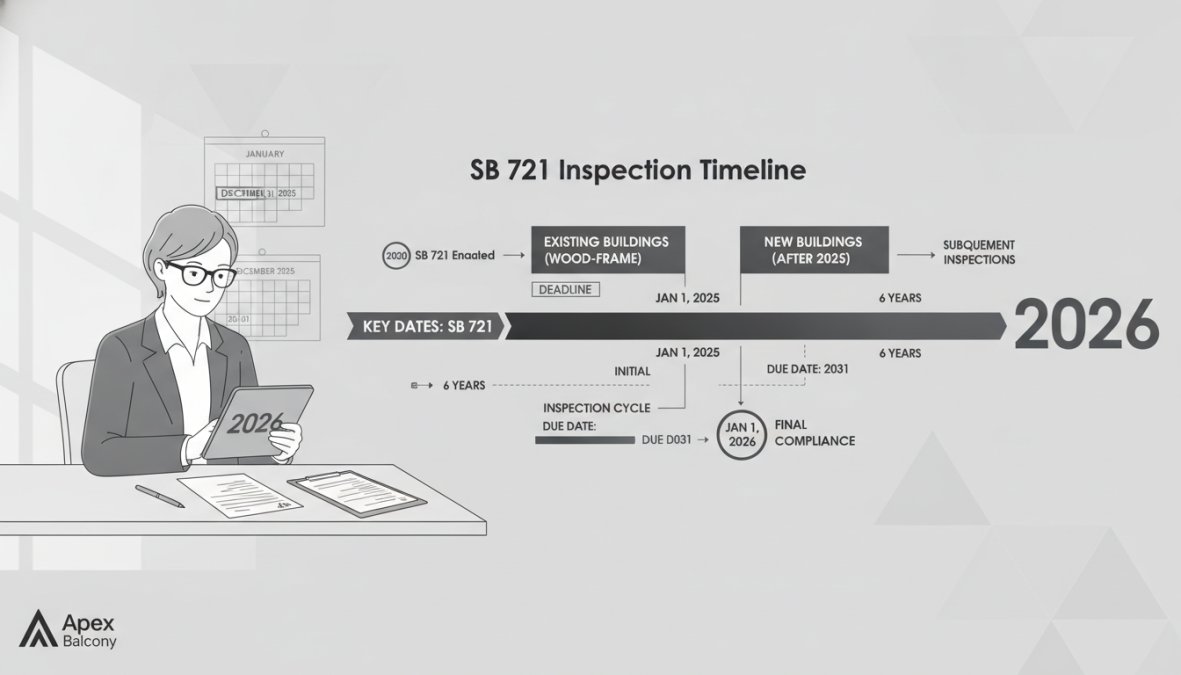
SB 721 compliance operates on a strict timeline. The law requires reinspection every six years from your last inspection date.

If your building was inspected in 2022, you must reinspect by 2028. Don’t wait until year five of your six-year cycle to schedule reinspection. Instead, plan for year four. This gives you two years to address findings before the next deadline and prevents the scenario where reinspection reveals urgent repairs with only months to complete them.

For repairs identified as urgent, the law provides a 120-day repair window from notification. Early inspection gives you clarity on what’s truly urgent versus routine maintenance. Once repairs are complete, you must obtain a new certification from a licensed professional confirming defects have been remedied.

Early compliance means your inspection and repair cycle is predictable and integrated into capital planning. Emergency compliance means scrambling to meet deadlines while managing unexpected costs.

Watch Out
If your last SB 721 inspection was more than 5 years ago, schedule your reinspection immediately. Waiting until year six leaves no time to address findings before the deadline.

SB 721 Penalties for Non-Compliance: What’s at Stake

Building owners who fail to conduct required inspections face civil penalties from local enforcement agencies starting at hundreds of dollars per day and escalating into thousands. For a 50-unit building missing the reinspection deadline by 60 days, accumulated penalties can reach $30,000 or more.

If a defect exists and you fail to repair it within 120 days, you face liability for any injuries that result. A balcony collapse creates premises liability claims that can exceed insurance coverage and create personal liability for board members. Insurance implications compound the problem: if your building suffers structural failure and the insurer discovers SB 721 non-compliance, they may deny your claim or cancel your policy.

Early compliance eliminates these risks. You have documented inspections, compliance certification, and a repair plan. If a problem occurs, you have evidence that you acted responsibly and in good faith.

SB 721 Compliance Checklist: Step-by-Step Vendor Selection & Implementation

Implementing early SB 721 compliance requires a structured approach.

Phase One: Assessment and Planning

  • Determine your building’s current inspection status
  • Confirm your reinspection deadline
  • Review capital reserves for potential repair budgets
  • Identify which balconies, decks, stairs, and walkways are subject to SB 721

Phase Two: Vendor Selection

  • Identify licensed architects or structural engineers with SB 721 experience
  • Request references from at least three firms
  • Request detailed scope of work and timeline
  • Confirm insurance coverage and licensing status

Phase Three: Inspection and Reporting

  • Schedule inspection to minimize tenant disruption
  • Ensure inspector has access to all exterior elevated elements
  • Review inspection report and request clarification
  • Obtain compliance certification

Phase Four: Repair Planning

  • Categorize findings by urgency
  • Obtain repair estimates from qualified contractors
  • Integrate repairs into capital budget across multiple fiscal years
  • Communicate findings and repair plans to board and residents

How to Select a Licensed Professional

Start by asking for references and calling previous clients about the inspector’s thoroughness and communication. Verify licensing through the California Architects Board or Professional Engineers Board. Ask about their inspection process: do they use moisture meters, borescopes, and detailed photography? Request a sample report and review it for clarity, specificity, and professionalism.

Tenant Communication Strategy

Send a notice at least two weeks before inspection. Explain that the inspection is required by California law and is a safety measure. Emphasize that inspection doesn’t necessarily mean repairs are needed. After inspection, share a summary of findings and frame any issues in the context of the repair plan.

Integrating Inspection Findings Into Long-Term Capital Planning

After inspection, map all identified repairs onto your five-year capital budget. Prioritize by urgency and cost. Look for opportunities to bundle repairs to reduce mobilization costs. Use inspection findings to refine your reserve fund study. Document everything: inspection reports, repair estimates, and invoices become invaluable if you face a liability claim.

PhaseTimelineKey ActionImpact on Budget
AssessmentMonth 1Determine inspection status and deadlineClarifies urgency
Vendor SelectionMonth 1-2Choose licensed professionalSets inspection cost
InspectionMonth 2-3Conduct thorough examinationIdentifies repair needs
PlanningMonth 3-4Categorize findings and obtain estimatesEnables multi-year budgeting
Repair Phase 1Year 1Address urgent/critical itemsProtects safety, spreads costs
Repair Phase 2Year 2-3Complete secondary repairsManages cash flow
CertificationYear 3-4Obtain compliance certificationDocuments completion

Liability Mitigation and Legal Protection Through Proactive Action

Early SB 721 compliance is fundamentally a liability management strategy. Once aware of a structural defect in an exterior elevated element, California law imposes a duty to repair it. This duty arises the moment you know or should know about the problem.

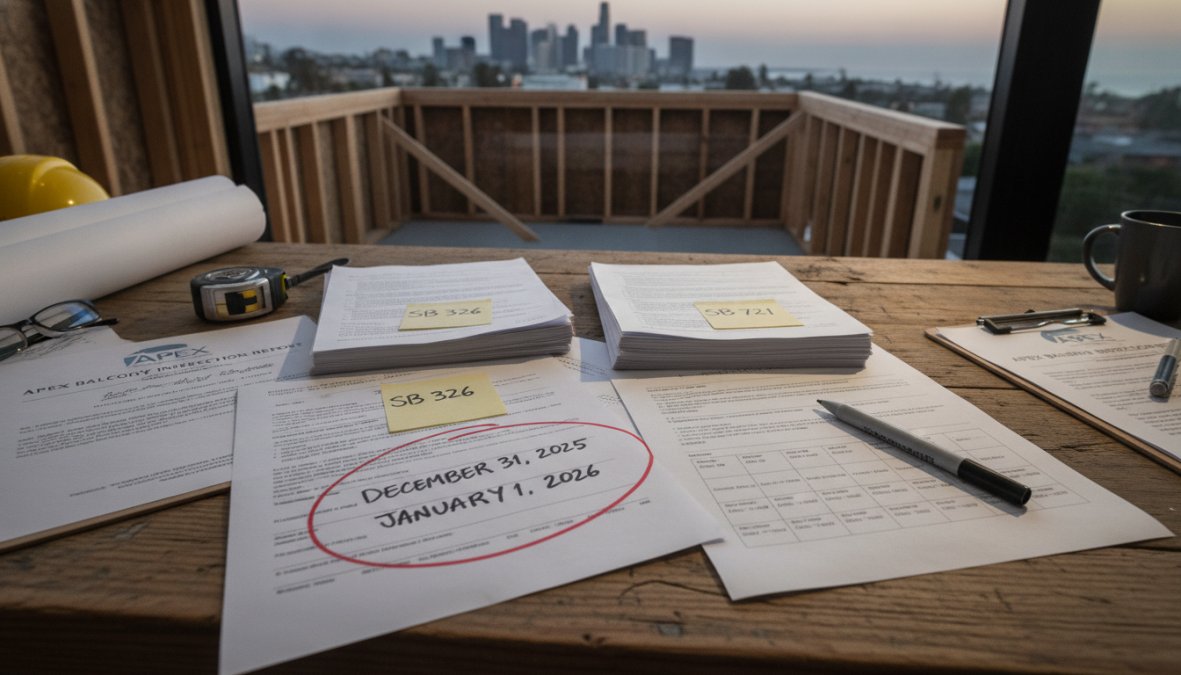
Software tools interface for Licensed for early SB 721 compliance

Early inspection converts this liability into a managed responsibility. You have a documented baseline, professional assessment of what’s safe, and a compliance certification. If a problem occurs after inspection and you’ve followed recommended repairs, you have evidence that you acted responsibly.

Compare this to the owner who delays inspection. If an incident occurs and the owner never inspected, they face liability for failing to discover a defect. If they inspected but didn’t repair, they face liability for knowing about the problem and ignoring it.

Insurance companies increasingly require compliance with local building codes and safety laws as a condition of coverage. Non-compliance with SB 721 can void your insurance or trigger non-renewal. Early compliance also protects board members personally: a board that conducted early inspection, documented findings, and implemented repairs has a strong defense against negligence claims.

Key Takeaway
Early SB 721 compliance creates a documented record of responsible ownership that protects you legally, financially, and operationally.

Conclusion: Early Action Protects Assets, Residents, and Your Bottom Line

Early inspection prevents minor problems from becoming major ones. It spreads repair costs across multiple budget cycles instead of creating a funding crisis. It protects you from liability exposure and insurance complications. It gives you control over your compliance timeline instead of letting enforcement action dictate it.

Don’t wait for enforcement action or structural failure to force your hand. Schedule your SB 721 inspection today and take control of your compliance strategy. Early action protects your residents, preserves your reserve fund, and keeps your property compliant and safe.

Book an inspection with Apex Balcony and get started protecting your building’s future.

Frequently Asked Questions

What are the penalties for not complying with SB 721?

Non-compliance with SB 721 can result in significant civil penalties assessed by local enforcement agencies. Beyond financial fines, property owners face escalating consequences: buildings can be cited for code violations, insurance premiums may increase substantially, and in worst-case scenarios, units may be deemed uninhabitable. Most critically, if a structural failure or resident injury occurs on non-inspected balconies, owners face severe liability exposure and potential legal action. Early SB 721 compliance eliminates these risks entirely.

What does an SB 721 inspection involve and why does early inspection prevent costly repairs?

An SB 721 inspection examines all exterior elevated elements (EEEs), balconies, decks, stairs, and walkways, for structural integrity issues including dry rot, termite damage, corrosion, waterproofing failures, and load-bearing defects. Licensed professionals assess damage severity and recommend repairs. Early inspection catches problems in their infancy: a small water intrusion found early costs far less to fix than structural rot discovered after years of damage accumulation. This proactive maintenance approach protects your building's structural integrity and keeps repair budgets predictable.

How do I know if my building needs SB 721 or SB 326 inspection?

SB 721 applies to multifamily residential buildings with exterior elevated elements (balconies, decks, stairs) that are more than six feet above ground. SB 326 covers similar properties but focuses on a different compliance timeline. The distinction matters for your inspection schedule. If you're unsure which applies, a licensed architect or structural engineer can quickly determine your building's classification. Most multifamily properties with balconies fall under SB 721. Early clarification ensures you meet the correct deadlines and avoid penalties.

What should I look for when selecting a vendor for SB 721 inspection?

Choose only licensed architects or structural engineers with specific experience in California balcony and exterior elevated element inspections. Verify they understand SB 721 and SB 326 requirements, have liability insurance, and can provide detailed compliance certification. Ask for references from similar-sized multifamily properties. Request clarity on their inspection process, damage minimization practices, and report comprehensiveness. Avoid vendors solely focused on identifying problems without understanding your building's long-term capital planning needs. A quality inspector becomes a strategic partner in protecting your asset.

Posted in BlogLeave a Comment on Early SB 721 Compliance: Financial & Legal Benefits

SB 326 vs SB 721 for Condominiums: Key Differences

Posted on July 19, 2026 by Apex Balcony admin
SB 326 vs SB 721 for Condominiums: Key Differences

Table of Contents

  • SB 326 vs SB 721 for Condominiums: What You Need to Know
    • Why This Matters for Property Owners and HOAs
  • What Is SB 326 and What Is SB 721?
    • SB 326: The Original Balcony Safety Law
    • SB 721: Expanded Requirements for All Properties
  • Key Differences Between SB 326 and SB 721
    • Applicability and Property Types
    • Exterior Elevated Elements (EEE) Scope
    • Inspection Timeline and Frequency
  • EEE Inspection Requirements California: What Gets Inspected
    • Defining Exterior Elevated Elements
    • What Inspectors Look For
  • HOA Compliance SB 326: Mandatory Inspection and Reporting
    • Inspection Report Requirements
    • Documentation and Record Retention
  • SB 721 Deadlines: Critical Compliance Dates for Condominiums
    • Initial Inspection Deadlines
    • Periodic Inspection Schedule
  • Balcony Inspection Report Requirements: Documentation Standards
    • What Must Be Included in Reports
    • Licensed Professional Requirements
  • Consequences of Non-Compliance and Liability Mitigation
    • Fines, Penalties, and Legal Exposure
    • Insurance and Liability Protection

Last Updated: July 19, 2026

SB 326 vs SB 721 for Condominiums: What You Need to Know

When the Malibu balcony collapse killed six people in May 2021, California property owners faced a wake-up call. The state responded with two critical laws that fundamentally changed how residential buildings must maintain their exterior structures. Understanding sb 326 vs sb 721 for condominiums is no longer optional, it’s a legal and safety imperative that affects every multi-family property in the state.

Most HOA boards initially don’t know which law applies to them, what deadlines they’re facing, or what happens if they miss compliance. Non-compliance can result in fines, liability exposure if injuries occur, and forced special assessments to cover emergency repairs.

Pro Tip
Many property managers assume they only need to comply with one law. In reality, SB 721 expanded SB 326’s requirements, meaning most condominiums must follow both frameworks simultaneously. The key is understanding which parts apply to your specific property.

Why This Matters for Property Owners and HOAs

These laws mandate proactive inspection before catastrophic failure occurs. For your building, this means regular professional assessments of every balcony, deck, stairway, and elevated outdoor area.

The financial impact is substantial. A typical condominium with 50 units might face inspection costs ranging from a few thousand dollars, plus potential repair assessments that can reach tens of thousands. However, catching issues early through mandatory inspections typically costs far less than emergency repairs or litigation following an accident.

According to [California Department of Consumer Affairs guidance on SB 326(/hoa-compliance-services-strategies/) and SB 721 compliance | dca.ca.gov], property managers who establish inspection schedules early and maintain detailed records significantly reduce their legal exposure.

Key Takeaway
The real cost of non-compliance isn’t just fines, it’s the potential liability if someone is injured on a balcony your building failed to inspect or repair properly.

What Is SB 326 and What Is SB 721?

SB 326: The Original Balcony Safety Law

Senate Bill 326, which took effect January 1, 2019, was California’s first statewide mandate for balcony safety inspections. It applied to residential buildings with three or more units built before January 1, 2008. The law required property owners to hire a licensed architect or structural engineer to inspect all Exterior Elevated Elements (EEE), primarily balconies, and report findings to the building’s governing body.

SB 326 mandated an initial inspection within a specific timeframe and then periodic re-inspections every nine years. Any element found to be in "poor condition" or presenting a "safety hazard" had to be reported, and the building had to develop a plan to address the issue.

SB 721: Expanded Requirements for All Properties

Senate Bill 721, which became effective January 1, 2022, addressed SB 326’s limitations. It expanded the mandate to cover ALL residential buildings with three or more units, regardless of construction date. More importantly, it broadened the definition of what must be inspected to include any Exterior Elevated Element: decks, stairways, railings, and other load-bearing components.

SB 721 also tightened the inspection timeline. While SB 326 allowed nine years between inspections, SB 721 requires inspections every six years for buildings that have had repairs, and every nine years for those in good condition.

Key Differences Between SB 326 and SB 721

Applicability and Property Types

The most fundamental difference is scope. SB 326 applies only to residential buildings with three or more units constructed before January 1, 2008. SB 721 applies to all residential buildings with three or more units, regardless of construction date.

A condominium built in 2010 would have had no balcony inspection mandate under SB 326. Under SB 721, it must comply fully. SB 721 also expanded applicability to Common Interest Developments (CIDs) beyond traditional condominiums, including planned unit developments and townhome communities.

RequirementSB 326SB 721
Applies to buildings built before 2008YesYes
Applies to buildings built after 2008NoYes
Covers balconies onlyYesNo
Covers all EEE (decks, stairs, railings)NoYes
Applies to residential 3+ unitsYesYes
Applies to Common Interest DevelopmentsLimitedYes

Exterior Elevated Elements (EEE) Scope

SB 326 focused narrowly on balconies. SB 721 broadened the definition significantly. Exterior Elevated Elements now include balconies, decks, patios, walkways, exterior stairs, railings, guardrails, and any other load-bearing structural component that is elevated above ground and exposed to the exterior environment.

Inspection Timeline and Frequency

SB 326 required an initial inspection by January 1, 2020, with re-inspections every nine years. SB 721 compressed this timeline: for buildings in poor condition or with repairs needed, inspections must occur every six years; for buildings in good condition, the nine-year cycle applies. The initial inspection deadline for post-2008 buildings was January 1, 2025.

EEE Inspection Requirements California: What Gets Inspected

Defining Exterior Elevated Elements

Exterior Elevated Elements are any structural components that are elevated above ground, exposed to the exterior environment, and support human occupancy or passage. This includes balconies, decks, patios, exterior stairs, railings, guardrails, and any load-bearing components attached to these structures.

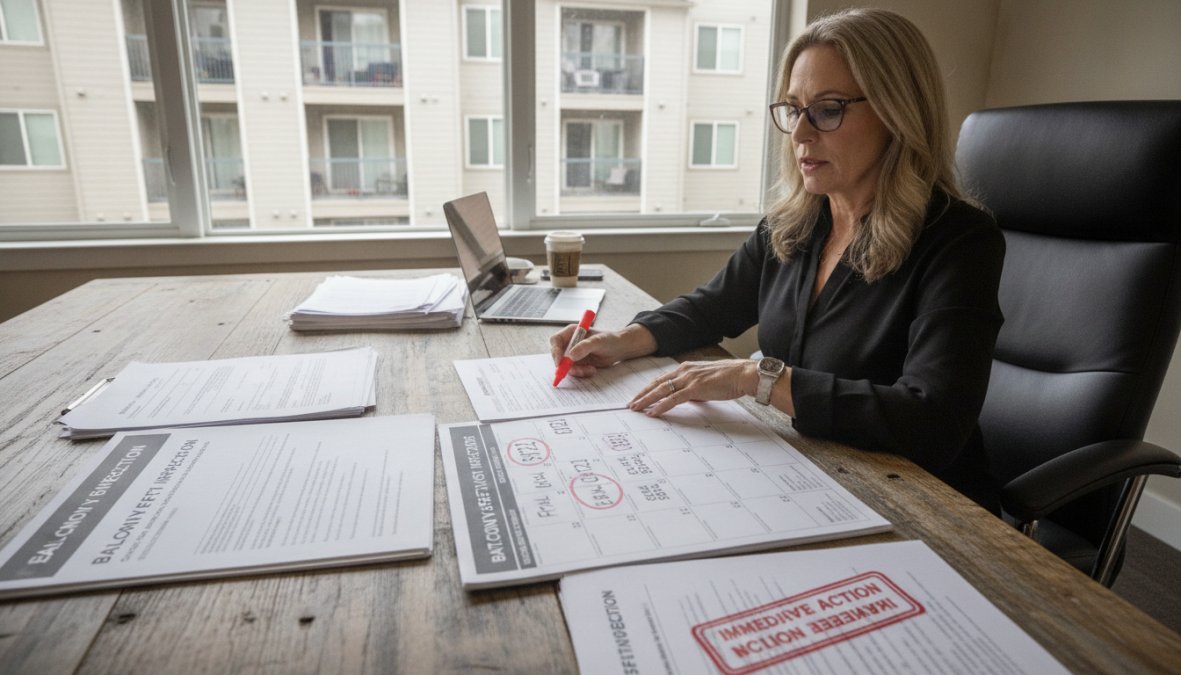
Professional illustration showing Licensed for sb 326 vs sb 721

What Inspectors Look For

A licensed architect or structural engineer conducting an EEE inspection examines wood for dry rot and termite damage using specialized tools. They check fastener corrosion, testing bolts and brackets for strength. They evaluate waterproofing and sealants, which are often the first line of defense against water intrusion that leads to wood decay. The inspection also includes load-bearing capacity assessment by reviewing original construction documents, testing fastener strength, or calculating load paths.

According to California Residential Code requirements for exterior elevated elements, inspectors must document their findings in a standardized report format that includes photographs, specific location descriptions, severity ratings, and recommendations for repair or further evaluation.

Watch Out
Many building owners attempt informal inspections or hire general contractors instead of licensed professionals. This is a compliance violation. Only a licensed architect or structural engineer can produce a report that satisfies SB 326 or [SB 721](/sb-721-inspection-timeline-owners-2026-guide/) requirements.

HOA Compliance SB 326: Mandatory Inspection and Reporting

Inspection Report Requirements

The inspection report is your building’s legal record of structural condition. It must be detailed enough to defend you in court if a claim arises and must comply with specific statutory requirements.

A compliant report must include the inspector’s name, license number, and signature; the property address and inspection date; a description of each Exterior Elevated Element inspected, including its location and current condition; and a classification of each element as "Good Condition," "Fair Condition," or "Poor Condition." Elements in Poor Condition or presenting a Safety Hazard must be flagged with specific repair recommendations. The report should include photographs showing the location and condition of each element.

Documentation and Record Retention

Your building’s governing body must retain the inspection report for at least 18 years. The report must be provided to unit owners within 30 days of completion. Maintain records of any repairs completed, the contractor who performed them, the cost, and the completion date.

Pro Tip
Create a dedicated folder for all inspection reports, repair invoices, and correspondence related to EEE compliance. This single organized file becomes your primary defense if your building ever faces a claim.

SB 721 Deadlines: Critical Compliance Dates for Condominiums

Initial Inspection Deadlines

For buildings subject to SB 326, the initial inspection deadline was January 1, 2020. For buildings constructed after January 1, 2008, the SB 721 initial inspection deadline was January 1, 2025. If your building missed this deadline, you are now in violation and should schedule an inspection immediately.

Periodic Inspection Schedule

After the initial inspection, SB 721 requires re-inspections on a schedule based on condition:

  • Good Condition: Re-inspection every nine years
  • Fair Condition: Re-inspection every six years
  • Poor Condition or Safety Hazard: Immediate repair and re-inspection after repairs are completed

A building that had a SB 326 inspection in 2019 and was found in Good Condition would normally be due for re-inspection in 2028 under SB 326’s nine-year cycle. However, if any repairs were made, the six-year cycle kicks in, making the building due for re-inspection in 2025.

Balcony Inspection Report Requirements: Documentation Standards

What Must Be Included in Reports

A compliant inspection report must be a professional document that can withstand legal scrutiny. The report must include the inspector’s professional credentials, inspection date, property address, and a detailed description of each Exterior Elevated Element examined. For each element, the report must state its location, dimensions, and current condition, describe any defects found including type and severity, and include a condition rating with specific recommendations for repair or further evaluation.

Licensed Professional Requirements

Only a licensed architect or structural engineer can conduct an SB 326 or SB 721 inspection. The inspector must be licensed in California, with their license number appearing on the report along with their signature. When selecting an inspector, verify their license through the California Department of Consumer Affairs.

Consequences of Non-Compliance and Liability Mitigation

Fines, Penalties, and Legal Exposure

Non-compliance carries multiple consequences. Local building departments can issue citations for failure to conduct required inspections, ranging from hundreds to thousands of dollars per violation. More serious is liability exposure: if someone is injured on a balcony or deck that your building failed to inspect, your building could be liable for medical costs, pain and suffering, and potentially punitive damages.

The liability exposure exists even if your building wasn’t legally required to comply. If a balcony collapses and injures someone, a plaintiff’s attorney will argue that your building should have conducted an inspection regardless of legal requirements.

Insurance and Liability Protection

The best liability protection is compliance. A building that has current inspection reports, documented repairs, and a clear maintenance plan is far less attractive to a plaintiff’s attorney than one with missing inspections or ignored repair recommendations.

Insurance companies recognize this. Buildings that maintain current SB 326 and SB 721 compliance often receive better insurance rates and broader coverage. Keep copies of inspection reports, repair contracts, invoices, and completion photos. Keep records of HOA board meetings where compliance was discussed and notices sent to unit owners about inspection findings.

According to California Association of Realtors guidance on property liability and disclosure, properties with documented compliance histories and clear maintenance records sell more quickly and at higher prices than those with compliance questions.

Key Takeaway
Compliance isn’t just about [avoiding fines](/avoiding-fines-balcony-non-compliance-sb326-sb721/), it’s about protecting your building’s value, your insurance coverage, and your personal liability as a board member or property manager.

Choosing Between SB 326 and SB 721 Compliance

The question isn’t which law to follow, it’s understanding that SB 721 supersedes SB 326 for most properties. If your building has three or more residential units, SB 721 applies. If your building was constructed before January 1, 2008, SB 326 also applies, but SB 721’s requirements take precedence where they conflict.

Assume SB 721 applies to your building unless you’re certain it doesn’t. The cost of proactive compliance, typically a few thousand dollars for an inspection, is far less than the cost of emergency repairs, liability claims, or fines for non-compliance. Building owners who treat SB 326 and SB 721 compliance as a routine maintenance requirement rather than an optional task protect their residents and their assets.


Your building’s safety and legal compliance depend on understanding which requirements apply to you and meeting deadlines consistently. If you’re uncertain whether your property is fully compliant with SB 326 and SB 721, consult with a licensed architect or structural engineer who can review your building’s construction date, unit count, and structure type to determine your compliance obligations and conduct a comprehensive inspection.

Frequently Asked Questions

What is the main difference between SB 326 and SB 721?

SB 326 applies specifically to condominiums and common interest developments with three or more units built before January 1, 2008. SB 721 expanded these requirements to include all residential buildings with three or more units, regardless of age or type, and broadened the definition of Exterior Elevated Elements (EEE) to include balconies, decks, stairs, and other load-bearing components. SB 721 also introduced more stringent inspection frequencies and reporting standards.

Which buildings are subject to SB 326 vs SB 721 for condominiums?

SB 326 applies to condominiums and common interest developments with three or more units constructed before January 1, 2008. SB 721 applies to all residential buildings with three or more units (including multi-family rental properties and newer condominiums), making it broader in scope. If your condominium was built after January 1, 2008, you likely fall under SB 721 rather than SB 326. Always verify your property's construction date and structure type to determine which law applies.

What are the inspection requirements under SB 721 deadlines for my condominium?

Initial inspections under SB 721 must be completed by January 1, 2025, for buildings constructed before January 1, 2008, and by January 1, 2025, for newer buildings. After the initial inspection, periodic inspections are required every six years for buildings in good condition, or every three years if deficiencies are found. All inspections must be conducted by a licensed architect or structural engineer and documented according to California Building Code standards.

What are Exterior Elevated Elements (EEE) and why do they matter?

Exterior Elevated Elements (EEE) include balconies, decks, exterior stairs, and other structural components that extend from a building and are supported by load-bearing systems. These elements are vulnerable to water intrusion, dry rot, termite damage, and structural failure, which can create serious safety hazards for residents. SB 721 requires thorough inspection of EEE to identify defects early, preventing catastrophic failures and protecting building occupants from injury or death.

What happens if my HOA doesn't comply with SB 326 or SB 721?

Non-compliance can result in significant fines, legal liability, and personal liability for board members. If an accident or injury occurs due to neglected maintenance of balconies or EEE, your HOA and its board members may face lawsuits, insurance denial, and substantial financial penalties. Additionally, failure to maintain required inspection records can result in regulatory enforcement actions from the California Department of Consumer Affairs. Compliance protects both residents and the organization's financial stability.

Posted in BlogLeave a Comment on SB 326 vs SB 721 for Condominiums: Key Differences

SB 721 Penalties for Non-Compliance Explained

Posted on July 18, 2026 by Apex Balcony admin
SB 721 Penalties for Non-Compliance Explained

Table of Contents

  • What Is SB 721 and Why Penalties Matter
    • SB 721 vs. SB 326: Which Law Applies to Your Property
  • SB 721 Penalty Structure: Daily Fines and Enforcement
    • How the $100-$500 Daily Fine Scale Works
    • Beyond Fines: Stop-Use Orders and Building Liens
  • SB 721 Deadlines: Critical Inspection and Compliance Timelines
  • SB 721 Property Owner Responsibilities and What Triggers Non-Compliance
    • Exterior Elevated Elements (EEEs) You Must Inspect
  • How to Avoid SB 721 Penalties: Compliance Checklist and Action Plan
    • Step-by-Step Checklist for Property Managers
    • Working with Qualified SB 721 Inspectors
  • Consequences of Non-Compliance Beyond Daily Fines
    • Insurance Premium Impacts and Liability Exposure
    • Appeals Process for SB 721 Fines and Violations
  • Conclusion: Protecting Your Property and Residents

Last Updated: July 18, 2026

What Is SB 721 and Why Penalties Matter

California Senate Bill 721 requires property owners to inspect exterior elevated elements (EEEs) like balconies, decks, and stairways for structural safety. Violations carry escalating daily fines, stop-use orders, and serious liability exposure. The law emerged from high-profile balcony collapses, including a 2015 Berkeley balcony collapse that killed 6 people that spurred lawmakers to establish mandatory inspection standards.

SB 721 applies to residential buildings with three or more units built before January 1, 2020. Property owners who delay or ignore these requirements face financial penalties, building liens, stop-use orders that prevent resident occupancy, and potential criminal liability if someone is injured.

Pro Tip
Many property managers assume their building is exempt because it’s small or recently renovated. Check your building’s construction date and unit count directly, these are the only factors that determine SB 721 applicability. A 12-unit building constructed in 2019 is subject to SB 721, even if it underwent recent repairs.

SB 721 vs. SB 326: Which Law Applies to Your Property

SB 326 and SB 721 address similar issues but apply to different building types and timelines. SB 326 covers residential buildings with three or more units built before January 1, 2018, requiring inspections of common area balconies and decks. SB 721 applies to buildings built before January 1, 2020, and expands the scope to include exterior stairways, walkways, and other elevated elements that pose fall risks.

If your building was constructed before January 1, 2018, you likely fall under SB 326 first. If it was built between January 1, 2018, and December 31, 2019, SB 721 applies. Some older buildings must comply with both laws.

Building Construction DateApplicable LawInspection ScopeDeadline Status
Before January 1, 2018SB 326Balconies, decks in common areasDeadline passed (2020)
January 1, 2018 – December 31, 2019SB 721All EEEs including stairs, walkwaysOngoing compliance required
January 1, 2020 and laterNeither lawStandard building code appliesStandard maintenance only

Property owners who completed SB 326 inspections should not assume they’re SB 721 compliant. The newer law’s expanded scope means additional elements require evaluation.

Watch Out
Confusing SB 326 and SB 721 timelines is a common mistake that leads to missed deadlines. If you’re unsure which law applies, assume SB 721 and verify with your local building department.

SB 721 Penalty Structure: Daily Fines and Enforcement

SB 721 penalties escalate based on how long a violation persists. Understanding this structure is essential because penalties compound daily, turning a delayed inspection into a five-figure liability within weeks.

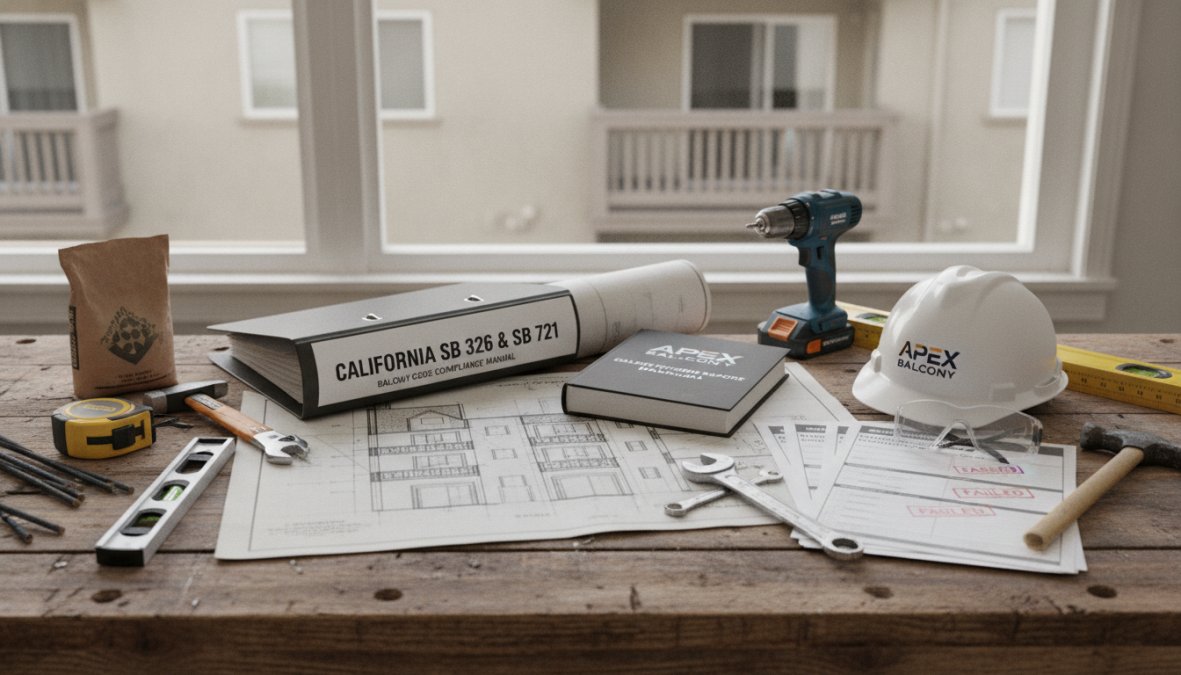
Professional illustration showing Licensed for SB 721 penalties

The penalty structure operates as follows:

First violation period (days 1-30): $100 per day for each violation
Second violation period (days 31-60): $200 per day for each violation
Third violation period (days 61+): $500 per day for each violation

A single building with three EEEs requiring inspection faces three simultaneous violations if inspections aren’t completed. That means $300 daily fines in the first month, $600 daily in the second month, and $1,500 daily thereafter. A property that misses a deadline by 90 days accumulates roughly $54,000 in fines before corrective action even begins.

Local enforcement agencies issue violation notices after inspections are overdue. The notice specifies which elements require inspection and sets a compliance deadline.

Key Takeaway
The cost of penalties often exceeds the cost of inspection and initial repairs combined. A $3,000 inspection fee paid on time is dramatically cheaper than $1,500 daily fines accumulating over months.

Beyond Fines: Stop-Use Orders and Building Liens

Daily fines are only the beginning. SB 721 non-compliance triggers additional enforcement mechanisms that can paralyze a building’s operations.

Stop-use orders prevent residents from accessing the affected element. If a balcony inspection reveals structural deficiencies, the city can issue an order prohibiting resident use until repairs are completed and re-inspected.

Building liens attach to the property when owners fail to pay penalties or comply with corrective action orders. A lien clouds the property’s title, complicating refinancing, sale, or loan modification. A property worth $2 million becomes unmarketable if a $50,000 SB 721 lien is recorded against it.

Corrective action orders mandate specific repairs within defined timelines. If a qualified inspector identifies water damage, wood rot, or structural cracks, the city issues an order requiring repairs by a licensed contractor.

SB 721 Deadlines: Critical Inspection and Compliance Timelines

For buildings constructed before January 1, 2020, the initial inspection deadline was January 1, 2025. This deadline has now passed, meaning any property that has not completed its first SB 721 inspection is currently in violation and accruing daily penalties.

After the initial inspection, follow-up inspections are required every six years. If an inspection identifies deficiencies requiring corrective action, re-inspection deadlines may be sooner, typically within one year of repair completion.

Watch Out
The January 1, 2025 initial inspection deadline has passed. If your property hasn’t been inspected yet, you’re in violation as of today. Contact a qualified SB 721 inspector immediately to begin the compliance process.

SB 721 Property Owner Responsibilities and What Triggers Non-Compliance

Property owners bear legal responsibility for SB 721 compliance, regardless of whether they manage the building directly or hire a property management company.

Non-compliance occurs when:

  • A required inspection is not completed by the deadline
  • An inspection is completed but documentation is not submitted to the local building department
  • Corrective action orders are issued but repairs are not completed by the specified deadline
  • Re-inspections required after repairs are not scheduled or completed

Qualified inspectors must be licensed structural engineers or certified building inspectors with specific SB 721 training. Using an unqualified inspector invalidates the inspection and leaves the property in violation.

Exterior Elevated Elements (EEEs) You Must Inspect

SB 721 defines exterior elevated elements broadly. EEEs include balconies and decks attached to residential units, exterior stairways and landings, walkways and elevated platforms, guardrails and railings on elevated surfaces, and any structural component more than 30 inches above grade that poses a fall risk.

Inspectors evaluate these elements for structural integrity, waterproofing, load-bearing capacity, and safety hazards. Common deficiencies include wood rot from water intrusion, corroded fasteners, cracked welds on steel components, and deteriorated concrete. A qualified SB 721 inspector examines not just the visible surface but also the structural frame, connection points, and underlying support systems.

How to Avoid SB 721 Penalties: Compliance Checklist and Action Plan

Avoiding SB 721 penalties requires a systematic approach.

Step 1: Verify your building’s SB 721 status. Contact your local building department and confirm your building’s construction date and unit count. Request any existing inspection records or compliance documentation.

Step 2: Hire a qualified SB 721 inspector. Verify that your inspector holds a current structural engineering license or SB 721 certification. Request references from other property managers.

Step 3: Schedule the inspection and notify residents. Provide at least 48 hours’ notice to residents that inspection access will be required.

Step 4: Complete the inspection and receive the report. A thorough inspection typically takes one to three days depending on building size.

Step 5: Submit inspection documentation to the city. Request written confirmation that the city received the documentation. Keep copies for your records.

Step 6: If deficiencies are identified, obtain repair estimates. Contact licensed contractors experienced in balcony and structural repairs. Obtain multiple estimates to understand repair scope and cost.

Step 7: Complete repairs and schedule re-inspection. Once repairs are finished, schedule a follow-up inspection to verify that work meets SB 721 standards.

Step 8: Schedule future inspections. Document your six-year reinspection deadline in your property management calendar.

Step-by-Step Checklist for Property Managers

  • Confirm building construction date and unit count with city records
  • Request existing SB 721 inspection documentation from previous owner or management
  • Identify all exterior elevated elements requiring inspection
  • Verify inspector’s SB 721 qualification and licensing
  • Schedule inspection with 48-hour resident notice
  • Attend inspection to document findings and ask clarifying questions
  • Receive final inspection report and review deficiency list
  • Obtain written confirmation that city received inspection documentation
  • If deficiencies exist, request repair cost estimates from three contractors
  • Submit corrective action plan to city if required
  • Complete repairs on schedule
  • Schedule and complete re-inspection after repairs
  • Submit re-inspection documentation to city
  • Document six-year reinspection deadline in property management system
  • Create annual compliance reminder 12 months before next inspection due date

Working with Qualified SB 721 Inspectors

Qualified inspectors hold either a current Professional Engineer (PE) license with structural engineering credentials or a California Building Inspector certification with SB 721 training. When evaluating inspectors, ask about years of SB 721 experience, familiarity with your local building department’s requirements, insurance coverage, typical inspection timeline and cost, and whether the inspector is willing to attend city meetings if questions arise about the inspection report.

Pro Tip
Ask potential inspectors for references from other property managers in your city. Local inspectors familiar with your building department’s specific expectations often produce reports that require fewer follow-up questions.

Consequences of Non-Compliance Beyond Daily Fines

Resident safety liability: If a resident is injured on a defective balcony or stairway that should have been inspected, the property owner faces personal injury lawsuits. Insurance may deny coverage if the property was in violation of SB 721 at the time of injury.

Difficulty selling or refinancing: Properties with unresolved SB 721 violations are difficult to sell or refinance. Lenders require proof of compliance before funding.

Insurance complications: Some insurers decline to renew policies for properties in SB 721 violation. Others increase premiums substantially. Properties in violation typically experience insurance premium increases of 10-25%, depending on the severity of deficiencies and the duration of non-compliance.

Resident complaints and turnover: Residents who discover their building is in violation may file complaints with local authorities, request rent reductions, or break leases.

Conclusion: Protecting Your Property and Residents

SB 721 compliance is not optional, it’s a legal requirement with serious financial and safety consequences. Property owners who understand the penalty structure, deadlines, and compliance process can avoid the escalating fines, liens, and liability exposure that plague unprepared buildings.

The path forward is straightforward: verify your building’s SB 721 status, hire a qualified inspector, submit documentation to your local building department, and address any deficiencies identified in the inspection report. This proactive approach costs significantly less than managing violations, penalties, and emergency repairs after structural failure occurs.


Protecting your residents and your property’s financial stability requires expert guidance through California’s complex balcony safety requirements. Apex Balcony provides professional inspection services with licensed inspectors who have decades of combined construction and design experience. We identify early signs of structural failure, deliver comprehensive inspection reports that satisfy local enforcement requirements, and guide you through corrective action planning. Book an inspection today and take control of your SB 721 obligations.

Frequently Asked Questions

What are the daily fines for SB 721 non-compliance?

SB 721 penalties for non-compliance range from $100 to $500 per day, depending on violation severity and local enforcement agency discretion. Fines accumulate daily until corrective action is completed and verified by a licensed contractor or structural engineer. Property owners cannot avoid these penalties by ignoring inspection deadlines or delaying repairs, violations compound quickly, potentially reaching thousands of dollars within weeks.

What happens if I miss the SB 721 inspection deadline?

Missing the SB 721 inspection deadline triggers immediate non-compliance status and daily fines begin accruing. Local enforcement agencies issue violation notices, and property owners face escalating penalties until inspections are completed and documented. Beyond fines, delayed compliance can result in stop-use orders on affected exterior elevated elements (EEEs), building liens, and potential legal liability if structural failure causes injury or property damage.

Does SB 721 non-compliance affect my property insurance?

Yes. Insurance carriers monitor SB 721 compliance status and may increase premiums, reduce coverage limits, or non-renew policies if violations are discovered during underwriting or claims investigation. Buildings with documented non-compliance or stop-use orders face higher liability exposure, making insurers reluctant to provide standard coverage. Maintaining compliance protects your insurance rates and ensures full coverage protection for residents and the property.

What is the difference between SB 721 and SB 326?

SB 326 applies to multi-family residential buildings with three or more units and requires mandatory balcony inspections every six years. SB 721 expands requirements to include all exterior elevated elements (balconies, decks, stairways, walkways) and applies to a broader range of properties. Both laws carry similar penalty structures, but SB 721 is more comprehensive in scope. Determine which law applies to your property based on unit count and element type, then comply with the applicable deadlines and inspection requirements.

Posted in BlogLeave a Comment on SB 721 Penalties for Non-Compliance Explained

SB 721 Requirements for 3-Unit Buildings: 2026 Compliance Guide

Posted on July 17, 2026 by Apex Balcony admin
SB 721 Requirements for 3-Unit Buildings: 2026 Compliance Guide

Table of Contents

  • What Is SB 721 and How It Applies to 3-Unit Buildings
    • Key Differences Between SB 721 and SB 326
  • Exterior Elevated Elements (EEE) Inspection Requirements
    • Understanding the 15% Rule
    • Inspection Frequency and Cycles
  • Who Qualifies as a SB 721 Qualified Inspector
    • How to Select and Vet an Inspector
  • SB 721 Deadlines and Penalties for Non-Compliance
    • Consequences of Missing Inspection Deadlines
  • SB 721 Compliance Checklist for Property Owners
    • Step-by-Step Compliance Timeline
  • Inspection and Repair Costs for SB 721 Requirements
    • Cost Factors and Budget Planning
    • Tax Implications of Inspection and Repair Expenses
  • Guidance for Out-of-State Owners and Property Managers
  • Conclusion

Last Updated: July 17, 2026

What Is SB 721 and How It Applies to 3-Unit Buildings

California’s Senate Bill 721 requires owners of residential buildings with three or more units to inspect all exterior elevated elements (EEEs) for safety and structural integrity. The law applies to ANY residential building with three or more units, traditional apartments, condos, or three-unit duplexes, regardless of construction date.

SB 721 emerged from a tragic 2015 balcony collapse in Berkeley that killed six people, exposing a critical gap: building owners had no systematic way to identify deteriorating balconies, decks, and stairways before catastrophic failure. The law closed that gap by mandating regular, professional inspections.

Inspections are not one-time events. Property owners must schedule initial inspections by specific deadlines and conduct follow-up inspections on a recurring cycle. Failure to comply results in substantial fines, legal liability if structural failure occurs, and potential loss of insurance coverage.

Watch Out
The most expensive mistake property owners make is discovering structural damage during inspection but delaying repairs. Dry rot, corrosion, and wood-framed deterioration accelerate rapidly once exposed. Early detection and prompt repair can save thousands of dollars compared to emergency structural replacement.

Key Differences Between SB 721 and SB 326

SB 326 (2018) applies to residential buildings with four or more units. SB 721 (2019) lowered the threshold to three or more units, expanding requirements to smaller properties including duplexes and small apartment complexes.

Inspection cycles differ significantly. SB 326 requires inspections every six years (or three years if repairs were needed). SB 721 uses a nine-year cycle for buildings that pass initial inspection, or six years if repairs are required. SB 326 applies only to properties built before January 1, 2008, while SB 721 applies to all residential buildings with three or more units regardless of construction date.

Both laws cover balconies, decks, exterior stairs, and railings, but SB 721 places particular emphasis on identifying early signs of dry rot and moisture damage in wood-framed load-bearing components.

Close-up view of a residential balcony showing wooden support structure, railings, and visible signs of weathering, moisture damage, and potential dry rot on exterior-facing wood components in natural daylight

Exterior Elevated Elements (EEE) Inspection Requirements

Exterior Elevated Elements are balconies, decks, stairways, landings, or walkways attached to a residential building and elevated above ground level. A qualified inspector examines railings, fasteners, support posts, ledgers, and connection points where elevated elements attach to the main building. Inspectors probe wood for soft spots indicating dry rot, measure corrosion on metal components, and test waterproofing integrity.

The inspection report classifies each exterior elevated element into one of three categories: safe, safe with repairs needed, or unsafe. Unsafe elements cannot remain in service and require immediate repairs or removal. Elements safe with repairs needed typically have a 120-day timeline for completion.

Understanding the 15% Rule

If 15% or more of exterior elevated elements require repairs, the property owner must conduct a comprehensive structural evaluation of the entire building’s support systems. This rule prevents treating balcony problems in isolation and requires assessment of whether deterioration indicates building-wide structural issues.

For example, in a 10-unit building with 20 balconies, if three or more balconies (15%) require repairs, the owner must hire a structural engineer to evaluate whether the deterioration reflects broader structural problems affecting the main support columns, ledger boards, or foundation connections.

Inspection Frequency and Cycles

SB 721 requires initial inspections by January 1, 2026, for most residential buildings with three or more units. After the initial inspection, the recurrence cycle depends on results: nine years if no repairs are needed, or six years if repairs are required.

Buildings with a history of deterioration may face more frequent inspection requirements. Buildings in coastal areas with salt corrosion risk or wood-framed structures in wet climates may also require more aggressive inspection schedules based on local enforcement guidance.

Who Qualifies as a SB 721 Qualified Inspector

California law specifies that inspectors must be licensed architects, licensed engineers, or licensed general contractors with specific qualifications. The inspector must have expertise in identifying structural deficiencies in exterior elevated elements and understanding failure modes of wood-framed structures.

The inspector’s license alone is necessary but not sufficient, they must demonstrate relevant experience inspecting exterior elevated elements. An architect who designs shopping centers but has never inspected residential balconies is not qualified.

How to Select and Vet an Inspector

Start by verifying credentials and requesting references from other property owners. Call references and ask: Did the inspector miss anything that later became a problem? Did the inspection report clearly explain findings?

Experience with your building type matters. An inspector experienced with wood-frame apartment buildings will spot dry rot patterns that an inspector accustomed to steel-frame commercial buildings might miss.

Ask the inspector directly: How many SB 721 and SB 326 inspections have you completed? If the answer is "almost none," that suggests insufficient experience. If the answer is "most of them require repairs," that may suggest unnecessary recommendations.

Pro Tip
Ask your inspector for a sample inspection report before hiring. A good report includes clear photographs, specific measurements, detailed condition descriptions for each element, and clear explanation of what repairs are needed and why.

SB 721 Deadlines and Penalties for Non-Compliance

The initial inspection deadline for most 3-unit buildings is January 1, 2026. This date is not flexible. Some buildings may have different deadlines based on construction date or previous inspections; contact your local building department to confirm your specific deadline.

Missing the inspection deadline triggers enforcement action. Local building departments can issue citations and impose fines ranging from hundreds to thousands of dollars per month of non-compliance. Non-compliance creates legal liability, if structural failure occurs and the property owner failed to conduct required inspections, the owner faces potential lawsuits from injured parties.

Consequences of Missing Inspection Deadlines

Insurance companies increasingly require proof of SB 721 compliance before renewing property coverage. A building without current inspection documentation may face policy cancellation or significant premium increases.

Lenders and title companies scrutinize SB 721 compliance. If you’re refinancing or selling, the buyer’s lender will likely require proof of current inspection and compliance. A building without current documentation may not qualify for financing.

For HOA-managed condominiums, SB 721 compliance becomes a fiduciary duty. HOA boards that fail to schedule required inspections expose the association to legal liability and potential personal liability for board members.

SB 721 Compliance Checklist for Property Owners

Initial Assessment:

  • Confirm your building’s SB 721 deadline
  • Identify all exterior elevated elements on your property
  • Verify that you have a qualified inspector
  • Request sample inspection reports from potential inspectors

Inspection Scheduling:

  • Schedule inspection at least 60 days before your deadline
  • Ensure residents have access to all exterior elements during inspection
  • Request detailed written report with photographs and condition assessments
  • Confirm that the inspector will classify each element as safe, safe with repairs needed, or unsafe

Review and Planning:

  • Review the inspection report thoroughly
  • If repairs are needed, obtain written repair estimates from licensed contractors
  • Apply the 15% rule: if 15% or more of elements need repairs, plan for structural engineer evaluation

Repair Execution:

  • Hire licensed contractors for all repair work
  • Ensure repairs are completed within the specified timeline (typically 120 days)
  • Document all repairs with photographs and contractor certifications

Follow-Up and Records:

  • File the inspection report with your local building department if required
  • Store inspection report and repair documentation securely for at least 10 years
  • Mark your calendar for the next required inspection (nine years if no repairs needed, six years if repairs were completed)
  • Notify your insurance company and lender that your building is SB 721 compliant

Step-by-Step Compliance Timeline

Month 1: Planning and Scheduling
Contact potential inspectors, review credentials, and schedule the inspection.

Month 2: Inspection and Initial Report
The inspector conducts the inspection (typically one to two days for a 3-unit building) and delivers a written report within one to two weeks.

Month 3: Repair Planning
If repairs are needed, obtain written estimates from licensed contractors. Prioritize repairs based on safety risk.

Months 4-6: Repair Execution
Licensed contractors complete repairs according to inspection findings. Document all work with photographs and certifications.

Post-Repair Completion
File documentation with your local building department if required and store records securely.

Inspection and Repair Costs for SB 721 Requirements

An inspection for a 3-unit building typically costs a moderate amount, with licensed architects potentially charging more than licensed general contractors. The inspection itself usually takes one to two days. Request a cost estimate before scheduling.

Repair costs depend entirely on inspection findings. A building with well-maintained elements might require minimal repairs (caulking, fastener replacement, minor painting). A building with significant dry rot or corrosion might require structural replacement of entire balconies or decks, which is substantially more expensive.

Cost Factors and Budget Planning

Building age is a primary factor, older buildings with wood-framed structures are more likely to have deterioration. Climate and location matter significantly; coastal properties face salt corrosion risk, while wet inland climates favor dry rot. The number of exterior elements also affects cost.

Material type influences repair costs dramatically. Replacing wood-framed railings is less expensive than replacing structural support posts. Metal corrosion repairs may require sandblasting and recoating. Waterproofing repairs prevent far more expensive structural failure later.

For budget planning, assume inspection will cost a moderate amount, and repairs will likely exceed the inspection cost if deterioration is found. Many property owners set aside a repair reserve of 10-15% of annual budget to cover SB 721-related expenses.

Tax Implications of Inspection and Repair Expenses

Inspection costs are generally deductible as ordinary business expenses in the year incurred. Repair costs may be deductible as maintenance if they restore the property to its previous condition, or capitalized as improvements if they extend useful life or add value.

For buildings held as rental property, SB 721 compliance expenses reduce taxable income. Owners of multi-unit buildings should work with a tax professional familiar with real estate to ensure proper classification.

Guidance for Out-of-State Owners and Property Managers

Out-of-state owners should hire a qualified local property manager or inspector who understands California requirements and can manage the compliance process on their behalf. When hiring a property manager, ensure they have specific experience with California’s balcony inspection laws.

If you manage the property yourself from out of state, establish relationships with a qualified inspector and licensed contractor in your property’s area. These professionals can guide you through the process and ensure compliance.

Out-of-state owners should verify that their property insurance covers SB 721-related liability. Review your policy with your insurance agent and confirm that your building’s SB 721 status is disclosed.


SB 721 compliance is mandatory for California property owners with three or more residential units. The deadline is January 1, 2026, and the consequences of missing it are serious: fines, legal liability, insurance complications, and potential structural failure that puts residents at risk.

The compliance process is straightforward when you work with experienced professionals. A qualified inspector conducts thorough inspections that identify structural problems early, when repairs are most cost-effective. Clear, detailed inspection reports guide your repair decisions and keep your property compliant with California law.

Don’t wait until the deadline crisis hits. Contact a qualified inspector today to schedule your SB 721 inspection and protect your property, your residents, and your investment.

Compliance StepTimelineKey Action
Initial PlanningMonth 1Hire qualified inspector, verify credentials
InspectionMonth 2Inspector evaluates all exterior elevated elements
Report ReviewMonth 2-3Analyze findings, obtain repair estimates
Repair ExecutionMonths 3-6Licensed contractors complete required work
DocumentationOngoingStore records, update insurance and lender
Next Inspection6-9 yearsSchedule follow-up based on initial results

Frequently Asked Questions

What is SB 721 and who does it apply to?

SB 721 is California legislation requiring inspection of Exterior Elevated Elements (EEEs) on multifamily residential buildings with 3 or more units. This includes balconies, decks, stairways, walkways, and landings. The law applies to property owners and HOAs managing these structures. Compliance is mandatory under Health and Safety Code Section 17973, with inspections required every 6 years for wood-framed structures and every 9 years for non-wood structures.

What is the 15% rule in SB 721 inspections?

The 15% rule allows inspectors to sample up to 15% of similar EEE components instead of inspecting every single element. For example, if a building has 20 balconies of identical construction, an inspector can inspect 3 balconies rather than all 20. However, if defects are found in the sample, 100% inspection of that component type becomes mandatory. This rule reduces inspection costs while maintaining safety standards.

What qualifies as a SB 721 qualified inspector?

SB 721 qualified inspectors must be licensed architects, licensed engineers, or licensed general contractors with specific building inspection experience. They must be able to identify structural failures, dry rot, corrosion, and deterioration in wood-based products and load-bearing components. When selecting an inspector, verify current California licensing, request references from similar projects, and confirm familiarity with SB 721 and SB 326 requirements.

What are the penalties for non-compliance with SB 721 requirements?

Non-compliance with SB 721 can result in significant fines, legal liability, and insurance implications. Property owners face enforcement action from local enforcement agencies if inspections are not completed by the January 1, 2026 deadline for initial inspections. Beyond financial penalties, failure to comply exposes owners to lawsuits if structural failures occur. Additionally, non-compliance may affect property insurance coverage and create liability for injuries or property damage resulting from undetected structural defects.

Posted in BlogLeave a Comment on SB 721 Requirements for 3-Unit Buildings: 2026 Compliance Guide

SB 721 Inspection Timeline for Owners: 2026 Compliance Guide

Posted on July 16, 2026 by Apex Balcony admin
SB 721 Inspection Timeline for Owners: 2026 Compliance Guide

Table of Contents

  • Understanding SB 721 and the Inspection Timeline for Owners
    • What is SB 721 and Why It Matters
    • Properties Subject to SB 721 Requirements
  • Key Dates: SB 721 Inspection Deadlines and the 6-Year Cycle
    • January 1, 2026 Deadline and Initial Compliance
    • The 6-Year Inspection Cycle Explained
  • The SB 721 Inspection Process: What Owners Need to Know
    • What Components Require Inspection
    • Who Is Qualified to Perform Inspections
    • Visual and Destructive Testing Standards
  • SB 721 Repair Requirements and Timelines After Inspection
    • The 120-Day Repair Window
    • Prioritizing Repairs by Severity
  • SB 721 Compliance Checklist: Step-by-Step Owner Action Plan
    • Pre-Inspection Preparation
    • During and After Inspection
    • Documentation and Reporting Requirements
  • SB 721 Penalties for Non-Compliance and Liability Risks
    • Enforcement Actions by Local Agencies
    • Insurance and Liability Implications
  • Budgeting and Reserve Planning for SB 721 Compliance
  • Local Jurisdiction Variations and SB 721 Enforcement

SB 721 Inspection Timeline for Owners: 2026 Compliance Guide

Last Updated: July 16, 2026

California property owners managing multifamily buildings face a critical compliance deadline with SB 721. This guide breaks down what you need to do, when you need to do it, and how to avoid penalties. Understanding the SB 721 inspection timeline isn’t optional, it’s the difference between staying compliant and facing enforcement action from your local building department.

Properties that miss inspection deadlines face escalating fines, potential legal liability, and operational restrictions. The buildings that handle this smoothly aren’t scrambling at the last minute; they mapped out their timeline months in advance.

Understanding SB 721 and the Inspection Timeline for Owners

Senate Bill 721 requires inspections of exterior elevated elements, balconies, decks, stairways, and elevated walkways, on multifamily residential buildings. The law emerged from high-profile balcony failures that resulted in injuries and deaths.

What makes SB 721 different from other building code requirements is its compressed timeline and mandatory enforcement. Unlike rules relying on owner initiative, SB 721 inspections are triggered automatically based on building age and occupancy type. Local enforcement agencies actively track compliance and impose penalties ranging from fines to operational restrictions.

The core requirement is straightforward: multifamily buildings with three or more units must have their exterior elevated elements inspected by a licensed professional. But coordinating between building management, licensed contractors, HOA boards, and local agencies requires careful planning.

Pro Tip
Start your compliance planning 6 months before your deadline. Most property managers who miss deadlines waited until the last 60 days, when licensed inspectors are booked solid.

Properties Subject to SB 721 Requirements

SB 721 applies specifically to multifamily residential buildings, three or more units in a single structure. Single-family homes, duplexes, and triplex properties are exempt. Commercial buildings are exempt. Condominiums are covered, but responsibility typically falls on the HOA board rather than individual unit owners.

Building age determines your deadline. Buildings constructed before January 1, 2014 had an initial deadline of January 1, 2025. Buildings constructed between January 1, 2014 and January 1, 2020 have a deadline of January 1, 2029. Newer buildings constructed on or after January 1, 2020 face their first inspection deadline six years after initial occupancy.

While SB 721 is a state law, local enforcement varies. Some jurisdictions have strict compliance tracking and aggressive penalty enforcement; others are still building their inspection databases. Regardless of your local agency’s approach, the state requirement applies equally everywhere.

For condominiums, the HOA board is responsible for scheduling and paying for building inspections. Individual owners cannot opt out or delay based on personal preference.

Key Dates: SB 721 Inspection Deadlines and the 6-Year Cycle

The January 1, 2026 deadline represents a major compliance milestone for buildings constructed before January 1, 2014. If your building hasn’t been inspected yet and falls into this category, you’re in the critical window now. This isn’t a soft deadline, local agencies are actively tracking compliance, and penalties begin accruing on January 2, 2026 for non-compliant properties.

Property manager reviewing inspection timeline and compliance documents on a desk with calendar, clipboard, and pen in modern office setting with natural light

(/hoa-reserve-study-balcony-repair-costs/) Inspection Deadlines and the 6-Year Cycle]

Once you complete your initial inspection, you must schedule your next inspection no later than six years from the previous inspection date. A building inspected on June 15, 2026 must schedule its next inspection by June 15, 2032. Missing that deadline by even one day makes you technically non-compliant.

For buildings constructed between January 1, 2014 and January 1, 2020, the first inspection deadline is January 1, 2029, roughly three years away. For buildings constructed on or after January 1, 2020, the first inspection deadline is six years after the building receives its initial occupancy permit.

Watch Out
Don’t assume your building’s construction date is the occupancy permit date. Request your occupancy permit documentation from the city; estimated dates can lead to missed deadlines.

The 6-year cycle is absolute. There are no extensions, no grace periods, and no exceptions for buildings undergoing major repairs.

The SB 721 Inspection Process: What Owners Need to Know

A licensed professional, typically a structural engineer, architect, or licensed building inspector, conducts a visual inspection of all exterior elevated elements. The inspector examines every balcony, deck, stairway, and elevated walkway for signs of structural distress: cracking, deterioration, rust, water damage, and separation of connections.

If the visual inspection reveals potential problems, the inspector may recommend destructive testing, removing small samples of material to assess internal conditions. This might include core sampling of concrete, wood boring to check for rot, or removal of fasteners to inspect for corrosion. Destructive testing adds cost and time but is often necessary for a complete structural assessment.

The inspection generates a written report documenting all findings, photographs, measurements, and the inspector’s professional opinion on structural integrity.

What Components Require Inspection

Exterior elevated elements include any structure extending from the building and elevated above ground level:

  • Exterior stairs and landings
  • Elevated walkways and catwalks
  • Exterior decks attached to residential units
  • Elevated entry platforms

The inspection covers the entire structure: load-bearing components, connections, fasteners, waterproofing, and structural supports. For balconies, this means examining the ledger board connection, support posts or cantilever beams, flooring system, railing, and waterproofing membranes.

Who Is Qualified to Perform Inspections

California law requires SB 721 inspections be performed by a licensed professional:

  • A licensed structural engineer
  • A licensed architect
  • A licensed building inspector with specific training
  • An engineer or architect with at least 10 years of building inspection experience

The inspector must have demonstrable expertise in structural systems and building code compliance. A general contractor or property manager cannot perform SB 721 inspections. The inspector’s professional license is on the line with every report, creating strong incentive for thorough, conservative reporting.

Visual and Destructive Testing Standards

Visual inspection uses standardized assessment criteria, looking for visible cracks, rust, rot, water staining, deterioration, separation at connections, missing fasteners, and waterproofing deterioration.

Destructive testing might include drilling core samples from concrete, boring into wood to check for decay, removing fasteners to inspect for corrosion, or removing sections of waterproofing. The extent depends on what the visual inspection reveals.

Visual inspection typically costs $1,500-$3,000 for a 20-unit building. Adding destructive testing could increase costs to $5,000-$10,000 or more. However, skipping destructive testing when concerns exist creates liability risk if hidden problems later emerge.

SB 721 Repair Requirements and Timelines After Inspection

Once the inspection report is complete, the clock starts on the repair timeline. California law requires that structural defects be repaired within a specific timeframe based on severity classification.

The 120-Day Repair Window

Repairs classified as "critical" or "immediate" must be completed within 120 days of the inspection report. This applies to conditions posing imminent risk of failure or injury, severely corroded fasteners, major cracks in load-bearing components, or complete separation of connections.

The 120-day window is strict. If your inspection is completed on March 1, you have until June 29 to finish critical repairs. Extensions are possible but require documented proof of active work and good-faith effort.

Non-critical repairs have a longer timeline, typically one year from the inspection report date. These require attention but don’t pose immediate safety risk.

Key Takeaway
The 120-day repair window begins when the inspection report is issued. Mark the report date on your calendar immediately and work backward to schedule contractor bids, permitting, and work commencement.

Prioritizing Repairs by Severity

Critical repairs must happen first, within the 120-day window. These get priority for contractor scheduling, permitting, and materials. Once critical repairs are underway, you can plan non-critical repairs for later in the year (within the one-year deadline).

Among non-critical repairs, prioritize lower-cost items that can be completed quickly, deferring expensive work to a later phase.

SB 721 Compliance Checklist: Step-by-Step Owner Action Plan

Pre-Inspection Preparation

Step 1: Confirm Your Building’s Inspection Deadline (Immediate)
Determine your building’s construction date and occupancy permit date. Confirm which category your building falls into and set calendar reminders.

Step 2: Budget for Inspection and Repairs (1-2 months before deadline)
Inspection costs typically range $2,000-$8,000 depending on building size. Request quotes from at least two licensed inspectors. Budget for potential destructive testing (add 30-50% to visual inspection cost) and set aside contingency funds for repairs.

Step 3: Schedule Your Inspection (3-4 months before deadline)
Licensed inspectors book up quickly. Contact inspectors 3-4 months in advance. Provide building details and get written quotes before committing.

Step 4: Prepare Building Access and Documentation
Ensure inspectors can access all balconies and elevated elements. Coordinate with residents in advance. Gather building plans, construction documents, and any previous inspection or repair records.

During and After Inspection

Step 5: Attend the Inspection or Designate a Representative
Someone from building management should be present to answer questions about building history and known issues.

Step 6: Review the Inspection Report Immediately Upon Receipt
Review it within 48 hours. Identify critical repairs, non-critical repairs, and any unclear findings. Contact the inspector for clarification if needed.

Step 7: Dispute Severity Classifications If Warranted (within 30 days)
If you believe the severity assessment is too aggressive, hire a second inspector for an independent opinion. This costs $1,500-$3,000 but might justify a more manageable repair timeline.

Step 8: Obtain Repair Bids from Licensed Contractors (within 30 days)
Share the inspection report with at least three contractors. Request detailed proposals breaking down costs by repair item and timeline.

Documentation and Reporting Requirements

Step 9: Document All Repair Work and Completion
As repairs are completed, document them with photographs, contractor invoices, and completion certifications.

Step 10: File Completion Documentation with Local Agency
Once repairs are complete, submit documentation to your local building department. Requirements vary by jurisdiction.

Step 11: Schedule Your Next Inspection (before six-year deadline)
Mark your calendar for the next inspection deadline, six years from your current inspection report date. Schedule 2-3 months before the deadline to avoid last-minute scrambling.

SB 721 Penalties for Non-Compliance and Liability Risks

Missing an SB 721 inspection deadline or failing to complete required repairs carries real consequences.

Enforcement Actions by Local Agencies

Local building departments impose penalties for non-compliance, starting with notices of violation and escalating to fines if compliance isn’t achieved. Fines can range from hundreds to thousands of dollars per day of non-compliance.

Beyond fines, local agencies can restrict operations. A non-compliant building might face restrictions on new unit leasing, occupancy permits for renovations, or forced occupancy reductions. These operational restrictions have immediate financial impact through lost rental income.

In extreme cases, local agencies can place liens on properties or pursue legal action to compel compliance.

Insurance and Liability Implications

Non-compliance creates significant liability exposure. If a balcony fails and someone is injured, and the building was non-compliant with SB 721, the property owner faces potential liability claims. Insurance carriers may refuse to cover incidents on structures that were knowingly non-compliant.

HOA boards and property managers can face personal liability if they fail to enforce SB 721 compliance. Board members can be sued by residents if negligence in managing compliance results in injury or property damage.

The reputational impact also matters. In competitive rental markets, tenants and buyers research building safety records. A building with SB 721 non-compliance history becomes harder to lease and sell.

Budgeting and Reserve Planning for SB 721 Compliance

SB 721 compliance requires budget planning at multiple levels. Inspection costs typically range from $2,000 to $8,000 depending on building size and complexity. Add another 30-50% if destructive testing is needed.

Repair costs are highly variable. A building with minor findings might need $10,000-$20,000 in repairs. A building with significant structural issues might need $100,000-$500,000 or more.

For HOA-managed buildings, SB 721 compliance costs typically come from reserve accounts. California law requires HOAs to maintain adequate reserves, and SB 721 compliance is a legitimate reserve expense. However, buildings with inadequate reserves face a difficult choice: special assessment to fund repairs, or deferred maintenance that creates liability.

The strategic approach is to anticipate SB 721 costs in your long-term reserve planning. If your building’s inspection deadline is January 1, 2029, start setting aside funds now. A building with 30 units might set aside $200-$300 per unit per year for three years, creating an $18,000-$27,000 reserve for inspection and anticipated repairs.

Local Jurisdiction Variations and SB 721 Enforcement

While SB 721 is a state law, local enforcement varies significantly. Some jurisdictions have dedicated SB 721 compliance staff and maintain detailed databases. Others handle SB 721 as part of general code enforcement.

Some cities have published detailed SB 721 guidance documents, inspection checklists, and repair timelines. Others provide minimal guidance. A few jurisdictions have created online portals where property owners can track compliance status and submit inspection reports electronically.

Contact your local building department or code enforcement agency to understand their specific SB 721 enforcement approach. Ask about inspection deadline tracking, required documentation, repair approval processes, penalty schedules, and available resources.


The bottom line: SB 721 compliance is non-negotiable. Buildings that get ahead of deadlines avoid emergency contractor pricing, inspection backlogs, and regulatory penalties. If your building’s deadline is approaching or has already passed, contact a licensed inspector immediately. If your deadline is years away, start reserve planning now. At Apex Balcony, we’ve helped hundreds of building owners and HOAs navigate SB 721 compliance with licensed inspections and expert guidance through the repair process. Book your inspection today and protect your residents and your assets.

Frequently Asked Questions

What is the current deadline for SB 721 inspections?

The primary SB 721 inspection deadline is January 1, 2026, for multifamily apartment buildings with three or more units. Property owners must complete initial inspections of all Exterior Elevated Elements (balconies, decks, stairways, and load-bearing components) by this date to remain compliant. Missing this deadline can result in enforcement action by local agencies and potential liability for resident safety.

How often are SB 721 inspections required under the 6-year cycle?

After the initial January 1, 2026 deadline, SB 721 requires inspections every 6 years. This means your next inspection cycle will be due by January 1, 2032, then 2038, and so on. The 6-year inspection cycle ensures ongoing structural integrity monitoring of balconies and other Exterior Elevated Elements throughout the building's lifespan.

What happens if I miss the SB 721 inspection deadline or fail compliance?

SB 721 penalties for non-compliance include enforcement actions from local building departments, potential fines, and mandatory corrective action orders. More critically, non-compliance exposes property owners to significant liability if a resident is injured due to a defective balcony or elevated element. Insurance coverage may be denied if you fail to maintain required inspections and repairs, leaving you personally liable for damages.

What is included in an SB 721 inspection, and who can perform it?

SB 721 inspections examine all Exterior Elevated Elements including balconies, decks, stairways, and load-bearing components for structural integrity and waterproofing. Inspections must be conducted by a licensed professional engineer, architect, or qualified inspector with construction experience. The inspection process includes both visual assessment and destructive testing where necessary to identify hidden damage, corrosion, or structural deficiencies.

Posted in BlogLeave a Comment on SB 721 Inspection Timeline for Owners: 2026 Compliance Guide

Apartment Safety Standards: Essential Requirements for Renters

Posted on July 15, 2026 by Apex Balcony admin
Apartment Safety Standards: Essential Requirements for Renters

Table of Contents

  • Understanding Apartment Safety Standards and Legal Requirements
    • What Constitutes Safe Living Conditions
    • Building Codes and Compliance Obligations
  • Essential Smoke Detectors and Carbon Monoxide Alarms
    • Installation and Testing Requirements
  • Door and Window Security: Deadbolts, Locks, and Peepholes
    • Window Locks and Access Points
  • Fire Safety and Emergency Exit Standards
    • Emergency Preparedness Planning
  • Landlord Safety Responsibilities and Property Management Obligations
    • Maintenance Requests and Hazard Prevention
    • Premises Liability and Tenant Protections
  • Common Area Security, Lighting, and Access Control Systems
    • Intercom Systems and Smart Lockers
    • Parking Security and Neighborhood Crime Statistics
  • How to Report Apartment Safety Violations and Know Your Tenant Rights
    • Documentation and Legal Recourse
  • Your Apartment Fire Safety Checklist and Move-In Inspection
    • Step-by-Step Safety Assessment

Apartment Safety Standards: Essential Requirements for Renters

Last Updated: July 15, 2026

Understanding apartment safety standards is essential for protecting yourself and your family. According to the National Multifamily Housing Council, safety violations in residential properties affect millions of renters annually, yet many residents remain unaware of their legal protections. This guide covers the legal requirements, practical safety measures, and your rights as a tenant, so you can confidently identify hazards and take action when needed.

Understanding Apartment Safety Standards and Legal Requirements

Apartment safety standards are the minimum physical and operational requirements that property owners must maintain to ensure resident safety and legal compliance. These standards cover everything from fire detection systems to structural integrity, and most are based on the International Building Code (IBC) and enforced through local housing authorities.

Your landlord bears the primary legal responsibility for maintaining safe living conditions. This is codified in residential tenancy laws across most states. When a property fails to meet apartment safety standards, tenants have legal recourse through housing courts, rent withholding, or repair-and-deduct provisions. The concept of "habitability" is central: a rental unit must be fit for human occupancy, which inherently includes meeting established safety standards.

A safe apartment requires proper structural integrity, functioning utilities, pest-free environments, and protection from environmental hazards like mold or lead paint. Building codes dictate specific measurements for door widths, electrical outlet spacing, and water pressure minimums, these are based on decades of safety data and incident prevention.

Pro Tip
Document everything. Take photos of safety hazards with timestamps, and send written requests to your landlord via email or certified mail. This creates a legal record if you need to pursue tenant protections later.

Property managers must conduct regular inspections and maintain detailed records of maintenance activities, including monthly smoke detector testing and annual fire suppression system inspections. Failure to do so can result in fines, loss of operating licenses, or liability claims if injuries occur.

Essential Smoke Detectors and Carbon Monoxide Alarms

Smoke detectors and carbon monoxide alarms are non-negotiable safety features in any residential apartment. Most jurisdictions require at least one smoke detector per bedroom, plus one in common areas like living rooms and hallways. Carbon monoxide detectors must be installed in apartments with fuel-burning appliances, furnaces, water heaters, stoves, or fireplaces.

Detectors must be hardwired with battery backup, or battery-operated with fresh batteries tested monthly. The National Fire Protection Association (NFPA) recommends testing detectors monthly by pressing the test button for three seconds until the alarm sounds. If a detector fails to sound, replace it immediately. A detector older than ten years should be replaced, even if it still functions.

Many landlords install detectors during initial occupancy but fail to maintain them properly. Dust accumulation, dead batteries, and age degradation all reduce effectiveness. If detectors are malfunctioning or missing, document this in writing and request replacement within 5-7 days.

Watch Out
Never cover, paint over, or remove batteries from smoke detectors. If detectors are too sensitive for your cooking habits, request your landlord install photoelectric models, which are less prone to false alarms from cooking.

Door and Window Security: Deadbolts, Locks, and Peepholes

Secure entry points are fundamental to apartment safety standards. Every exterior door must have a functioning deadbolt lock that extends at least one inch into the door frame, installed on solid wood or metal doors, not hollow-core doors that can be kicked through.

A functioning peephole on the front door allows you to see who’s outside before opening. This simple device prevents forced entry and protects against social engineering attacks. If your apartment lacks a peephole, request installation.

Window locks and access points represent a frequently overlooked vulnerability. Ground-floor and fire escape-accessible windows must have functioning locks. Sliding windows should have security bars or pins that prevent sliding from the outside. Many renters add supplemental security measures like door wedges or portable door locks without violating lease agreements.

Security FeatureRequirementInspection Check
Front door deadbolt1-inch throw minimumLocks securely, doesn’t stick
PeepholeMust be presentProvides clear view of hallway
Window locksAll accessible windowsTurn/slide smoothly, engage fully
Door frameSolid constructionNo gaps, hinges secure
Strike plateReinforced installation3-inch screws into frame

Fire Safety and Emergency Exit Standards

Fire safety standards in multifamily housing are among the most stringent apartment safety standards. Every apartment must have at least two independent emergency exits, typically the main door and a window that opens to a fire escape, balcony, or ground level.

Fire escape maintenance is the landlord’s responsibility, but renters should inspect them regularly. Fire escapes must be clear of obstacles, rust must not compromise structural integrity, and stairs must support weight without excessive movement. If a fire escape is rusted, broken, or blocked, report it immediately.

Emergency preparedness planning starts with knowing your building’s evacuation routes. Walk through your apartment and identify two ways out of each room. Establish a meeting point with family members outside the building. Keep a flashlight and phone charger in your bedroom so you can signal rescuers and call for help if needed.

Smoke inhalation is the leading cause of fire-related deaths, not burns. Stay low where air is clearer, cover your nose and mouth with a damp cloth if possible, and move toward exits quickly. Close doors behind you to slow fire spread, but never lock doors that block others’ escape.

Key Takeaway
Never use elevators during a fire; always use stairs. If stairs are blocked, close yourself in a room with a window, signal from the window, and call 911 to report your location.

Landlord Safety Responsibilities and Property Management Obligations

Property managers and landlords have explicit legal duties to maintain apartment safety standards. These responsibilities include regular inspections, prompt repairs, hazard disclosure, and maintaining proper documentation.

Maintenance requests must be addressed within a reasonable timeframe: 24-48 hours for emergency issues like no heat or water, and 7-14 days for non-emergency repairs. Document all requests in writing and keep copies. If your landlord ignores requests, you may have the right to repair-and-deduct, where you hire a contractor and deduct costs from rent (check your state’s specific rules).

Hazard prevention includes regular pest control inspections, mold testing if moisture issues exist, and lead paint disclosure in pre-1978 buildings. Landlords must provide written notice of known hazards and maintain records of inspections and remediation.

Premises liability extends beyond the apartment unit itself. Common areas like hallways, stairwells, parking lots, and lobbies must be maintained safely. Poor lighting in parking areas, broken stairs, or unsecured entry doors create liability exposure that landlords must address.

Common Area Security, Lighting, and Access Control Systems

Common areas, hallways, stairwells, lobbies, parking areas, must be adequately lit and secure. Poor lighting in these spaces creates vulnerability to crime and increases accident risk. Burned-out hallway lights, dark stairwells, and unlit parking lots are code violations and should be reported immediately.

Access control systems vary by building size. Smaller buildings might use deadbolted main doors with tenant-controlled keys. Larger multifamily housing typically uses intercom systems where visitors announce themselves before entry, or electronic key card systems that log access.

Intercom systems allow tenants to verify visitor identity before buzzing them in, adding a critical security layer. Modern systems include video intercoms where you can see the visitor on your phone or apartment screen. If your building’s intercom is broken, request repair.

Smart lockers in building lobbies provide secure package delivery, reducing theft of unattended parcels. If your building lacks secure package delivery, suggest this to management as a low-cost security improvement.

Parking security depends on lot design and lighting. Well-lit parking areas with clear sightlines reduce crime risk. Gated or access-controlled parking is superior to open lots. Check local police department crime maps and neighborhood safety ratings when selecting an apartment.

How to Report Apartment Safety Violations and Know Your Tenant Rights

Reporting safety violations requires understanding your jurisdiction’s specific procedures and your legal protections. Most states prohibit "retaliatory eviction", landlords cannot evict or threaten tenants for reporting code violations or requesting repairs.

Documentation is your strongest tool. Photograph hazards with timestamps, send written requests via email or certified mail, and keep all correspondence. Written communication creates a legal record that proves you reported the issue and when.

Contact your local housing authority or code enforcement office to file formal complaints about serious violations. These agencies have authority to inspect properties and issue citations to non-compliant landlords.

Legal recourse options vary by state but typically include:

  • Repair-and-deduct: hire a contractor and deduct costs from rent (within state-defined limits)
  • Rent withholding: stop paying rent until violations are corrected (must follow specific procedures)
  • Lease termination: break the lease without penalty if conditions are uninhabitable
  • Small claims court: sue for damages if violations caused injury or property damage
  • Housing court: seek judicial remedies for serious, persistent violations

Tenant rights organizations in your area provide free advice on navigating these options. Many states have legal aid societies that assist low-income renters with housing disputes at no cost.

Watch Out
Never withhold rent without following your state’s specific legal procedures. Improper rent withholding can result in eviction, even if the underlying safety violations are legitimate. Consult a tenant rights organization or attorney before taking this step.

Your Apartment Fire Safety Checklist and Move-In Inspection

A comprehensive move-in inspection protects your security deposit and documents existing conditions before you’re held responsible for damage. Complete this inspection within the first week of occupancy, photograph everything, and provide a copy to your landlord.

Renter conducting a thorough safety inspection in an apartment, checking a smoke detector on the ceiling, examining a deadbolt lock on the front door, and inspecting a window lock while holding a checklist clipboard

Step-by-Step Safety Assessment:

  1. Smoke and Carbon Monoxide Detectors, Locate all detectors and verify they’re present in required locations. Press test buttons; alarms should sound within 3 seconds. Check installation dates; detectors over 10 years old need replacement. Document any missing or non-functional detectors in writing.

  2. Door Security, Test front door deadbolt; it should extend at least 1 inch into frame. Check peephole for clear visibility of hallway. Inspect door frame for gaps or damage. Test door closure; it should close and latch smoothly.

  3. Window Security and Condition, Test all window locks and verify they engage fully. Check for broken glass, cracks, or missing panes. For ground-floor or fire-escape-accessible windows, confirm locks are present.

  4. Fire Escape Access, Verify fire escape is accessible and not blocked. Check for rust, loose bolts, or structural damage. Ensure stairs are solid and don’t move excessively.

  5. Electrical Safety, Verify outlet covers are present and functioning. Test light switches; all should work without sparking. Check for exposed wiring or damaged outlets.

  6. Plumbing and Water, Test all faucets for water pressure and temperature control. Check under sinks for leaks or water damage. Verify toilet flushes properly.

  7. Heating and Cooling, Test heating system; it should reach comfortable temperature within 30 minutes. Verify air conditioning works (if provided). Check thermostat functionality.

  8. Structural and Environmental, Check for visible mold, water stains, or dampness. Inspect walls and ceilings for cracks or damage. Look for signs of pests.

  9. Common Areas, Evaluate hallway lighting. Check stairwell condition and lighting. Assess lobby security and intercom functionality. Review parking area lighting.

  10. Documentation, Photograph all areas, especially any damage or safety concerns. Create a written inventory noting condition of each item. Provide copies to landlord within 7 days.

This systematic approach takes about 60-90 minutes but provides comprehensive documentation of your apartment’s condition at move-in. If you discover serious safety violations during this inspection, address them before moving in your belongings.


Apartment safety isn’t negotiable, it’s your fundamental right as a tenant. When you identify safety violations, report them promptly and follow up in writing. If your landlord ignores requests or retaliates, tenant rights organizations and legal aid can help you navigate your options. For property owners and managers seeking to ensure comprehensive compliance with California’s elevated exterior safety standards, Apex Balcony’s licensed inspection team specializes in identifying structural failures in balconies, decks, and stairways that could compromise resident safety. Book an inspection with Apex Balcony today and protect your residents while maintaining legal compliance.

Frequently Asked Questions

What are the basic apartment safety standards landlords must meet?

Landlords must ensure apartments meet building codes for fire safety, structural integrity, and habitability. This includes functioning smoke detectors and carbon monoxide alarms, secure deadbolt locks on entry doors, working emergency exits, adequate common area lighting, and maintenance of all safety features. Specific requirements vary by jurisdiction and lease agreement, but premises liability standards require landlords to maintain safe conditions and address hazards promptly.

How do I report apartment safety violations to authorities?

Document the violation with photos and dates, then contact your local building inspection department or housing authority. File a written complaint with your landlord first (keep copies), then escalate to city/county inspectors if not resolved. Many jurisdictions allow anonymous complaints. Know your tenant rights, most areas protect renters from retaliation for reporting safety violations. Keep records of all communications and maintenance requests related to the hazard.

What should be on an apartment fire safety checklist before moving in?

Verify smoke detectors and carbon monoxide alarms are present and functional in all required areas. Check that emergency exits are clearly marked and unobstructed. Test door deadbolts and window locks. Confirm fire extinguishers are accessible in common areas. Review evacuation routes and meeting points. Ensure stairwells are well-lit and free of hazards. Document the condition of all safety features in writing during your move-in inspection to protect your security deposit.

What cybersecurity measures should smart apartments have?

Smart apartment systems should use encrypted connections, strong password requirements, and two-factor authentication for access control and smart locks. Intercom systems and security cameras must comply with privacy laws. Regularly update firmware on all connected devices. Ensure smart lockers and entry systems have secure data storage. Ask your property manager about their cybersecurity protocols and data protection policies before using smart features.

Posted in BlogLeave a Comment on Apartment Safety Standards: Essential Requirements for Renters

HOA Compliance Services: 7 Essential Strategies for 2026

Posted on July 14, 2026 by Apex Balcony admin
HOA Compliance Services: 7 Essential Strategies for 2026

Table of Contents

  • What Are HOA Compliance Services and Why They Matter
    • Understanding CC&Rs and Community Standards
    • Legal Liability and Fiduciary Duty
  • Cost-Benefit Analysis: Outsourcing vs. Self-Management
    • Hidden Costs of Self-Managed Compliance
    • ROI of Professional HOA Compliance Services
  • HOA Violation Letter Templates and Enforcement Best Practices
    • Creating Compliant Violation Notices
    • Step-by-Step Violation Appeal Process
  • HOA Violation Enforcement Best Practices for Board Members
    • Due Process and Fair Housing Compliance
    • Documentation and Audit Trails
  • HOA Compliance Software Tools and Technology Solutions
    • Real-Time Tracking and Mobile Inspection Apps
    • Integration with Accounting and Financial Systems
  • Professional HOA Compliance Services: Specialized Inspections and Risk Mitigation
    • Community Inspections and Property Maintenance Standards
    • Structural and Safety Compliance (SB 326 and SB 721)
  • Post-Pandemic Compliance Trends and Operational Efficiency
  • Conclusion: Building a Sustainable Compliance Framework

Last Updated: July 14, 2026

What Are HOA Compliance Services and Why They Matter

HOA compliance services ensure your community operates within legal boundaries and follows its governing documents. These services include violation tracking, enforcement procedures, documentation management, and adherence to CC&Rs (Covenants, Conditions, and Restrictions). Many boards attempt to manage compliance internally using spreadsheets and informal processes, which creates gaps, inconsistencies, and litigation exposure.

Understanding CC&Rs and Community Standards

Your CC&Rs form the legal foundation of your community, defining what residents can and cannot do with their properties. The challenge is that boards often fail to enforce them consistently, opening the door to selective enforcement claims and legal challenges.

Professional hoa compliance services ensure your CC&Rs are enforced fairly and consistently. This means documenting violations, applying rules uniformly across all units, and maintaining clear records of every enforcement action. When a resident challenges a violation notice, your documentation becomes your defense.

According to California Department of Consumer Affairs guidance on HOA governance, boards have a fiduciary duty to enforce community rules fairly and transparently. Failure to enforce creates liability for the board and the association.

Legal Liability and Fiduciary Duty

Board members often don’t realize they have personal liability exposure when compliance is mishandled. Your fiduciary duty requires that you act in the community’s best interest, which includes protecting the association’s assets and enforcing its governing documents. When violations go unenforced or enforcement is inconsistent, you’re failing that duty.

The consequences are real. Residents sue over selective enforcement. Assessments increase because compliance issues devalue properties. A single lawsuit over a mishandled violation notice can cost tens of thousands in legal fees alone.

Professional hoa compliance services transfer this risk. When a licensed property manager or compliance specialist handles enforcement, the association has evidence that decisions were made by trained professionals following established procedures.

Cost-Benefit Analysis: Outsourcing vs. Self-Management

The decision to outsource compliance or manage it internally often comes down to cost. But comparing only the direct expense misses the real financial picture.

Hidden Costs of Self-Managed Compliance

Self-management appears cheaper on the surface, but hidden costs accumulate quickly. A property manager handling compliance manually spends 10-15 hours per week on violation tracking, notice generation, and documentation, roughly 500-750 hours annually. At $25 per hour, that’s $12,500-$18,750 in labor costs alone.

Associations with documented compliance issues also face higher insurance premiums. Insurers view poor enforcement as a risk factor. Additionally, a single violation dispute reaching litigation can cost $5,000-$15,000 in attorney fees. Self-managed compliance, which often lacks proper documentation, makes these disputes more likely.

ROI of Professional HOA Compliance Services

When you invest in professional hoa compliance services, you’re buying consistency, documentation, and risk mitigation. Consistent enforcement increases compliance rates, reducing the volume of violations over time. Better documentation reduces legal exposure, when a resident challenges a violation notice, you have dated photos, inspection records, and written communication trails.

Improved community aesthetics increase property values. Studies show that well-maintained communities command 5-10% higher property values than poorly maintained ones. For a community with average home values of $500,000, that’s $25,000-$50,000 per home in added value. Professional services also reduce board burnout by freeing members to focus on strategic decisions rather than enforcement minutiae.

HOA Violation Letter Templates and Enforcement Best Practices

Violation notices are your primary enforcement tool, but they must be carefully crafted to be legally defensible and fair.

Creating Compliant Violation Notices

Your violation notice must clearly identify the violation with specific details, cite the specific CC&R or rule being violated, and give the resident a reasonable timeline to cure the violation, typically 10-30 days depending on severity.

The tone matters. Professional notices are factual, respectful, and focused on the specific violation. California Civil Code Section 5855 requirements for HOA enforcement notices specifies that notices must include the right to request a hearing and explain how to exercise it. Omitting this language makes the notice challengeable.

Documentation is critical. Every notice should be accompanied by dated photographs showing the violation. These photos become evidence if the resident disputes the violation.

Step-by-Step Violation Appeal Process

Residents have a right to appeal violation notices. A professional process protects both the resident’s rights and the association’s interests.

Step 1: Resident Submits Appeal (Within 10-15 days of notice)
The resident submits a written request for a hearing, explaining why they believe the violation notice was issued in error.

Step 2: Hearing Scheduled (Within 15-30 days)
The association schedules a hearing before the board or a designated hearing officer. The resident receives written notice of the hearing date, location, and their rights.

Step 3: Hearing Conducted (30-60 minutes)
The resident presents their case. The board or hearing officer asks questions. The property manager or compliance specialist presents evidence (photos, documentation, CC&R language).

Step 4: Decision Issued (Within 5-10 days of hearing)
The board issues a written decision explaining why the violation was upheld or overturned. If upheld, the resident receives a new cure timeline.

Step 5: Appeal to Arbitration (If applicable)
Some associations offer a second level of appeal to an outside arbitrator, providing additional fairness and reducing litigation risk.

StepTimelineResponsible PartyKey Documentation
Appeal submitted10-15 days after noticeResidentWritten appeal letter
Hearing scheduled15-30 daysProperty managerHearing notice to resident
Hearing conducted30-60 minutesBoard/hearing officerHearing transcript or notes
Decision issued5-10 days after hearingBoardWritten decision letter
Arbitration (if applicable)30-45 daysOutside arbitratorArbitration decision

HOA Violation Enforcement Best Practices for Board Members

Enforcement requires a system that’s fair, consistent, and sustainable.

Due Process and Fair Housing Compliance

Due process means following your own rules consistently. If your CC&Rs require a 30-day cure period, you can’t give one resident 14 days and another 45 days. This inconsistency invites disputes and opens you to selective enforcement claims.

Fair housing laws add another layer of complexity. You cannot enforce rules differently based on protected characteristics like race, color, religion, sex, national origin, disability, or familial status. The defense against fair housing claims is documentation. When you have a system that applies rules consistently to all residents, you have evidence that decisions weren’t based on protected characteristics.

Documentation and Audit Trails

Every enforcement action must be documented: the initial violation observation with date and details, photographs, the violation notice, the resident’s response, cure deadline and compliance, follow-up inspections, any hearing or appeal, and the final resolution.

This documentation trail demonstrates that you followed fair processes and provides evidence if litigation occurs. A well-documented enforcement action is defensible; a poorly documented one is vulnerable. Professional compliance software integrates violation tracking with photo documentation, notice generation, and audit trails automatically.

HOA Compliance Software Tools and Technology Solutions

Modern software replaces manual spreadsheets with systems that track violations, generate notices, and maintain audit trails automatically.

Property manager using mobile inspection app on tablet to photograph property violation and record details, with clipboard and property maintenance notes visible

Real-Time Tracking and Mobile Inspection Apps

Mobile inspection apps let property managers or board members log violations while on-site. Inspectors use their phones or tablets to photograph violations, record details, and automatically timestamp entries. This real-time data capture eliminates transcription errors and ensures consistency.

GPS tagging records the exact location of each violation, preventing disputes about whether a violation occurred at a specific address. Real-time tracking also enables dashboard reporting, allowing boards to see violation trends and track enforcement velocity.

Integration with Accounting and Financial Systems

When compliance software integrates with your accounting platform, violations automatically create accounts receivable entries. This integration eliminates manual data entry and ensures that financial records match compliance records. If a violation results in a fine, that fine appears in both systems, preventing discrepancies.

Professional HOA Compliance Services: Specialized Inspections and Risk Mitigation

Some compliance challenges require specialized expertise. Structural safety, accessibility compliance, and regulatory inspections fall outside the scope of typical property management.

Community Inspections and Property Maintenance Standards

Regular community inspections identify violations before they become serious problems. Professional inspectors use standardized checklists that ensure consistency. Every unit is evaluated against the same criteria, eliminating bias or oversight.

The inspection report becomes a strategic tool. It shows residents what the association is monitoring, sets expectations for compliance, and provides a baseline for measuring improvement. Communities that conduct regular inspections typically see fewer violations.

Structural and Safety Compliance (SB 326 and SB 721)

California’s SB 326 and SB 721 laws require associations to inspect elevated exterior elements, balconies, decks, stairs, and walkways for structural safety. These inspections must be conducted by licensed professionals and are mandatory for many associations.

Licensed inspectors with construction and design experience can identify early signs of structural failure before they become dangerous. The cost of these inspections is far lower than the cost of structural failure. SB 326 and SB 721 compliance is a legal requirement that protects residents and the association.

Post-Pandemic Compliance Trends and Operational Efficiency

The pandemic changed how associations operate. Remote meetings, digital communication, and virtual inspections became standard and have persisted.

Digital documentation has become the norm. Digital records are searchable, shareable, and backed up automatically. Remote board meetings have expanded participation and reduced the burden on board members. Automation has reduced administrative overhead, violation notices can now be generated automatically from inspection data, reducing errors and accelerating enforcement timelines.

The trend toward professional management continues to accelerate. Associations that managed compliance internally discovered how time-consuming it is. Many have shifted to professional property managers or compliance specialists, recognizing that the cost is justified by improved consistency and reduced board member burnout.


Effective HOA compliance requires systems, documentation, and expertise. Whether you choose to manage compliance internally or outsource to professionals, the key is consistency, fairness, and thorough documentation. For associations managing structural compliance challenges like balcony safety, professional inspection services are non-negotiable. Apex Balcony provides licensed, experienced inspectors who ensure your community meets SB 326 and SB 721 requirements while identifying early signs of structural failure. Book an inspection today and protect your residents and assets.

Frequently Asked Questions

What exactly do HOA compliance services do?

HOA compliance services help enforce community rules, manage violations, conduct property inspections, and ensure adherence to CC&Rs (Covenants, Conditions, and Restrictions). Services range from software platforms that automate violation tracking to full-service professional management firms that handle inspections, violation notices, appeals, and documentation. They protect legal liability, maintain community standards, and ensure fair enforcement across all residents.

Should we outsource HOA compliance services or manage it ourselves?

The decision depends on your community's size, budget, and volunteer capacity. Self-management saves costs but requires significant board time, training, and risk of inconsistent enforcement. Professional HOA compliance services reduce liability, improve transparency, and eliminate enforcement bias, but cost more. Consider: staff availability, legal complexity, fine schedules, and potential disputes. Many communities find outsourcing reduces burnout and legal exposure.

What should an HOA violation letter template include?

A compliant violation letter must include: specific CC&R violation cited, date observed, property address and owner name, detailed description of the violation, cure period (typically 14-30 days), fine schedule if applicable, appeal process instructions, and contact information. Letters must comply with fair housing laws and due process requirements. Many HOA compliance software tools generate customizable templates automatically to ensure legal compliance.

How do HOA compliance software tools integrate with accounting systems?

Modern HOA compliance software connects violation tracking to financial systems, automatically recording fines and late fees in accounting records. Integration enables real-time reporting on compliance revenue, tracks accounts receivable for unpaid fines, and streamlines dues collection. This eliminates manual data entry, reduces accounting errors, and provides boards with clear visibility into both compliance and financial health across the community.

What are the main post-pandemic compliance trends for HOAs?

Post-pandemic trends include increased focus on transparency and community communication, adoption of mobile-first inspection tools for remote board members, integration of virtual meeting capabilities for dispute resolution, and emphasis on mental health-aware enforcement (flexibility during hardship). Communities are also prioritizing digital documentation and audit trails to reduce in-person contact while maintaining accountability and fairness in rule enforcement.

Posted in BlogLeave a Comment on HOA Compliance Services: 7 Essential Strategies for 2026

How to File SB 721 Inspection Report: 2026 Guide

Posted on July 13, 2026 by Apex Balcony admin
How to File SB 721 Inspection Report: 2026 Guide

Table of Contents

  • What is SB 721 and Why Filing Your Inspection Report Matters
  • Understanding Exterior Elevated Elements (EEE) Subject to SB 721
    • Common EEE Components
  • SB 721 Inspector Qualifications: Who Can Perform Your Inspection
    • Checklist for Hiring a Qualified Professional
  • Step-by-Step: How to File SB 721 Inspection Report With Your Local Jurisdiction
    • Step 1: Obtain Your Completed Inspection Report
    • Step 2: Verify Report Compliance Requirements
    • Step 3: Submit to Your Local Building Department
    • Step 4: Document Submission and Retain Records
  • SB 721 Repair Timeline: Understanding Your Compliance Deadlines
    • January 1, 2026 Initial Inspection Deadline
    • Six-Year Inspection Cycle and Re-filing Requirements
  • SB 721 Non-Compliance Penalties: What Happens If You Miss Filing
  • Common Mistakes to Avoid When Filing Your SB 721 Report
  • Cost Estimation and Budgeting for SB 721 Compliance

Last Updated: July 13, 2026

What is SB 721 and Why Filing Your Inspection Report Matters

SB 721, the Building Standards Administrative Code, requires inspections of exterior elevated elements (EEE) on multi-family residential buildings. Property owners must file completed inspection reports with their local building department by January 1, 2026. This isn’t optional, missing the deadline triggers penalties and legal liability. Many properties remain non-compliant because owners don’t understand the filing mechanics, and requirements vary by jurisdiction.

Pro Tip
The single biggest mistake property owners make is assuming their inspector will handle the filing. The property owner is responsible for submitting the report to the building department. Mark this task on your calendar now.

Understanding Exterior Elevated Elements (EEE) Subject to SB 721

Your inspection report focuses exclusively on exterior elevated elements: balconies, decks, stairs, walkways, and other elevated structures extending beyond the building envelope. Not every outdoor feature is subject to SB 721, roof-mounted equipment, ground-level patios, and interior common areas are excluded.

Common EEE Components

The following elements must be evaluated:

  • Balconies and decks – railings, fasteners, waterproofing membranes, and structural connections
  • Exterior stairs and landings – treads, risers, handrails, and attachment points
  • Walkways and elevated platforms – any pedestrian surface elevated more than 30 inches above grade
  • Guardrails and safety railings – load-bearing capacity and proper installation
  • Waterproofing systems – membranes, sealants, and drainage on elevated surfaces
  • Structural supports – posts, beams, and connections bearing weight
  • Fasteners and hardware – bolts, anchors, and mechanical connections showing corrosion or failure
Close-up of residential balcony showing weathered wood railings, metal fasteners with visible corrosion, and exposed waterproofing membrane on a multi-story apartment building

Each component is assessed for structural integrity, waterproofing effectiveness, and code compliance with condition ratings of "Good," "Fair," or "Poor." Your filing submission must include this detailed breakdown.

Key Takeaway
SB 721 doesn’t require you to fix every deficiency immediately. It requires you to identify deficiencies, report them accurately, and establish a repair timeline.

SB 721 Inspector Qualifications: Who Can Perform Your Inspection

Not every contractor can legally perform an SB 721 inspection. California law requires inspections be conducted by a licensed professional. Filing a report prepared by an unqualified inspector will be rejected.

Qualified inspectors must hold one of these licenses:

  • Structural engineer – Professional Engineer (PE) license with structural engineering specialization
  • Architect – Licensed architect with building envelope and structural assessment experience
  • Building inspector – City or county-certified building inspector with relevant experience
  • Licensed contractor – General or specialty contractor with documented balcony inspection experience

The inspector must carry errors and omissions insurance and verify credentials to the building department upon request.

Checklist for Hiring a Qualified Professional

  • Verify the inspector holds an active California PE, architect, or contractor license
  • Request the license number and confirm it’s current through the California Department of Consumer Affairs
  • Ask for examples of previous SB 721 inspection reports they’ve filed
  • Confirm they carry errors and omissions insurance with minimum coverage limits
  • Verify they understand your city’s filing requirements and submission format
  • Request a written scope of work listing all EEE components they will evaluate
  • Confirm the inspection fee and whether it includes filing submission
  • Ask about timeline for report completion
  • Verify they provide a detailed written report with condition ratings and photos
  • Confirm they will note any immediate hazards requiring emergency repair notification

Step-by-Step: How to File SB 721 Inspection Report With Your Local Jurisdiction

Filing involves four distinct steps completed in order.

Step 1: Obtain Your Completed Inspection Report

The inspection report must include:

  • Inspector’s name, license number, and contact information
  • Property address and assessor parcel number (APN)
  • Date of inspection and methodology
  • Detailed condition assessment of each EEE component with photographs
  • Structural integrity findings and waterproofing condition ratings
  • List of any immediate hazards requiring emergency repair
  • Service life projections for major components
  • Repair or maintenance recommendations

The report must be on the inspector’s letterhead and signed by the licensed professional. Some jurisdictions require notarization.

Step 2: Verify Report Compliance Requirements

Before submitting, confirm your inspection report meets your city’s filing requirements. Building departments vary significantly.

Report format: Some jurisdictions accept PDF submissions; others require printed copies or original hard copies with wet signatures.

Specific forms: Many California cities have adopted standardized SB 721 inspection report forms. Check your city’s building department website or contact the permit counter to download the required form.

Supporting documentation: Some jurisdictions require photographs of each EEE component or a site plan showing the location of all elevated elements.

Immediate hazard notification: If the inspection identifies immediate hazards, you may be required to notify the building department separately before filing the full report.

Contact your local building department’s permit counter and ask: "What are the filing requirements for SB 721 inspection reports?"

Watch Out
Filing an incomplete report will be rejected. A single missing page or unsigned section means the entire submission will be returned. Call ahead to confirm requirements.

Step 3: Submit to Your Local Building Department

Electronic submission (most common):

  1. Log into your city’s permit portal or building department website
  2. Locate the SB 721 inspection report submission form or upload portal
  3. Enter the property address and assessor parcel number
  4. Attach the inspection report PDF and required supporting documents
  5. Submit and note the confirmation number
  6. You’ll typically receive email confirmation within 1-3 business days

In-person submission:

  1. Print two copies of the inspection report
  2. Visit the building department’s permit counter during business hours
  3. Request the SB 721 inspection report submission form
  4. Complete the form with your property information
  5. Submit both copies and the form together
  6. Request a stamped received copy and note the date

Mail submission:

  1. Print two copies of the inspection report
  2. Complete the city’s SB 721 submission form
  3. Mail via certified mail with return receipt
  4. Call the building department 5-7 business days later to confirm receipt

Step 4: Document Submission and Retain Records

Create a submission file including:

  • Proof of submission (email confirmation, stamped received copy, or certified mail receipt)
  • Copy of the inspection report you filed
  • Copy of the city’s submission form
  • Confirmation of filing date and any reference number assigned
  • Notes on any immediate hazards and your repair timeline

Keep this file for the entire six-year inspection cycle.

StepActionTimelineProof Needed
1Hire qualified inspector and complete inspection2-4 weeksSigned inspection report
2Verify city’s filing requirements1-2 daysCity submission checklist or form
3Submit report to building departmentSame day or within 1 weekEmail confirmation or stamped receipt
4Document and file submission proofSame daySubmission confirmation with date

SB 721 Repair Timeline: Understanding Your Compliance Deadlines

Filing your inspection report is the first step. The law establishes specific deadlines for addressing deficiencies.

January 1, 2026 Initial Inspection Deadline

All exterior elevated elements in multi-family residential buildings must be inspected and reported by January 1, 2026. The inspection doesn’t require repairs to be completed immediately, but you must document conditions and establish a repair plan.

If the inspection identifies an immediate hazard (structural failure, railing collapse risk, or waterproofing failure creating safety risk), you must notify the building department and address it within 15-30 days depending on severity.

Six-Year Inspection Cycle and Re-filing Requirements

After your initial filing, you must repeat the inspection every six years:

  • By January 1, 2026: Initial inspection and filing required
  • By January 1, 2032: Second inspection and re-filing required
  • By January 1, 2038: Third inspection and re-filing required

Between inspections, you’re responsible for maintaining EEE in the documented condition. The building department may conduct follow-up inspections to verify repairs were completed.

SB 721 Non-Compliance Penalties: What Happens If You Miss Filing

Missing the January 1, 2026 deadline triggers escalating penalties.

Initial non-compliance (first 30 days): Building departments send a notice of violation. You have 30 days to file and come into compliance.

Continued non-compliance (30-90 days): Civil penalties typically range from several hundred to several thousand dollars per month.

Enforcement action (90+ days): The building department may pursue legal action, place holds on building permits, or require court-ordered repairs.

Liability exposure: Non-compliance creates personal liability. If a resident is injured due to a deficiency that should have been identified in an SB 721 inspection, the property owner may face civil liability for negligence.

The cost of filing an inspection report is far less than non-compliance penalties, legal action, or injury liability.

Common Mistakes to Avoid When Filing Your SB 721 Report

Mistake 1: Submitting an incomplete report. Reports lacking photographs, condition assessments, or the inspector’s signature are returned. Verify completeness before filing.

Mistake 2: Using an unqualified inspector. If your inspector doesn’t hold a valid PE, architect, or contractor license, the report will be rejected.

Mistake 3: Missing the city-specific submission form. Many jurisdictions have adopted their own SB 721 forms. Submitting a generic report when a form is required results in rejection.

Mistake 4: Failing to identify immediate hazards. Notify the building department separately and immediately if the inspection identifies immediate hazards.

Mistake 5: Not retaining proof of submission. Without documentation proving you filed by the deadline, you have no defense against non-compliance claims.

Mistake 6: Assuming your property manager will handle it. Verify that filing has been completed with the building department.

Mistake 7: Delaying repair work indefinitely. If deficiencies are identified, establish and follow a repair timeline. Building departments track compliance.

Watch Out
Property owners often believe they have until January 1, 2026 to start the inspection process. You actually need to start now. Inspectors are booked months in advance.

Cost Estimation and Budgeting for SB 721 Compliance

Inspection costs typically range based on property size and complexity. A small apartment complex with 20-30 units costs several thousand dollars; larger properties can exceed this significantly. Costs depend on:

  • Number of units and EEE components
  • Property condition and accessibility
  • Whether previously inspected (re-inspections are often less expensive)
  • Inspector’s experience level and local market rates

Report preparation costs are usually included in the inspection fee.

Filing costs are minimal for electronic submissions. In-person or mail submissions may require staff time or certified postage.

Repair costs depend entirely on inspection findings. Budget for repairs based on the report, not as an upfront cost.

Timeline for budgeting:

  • Start the inspection process immediately if you haven’t already
  • Budget for inspection costs within 60-90 days
  • Plan repair costs based on inspection findings
  • Establish a repair schedule complying with building department requirements
  • Budget for re-inspection in six years

Missing the SB 721 filing deadline creates legal and financial risk that compounds over time. Act now: hire a qualified inspector, complete the inspection, and file the report with your local building department before the January 1, 2026 deadline.

Frequently Asked Questions

Do I need to submit my SB 721 report to the city?

Yes. Property owners must file their SB 721 inspection report with their local building department by the deadline specified in your jurisdiction. Submission to the building department is a legal requirement for compliance. Contact your local code enforcement office to confirm the exact submission process and required documentation for your specific city or county.

Who is qualified to perform an SB 721 inspection?

SB 721 inspections must be conducted by licensed professionals including structural engineers, licensed contractors, or other qualified inspectors as defined by California building code. Your inspector should have specific experience with exterior elevated elements (EEE) assessment, waterproofing evaluation, and structural integrity testing. Verify credentials and ask about their experience with similar multi-family housing projects before hiring.

What happens if I miss the SB 721 inspection deadline?

Missing the SB 721 filing deadline can result in non-compliance penalties imposed by your local building department, including fines and potential legal action. Code enforcement may issue citations and require immediate corrective action. Delays can also complicate future property transactions and insurance coverage. Prioritize filing before your jurisdiction's deadline to avoid penalties and maintain resident safety.

How often must I file an updated SB 721 inspection report?

SB 721 requires inspection and filing every six years as part of the ongoing compliance cycle. After your initial inspection by January 1, 2026, you must schedule subsequent inspections at six-year intervals. Maintain detailed maintenance records between inspections and report any immediate hazards to your building department without delay to ensure continuous compliance.

Posted in BlogLeave a Comment on How to File SB 721 Inspection Report: 2026 Guide

California Balcony Safety Law Deadlines: SB 326 vs SB 721

Posted on July 12, 2026 by Apex Balcony admin
California Balcony Safety Law Deadlines: SB 326 vs SB 721

Table of Contents

  • SB 326 vs SB 721: Understanding California’s Balcony Safety Laws
    • What SB 326 Requires
    • What SB 721 Requires
  • Critical Deadlines and Extension Dates for Compliance
    • SB 326 Deadline Timeline
    • SB 721 Deadline Timeline
  • Who Must Comply: Property Types and Exemptions
  • SB 721 Inspection Requirements and Scope
    • Defining Exterior Elevated Elements (EEEs)
    • Visual vs. Invasive Testing Requirements
  • Inspection Frequency: 6-Year vs 9-Year Cycles
  • California Balcony Inspection Penalties for Non-Compliance
    • Daily Fines and Liability Exposure
    • Property Owner Liability and Insurance
  • Cost of Balcony Safety Inspection in California
    • Budget Planning and Cost Variables
    • Property Manager Compliance Checklist
  • Hiring a Structural Engineer for Balcony Inspection
    • Licensed Professional Requirements
    • Vendor Selection Criteria and Questions to Ask

Last Updated: July 12, 2026

Understanding California balcony safety law deadlines is critical for property owners, HOA boards, and building managers. California’s two major balcony safety laws, SB 326 and SB 721, create confusion about what’s required, when it’s due, and what happens if you miss the deadline. This guide provides the exact timeline, requirements, and next steps to stay compliant.

SB 326 vs SB 721: Understanding California’s Balcony Safety Laws

SB 326 (passed in 2018) requires visual inspections of exterior elevated elements in residential buildings three or more stories tall. Inspections must happen every six years and be signed off by a licensed architect or structural engineer. Non-compliance triggers daily fines starting at $100 per day.

SB 721 (passed in 2022) expanded requirements by lowering the threshold to buildings two or more stories and broadening what qualifies as an "exterior elevated element." It adds invasive testing requirements and extends the inspection cycle to nine years for some properties. Daily fines reach $200 or more, plus potential liability exposure.

The critical distinction: SB 326 focuses on visual assessment and basic structural integrity. SB 721 demands deeper investigation, including invasive testing for wood deterioration, waterproofing failures, and load-bearing component failures.

LawYear PassedBuilding HeightInspection CycleTesting TypeDaily Fine
SB 32620183+ stories6 yearsVisual only$100+
SB 72120222+ stories9 yearsVisual + invasive$200+

Critical Deadlines and Extension Dates for Compliance

SB 326 Deadline Timeline

The original SB 326 compliance deadline was January 1, 2025, extended to January 1, 2026 for buildings actively working toward compliance. If your building completed an SB 326 inspection between January 1, 2018 and December 31, 2024, your next inspection is due six years from the completion date. Track your inspection completion date carefully, the six-year clock starts when the licensed professional signed the report.

SB 721 Deadline Timeline

SB 721 created a compliance schedule based on building height and location. The first wave of inspections was due by January 1, 2025 for buildings in specified regions; the second wave followed on January 1, 2026. The state extended deadlines by six months for properties that submitted requests by specific cutoff dates, but these extensions are no longer available as of mid-2026. If you haven’t started your SB 721 inspection, you’re now in violation and accruing daily fines.

Going forward, SB 721 inspections are due every nine years from completion date, using a rolling cycle rather than a fixed calendar deadline.

Who Must Comply: Property Types and Exemptions

Properties that MUST comply:

  • Condominiums (all sizes)
  • Apartment complexes with 2 or more stories (SB 721) or 3 or more stories (SB 326)
  • Mixed-use residential buildings with residential units above ground level
  • Townhomes and row houses with shared balconies or elevated walkways

Properties that are EXEMPT:

  • Single-family homes (unless part of a planned community with shared elements)
  • Buildings under two stories (SB 721 exemption only)
  • Commercial buildings without residential units
  • Mobile home parks (different regulations apply)

When SB 721 lowered the threshold from three stories to two stories, two-story buildings became newly subject to compliance. If your building is exactly two stories and hasn’t conducted an SB 721 inspection, you’re now in violation.

Watch Out
If you own a two-story residential building and haven’t conducted an SB 721 inspection, you’re now in violation. The state began enforcement in 2026, and property owners are receiving notices of violation with daily fines accruing retroactively to January 1, 2026.

SB 721 Inspection Requirements and Scope

An SB 721 inspection is a systematic, documented evaluation of every exterior elevated element with specific testing protocols and professional requirements.

Defining Exterior Elevated Elements (EEEs)

Exterior Elevated Elements (EEEs) include balcony decking and framing, deck boards and support systems, exterior stairways and landings, railings and guardrails, connections between elevated structures and the main building, waterproofing membranes and flashing, underlying support beams and columns, and ledger boards connecting decks to the building. If a component supports weight or prevents failure of an elevated element, it’s an EEE and must be inspected.

Visual vs. Invasive Testing Requirements

An SB 721 inspection starts with visual assessment. The licensed professional documents visible signs of deterioration: cracks, rot, rust, loose fasteners, failed waterproofing, and movement or settling.

If visual assessment reveals signs of decay, moisture intrusion, or structural compromise, invasive testing is required. This includes probing wood with moisture meters and decay detectors, removing fasteners to inspect hidden surfaces, testing waterproofing membranes for breaches, and measuring beam deflection. Invasive testing adds significant time and cost, a visual-only assessment might take one day, while an inspection requiring invasive testing can take three to five days.

The inspector must document all findings in a written report signed by a licensed architect or structural engineer, identifying defects, rating severity, and recommending repairs or further investigation.

Inspection Frequency: 6-Year vs 9-Year Cycles

SB 326 requires inspections every six years with no flexibility based on condition. SB 721 uses a nine-year cycle starting from when you complete your first SB 721 inspection. If you’re currently doing your first SB 721 inspection in 2026, your next one won’t be due until 2035.

Pro Tip
Don’t assume that completing an SB 326 inspection satisfies SB 721 requirements. An SB 721 inspection can replace an SB 326 inspection, but not vice versa. If you’re subject to SB 721, you need an inspection meeting SB 721 standards, including invasive testing where required.

California Balcony Inspection Penalties for Non-Compliance

Daily Fines and Liability Exposure

Under SB 326, property owners face fines of $100 to $200 per day beginning on the deadline date and continuing until inspection is completed. Under SB 721, daily fines are higher: $200 to $400 per day. A building missing the SB 721 deadline by 30 days could accrue $6,000 to $12,000 in fines before inspection is even scheduled.

If a balcony failure causes injury or death and the property owner hadn’t completed a required inspection, that failure becomes evidence of negligence. Insurance may not cover the liability claim, and the property owner could face personal liability for damages.

Property Owner Liability and Insurance

Most standard commercial general liability policies exclude balcony and elevated element failures if the property owner is out of compliance with local building codes and safety laws. This creates double financial exposure: the liability claim itself and legal defense costs because the insurance company denies coverage based on non-compliance.

Cost of Balcony Safety Inspection in California

Budget Planning and Cost Variables

A visual-only inspection of a small apartment building (4-8 units) costs $2,000 to $4,000. A mid-size complex (20-40 units) with invasive testing runs $8,000 to $15,000. Large complexes (100+ units) with significant deterioration can exceed $30,000.

Cost variables include building age and condition, balcony complexity, accessibility requirements, geographic location, and testing requirements. Older buildings with visible deterioration require more invasive testing, which increases cost. Buildings requiring scaffolding or lifts add $2,000 to $5,000.

Key Takeaway
Budget for invasive testing as a standard cost, not a contingency. Most California buildings built before 2000 will require invasive testing under SB 721. Plan for 30-50% higher costs than a visual-only inspection.

Property Manager Compliance Checklist

  • Identify which law applies to your building (SB 326, SB 721, or both)
  • Determine your building’s inspection deadline based on height, location, and law
  • Calculate when your next inspection is due
  • Set a calendar reminder 90 days before the deadline to begin vendor selection
  • Request proposals from at least three licensed structural engineers or architects
  • Verify each vendor’s experience with SB 326 and SB 721 compliance
  • Confirm insurance coverage and bonding before signing a contract
  • Schedule the inspection at least 60 days in advance
  • Prepare building access and notify residents of inspection dates
  • Review the completed inspection report for defects and recommendations
  • File the inspection report with the local building department by the required deadline
  • If defects are identified, create a repair timeline and budget
  • Document all repairs and obtain sign-offs from the licensed professional
  • Store inspection reports and repair documentation for at least 10 years
  • Set a reminder for your next inspection cycle
Property manager reviewing inspection documents and compliance checklist at a desk with a calendar marking balcony safety law deadlines, natural office lighting

Hiring a Structural Engineer for Balcony Inspection

Licensed Professional Requirements

California law requires that the inspection report be signed by a licensed architect (LA) or professional engineer (PE) with structural engineering credentials. The licensed professional must carry errors and omissions (E&O) insurance and maintain a current license with the California Department of Consumer Affairs. Verify the professional’s license status on the state’s online license verification system before hiring.

The professional must have experience with balcony and elevated element inspection. Look for professionals who can demonstrate previous SB 326 or SB 721 inspections and provide references from other property owners or HOA boards.

Vendor Selection Criteria and Questions to Ask

When evaluating vendors, ask: How many SB 326 and SB 721 inspections have you completed? (Look for at least 20-30.) What is your process for invasive testing? What is your timeline and cost estimate? Request a sample report that includes photographs, specific defect locations, severity ratings, and repair recommendations. Vague reports are not acceptable.


Missing California balcony safety law deadlines creates cascading problems: daily fines, liability exposure, and the stress of managing an aging building with unaddressed defects. The solution is straightforward: get your inspection done now, understand what repairs are needed, and build a maintenance plan to prevent future failures. Book an inspection today and take control of your building’s safety and compliance.

Frequently Asked Questions

What is the difference between SB 721 and SB 326 California balcony safety laws?

SB 326 applies to residential buildings with three or more units built before January 1, 2020, and requires initial exterior elevated elements inspections by January 1, 2025. SB 721, which amended SB 326, expanded the scope to include additional building types and created stricter inspection frequency requirements. SB 721 requires reinspection every 6 years for buildings with balconies showing signs of failure, or every 9 years for those in good condition. Both laws mandate compliance with California Civil Code requirements for structural integrity and safety of balconies, decks, and stairways.

What are the penalties for missing California balcony inspection deadlines?

Property owners face daily civil penalties for non-compliance with SB 721 inspection requirements. Penalties accumulate each day the property remains non-compliant, creating significant financial liability. Beyond fines, property owners face increased insurance risk and potential liability exposure if a structural failure occurs on an uninspected balcony. Cities enforce compliance through building and safety departments, and failure to file required inspection reports with local authorities can result in citations and legal action. Early compliance protects your property and residents from both financial penalties and safety hazards.

How much does a balcony safety inspection cost in California?

Balcony safety inspection costs vary based on property size, number of exterior elevated elements, building complexity, and whether invasive testing is needed. Factors affecting pricing include the square footage of balconies, accessibility of elements, and whether the property has experienced previous structural issues. For an accurate cost estimate tailored to your specific property, contact a licensed inspection firm to discuss your building's unique characteristics. Many firms offer free initial consultations to help you understand your obligations and budget for compliance work.

Do I need a licensed structural engineer or architect to perform balcony inspections?

Yes, California law requires that balcony inspection reports be signed by a licensed architect or structural engineer to ensure compliance with SB 721 requirements. While visual inspections can be conducted by qualified contractors, the final written evaluation must bear the stamp of a licensed professional. When hiring an inspector, verify their credentials and experience with California balcony safety laws. Ask about their familiarity with EEE (Exterior Elevated Elements) requirements, waterproofing assessment, and structural integrity evaluation to ensure thorough, compliant inspections.

Posted in BlogLeave a Comment on California Balcony Safety Law Deadlines: SB 326 vs SB 721

Posts navigation

Older posts
Newer posts

Recent Posts

  • ADU Structural Engineering Requirements for California Permits
  • 7 Signs Your Home Needs a Structural Engineering Inspection
  • Definition of a Balcony: Types, Codes & Safety
  • Cantilever Beam Deck Construction: Code Rules
  • Third Party Inspection: A Guide for Property Owners

Recent Comments

No comments to show.

Archives

  • September 2026
  • August 2026
  • July 2026
  • June 2026

Categories

  • Blog
Logo
Created by Unilime.Group
  • Balcony Law
  • About us
  • Inspection services
  • FAQ
  • Blog

Call us ‪+1 818-806-7885‬
License: CSLB #1101305

Apex Balcony Inspection
‪+1 818-806-7885‬
[email protected]
4645 Van Nuys Blvd #201
Sherman Oaks CA 91403

Created by Unilime.Group