Avoiding Fines for Balcony Non-Compliance: SB 326 & SB 721 Guide
Avoid balcony non-compliance fines with our complete SB 326 & SB 721 guide. Learn inspection deadlines, requirements, and penalties. Start your compliance.
Table of Contents
- Understanding SB 326 vs SB 721: What’s Required to Avoid Fines
- Exterior Elevated Elements (E3) Explained: What Gets Inspected
- Inspection Deadlines and Timelines: Missing These Costs You
- Balcony Inspection Checklist: Step-by-Step Compliance Guide
- Balcony Railing Height Requirements and Code Standards
- Condo Balcony Maintenance Responsibilities: Who’s Liable
- Consequences of Non-Compliance: Fines, Liability, and Insurance Risk
- Hiring Qualified Inspectors: Vetting Criteria and Cost Breakdown
Avoiding Fines for Balcony Non-Compliance: SB 326 & SB 721 Guide
Last Updated: June 30, 2026
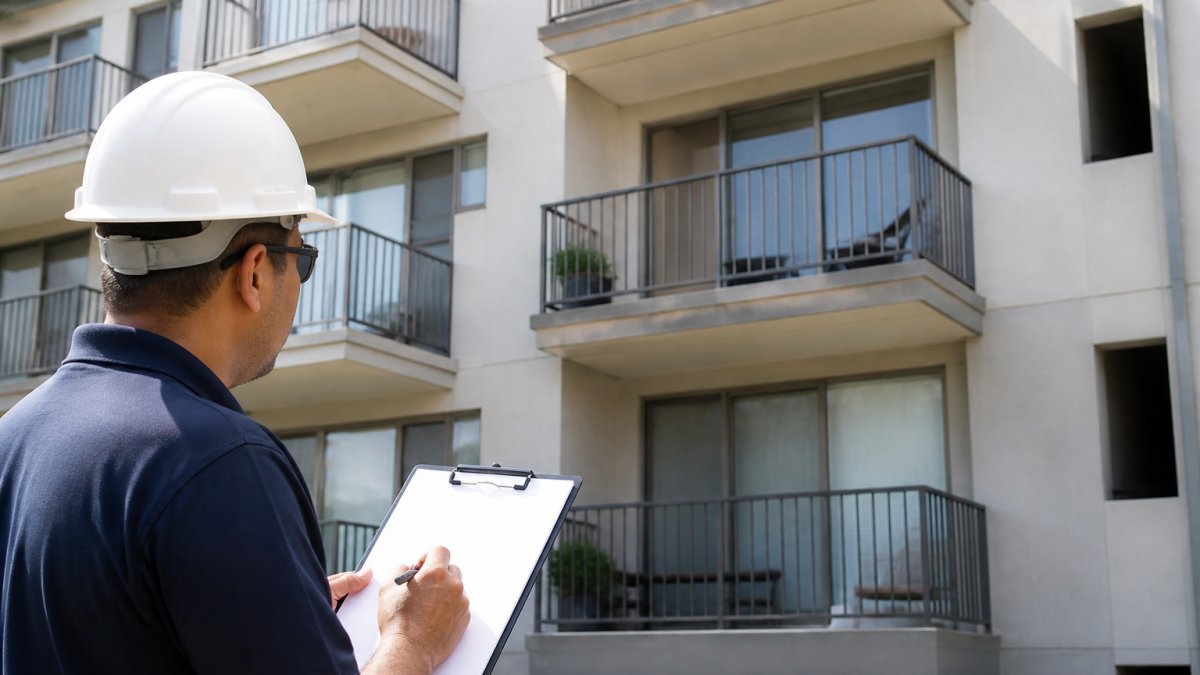
California’s SB 326 and SB 721 laws mandate regular inspections of balconies and exterior elevated elements to prevent catastrophic failures. Penalties for non-compliance can be severe. This guide covers the practical steps needed to stay compliant, avoid fines, and protect residents.
Understanding SB 326 vs SB 721: What’s Required to Avoid Fines
SB 326 (Balcony Inspection Law) took effect January 1, 2019, and applies to residential buildings with three or more units. It requires inspections of balconies and exterior elevated elements by a licensed structural engineer or architect.
SB 721 (Balcony Safety Improvement Law) expanded requirements starting January 1, 2023, broadening the definition to include stairs, decks, walkways, and other exterior elevated elements. It also mandated more frequent inspection cycles and stricter reporting requirements.
The key practical difference: SB 326 requires inspections every six years; SB 721 shortened this to every three years. If your building underwent an inspection before SB 721 took effect, you’re now operating under the new three-year cycle. Missing either deadline results in civil penalties, liability exposure, and potential legal action from residents.
SB 326 requires six-year inspection cycles; SB 721 requires three-year cycles. If your last inspection was before January 1, 2023, you’re already under the new timeline.
Exterior Elevated Elements (E3) Explained: What Gets Inspected
Exterior Elevated Elements (E3) refers to any structure attached to a building that’s elevated above ground level and poses a fall risk. Understanding what qualifies as E3 determines whether your property is subject to inspection requirements.
E3 includes balconies, decks, exterior stairs, landings, fire escapes, elevated walkways, railings, and fasteners supporting these elements.
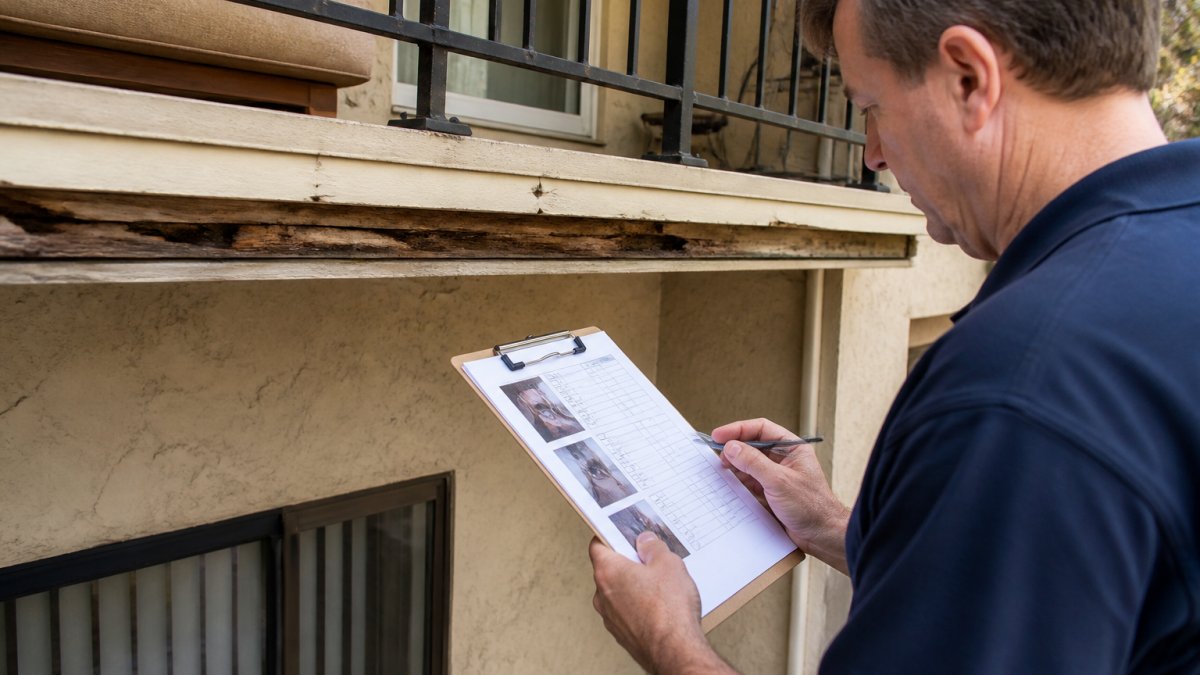
The inspection focuses on structural integrity: dry rot in wood, corrosion in metal fasteners, concrete deterioration, waterproofing failures, and load-bearing compromise. Inspectors examine visible components, conduct invasive testing to detect hidden deterioration, assess fastener condition, evaluate waterproofing, check connections to the main structure, verify railing height and safety compliance, and evaluate load-bearing capacity.
Many property owners assume balconies are fine because they "look okay." This is dangerous, dry rot and corrosion often progress invisibly until failure is imminent. Licensed inspectors identify early-stage deterioration that untrained eyes miss.
Visual inspection alone is insufficient under SB 721. Invasive testing is required to detect hidden dry rot and corrosion. Properties relying only on surface-level checks are at high risk of non-compliance findings.
Inspection Deadlines and Timelines: Missing These Costs You
Inspection deadlines are the enforcement mechanism behind these laws. Missing them triggers escalating penalties and liability exposure.
Initial Inspection Cycle Requirements
Buildings inspected under SB 326 (before January 1, 2023): Your next inspection is due three years from the date of your most recent inspection.
Buildings that have never been inspected: You must schedule an inspection immediately. The deadline for initial compliance was January 1, 2023. If you haven’t completed an initial inspection, you are currently non-compliant.
New construction: Buildings completed after January 1, 2023, must have an initial inspection within one year of occupancy.
The inspection must be completed and a report filed with the HOA and property owner within the required timeframe. Simply scheduling an inspection doesn’t satisfy the requirement.
Recurring Inspection Frequency
Once an initial inspection is complete, subsequent inspections are due every three years from the completion date of the previous inspection. This creates a rolling compliance schedule. If your 2024 inspection is completed in March, your next inspection is due in March 2027.
Some properties may qualify for extended timelines if the inspection reveals no significant defects and a maintenance plan is in place. However, this extension requires explicit approval from the local building official and must be documented.
| Inspection Stage | Timeline | Key Requirement |
|---|---|---|
| Initial inspection (first-time) | By January 1, 2023 (or within 1 year of occupancy for new construction) | Licensed structural engineer or architect |
| Subsequent inspections | Every 3 years from completion of previous inspection | Same qualified professional |
| Report filing | Within 30 days of inspection completion | Submitted to HOA and property owner |
| Remediation deadline | Varies by defect severity (30 days to 1 year) | Documented maintenance plan required |
Balcony Inspection Checklist: Step-by-Step Compliance Guide
A thorough inspection follows a structured process. Understanding what happens during the inspection helps you prepare and ensures nothing is missed.
Pre-Inspection Planning
- Notify residents at least 10 days in advance, explaining the inspection purpose and timeline.
- Clear balconies of furniture, plants, and personal items to provide unobstructed access.
- Compile documentation including previous inspection reports, maintenance records, permits, and architectural plans.
- Identify problem areas and point out visible issues to the inspector.
- Schedule access with residents, coordinating entry requirements.
During the Inspection
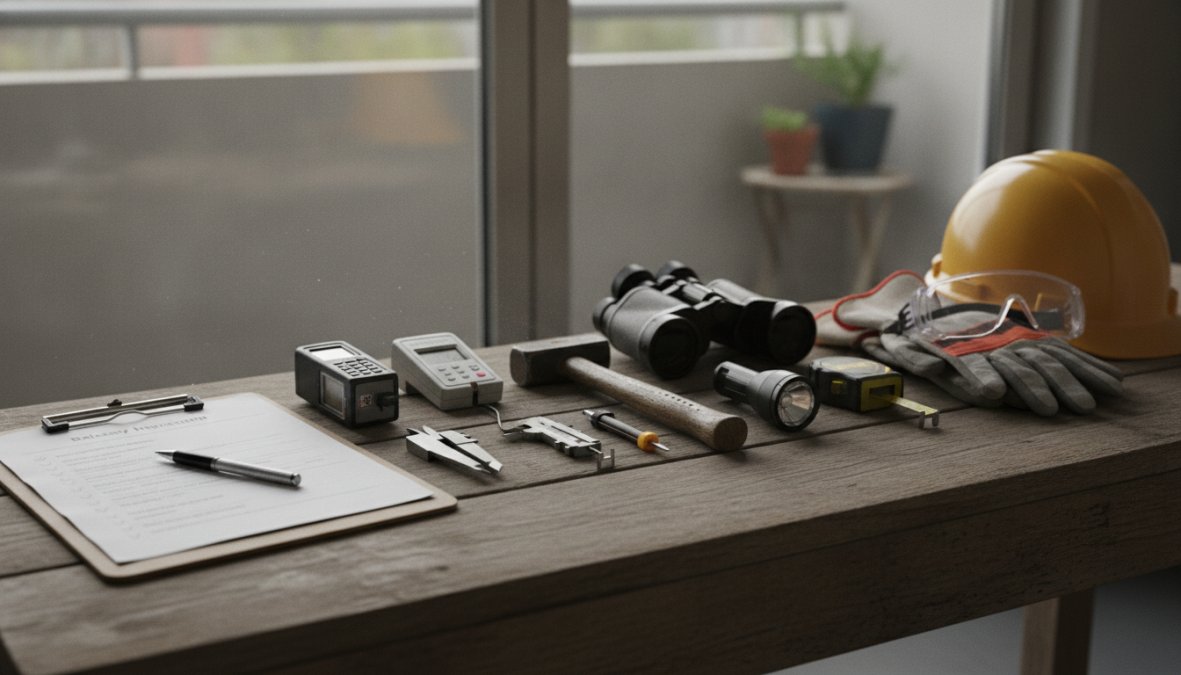
The licensed inspector will conduct a visual assessment of all E3 components, perform invasive testing by drilling or probing to detect hidden deterioration, measure railing heights for code compliance, test fasteners for corrosion, photograph defects, and classify findings by severity: critical (immediate danger), major (significant deterioration), or minor (early-stage).
The entire inspection typically takes 2-4 hours for a mid-sized building, depending on the number of units and E3 elements.
Balcony Railing Height Requirements and Code Standards
Railing height is one of the most commonly cited code violations in balcony inspections. California Building Code sets specific requirements, and non-compliance creates both safety hazards and legal liability.
Standard railing height is 36 inches measured from the walking surface to the top of the railing. For certain residential applications, the code may require 42 inches.
Inspectors measure railing height at multiple points because uneven railings are common in older buildings. A railing that’s 36 inches at one end but 33 inches at another is non-compliant at the low point.
Baluster spacing (vertical slats) must not allow passage of a 4-inch sphere, preventing children from becoming trapped. Corroded or damaged balusters that create larger gaps are cited as violations.
Load-bearing requirements specify that railings must withstand a horizontal force of 200 pounds applied at the top rail. Loose or deteriorated railings fail this test and require reinforcement or replacement.
Many buildings built before 2010 have railings that don’t meet current code standards. These are not grandfathered in and must be brought into compliance.
If your inspection report flags railing height violations, you don’t necessarily need to replace the entire railing. In many cases, adding a top rail extension or cap can bring the railing into compliance at a fraction of replacement cost.
Condo Balcony Maintenance Responsibilities: Who’s Liable
Understanding who is responsible for maintenance and repairs determines who bears the cost of remediation and who faces liability if someone is injured.
HOA Obligations Under California Civil Code
HOAs are the primary responsible party under California Civil Code Section 5551. The HOA must ensure inspections are completed on schedule by qualified professionals, maintain a reserve study accounting for balcony repair costs, develop a maintenance plan based on inspection findings, fund repairs (the HOA cannot defer critical repairs due to budget constraints), communicate inspection results and planned repairs to unit owners, and maintain records for a minimum of seven years.
If the HOA fails to complete inspections or defer critical repairs, unit owners can sue for breach of fiduciary duty. If an injury occurs due to deferred maintenance, the HOA and potentially individual board members can face personal liability.
Property Owner and Unit Owner Roles
Individual unit owners have secondary responsibilities: maintain unit-specific balconies designated as part of the unit, report defects to the HOA immediately, cooperate with inspections by providing access, and avoid unauthorized modifications.
The distinction between common-area and unit-specific balconies varies by building. The CC&Rs (Covenants, Conditions & Restrictions) document specifies this for your building. In practice, the HOA bears most responsibility and cost for compliance.
Consequences of Non-Compliance: Fines, Liability, and Insurance Risk
Penalties for non-compliance extend far beyond monetary fines to include legal liability, insurance complications, and potential criminal exposure.
Financial Penalties and Legal Exposure
Civil penalties under California Civil Code can reach $1,000 per day of violation. For an HOA that misses an inspection deadline by several months, cumulative penalties can exceed $100,000.
Attorney fees and litigation costs arise when residents sue the HOA for failing to maintain safe conditions. Legal defense costs typically exceed $50,000 for a contested case.
Remediation costs for deferred repairs compound over time. A railing that costs $5,000 to repair when first identified can cost $15,000 or more if deterioration progresses. Balconies requiring structural replacement can cost $50,000 to $150,000 per unit.
Forced HOA assessment may be necessary to fund repairs. If the reserve fund is inadequate, the HOA can levy special assessments on unit owners.
Insurance and Liability Implications
General liability insurance may exclude coverage for injuries occurring due to deferred maintenance. If a resident is injured by a falling balcony and the inspection report documented the hazard months earlier, the insurer may deny the claim.
Directors and officers liability insurance protects individual board members from personal liability, but typically excludes willful negligence. If board minutes show the board was aware of inspection findings and chose not to fund repairs, the D&O policy may not cover board members’ personal exposure.
Property insurance rates increase for buildings with documented safety violations. Some insurers may refuse to renew coverage for buildings with outstanding inspection violations.
Mortgage and refinancing complications arise when lenders discover non-compliance with state safety laws. Some lenders require proof of compliance before closing a loan or refinancing.
Insurance exclusions for deferred maintenance are common. If your HOA is deferring repairs identified in inspection reports, the HOA’s liability insurance may not cover resulting injuries, creating personal liability for board members.
Hiring Qualified Inspectors: Vetting Criteria and Cost Breakdown
Not every contractor can perform a balcony inspection. The law specifies who is qualified, and hiring an unqualified inspector creates compliance risk.
Qualifications: Licensed Structural Engineers and Architects
Licensed Structural Engineers (SE) are the most common choice for balcony inspections. They have formal training in structural analysis, material science, and building codes.
To verify a structural engineer’s license:
- Check the California Department of Consumer Affairs Professional Engineers database
- Confirm the license is current and in good standing
- Verify experience with residential balcony inspections
- Ask for references from recent balcony inspection projects
Licensed Architects (AIA) can also perform inspections if they have structural expertise. Verify specific experience with SB 326/SB 721 compliance and balcony assessment.
Other professionals who cannot perform SB 326/SB 721 inspections: general contractors, home inspectors, handypersons, and building inspectors.
Hiring an unqualified inspector invalidates your compliance, even if the inspection is completed on time.
Cost Estimation and Budget Planning
Inspection costs typically range from $2,000 to $8,000 per building, depending on the number of units, number of balconies, building age and condition, location, and structural complexity.
Remediation costs depend on findings:
- Minor repairs (sealant, fastener replacement, paint): $500-$2,000 per balcony
- Moderate repairs (railing reinforcement, waterproofing): $3,000-$8,000 per balcony
- Major repairs (structural replacement, dry rot remediation): $15,000-$50,000+ per balcony
Buildings with older construction should budget conservatively. A 50-unit building with average remediation needs might face $150,000 to $300,000 in total repair costs.
Reserve fund planning: The HOA should allocate 5-10% of the annual operating budget to balcony maintenance and compliance.
| Cost Category | Low Estimate | High Estimate | Variables |
|---|---|---|---|
| Inspection (20-50 units) | $2,500 | $5,000 | Building age, complexity, access |
| Minor repairs (per balcony) | $500 | $2,000 | Sealant, fasteners, paint |
| Moderate repairs (per balcony) | $3,000 | $8,000 | Railing work, waterproofing |
| Major repairs (per balcony) | $15,000 | $50,000+ | Structural replacement, dry rot |
| Annual reserve allocation | 5% | 10% | Building size, age, history |
Avoiding fines for balcony non-compliance protects your residents and your property’s long-term value. The inspection process is straightforward when you understand the requirements, hire qualified professionals, and plan for remediation costs. California Department of Consumer Affairs Professional Engineers Database can verify inspector credentials, and California Civil Code Section 5551 on HOA Responsibilities outlines your legal obligations.
Frequently Asked Questions
What are the main penalties for balcony non-compliance with SB 326 and SB 721?
Penalties for avoiding fines for balcony non-compliance include significant civil fines imposed by local authorities, potential legal liability if structural failure causes injury, and mandatory remediation costs that can exceed inspection expenses. HOAs may face enforcement action and property owners could face difficulty selling or refinancing properties with unresolved safety violations. Insurance claims may be denied if non-compliance contributed to damage or injury.
How often should I conduct balcony inspections to avoid non-compliance fines?
Initial inspection cycles vary by property age and construction date, but most properties must complete their first inspection within 6-9 years of SB 721 implementation. After the initial inspection, recurring inspection frequency typically occurs every 6 years for properties with no significant deterioration, or sooner if structural integrity issues are identified. Your licensed structural engineer will recommend the appropriate inspection cycle based on findings.
Who is responsible for condo balcony maintenance responsibilities, the HOA or individual unit owners?
California Civil Code generally assigns common interest development (CID) maintenance to HOAs for structural elements, though responsibility depends on your governing documents. Typically, the HOA is responsible for balcony structure, railings, and waterproofing as common property, while unit owners may be responsible for interior finishes. Review your CC&Rs and consult legal counsel to clarify obligations and ensure proper maintenance planning to avoid non-compliance fines.
What qualifications should I look for when hiring a balcony inspector?
Hire only licensed structural engineers or licensed architects with specific experience in California balcony inspection and SB 326/SB 721 compliance. Verify current licensure, request references from similar properties, and confirm they understand load-bearing assessment, waterproofing evaluation, and dry rot/corrosion detection. Ask about their process for invasive testing if needed and their ability to provide detailed certification reports required by law.