Logo
  • Balcony Law
  • About us
  • Inspection services
  • FAQ
  • Blog
  • Call us ‪+1 818-806-7885
  • Book now

Tag: balcony safety

What Landlords Need to Know About Balcony Safety Compliance

Posted on November 22, 2026November 22, 2026 by Apex Balcony admin
What Landlords Need to Know About Balcony Safety Compliance

Last Updated: November 20, 2026

Quick Summary

Balcony safety compliance for landlords is the legal duty to keep every elevated outdoor structure safe, inspected, and documented, covering railings, walking surfaces, supports, and waterproofing. California SB 721 requires periodic inspections of exterior elevated elements on covered multifamily buildings by a licensed professional, documented in writing.

  • A Berkeley balcony collapse in 2015 killed six people and pushed state lawmakers to act.
  • Lease clauses generally do not eliminate landlord liability for structural safety.
  • Routine visual checks are monthly to quarterly; professional inspections follow the statutory schedule.
  • Log findings as Critical, Serious, or Monitor, and escalate critical findings the same day.
  • Keep inspection reports, photos, repair invoices, and tenant notices for at least the statutory retention period.
Is your building SB 721 compliant?Apex Balcony inspects balconies, decks, and stairways for California landlords and HOAs, with reports built for compliance.

Book Your Inspection

Table of Contents

  • Why Balcony Safety Compliance Matters for Landlords
    • The Human and Financial Cost of Neglect
    • Your Duty of Care and Liability Exposure
  • California SB 721 Balcony Inspection Requirements
    • Which Buildings Are Covered and When Inspections Are Due
  • Landlord Balcony Inspection Checklist
    • Structural Integrity and Signs of Deterioration
    • Railings, Balustrades, and Guardrail Safety
  • Routine Visual Checks vs. Professional Inspections
  • How to Write a Balcony Safety Compliance for Landlords Letter
  • Balcony Inspection Report and Documentation for Insurance
    • The Compliance Workflow, Step by Step
    • Escalation Criteria: What Triggers Immediate Action
    • Tenant Communication Templates and Timelines
    • The Insurance File
  • Building Codes, Local Regulations, and Tenant Responsibilities
    • The Codes That Actually Govern a Balcony
    • A Jurisdiction Profile You Can Build in an Afternoon
    • Tenant Responsibilities That Actually Reduce Your Risk
  • Book Your Balcony Safety Inspection with Apex Balcony
  • Frequently Asked Questions

Why Balcony Safety Compliance Matters for Landlords

Balcony safety compliance for landlords is the legal duty to keep every elevated outdoor structure safe, inspected, and documented, railings, walking surfaces, supports, and waterproofing. This guide covers what you must do, when, and how to prove it.

The stakes are not abstract. A Berkeley balcony collapse in 2015 killed six people (Berkeley balcony collapse leaves 6 people dead). Incidents like these have pushed state lawmakers to act.

The Human and Financial Cost of Neglect

A failed balcony rarely fails without warning. Cracks, rust stains, soft wood, and pooling water show up first. Ignore them and the repair bill grows while the risk grows faster.

A single injury claim can outrun the value of the building, and insurers now ask pointed questions about inspection records before renewing a policy.

Your Duty of Care and Liability Exposure

Duty of care is the legal obligation to protect people who use your property from foreseeable harm, residents, guests, delivery workers, and anyone else who steps onto a balcony.

Liability exposure shows up in three places:

  • Civil lawsuits from injured parties
  • Fines and enforcement actions from local building departments
  • Insurance denial when records show you knew about a hazard and did nothing

A common mistake is assuming a lease clause shifts this risk to the tenant. Landlord liability for structural safety is generally not eliminated by lease terms.

California SB 721 Balcony Inspection Requirements

California SB 721 requires periodic inspections of exterior elevated elements on covered multifamily buildings by a licensed professional, documented in writing. Review the statute itself to confirm which buildings and elements are covered.

Which Buildings Are Covered and When Inspections Are Due

Inspection deadlines are set by the statute and tied to the building’s compliance period. If you own a covered building and have not checked your due date, do it now.

For a detailed breakdown of deadlines and building eligibility, see our guide to SB 721 inspection requirements for landlords.

Landlord Balcony Inspection Checklist

A landlord balcony inspection checklist is a structured list you work through on every walkthrough, covering structure, railings, surfaces, drainage, and connections. Use our California Balcony Safety Inspection Checklist to perform or prepare for the inspection described in this section.
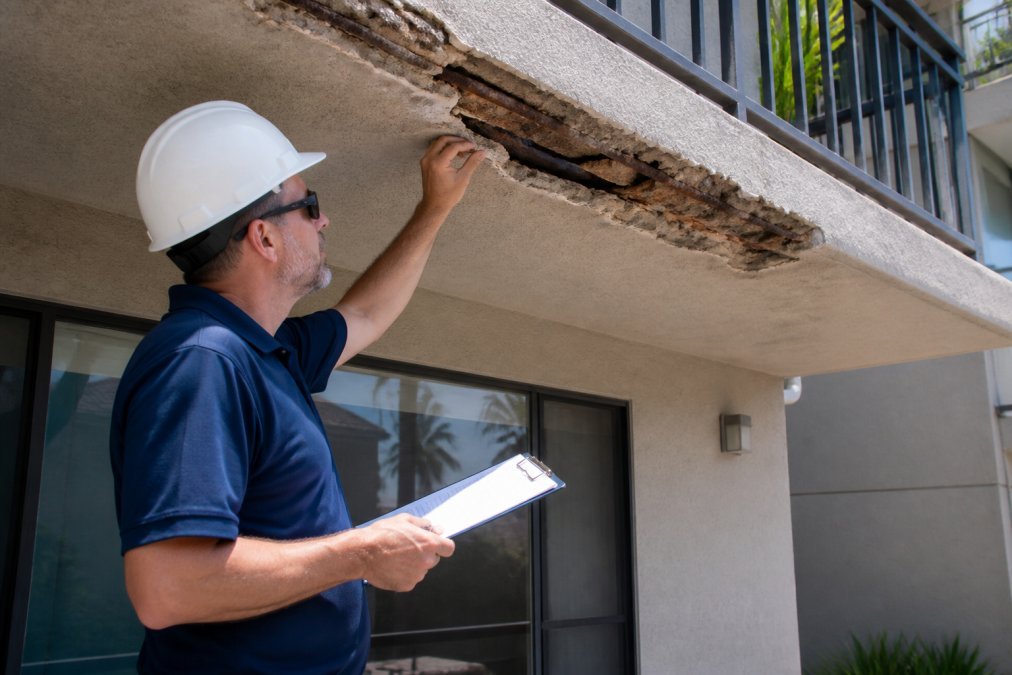
An inspector in a white hard hat examines a deteriorated, cracked concrete balcony ceiling while holding a clipboard beside a modern building.

Start with a visual walkthrough from below, then move up top. Note anything that looks different from the last visit.

  • Cracks in concrete slabs, columns, or soffits
  • Rust stains or exposed rebar
  • Soft, spongy, or splintering wood

Structural Integrity and Signs of Deterioration

Structural integrity is the ability of a balcony’s supports and connections to carry the loads placed on them. When it fails, it usually fails at the connections first.

Watch for these warning signs:

  • Diagonal cracks that grow over time
  • Crumbling concrete at the edges
  • Dark streaks that suggest water intrusion

Water intrusion is a common contributor to balcony deterioration. Water gets in, wood rots or steel corrodes, and load capacity can drop without obvious warning.

Railings, Balustrades, and Guardrail Safety

Railings are the last line of defense against a fall. A guardrail must hold firm when someone leans on it, and baluster gaps must be narrow enough to stop a child from slipping through.

Check these points every visit:

  • Push hard on each post. Any give means a problem.
  • Look for rust at the base plate and anchors.
  • Confirm handrails are secure and continuous.

Routine Visual Checks vs. Professional Inspections

Routine visual checks and professional inspections are not the same thing. A visual check is a quick, frequent look for changes.

Here is how they compare:

FeatureRoutine Visual CheckProfessional Inspection
Who performs itOwner or property managerLicensed inspector
FrequencyMonthly to quarterlyPer statutory schedule
DepthSurface observationsStructural and material assessment
OutputNotes and photosSigned written report
Legal weightSupports your recordsMeets compliance requirements

A visual check catches problems early. A professional inspection proves compliance and gives you a report that holds up under scrutiny.

Watch out: treating a quick walkthrough as a substitute for a licensed inspection can leave a gap in your compliance record.

How to Write a Balcony Safety Compliance for Landlords Letter

A balcony safety compliance for landlords letter is a written notice to tenants about an upcoming inspection, stating the date, the reason, what access is needed, and what tenants should do to prepare.

Send it early, keep it plain, and include these elements:

  • The inspection date and a backup window
  • The legal basis for the inspection
  • Which areas need access

Keep a copy of every letter. It becomes part of your compliance file.

For help drafting proper notice language and handling tenant questions, see our guide on how to communicate safety inspection schedules to tenants.

Balcony Inspection Report and Documentation for Insurance

A balcony inspection report is the signed written record of what the inspector found and what needs fixing. It is the single most important document in your compliance file, but a report alone is not a compliance system. Insurers and auditors want a closed loop: inspection scheduled, findings logged, hazards escalated, repairs signed off, tenants notified, and records retained.

The Compliance Workflow, Step by Step

  1. Schedule the inspection before the deadline. Work backward from the statutory due date and book with enough lead time to reschedule if weather or access fails. Put the due date and booked date in a shared calendar with a reminder 60 days out.
  2. Send tenant notice. Use a written notice stating the date, backup window, legal basis, areas needing access, what to clear from the balcony, a contact name and phone number, and how long the inspection takes. Keep a copy in the compliance file.
  3. Conduct the inspection and collect the report. Confirm the inspector’s credential matches the statute and that the report is signed and dated.
  4. Log every finding with a severity rating. Use a three-tier scale: Critical (imminent risk of collapse or fall, restrict access immediately), Serious (deterioration that will become critical without repair, schedule repair on a defined timeline), and Monitor (early-stage wear, re-check at the next visual walkthrough).
  5. Escalate critical findings the same day. Restrict access, notify tenants in writing, and engage a licensed engineer or contractor for a repair scope. Do not wait for the next scheduled inspection.
  6. Complete repairs and obtain sign-off. Keep the contractor’s invoice, completion date, and photos of the repaired condition. If the repair changes the structure, confirm whether a re-inspection is required.
  7. Reopen the balcony only after sign-off. Document the reopening date and the basis for it.
  8. Retain the file. Keep the inspection report, inspector credentials, photos, repair invoices, tenant notices, acknowledgment records, and visual-check log together for at least the statutory retention period, and longer if your insurer requires it.

Escalation Criteria: What Triggers Immediate Action

Not every finding waits for the next cycle. Treat any of the following as a critical finding that requires same-day access restriction and specialist assessment:

  • Visible movement, sagging, or bounce in the walking surface or supports.
  • Diagonal or widening cracks in concrete, or exposed, corroded rebar.
  • Soft, spongy, or crumbling wood at post bases, ledgers, or connections.

Watch out: leaving a balcony open after documenting a critical finding creates avoidable liability exposure.

Tenant Communication Templates and Timelines

Keep three short templates ready so you are not drafting under pressure:

  • Inspection notice, sent at least the period required by your lease or local law before the visit; states date, window, access, and preparation.
  • Access restriction notice, sent the same day a critical finding is identified; states that the balcony is closed, the reason, the expected duration, and how tenants will be notified when it reopens. Ask for written acknowledgment and log who responded.
  • Reopening notice, sent after repair sign-off; states the reopening date and confirms the balcony is safe for normal use.

Log the date each notice was sent, the method (email, portal, posted notice), and any acknowledgment. If a tenant does not acknowledge, document the follow-up attempt.

The Insurance File

Insurance carriers may ask for records of inspections and repairs. Keeping a clear paper trail supports your position if coverage questions arise. Assemble the file in this order so an underwriter can follow it:

  • The inspection report and the inspector’s credentials.
  • Photos of every defect found, labeled by location and date.
  • The severity log and the escalation record for each critical finding.

To understand how documentation and non-compliance affect your policy, read our breakdown of SB 326 and SB 326 non-compliance insurance implications.

Building Codes, Local Regulations, and Tenant Responsibilities

Building codes set the minimum safety standards for railings, loads, and materials. Local regulations add inspection schedules and reporting rules on top. Both apply at the same time, and neither excuses you from the other.

The Codes That Actually Govern a Balcony

Three layers of rules apply to almost every multifamily balcony in the United States:

  • The model building code adopted by your jurisdiction. Many jurisdictions adopt a version of the International Building Code (IBC) or the International Residential Code (IRC), published by the International Code Council. Confirm the edition and numeric requirements (guardrail height, baluster spacing, live loads) that your local building department has adopted, since local amendments may differ.
  • State and local inspection statutes. These create a legal duty to inspect on a schedule, not just to build correctly. Examples include California SB 721 and California SB 326. Other states and cities have their own facade-inspection or balcony-inspection ordinances, and the trigger, frequency, and inspector qualifications differ, so confirm the rule for each property address rather than assuming one state’s schedule applies everywhere.
  • Occupational and fire rules for shared or commercial balconies. If a balcony is accessible to the public or used by employees, OSHA walking-working-surface and guardrail rules and local fire-code egress requirements can apply in addition to the building code.

A common pattern is for a landlord to read one state’s inspection statute and assume it is universal. It is not. Build a short jurisdiction profile for each property: which code edition is adopted, which inspection statute (if any) applies, who is qualified to inspect, and what the record-retention period is. That jurisdiction-by-jurisdiction approach also matters when evaluating access methods for inspections, since rope descent systems may be subject to requirements distinct from balcony-specific rules.

A Jurisdiction Profile You Can Build in an Afternoon

For each property, record these fields in your compliance file:

  1. Adopted code edition and local amendments, confirm with the local building department, not a blog.
  2. Applicable inspection statute or ordinance, name it, cite the section, and note the covered building types and element types.
  3. Inspector qualification, licensed architect, licensed engineer, certified inspector, or other credential the statute names.
  4. Inspection interval and first-due date, calculate from the statute’s compliance window, not from the date you bought the building.
  5. Report contents and filing destination, some jurisdictions require a report to be filed with the local agency, not just kept on site.
  6. Record-retention period, keep records at least as long as the statute requires, and longer if your insurer asks.

Watch out: treating a neighboring city’s schedule or a generic online summary as your legal requirement can lead to a violation. Confirm the requirement with the local building department.

Tenant Responsibilities That Actually Reduce Your Risk

Tenant duties are not a substitute for landlord duties, but they are a useful early-warning layer. Put these expectations in the lease and reinforce them in writing:

  • Report cracks, rust stains, soft wood, wobbly railings, or standing water immediately through a documented channel (a maintenance portal or written notice, not a phone call that leaves no record).
  • Do not overload the balcony with grills, planters, furniture, or storage; confirm the posted or lease-stated load limit and keep heavy items near the supported edge, not the cantilevered tip.
  • Keep drains and scuppers clear of leaves and debris.

Landlord responsibilities that run alongside them:

  • Schedule and pay for required inspections.
  • Complete safety-critical repairs within a defined timeframe, and restrict access to any balcony that is not safe.
  • Keep records for the required period and make them available to the inspector and insurer.

A shared duty of care works best when both sides know their role and every report leaves a paper trail. Give tenants a simple reporting channel, log every report, and close the loop in writing.

Book Your Balcony Safety Inspection with Apex Balcony

Compliance is a process, not a one-time event.

That is where we come in. Apex Balcony provides professional balcony safety inspections for California property owners.

We have worked with hundreds of building owners. If you are ready to protect your residents and your assets, book a balcony safety inspection with our team.


The real risk is not the inspection fee. It is the repair you never scheduled and the report you never wrote.

Frequently Asked Questions

What are landlords responsible for when it comes to balcony safety?

Landlords must maintain balconies, decks, and stairways in safe condition, which includes regular visual checks and professional inspections required by law. In California, SB 721 requires inspections of balconies and other elevated exterior elements for buildings with three or more units. Landlords also have a duty of care to warn tenants of hazards, restrict access to unsafe areas, and keep records of inspections and repairs. Failing to meet these responsibilities can lead to liability for injuries or property damage.

How often should landlords inspect balconies?

California SB 721 requires periodic professional inspections of balconies, decks, and stairways for covered buildings; confirm the current interval in the statute. Between professional inspections, landlords should perform routine visual checks at least annually and after any extreme weather event. A simple landlord balcony inspection checklist can help you spot cracks, corrosion, loose railings, or water damage early. Document each check and address any issues promptly to maintain balcony safety compliance.

What is California SB 721, and which rental buildings does it cover?

California SB 721 is a law that mandates periodic inspections of balconies, decks, and other elevated exterior elements in rental buildings with three or more dwelling units. Confirm the buildings covered and the qualified inspector types in the current statute. The law aims to prevent balcony collapses by identifying structural issues early. Compliance deadlines vary based on building type and location.

What should landlords do if a balcony inspection finds structural damage?

If an inspection reveals structural damage, landlords must act quickly to protect tenants. First, restrict access to the affected balcony until repairs are completed. Notify tenants in writing about the hazard and the repair timeline. Hire a licensed contractor to perform the necessary repairs, and obtain all required permits. Keep detailed records of the inspection report, repair invoices, and communication with tenants. This documentation demonstrates your commitment to balcony safety compliance and can help with insurance claims or legal defense.

GoogleAdd apexbalcony.com as a preferred source on Google →
Posted in BlogTagged balcony safety, balcony safety compliance for landlords, balcony safety compliance for landlords letter, california sb 721 balcony inspection requirements, landlord balcony inspection checklistLeave a Comment on What Landlords Need to Know About Balcony Safety Compliance

Legal Liability for Balcony Safety in California

Posted on November 8, 2026November 8, 2026 by Apex Balcony admin
Legal Liability for Balcony Safety in California

Last Updated: November 6, 2026

Quick Summary

Legal liability for balcony safety in California falls on owners and associations, not tenants. SB 721 requires periodic inspections of balconies and elevated elements in buildings with three or more units, while SB 326 requires condo associations to inspect and report. Liability turns on duty, notice, causation, and comparative fault, and a documented paper trail is the best defense.

  • SB 721 covers rental buildings with three or more units; SB 326 covers condos and common interest developments.
  • Both laws require inspections of at least 15% of elevated exterior elements.
  • A board that defers a flagged repair while leaving the balcony open supports a negligence claim.
  • After a balcony injury, courts examine duty, notice, causation, and comparative fault allocation.
  • Stop access to an unsafe balcony first, then document, notify, and hire a qualified inspector.
Is your building exposed to a balcony claim?Apex Balcony inspects balconies, decks, and stairways for SB 721 and SB 326 compliance.

Book a Balcony Inspection

Table of Contents

  • How California Balcony Laws Create Legal Exposure for Owners and Associations
    • SB 721 and SB 326: What Each Law Requires
    • Covered Buildings and Elevated Exterior Elements
  • Balcony Inspection Requirements California Owners Must Meet
    • Deadlines, Inspection Cycles, and Sampling Rules
  • HOA Responsibility for Balcony Repairs in California
    • The Three Layers of HOA Duty
    • Exclusive-Use Balconies and the Allocation Trap
    • What the Board Should Document
    • When the Association and Owner Disagree
  • Property Manager Liability for Unsafe Balconies
  • How Liability Is Determined After a Balcony Injury
    • Step One: Was There a Duty of Care?
    • Step Two: Was There Notice of a Dangerous Condition?
    • Step Three: Did the Breach Cause the Injury?
    • Step Four: How Is Fault Allocated?
    • Where Negligence Per Se Fits
    • Compliance Is Not a Complete Shield
    • The Evidence That Decides These Cases
    • What This Means for Owners and Boards
  • What to Do Immediately After Discovering an Unsafe Balcony
  • Balcony Safety Inspection Checklist for Compliance and Risk Reduction
  • Book a Compliance Inspection Before a Hazard Becomes a Claim
  • Frequently Asked Questions

How California Balcony Laws Create Legal Exposure for Owners and Associations

Legal liability for balcony safety in California starts with one uncomfortable fact: a failed balcony is rarely a surprise.

Inspector in safety gear examining a weathered balcony railing for balcony safety compliance

Two incidents shaped the current rules: the 2015 Berkeley balcony collapse that killed six people, and the 2021 Malibu balcony collapse.

Balcony safety is the practice of inspecting, maintaining, and repairing elevated exterior elements so they carry loads safely and meet state standards.

SB 721 and SB 326: What Each Law Requires

SB 721 covers apartment buildings with three or more units.

SB 326 covers condominiums and other common interest developments.

The core difference: SB 721 targets rental properties, SB 326 targets homeowner associations. Both put the duty on the owner or association, not the tenant.

For condo boards, the deeper rules sit in the SB 326 guide for condos. For a full walkthrough of the statutes, see the California balcony laws compliance guide.

Covered Buildings and Elevated Exterior Elements

Covered structures include multifamily residential buildings and common interest developments. The law reaches beyond balconies.

Covered elements typically include:

  • Balconies and decks
  • Stairways and exterior stairs
  • Walkways and landings
  • Guardrails and railings
  • Any element supported by load-bearing components

If people walk on it and it hangs above ground or another unit, assume it is covered.

Balcony Inspection Requirements California Owners Must Meet

Balcony inspection requirements California owners face are specific: who inspects, when, how much of the structure, and what the report must contain.

A qualified inspector must hold a license as an architect, engineer, or certified building inspector. The inspector documents structural integrity, water intrusion, dry rot, and deterioration, then files a report with repair recommendations.

Deadlines, Inspection Cycles, and Sampling Rules

Sampling rules matter just as much.

The complete breakdown lives in the 15% sampling rule guide.

LawApplies ToWho InspectsMinimum Sample
SB 721Buildings with 3+ unitsLicensed architect, engineer, or certified inspector15% of elevated elements
SB 326Condos and common interest developmentsLicensed structural engineer or architect15% of elevated elements

HOA Responsibility for Balcony Repairs in California

HOA responsibility for balcony repairs in California rarely resolves to a single answer, because three sources of duty stack: the statute, the governing documents, and the association’s own conduct after it learns of a hazard.

The Three Layers of HOA Duty

Start with the statute. SB 326 places the inspection and reporting duty on the association, which cannot contract that duty away to individual owners.

Then read the governing documents. CC&Rs, bylaws, and recorded maintenance agreements allocate repair and replacement costs between the association and owners.

Finally, look at the association’s own conduct.

Exclusive-Use Balconies and the Allocation Trap

Exclusive-use balconies are where most disputes begin. The owner has the only key and may even have repainted the railing, but the structural slab, load-bearing connections, and guardrail anchorage are usually association maintenance obligations.

Watch out: an owner who makes unauthorized structural repairs to an exclusive-use balcony can create a coverage dispute and shift liability back onto the association for failing to supervise the work.

What the Board Should Document

A defensible board record typically includes:

  • The inspection report and the date the board received it
  • Board minutes showing the repair was discussed, prioritized, and funded
  • A written repair scope from a licensed contractor or engineer
  • A schedule showing repairs were completed within a reasonable time
  • Notice to affected owners when a hazard required restricting access
  • A reserve study line item or special assessment showing the repair was funded

If the association cannot fund a repair immediately, the board should restrict access to the unsafe element and document that decision. Deferring a repair while leaving the balcony open is the fact pattern that supports a negligence claim.

When the Association and Owner Disagree

Disputes over who pays usually surface after a report, not before. Most practitioners find that the declaration’s maintenance matrix controls cost allocation while the statute controls the inspection duty, and the two questions should be analyzed separately.

For liability after a collapse, see the HOA balcony collapse liability analysis.

Property Manager Liability for Unsafe Balconies

Property manager liability for unsafe balconies turns on the management agreement. A manager who holds the maintenance duty and ignores a known hazard can face negligence claims alongside the owner.

Managers should keep three things documented:

  • Inspection scheduling and completion
  • Repair requests sent to the owner
  • Owner responses and repair timelines

If the owner refuses a repair, the manager needs a written record. That paper trail is the difference between “we flagged it” and “we let it happen.”

How Liability Is Determined After a Balcony Injury

After a balcony injury, a court does not ask whether the owner filed an inspection report. It asks narrower questions about duty, notice, causation, and fault allocation.

Step One: Was There a Duty of Care?

Premises liability in California imposes a duty on the person who occupies or controls the property to exercise reasonable care for the safety of people lawfully on it. For a balcony, the duty typically attaches to the owner, the association, or the manager who holds maintenance responsibility, sometimes more than one at once.

Step Two: Was There Notice of a Dangerous Condition?

Notice is where most balcony cases turn. A plaintiff can establish notice in three ways:

  • Actual notice, the owner or board received a report, complaint, or work order identifying the condition.
  • Constructive notice, the condition existed long enough that a reasonable inspection would have discovered it.
  • Notice created by statute, the inspection statute required the owner to look, and the failure to look is treated as a failure to discover what a proper inspection would have found.

A dated inspection report flagging water intrusion or dry rot is the strongest actual-notice evidence a plaintiff can obtain.

Step Three: Did the Breach Cause the Injury?

Causation has two parts. Actual cause asks whether the injury would have happened but for the unsafe condition. Proximate cause asks whether the injury was a foreseeable result of the owner’s conduct. A collapsed guardrail that gives way under ordinary leaning pressure is a classic foreseeable harm.

Step Four: How Is Fault Allocated?

California applies comparative fault, meaning a plaintiff’s own negligence reduces recovery rather than barring the claim entirely. If an injured party ignored posted warnings, removed a barricade, or overloaded a balcony beyond its posted capacity, the jury may assign a percentage of fault to that person. The owner’s share of fault is then measured against that percentage.

Where Negligence Per Se Fits

Negligence per se applies when a statute defines the standard of care and the violation caused the injury. Under California Civil Code Section 5551, owners must inspect elevated elements and file reports on schedule. A missed inspection or a report filed after the deadline becomes evidence that the owner fell below the statutory standard. It does not automatically establish liability, but it shifts the burden of explanation onto the owner.

Compliance Is Not a Complete Shield

An owner can file every report on time and still face a premises liability claim if a known hazard went unrepaired. The inspection statute sets a floor for diligence, not a ceiling on responsibility. A report recommending repair followed by inaction is often worse for the defense than no report at all, because it proves the owner knew.

The Evidence That Decides These Cases

Balcony injury litigation usually turns on documents rather than testimony. The records that matter most include:

  • Inspection reports and the dates they were received
  • Board minutes and repair authorizations
  • Work orders, invoices, and contractor scopes
  • Maintenance logs showing prior complaints
  • Photographs of the condition before and after the incident
  • Notices restricting access and the dates they were posted
  • Insurance correspondence and claim files

A common pattern is an owner who can produce a timely inspection report but cannot produce a single document showing the recommended repair was scheduled.

What This Means for Owners and Boards

The practical takeaway: liability is managed through a paper trail, not a single filing. An owner or board that inspects on schedule, documents findings, restricts access to hazards, and tracks repairs to completion is in a materially better position than one that treats the report as the finish line.

What to Do Immediately After Discovering an Unsafe Balcony

Stop access first. Restrict access to the balcony, deck, or stairway and post clear notice. Do not wait for a second opinion before blocking the area.

Then move through these steps:

  • Document the condition with dated photos and notes
  • Notify the owner, board, or insurer in writing
  • Hire a qualified inspector to assess the full structure
  • Get a written repair scope and timeline
  • Keep every record for the claims file

Watch out: patching cosmetic cracks without an engineering assessment can hide active water intrusion and turn a repair into a collapse.

Balcony Safety Inspection Checklist for Compliance and Risk Reduction

A balcony safety inspection checklist keeps boards and owners ahead of both the statute and the claim. Use this one before and after every inspection.

  • Confirm building type and which law applies
  • Verify inspector license and insurance
  • Review prior inspection reports and repair records
  • Confirm the 15 percent sample is representative
  • Check balconies, decks, stairways, walkways, and guardrails
  • Look for water intrusion, dry rot, rust, and cracking
  • Photograph every deficiency with location notes
  • File the report by the statutory deadline
  • Schedule corrective repairs with a written timeline
  • Restrict access to any unsafe element immediately

Book a Compliance Inspection Before a Hazard Becomes a Claim

The gap between a compliant building and a lawsuit is usually one missed inspection.

We specialize in SB 326 and SB 721 compliance and inspect every elevated exterior element: balconies, decks, stairways, and guardrails.

Get started with Apex Balcony and turn a legal risk into a documented, defensible maintenance record. Review our California building inspection services to schedule your compliance inspection.


The statute does not care that the board was worried about repair costs. It cares that the inspection happened on time and the hazard was addressed.

Frequently Asked Questions

What is the new balcony law in California?

California has two key balcony laws: SB 721, which applies to multifamily residential buildings with three or more units, and SB 326, which applies to condominiums and common interest developments. Both require periodic inspections of elevated exterior elements like balconies, decks, stairways, and walkways by qualified inspectors. Compliance helps prevent structural failures and reduces legal exposure for owners and associations.

Can a property owner be liable if someone is injured on an unsafe balcony?

Yes. Under premises liability principles, a property owner or association can be held liable for injuries caused by unsafe conditions they knew or should have known about. If the owner failed to conduct required inspections or repair known hazards, negligence per se may apply, especially if statutory violations contributed to the injury. Liability can extend to HOAs, landlords, and property managers depending on their control over the property and maintenance responsibilities.

How often do balconies need to be inspected under California law?

Regular inspections help identify deterioration early and demonstrate compliance with balcony inspection requirements California enforces.

What should a property manager do after discovering an unsafe balcony?

Immediately restrict access to the unsafe balcony and any adjacent areas to prevent injury. Document the condition with photos and notes, then notify the owner or HOA board in writing. Arrange for a qualified inspector or engineer to assess the extent of the damage and recommend corrective repairs. Keep detailed records of all actions taken, as these will be important for insurance claims and legal defense. Following a balcony safety inspection checklist can help ensure no step is missed.

GoogleAdd apexbalcony.com as a preferred source on Google →
Posted in BlogTagged balcony safety, hoa responsibility for balcony repairs in california, legal liability for balcony safety in california, property manager liability for unsafe balconiesLeave a Comment on Legal Liability for Balcony Safety in California

Recent Posts

  • What Landlords Need to Know About Balcony Safety Compliance
  • Best Hardware for Cantilevered Deck Connections: A Connector Guide
  • 7 SB 721 Inspection Payment Options for Property Owners
  • Are Hidden Balcony Framing Problems Showing Up in Your Building?
  • Apartment Building Maintenance Budget: A Step-by-Step Guide

Recent Comments

No comments to show.

Archives

  • November 2026
  • October 2026
  • September 2026
  • August 2026
  • July 2026
  • June 2026

Categories

  • Blog
Logo
Created by Unilime.Group
  • Balcony Law
  • About us
  • Inspection services
  • FAQ
  • Blog

Call us ‪+1 818-806-7885‬
License: CSLB #1101305

Apex Balcony Inspection
‪+1 818-806-7885‬
[email protected]
4645 Van Nuys Blvd #201
Sherman Oaks CA 91403

Created by Unilime.Group