Balcony Safety Inspection Services California: 2026 Guide
Balcony safety inspection services in California explained. Understand SB 326, SB 721 deadlines, costs, and compliance steps. Book your inspection today.
Table of Contents
- Why Balcony Safety Inspection Services in California Are Now Mandatory
- SB 721 vs SB 326: Understanding Both California Balcony Laws
- SB 721 Inspection Deadline and SB 326 Compliance Timeline
- SB 326 Balcony Inspection Requirements: What the Law Actually Demands
- What Happens During a Balcony Safety Inspection in California
- Structural Integrity Inspection Checklist for Property Managers
- Balcony Inspection Cost in California: What to Budget
- Post-Inspection Repair Workflow and Consequences of Non-Compliance
Last Updated: June 17, 2026
California property owners have a compliance problem that is costing them more than they realize. Balcony safety inspection services california law now mandates are not optional paperwork exercises. They are legally enforceable requirements with real deadlines, real penalties, and real liability exposure. At Apex Balcony, we have worked with hundreds of building owners across the state, and the most common mistake we see is waiting too long. Below, we cover exactly what the law requires, what inspections involve, and how to build a repair workflow that protects your property and your residents.
Here is what most guides get wrong: they treat SB 721 and SB 326 as interchangeable. They are not. They cover different building types, different inspection timelines, and different inspector qualification requirements. Getting that distinction wrong can mean a failed inspection, a violation notice, or worse.
Why Balcony Safety Inspection Services in California Are Now Mandatory
California mandates balcony inspections because structural decay in elevated exterior elements is a documented, preventable cause of catastrophic failure. Waterproofing failures, wood rot, and corrosion in load-bearing connections can progress invisibly for years before a deck or balcony gives way without warning.
The Berkeley Balcony Incident That Changed California Law
The 2015 balcony collapse at the Library Gardens apartment complex in Berkeley killed six people and injured seven more. The balcony failed due to dry rot in the structural framing, a condition developing for years beneath a surface that looked fine. The Berkeley balcony incident became the direct legislative catalyst for both SB 721 and SB 326. As documented in California Legislative Information on SB 721, the law was specifically designed to address the systemic gap between visible surface conditions and hidden structural decay in multifamily housing. Visual maintenance checks by property management staff are not sufficient.
SB 721 vs SB 326: Understanding Both California Balcony Laws
SB 721 and SB 326 are California’s two primary statutes governing the inspection of exterior elevated elements (EEE) in residential buildings. Both laws address the same underlying safety problem but apply to different property types and impose different procedural requirements.
| Feature | SB 721 | SB 326 / Civil Code 5551 |
|---|---|---|
| Property Type | Apartment buildings (3+ units, non-HOA) | Condominiums and HOA communities |
| Governing Body | State of California | HOA / Condominium associations |
| Inspector Type | Licensed architect, engineer, or contractor | Licensed architect or structural engineer only |
| Inspection Frequency | Every 6 years | Every 9 years |
| First Deadline | January 1, 2025 | January 1, 2025 |
| Sampling Requirement | All EEE | Statistically significant sampling |
Who Is Covered Under SB 721
SB 721 applies to apartment buildings with three or more dwelling units not governed by a homeowners association. It covers all exterior elevated elements, balconies, decks, stairways, walkways, and their associated railings and waterproofing systems. Building owners bear compliance responsibility directly. A licensed contractor, architect, or structural engineer may conduct the inspection, giving SB 721 properties more flexibility in inspector selection than SB 326 buildings.
Who Is Covered Under SB 326 and Civil Code 5551
SB 326, codified under Civil Code 5551, targets condominium associations and HOA-governed communities. Inspections must be performed exclusively by a licensed architect or structural engineer, a stricter credential requirement than SB 721. The inspection must cover a statistically significant sample of each type of exterior elevated element, not necessarily every unit. HOA boards carry the compliance obligation, and findings must be disclosed to members.
SB 721 Inspection Deadline and SB 326 Compliance Timeline
Both laws set January 1, 2025 as the first major compliance deadline. For SB 721, building owners who missed that deadline are now operating in violation and face escalating enforcement risk. For SB 326, the first inspection cycle must be completed before the end of 2025 for most associations, with subsequent inspections on a nine-year rolling schedule.
Missing the SB 721 or SB 326 inspection deadline does not pause the clock. Violations accumulate from the deadline date, not from when an inspector finally shows up. Waiting to schedule your inspection does not reduce your exposure.
Local enforcement agencies have authority to issue violation notices, order emergency repairs, and restrict occupancy of unsafe elements. Conditions posing an immediate safety threat require emergency remediation, while non-emergency deficiencies must typically be addressed within 120 days of the inspection report.
SB 326 Balcony Inspection Requirements: What the Law Actually Demands
SB 326 balcony inspection requirements go beyond a visual walkthrough. The law specifies that inspections must assess load-bearing components and their waterproofing systems with enough depth to identify structural decay, wood rot, and moisture intrusion not visible from the surface.
Exterior Elevated Elements Covered by Law
The term Exterior Elevated Elements (EEE) is defined under California law as load-bearing components and associated waterproofing systems for any structure that extends beyond the exterior walls of a building, is elevated more than six feet above ground, and is designed for human occupancy. This includes:
- Balconies and decks
- Stairways and walkways
- Railings and guardrails attached to elevated structures
- Support framing and structural connections
- Waterproofing membranes, flashings, and drainage systems
Inspector Qualifications: Who Is Licensed to Inspect
Under SB 326, only a licensed architect or structural engineer may conduct the inspection and sign the report. SB 721 allows a broader pool that includes licensed contractors with relevant experience. A general contractor offering SB 326 inspections is not compliant with the law regardless of construction experience. Confirm credentials before signing an engagement letter.
What Happens During a Balcony Safety Inspection in California
A compliant balcony safety inspection in California follows a structured methodology moving from surface observation to subsurface investigation. For a mid-size multifamily building, a thorough inspection can take several hours, not thirty minutes.
Visual Investigation and Non-Destructive Testing
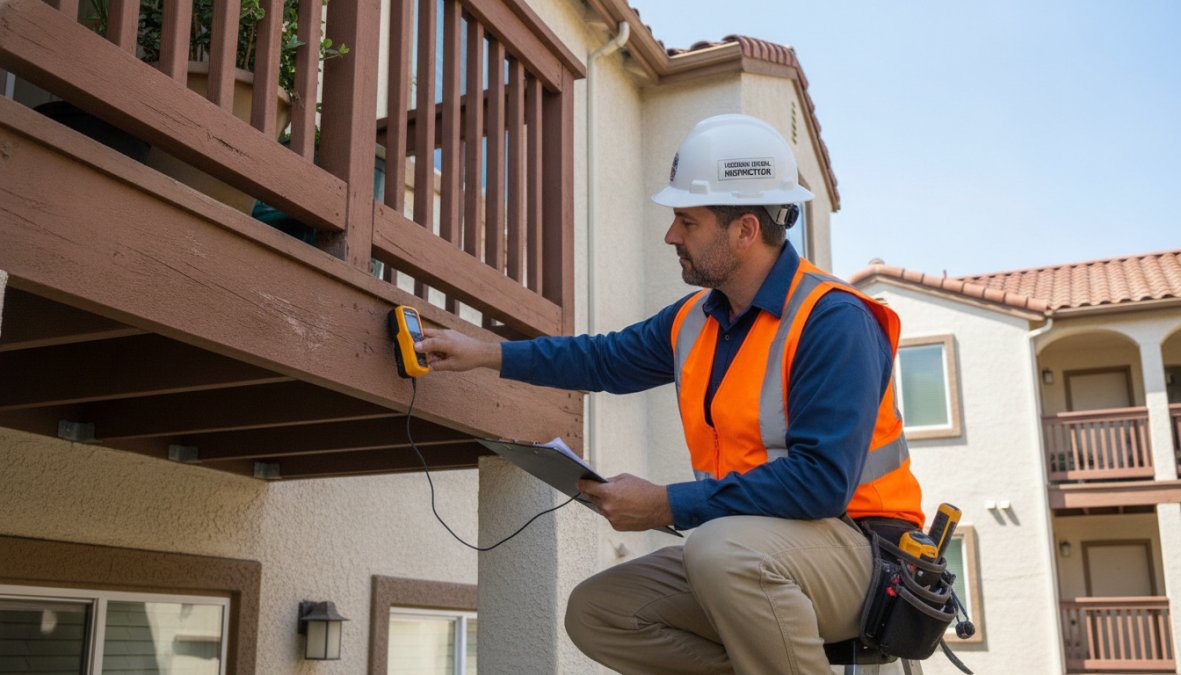
Inspectors begin with a visual survey of all accessible exterior elevated elements, looking for surface cracking, staining, paint bubbling, rust streaks, and visible deformation. Non-destructive methods include probing wood members with a pick or awl to detect soft spots, using moisture meters to identify elevated moisture content, and infrared thermal imaging to locate hidden water intrusion pathways, all without opening walls or removing finish materials.
Destructive Testing, Borescope, and Moisture Analysis
Where non-destructive methods indicate potential decay, inspectors may open small sections of decking or cladding to visually inspect framing below. Borescope cameras allow inspectors to see into cavities through small drilled holes, minimizing invasiveness. Moisture analysis using calibrated sensors quantifies the severity of water intrusion and predicts the rate of ongoing decay. According to California Department of Consumer Affairs guidance on building inspections, inspectors must document all findings with sufficient detail to support a repair scope.
Request that your inspector photograph every area of concern during the inspection. Photographic documentation becomes critical evidence if you need to dispute a contractor’s repair scope or negotiate with your insurance carrier.
Structural Integrity Inspection Checklist for Property Managers
Use this checklist before and after your inspection to stay organized and reduce surprises.
Pre-Inspection Preparation:
- Confirm inspector holds the correct license for your building type (SB 326: architect or engineer; SB 721: licensed contractor, architect, or engineer)
- Gather existing maintenance records and prior inspection reports
- Ensure all balconies and exterior elevated elements are accessible (move furniture, clear debris)
- Notify residents of inspection dates and access requirements
- Confirm permit requirements with your local jurisdiction
During Inspection:
- Request a written scope of work before the inspector begins
- Ask inspector to flag any elements requiring immediate safety restriction
- Confirm that moisture meters and probing tools are being used, not just visual observation
- Verify the inspector is documenting findings photographically
Post-Inspection:
- Review the written report within 5 business days of receipt
- Identify items classified as immediate hazards versus deferred maintenance
- Share findings with HOA board or building ownership per disclosure requirements
- Initiate contractor bidding for required repairs within the legally prescribed timeframe
- File the inspection report with your local enforcement agency if required
Balcony Inspection Cost in California: What to Budget
Balcony inspection cost California property owners face varies based on building size, element count, inspection methodology, and inspector credentials. Many providers price per element rather than per building. Destructive testing adds cost for opening and patching finish materials.
| Building Type | Estimated Inspection Scope | Relative Cost Range |
|---|---|---|
| Small apartment (3-10 units) | All EEE, visual + moisture | Lower range |
| Mid-size complex (11-50 units) | All EEE, non-destructive + sampling | Mid range |
| Large complex (50+ units) | Statistical sampling, borescope, destructive | Higher range |
| HOA/Condo (SB 326) | Statistically significant sample | Mid to higher range |
Get at least three quotes from licensed inspectors before committing. The cheapest inspection is not always the most defensible one if findings are later challenged.
How Insurance Premiums Are Affected by Compliance Status
Insurance premium impact is one of the most underreported consequences of balcony inspection compliance status. Many commercial property insurers now request proof of SB 721 or SB 326 compliance at policy renewal. Buildings without a current inspection report may face higher premiums, coverage exclusions for deck and balcony-related claims, or outright non-renewal. Conversely, buildings with documented inspection histories and completed repairs often qualify for better terms. Per Insurance Information Institute guidance on property risk management, documented maintenance and inspection records are among the top factors insurers evaluate when pricing commercial property policies.
Post-Inspection Repair Workflow and Consequences of Non-Compliance
Getting the inspection done is only the first step. The repair workflow that follows determines whether a building achieves genuine compliance or simply adds a report to a file.
Step-by-Step Repair Process After a Failed Inspection
- Classify findings by urgency. Separate immediate hazards (requiring closure or emergency repair) from standard deficiencies. Immediate hazards must be addressed before residents can use the affected element.
- Restrict access to unsafe elements. Post signage and physically block access to any element flagged as an immediate safety risk. Failure to do this creates direct liability exposure.
- Obtain contractor bids. Solicit bids from licensed contractors experienced with balcony and deck repair. Verify that repair plans address both structural decay and waterproofing deficiencies, not just cosmetic issues.
- Pull required permits. Most structural repairs to exterior elevated elements require building permits. Confirm requirements with your local jurisdiction before work begins.
- Execute repairs and document progress. Maintain a written record of all repair work, including contractor invoices, permit approvals, and inspection sign-offs.
- Schedule a re-inspection. After repairs are complete, a follow-up inspection confirms deficiencies have been resolved and the building assessment is current.
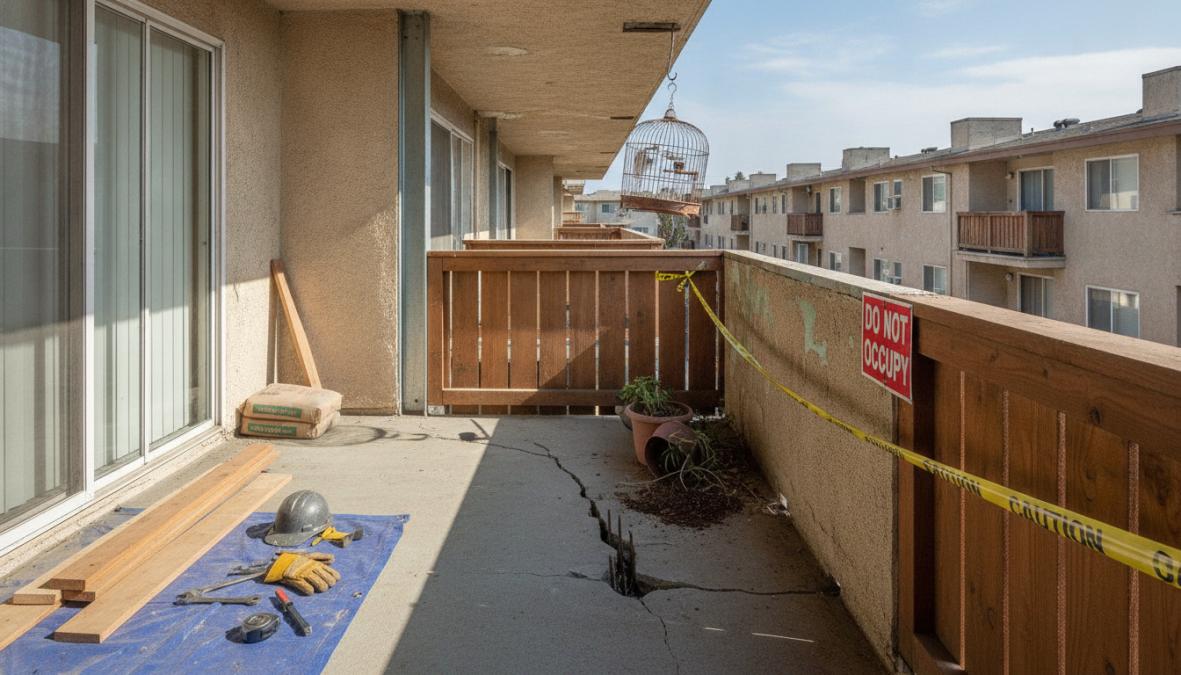
Liability Exposure, Negligence Per Se, and Violation Notices
Non-compliance with SB 721 or SB 326 creates a specific legal risk called negligence per se, a doctrine that allows a plaintiff to establish a defendant’s negligence by proving the defendant violated a statute enacted to protect the public from the type of harm that occurred. If a balcony collapses and the building owner never completed the legally required inspection, the owner’s negligence is presumed. Beyond civil liability, local enforcement agencies can issue formal violation notices, assess administrative penalties, and order elements closed to occupancy. As referenced in California Civil Code Section 5551 text, the law explicitly authorizes enforcement actions against associations and owners who fail to comply. The cost of a compliant inspection is a fraction of the cost of defending a negligence claim or managing a balcony collapse incident.
Completing your SB 721 or SB 326 inspection is not just a legal box to check. It is the single most effective action a property owner can take to reduce liability exposure, maintain insurance coverage, and protect residents from preventable structural failures.
Apex Balcony’s licensed inspectors bring decades of combined construction and design experience to every building assessment, covering all exterior elevated elements including balconies, decks, and stairways. Our team specializes in SB 326 and SB 721 compliance and provides a clear path to required repairs after every inspection.
California’s balcony inspection laws are not going away, and enforcement is only becoming more consistent as deadlines pass. If your building has not yet completed its required inspection, every additional month of delay adds to your liability exposure and narrows your repair timeline. Apex Balcony has helped hundreds of building owners across California achieve compliance through comprehensive inspections, detailed reporting, and expert guidance on the repair process. Book your inspection with Apex Balcony and get the documentation, clarity, and compliance your property needs.
Frequently Asked Questions
What is the difference between California's SB 721 and SB 326 balcony inspection laws?
SB 721 applies to apartment buildings with three or more units owned by a single landlord, while SB 326 governs condominium associations and HOAs under Civil Code 5551. Both laws require inspection of Exterior Elevated Elements such as balconies, decks, and stairways, but they have different compliance deadlines, inspector qualification requirements, and reinspection cycles. Property managers should confirm which law applies to their specific building type before scheduling balcony safety inspection services in California.
What is the SB 721 inspection deadline for California apartment owners?
Under SB 721, apartment building owners were required to complete their initial Exterior Elevated Element inspections by January 1, 2025. After that, reinspections are required every six years. SB 326, which covers HOAs and condominium associations, required initial inspections to be completed by January 1, 2025 as well, with a recurring nine-year inspection cycle thereafter. Missing these deadlines exposes property owners to violation notices, fines, and significant liability exposure.
How much do balcony safety inspection services cost in California?
Balcony inspection cost in California varies based on building size, number of units, and the inspection methodology required. Smaller buildings may see lower costs, while large multifamily complexes requiring destructive testing, borescope analysis, or statistically significant sampling across many Exterior Elevated Elements will cost more. Most service providers offer project-based pricing and require a site consultation before providing a quote. Investing in a compliant inspection early typically reduces long-term costs by identifying structural decay before it requires major repair.
What does a California balcony safety inspection actually include?
A compliant balcony safety inspection in California covers all Exterior Elevated Elements, including balconies, decks, stairways, and walkways. Inspectors perform a visual investigation for signs of wood rot, structural decay, and waterproofing failure. Depending on findings, they may use non-destructive methods like moisture sensors and infrared imagery, or destructive testing and borescope cameras to assess concealed framing. The inspector then issues a safety certification or flags items requiring repair, with findings documented in a formal report for local enforcement and maintenance records.
What happens if a balcony fails inspection in California?
If a balcony or other Exterior Elevated Element fails inspection, the property owner must restrict access immediately and begin the repair process. Under SB 721 and SB 326, the inspector must notify local enforcement agencies of unsafe conditions. Owners face a defined repair window and must document completed work. Failure to act creates serious liability exposure, including negligence per se claims if a balcony collapse injures a resident. Non-compliance can also trigger violation notices, fines, and increased insurance premiums for the property.
Who is qualified to perform SB 326 balcony inspections in California?
SB 326 requires that inspections be performed by a licensed structural engineer, architect, or a licensed contractor with relevant experience in structural inspection. SB 721 allows a broader range of qualified professionals including licensed civil or structural engineers, architects, and certain licensed contractors. Hiring a qualified, licensed inspector is critical, an inspection performed by an unqualified party does not satisfy the legal requirement and leaves the property owner exposed to non-compliance penalties and liability.