
Last Updated: November 3, 2026
Quick Summary
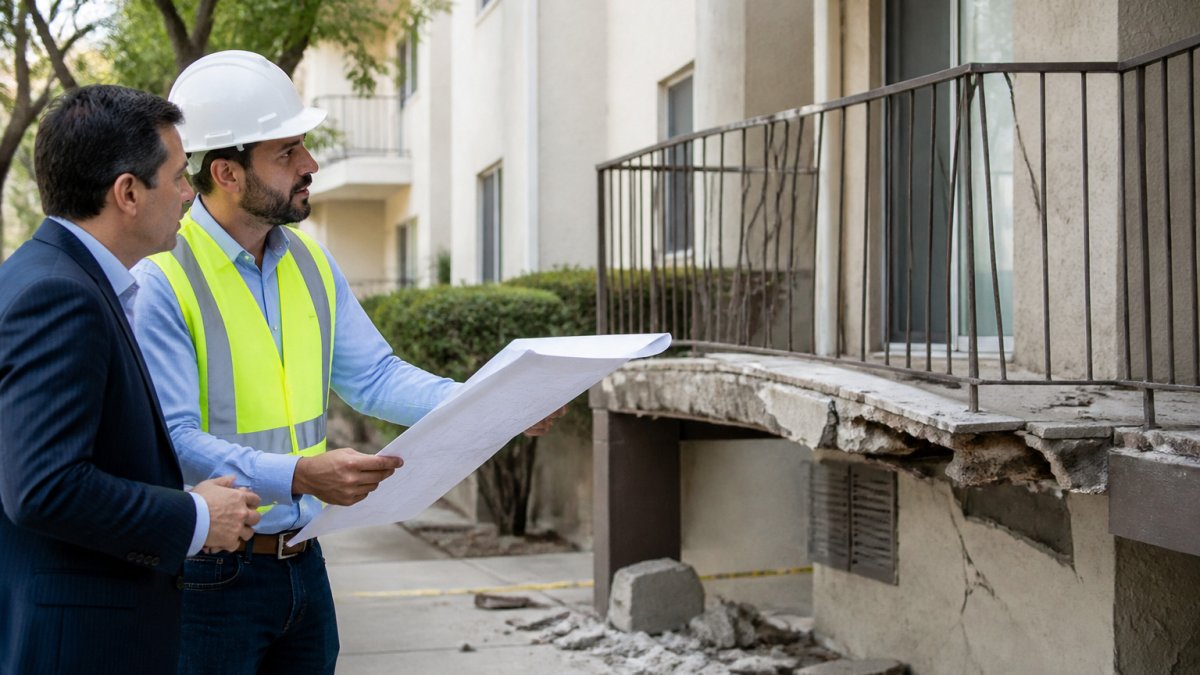
Legal liability for balcony collapses in HOA communities rests on premises liability law, which requires whoever controls a walkable surface to keep it safe. In an HOA, that control is split between the board, the management company, and individual owners, and the split is exactly where collapse claims get decided.
- Wood rot and corrosion of metal fasteners and connectors are common causes of balcony failure.
- SB 326 requires associations to have exterior elevated elements inspected by a licensed professional on a statutory cycle.
- The maintenance matrix in your declaration controls whether the HOA or homeowner is responsible for balcony repairs.
- After a collapse, secure the scene, preserve evidence, and do not allow repairs until an engineer documents the condition.
- A quarterly walkthrough should probe ledger boards and framing for soft wood and check fasteners for corrosion.
Table of Contents
- Premises Liability and Balcony Collapse Liability in HOA Communities
- Common Causes of Balcony Collapses and Construction Defects
- SB 326 Balcony Inspection Requirements for HOA Boards
- HOA Board Member Liability for Negligence and Failure to Inspect
- Balcony Maintenance Responsibility: HOA vs Homeowner
- HOA Insurance Coverage Nuances and Indemnification Gaps
- Steps to Take After a Balcony Collapse
- Preventative Maintenance Checklists and State-Specific Inspection Mandates
- Frequently Asked Questions
Premises Liability and Balcony Collapse Liability in HOA Communities
Legal liability for balcony collapses in HOA communities rests on premises liability law, which requires whoever controls a walkable surface to keep it safe. In an HOA, that control is split between the board, the management company, and individual owners, and the split is exactly where collapse claims get decided. California’s SB 326 and SB 721 turned that abstract duty into a paper trail: inspections, reports, and repair deadlines that a plaintiff’s attorney will request in the first week of litigation.
Buildings rarely collapse without warning signs. They collapse after years of deferred maintenance, missing records, and a board that assumed someone else was watching.
Below, we break down who carries the duty of care, what the statutes require, and how boards close the gaps before an accident closes them for you.
How Duty of Care Applies to Common Areas and Limited Common Elements
Duty of care is the legal obligation to maintain property in a reasonably safe condition for people lawfully on it. For an HOA, that duty attaches to common areas the association controls and, in many declarations, to limited common elements assigned to a unit but maintained by the board.
The distinction matters in a lawsuit. A balcony the association must maintain is a balcony the association can be sued over. A balcony the owner must maintain shifts the primary duty, but boards rarely escape entirely: failure to inspect, failure to enforce repair obligations, and failure to warn can all create independent exposure.
Boards should read the declaration before an accident, not after. The maintenance matrix in your CC&Rs is your first line of defense, and it is also the document opposing counsel will read first.
Common Causes of Balcony Collapses and Construction Defects
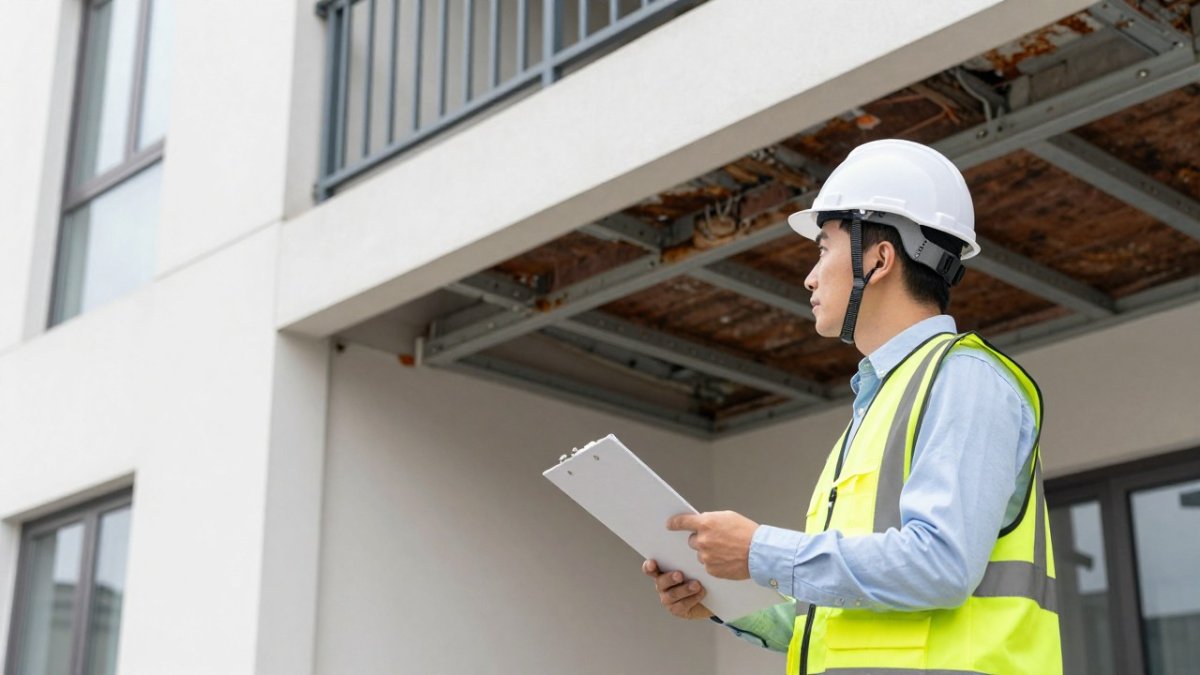
Wood rot and corrosion of metal fasteners and connectors are common causes of balcony failure. Both can be slow and easy to overlook. Water intrusion at the ledger board, failed flashing, and blocked drainage create the conditions, and time does the rest.
Construction defects sit underneath many of these failures. For a focused breakdown of balcony collapse causes and how to prevent them, see our dedicated guide. Common examples include:
- Fastener failure from galvanized or coated hardware that corrodes in coastal salt air
- Load-bearing capacity shortfalls where a balcony was framed for foot traffic but loaded with planters, furniture, and gatherings
- Building code violations in original waterproofing or guardrail attachment
- Negligent repair that covers rot with new decking instead of replacing the framing
Structural integrity is a chain, and the weakest link decides the outcome. A guardrail bolted into rotted wood fails the same as one never bolted at all.
SB 326 Balcony Inspection Requirements for HOA Boards
SB 326 requires associations to have exterior elevated elements inspected by a licensed professional on a statutory cycle. Readers should confirm the current deadlines and scope with the official text of the statute.
Boards should treat the inspection as a governance obligation, not a vendor errand. Miss the deadline and you have handed a plaintiff a documented failure to inspect.
What the Inspection Report Must Cover and How to Use It
A compliant report identifies each inspected element, describes its condition, flags structural deficiencies, and recommends repair or replacement. Our Balcony Inspection Report Requirements guide explains the report contents, inspector qualifications, and compliance steps. It must be signed by a qualified inspector and retained as an association record.
Use the report as a work plan. Rank deficiencies by severity, fund the critical repairs first, and document every board vote. A report that sits in a drawer protects no one.
HOA Board Member Liability for Negligence and Failure to Inspect
Directors may be protected by the business judgment rule when they act in good faith and on reasonable information (business judgment rule | Wex | US Law). That protection may not apply when a board ignores a known hazard or skips a statutory inspection. If your board is ignoring safety warnings, see What to Do If Your HOA Board Ignores Balcony Safety for practical steps to escalate and force action.
Personal exposure is real but usually secondary. The association is the named defendant, and the board’s decisions become the association’s conduct.
Balcony Maintenance Responsibility: HOA vs Homeowner
The answer depends on your governing documents, not on general assumptions, and the document that controls is the maintenance matrix in the declaration or its incorporated maintenance addendum.
The legal categories matter because they drive who is the defendant. A common-element balcony is association property, and the association’s duty of care attaches directly. A limited common element, such as a balcony reserved for the exclusive use of one unit, is often maintained by the association but used by the owner, and declarations vary on whether the association or the owner bears repair costs.
A practical way to read the matrix is to build a one-page allocation table before any dispute starts. For each elevated element, list the component, the responsible party under the declaration, the inspection interval, the funding source, and the record that proves the work was done. Components to separate include the deck surface and waterproofing membrane, the framing and ledger board, the fasteners and connectors, the guardrail and its attachment points, the flashing, and the drainage scuppers.
Where those lines blur, disputes follow. Owners withhold assessments, boards delay repairs, and the balcony keeps deteriorating while the argument runs. If a dispute persists, our guide to legal steps for forcing HOA balcony repairs covers how to compel the responsible party to fix the balcony.
Watch out: a board that repairs an owner-responsibility balcony without a written allocation decision can later be argued to have assumed the maintenance duty for every similar balcony in the community, which converts a one-time repair into a permanent obligation.
HOA Insurance Coverage Nuances and Indemnification Gaps
Most boards assume the master policy covers everything. It usually does not, and the gap between what the association thinks it bought and what the policy actually pays is where balcony-collapse claims become financial crises.
On the property side, the master policy responds to the physical damage to the structure, but the response is shaped by the governing documents. Many declarations require the association to insure the common elements and the limited common elements to replacement cost, while unit owners insure their own improvements and personal property under an HO-6 policy.
On the liability side, the master policy defends and indemnifies the association for injury claims, subject to limits, deductibles, and exclusions. Three exclusions recur in collapse litigation. Construction defect and faulty workmanship exclusions can bar coverage for the underlying defective construction, though courts often distinguish between the defective work itself and the resulting bodily injury.
Indemnification clauses in the declaration and the management agreement add another layer. A management company may be indemnified by the association for ordinary negligence, which means the association absorbs the loss even when the manager’s failure to schedule an inspection contributed to it. Some management agreements carve out gross negligence and willful misconduct; many do not.
Watch out: an association that tenders a claim to its liability carrier without also notifying the property carrier, or that authorizes repairs before an engineer documents the failure, can compromise both coverage positions at once. Notice provisions are strict, and late notice is one of the most common grounds carriers cite when denying a collapse claim.
sample HO-6 policy and loss-assessment coverage overview
Steps to Take After a Balcony Collapse
Secure the scene and call emergency services first. Then preserve evidence: photograph the failure, retain the collapsed components, and do not allow repairs until an engineer has documented the condition. Notify your insurer immediately and put a litigation hold on all maintenance records.
From there, the sequence matters:
- Retain a structural engineer to determine the cause
- Pull inspection reports, work orders, and board minutes
- Notify counsel and preserve the privilege
- Inspect all similar elements on the property
- Document every action with dates
A personal injury lawsuit may follow within the applicable statute of limitations, so confirm the applicable period with counsel. Compensatory damages in these cases can include medical costs, lost earnings, and pain and suffering (personal injury recovery | Wex | US Law). The association’s records from the weeks after the collapse will shape the settlement or the verdict.
Preventative Maintenance Checklists and State-Specific Inspection Mandates
A checklist beats a crisis. We give boards a short quarterly walkthrough that catches most problems early:
- Probe ledger boards and framing at the wall connection for soft wood
- Check fasteners and connectors for rust, corrosion, or movement
- Confirm drainage paths and flashing are clear and intact
- Test guardrails for wobble and verify attachment points
- Photograph every element and file with the date
- Log deficiencies and assign a repair deadline at the next board meeting
State mandates vary. Readers in California should review the current text of SB 721 and SB 326 for the scope and inspection requirements that apply to their property.
That is the throughline in all of this: liability for a balcony collapse is rarely created in the moment of failure. It is built over years of unrecorded decisions. The boards that avoid litigation are the ones that can produce a clean file.
If your association is behind on inspections or unsure which statute applies, Apex Balcony can help. Apex Balcony offers inspection services for elevated exterior elements, including balconies, decks, and stairways, to support SB 326 and SB 721 compliance. Contact us for current details on our services. Get started with Apex Balcony and put a documented inspection record behind your next board meeting.
Frequently Asked Questions
Is the HOA responsible for balcony repairs in California?
It depends on the governing documents. Balconies are often classified as common areas or limited common elements. If the HOA owns or maintains the structural components, the board is typically responsible for repairs. Under SB 326, HOAs must inspect exterior elevated elements and address safety issues. Review your CC&Rs and consult counsel to confirm whether the balcony is an association or owner maintenance obligation.
What are the legal consequences of failing to inspect HOA balconies?
Boards that skip required inspections can face personal injury lawsuits, compensatory damages, and claims of negligence or failure to inspect. SB 326 noncompliance may also expose the HOA to fines and weaken insurance coverage. Documented maintenance records and inspection reports are key evidence in defending a tort claim. Consult legal counsel about your specific obligations.
What is the difference between common area and exclusive use balcony liability?
Common area balconies are controlled and maintained by the HOA. Exclusive use balconies are reserved for one owner but may still be association property. Liability follows control and maintenance duties. If the HOA is responsible for structural integrity, it usually bears liability for collapse. If the owner is responsible for upkeep, liability may shift. Your CC&Rs define these terms.
How do state inspection laws like SB 326 affect HOA liability?
SB 326 requires HOAs to inspect exterior elevated elements on a statutory cycle and address necessary repairs. Compliance creates a record of due care. Failure to inspect or repair can support a negligence claim and may void insurance coverage. The law does not eliminate liability, but it sets a clear standard that boards should follow to reduce exposure.
