
Last Updated: November 4, 2026
Quick Summary
To conduct annual balcony safety inspections, landlords first perform a visual walkthrough of every elevated element, then commission a licensed professional for a structural integrity assessment. Document all findings in a dated, indexed file, notify tenants in writing, and budget separately for remediation.
- SB 721 covers apartment buildings, while SB 326 covers common-interest developments such as HOAs and condos.
- Before the inspection, gather building plans, prior reports, maintenance records, and a list of all balconies with unit numbers.
- Send two written notices per cycle: an access notice before the inspection and a results notice after the report is issued.
- Budget for soft costs like engineering follow-up, permits, and re-inspection, not just the contractor’s bid.
- Get at least two bids for anything beyond routine patching and ask contractors to price by line item.
Table of Contents
- Why Annual Balcony Safety Inspections Protect Landlords
- SB 326 Balcony Inspection Requirements Landlords Must Meet
- What You’ll Need Before the Inspection
- Step 1: Perform a Visual Walkthrough of Every Elevated Element
- Step 2: Commission a Balcony Structural Integrity Assessment
- Step 3: Hiring a Licensed Balcony Inspector
- Step 4: Document Findings and Notify Tenants
- Budgeting for Remediation and Choosing a Digital Record System
- Frequently Asked Questions
Why Annual Balcony Safety Inspections Protect Landlords
Balcony safety inspections are the periodic, documented examinations of elevated exterior elements that catch structural failure before it causes injury. Building owners have worked through this process with Apex Balcony. The stakes are not theoretical.
The core argument here is simple: an inspection is not paperwork. It is your legal defense and your early-warning system. A documented inspection cycle shows you acted reasonably. A missing one shows the opposite.
Below, we walk through the full annual process, from legal triggers to documentation, so you can run it without guesswork.
SB 326 Balcony Inspection Requirements Landlords Must Meet
SB 326 applies to common-interest developments such as HOAs and condominiums. Landlords and property owners should review the statute’s current inspection, reporting, and repair requirements with the official California legislative text or qualified counsel.
SB 721 vs. SB 326: Which Law Applies to Your Building
SB 721 covers apartment buildings. SB 326 covers common-interest developments such as HOAs and condos. The dividing line is building type, not size alone.
Landlords often ask us which law governs their property before they hire anyone. You can get a direct answer without a sales call by reviewing a side-by-side comparison of SB 326 and SB 721 requirements.
What You’ll Need Before the Inspection
Preparation cuts inspection time and prevents surprises. Gather these items before the inspector arrives:
- Building plans and prior inspection reports
- Maintenance records for waterproofing and drainage
- A list of all balconies, decks, and stairways with unit numbers
- Tenant contact details for access scheduling
- A budget line for any immediate repairs
A landlord preparing for the inspection can find a step-by-step inspection preparation checklist to work through before the visit.
Step 1: Perform a Visual Walkthrough of Every Elevated Element
Walk every elevated element yourself first. This is not a substitute for a professional inspection, but it helps you spot the obvious and prioritize.
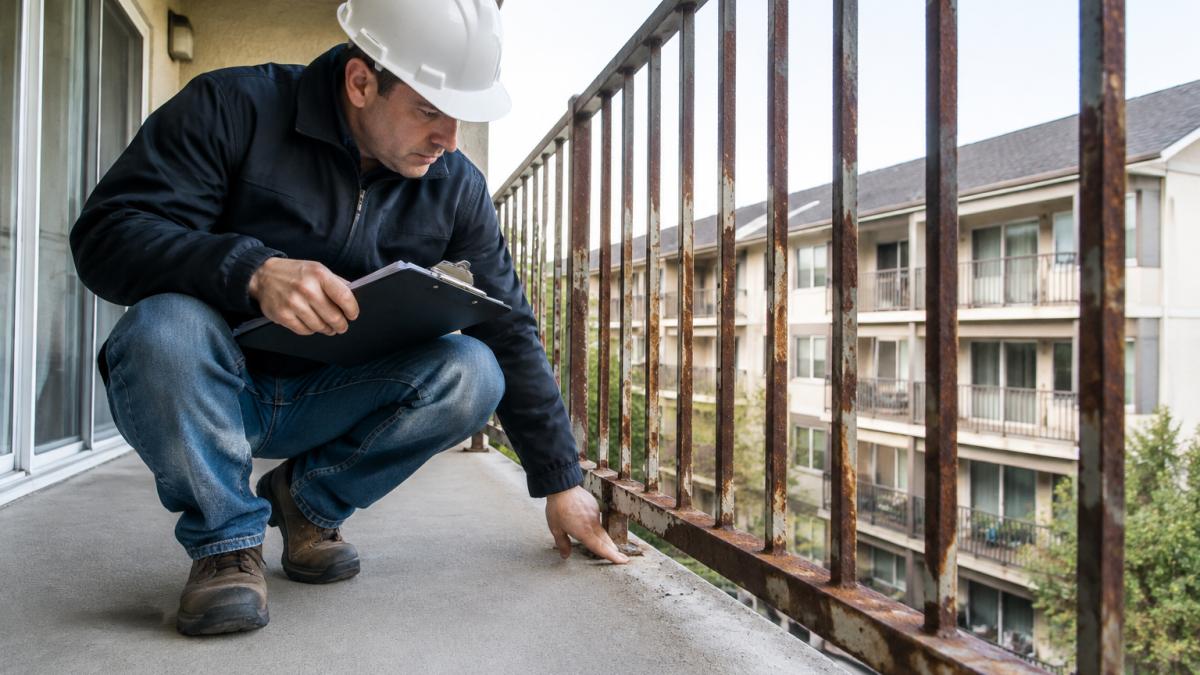
Check railing stability, connection points, decking materials, and drainage systems. Look for corrosion on fasteners and ledger boards.
Common Balcony Safety Hazards to Flag
- Rust or corrosion on metal fasteners
- Dry rot in wood decking
- Cracks or spalling in concrete
- Loose or wobbling railings
- Standing water from blocked drainage
- Water stains on the underside
Step 2: Commission a Balcony Structural Integrity Assessment
A balcony structural integrity assessment goes deeper than a visual check. It examines concealed areas, load-bearing components, and the building envelope. Structural assessments may use non-destructive testing to examine hidden areas, depending on the inspector and the building.
This is where DIY ends. Visual inspection finds symptoms. A structural assessment finds causes.
Step 3: Hiring a Licensed Balcony Inspector
Hire a licensed professional for the inspection rather than relying on an unlicensed or general contractor, and confirm their licensing, report scope, and insurance before hiring.
A common mistake is choosing on price alone. A cheap report that misses a deficiency is worthless when you are audited or sued. Landlords at the hiring stage can follow a seven-step process for choosing a qualified balcony inspector to vet candidates properly.
Step 4: Document Findings and Notify Tenants
Documentation is where most landlords lose their protection. A signed deficiency report sitting in a drawer does not prove diligence; a dated, indexed file that shows what you found, when you found it, and what you did about it does.
A defensible inspection file for each elevated element should contain:
- The signed and dated deficiency report from the licensed inspector, including photographs of every flagged condition
- The inspector’s license number, scope of work, and certificate of insurance
- A repair log linking each deficiency to the contractor, permit (where required), completion date, and post-repair photo
- The tenant notice sent before access and the results notice sent after the inspection
- Prior-cycle reports so a multi-year pattern (recurring water intrusion, repeated railing loosening) is visible at a glance
- The maintenance history for waterproofing, drainage, and coatings, since deferred maintenance is the most common root cause inspectors cite
Retention matters. Records are typically retained for a long period because claims can arise years after an incident. Confirm the retention period that applies to your building with counsel.
Maintaining a comprehensive digital record ensures that every structural assessment remains organized alongside your broader rental inspection checklist to prevent oversight during routine property maintenance.
Tenant Notification: What to Send and When
Tenant communication is part of the record, not an afterthought. Send two written notices per cycle:
- Access notice, sent with enough lead time for tenants to arrange to be home or authorize entry, stating the inspection date window, who will enter, what they will examine, and how to request an accommodation. Keep a copy with delivery confirmation.
- Results notice, sent after the report is issued, telling tenants what was found in their unit’s elevated elements, what repairs are scheduled, and any interim safety instructions (for example, keep the balcony clear or limit occupancy until a railing is re-anchored).
Watch out: verbal notice or a hallway conversation gives you no proof of delivery, and a tenant who claims they were never told about a known hazard undercuts your entire defense.
Digital Record-Keeping for Multi-Year Cycles
Paper files fail at exactly the moment you need them, when a future inspector, buyer, lender, or attorney asks for a five-year history. A cloud-based system solves the multi-year cycle problem that most guides ignore. When choosing a tool, consider whether it lets you:
- Store reports, photos, permits, and repair invoices against each individual balcony or stairway, not just the building
- Set recurring reminders tied to the statutory inspection cycle so a deadline never slips
- Attach photos to a timeline so before-and-after repair evidence lives in one place
- Export a complete history as a single PDF when an auditor or insurer requests it
- Control access so property staff, the inspector, and counsel can view records without emailing attachments around
You do not need specialty software to start. A structured cloud folder per building, with subfolders per elevated element and a running repair log spreadsheet, beats a filing cabinet and costs nothing. Move to a dedicated maintenance or compliance platform when you manage enough units that reminder tracking becomes the failure point.
Once the inspection is complete, a detailed method for documenting balcony inspections and meeting SB 326 records requirements helps you build a file that holds up.
Budgeting for Remediation and Choosing a Digital Record System
Remediation costs depend on what the inspection finds, but owners can still plan a budget around their building’s age and construction.
A practical way to structure the budget:
- Baseline contingency, set aside a per-balcony reserve for routine findings (fastener replacement, railing re-anchoring, localized waterproofing patching). Owners can size this reserve from their own repair history over several cycles.
- Deferred-maintenance reserve, fund separately for known-but-unaddressed conditions (aging waterproofing membranes, corroded ledger connections). These are the findings that turn a small repair into a structural project.
- Structural contingency, a larger reserve held for the low-probability, high-cost outcome: a deficiency report that requires shoring, partial reconstruction, or temporary closure of units. Even a modest reserve prevents a single report from becoming a cash-flow crisis.
- Soft costs, budget for engineering follow-up, permits, and re-inspection, not just the contractor’s bid. These routinely add to the sticker price of a repair.
Watch out: budgeting only for the inspection fee and treating repairs as an unbudgeted surprise is the single most common way owners get caught short, the inspection is the cheap part.
Estimating Repair Costs From the Deficiency Report
When the report lands, do not accept a single contractor bid as the number. Get at least two bids for anything beyond routine patching, and ask each contractor to price by line item so you can compare like for like. Separate the report’s findings into three buckets: safety-critical (address immediately, before the next cycle), code-required (address within the statutory repair window), and monitor-only (log and re-check next cycle).
For planning purposes, review SB 326 inspection cost benchmarks to build a realistic budget, and keep every bid and invoice in the same record system as the inspection report so future cycles can be budgeted from actual history.
Choosing a Digital Record System
The record system is the other half of this section because budgeting and record-keeping are the same discipline: both depend on a searchable history. A system that stores reports, photos, bids, and repair invoices against each elevated element lets you answer the two questions that matter at budget time, what did we spend last cycle, and what did we defer?, in minutes. A structured cloud folder and a running log are a reasonable starting point; a dedicated compliance platform may help as the number of buildings grows.
| Stage | Action | Frequency |
|---|---|---|
| Visual walkthrough | Owner spot-check of railings, decking, drainage | Annual |
| Structural assessment | Licensed professional deep review | Per statutory cycle |
| Documentation | File reports, photos, repair logs | Every inspection |
| Tenant notice | Written findings and access notice | Every inspection |
Frequently Asked Questions
How often should a balcony be inspected?
The inspection cycle and scope under SB 326 and SB 721 should be confirmed against the current text of each statute. Many landlords run their own visual walkthrough annually between those cycles to catch corrosion, loose fasteners, and drainage problems early. Keep every report on file so you can show a continuous inspection cycle if a claim or audit arises.
Can landlords perform their own annual balcony safety inspections?
Landlords can do a visual walkthrough of their own property, and doing so is a smart habit. What they cannot do is sign off on the structural evaluation that SB 326 and SB 721 require. Confirm the current qualification requirements in the statute for who may perform that work. Use your own walkthrough to spot obvious hazards, then hire a qualified professional for the formal balcony structural integrity assessment.
What are the most common signs of structural failure in elevated decks?
Watch for corrosion on fasteners and connection points, dry rot in ledger boards and decking materials, railing that moves when pushed, standing water from blocked drainage systems, and cracks or spalling in concrete slabs. Waterproofing failures often show as staining or soft spots underneath the deck. Any of these findings should trigger a closer look from a licensed balcony inspector before you allow tenants to keep using the space.
How do I document balcony inspections for liability protection?
Keep the signed deficiency report, photos of every flagged item, the inspector’s license details, and dated repair invoices in one file per building. Log tenant notification dates and the exact language you used. A digital record-keeping system makes this easy to search if you are audited or named in a claim. The paper trail showing a continuous inspection cycle and prompt remediation is what protects you, so treat documentation as part of the inspection itself.
Compliance is not a one-time event. It is a habit that protects your residents and your reserve fund. Apex Balcony brings licensed inspectors with decades of combined construction and design experience, specialized SB 326 and SB 721 expertise, and comprehensive review of balconies, decks, and stairways. Get started with Apex Balcony and put a documented inspection cycle in place this year.
