
Table of Contents
- What Drives the Cost of Balcony Structural Repairs in California
- Balcony Repair Cost: Minor Fixes vs. Major Structural Work
- Balcony Replacement Cost: When Repair Is No Longer Viable
- Balcony Inspection Cost and SB 326 / SB 721 Compliance
- Who Pays for Balcony Repairs in an HOA: Owner vs. Association Responsibility
- Repair vs. Replace: A Decision Framework for Property Owners
- Budgeting, Financing, and the Cost of Delaying Balcony Repairs
- Frequently Asked Questions
Last Updated: October 8, 2026
What Drives the Cost of Balcony Structural Repairs in California
The cost of balcony structural repairs in California depends on damage severity, repair scope, and regional labor rates, not on a single statewide price. Most estimates range widely because two balconies with identical square footage can need completely different work.
A balcony is an exterior elevated element: any walking surface more than 6 feet above grade, including decks, stairways, and landings attached to a building. The California legislature passed SB 326 and SB 721 after the 2015 Berkeley balcony collapse that killed six students, and the state’s repair market has been shaped by those laws ever since.
The Cost Stack: What You Are Actually Paying For
A balcony repair estimate is not one number, it is a stack of line items. Understanding the stack is how you tell a fair bid from a padded one. A typical project can include:
- Inspection and condition assessment, a licensed professional documents every elevated element, often with photo evidence and a written report
- Engineering and design, structural calculations, repair details, and stamped plans where the scope triggers them
- Permits and plan review, jurisdiction-dependent fees and review timelines
- Demolition and debris removal, tearing out failed decking, railings, stucco, or tile and hauling it away
- Structural repair, wood framing replacement, concrete patching, spall repair, rebar treatment, or connection reinforcement
- Waterproofing, membrane replacement, flashing, sealants, and drainage corrections
- Finish restoration, stucco, tile, paint, coatings, and railing refinishing
- Mobilization and access, scaffolding, swing stages, lifts, and crew setup, which can be a meaningful share of a small job
On a small repair, mobilization and access can rival the cost of the repair itself, while on a large building-wide project those same costs spread across many balconies and shrink per unit.
Damage Severity and Repair Scope
Severity is the single largest cost driver. A hairline crack that needs sealing is a very different project from a balcony with rotted wood framing, corroded bolts, and a failed waterproofing membrane. Repair scope follows severity: cosmetic fixes stay small, while structural reinforcement, demolition, and engineering design plans push costs up fast.
A useful way to think about it is in tiers:
- Cosmetic and minor, crack sealing, flashing repair, fastener replacement, recoating, and localized membrane patches. These are per-item or per-visit jobs.
- Moderate, localized decay or membrane failure that requires opening the assembly, replacing some framing or decking, and restoring waterproofing and finish. These are priced per balcony.
- Severe and structural, widespread decay, failed connections, or a membrane that has failed across the entire walking surface. These are priced per square foot and often scoped building-wide.
The jump between tiers is rarely linear. Opening a balcony to fix a moderate problem frequently reveals a severe one, which is why a condition assessment comes before any cost estimate.
Regional Labor and Material Rates
Labor rates vary across the state. Crews in dense coastal metros charge more than those inland, and older buildings often need custom-milled materials that cost more than stock lumber or standard railings. Permit fees and inspection requirements also differ by jurisdiction, which is why the same repair can price differently in two neighboring counties.
Three regional patterns are worth knowing:
- Coastal metros carry the highest labor and access costs, plus stricter corrosion exposure that drives more frequent membrane and fastener work.
- Inland and Central Valley areas generally see lower labor rates but can face longer material lead times and higher mobilization costs when specialized crews travel in.
- Older urban building stock tends to need custom fabrication and more invasive demolition, both of which raise cost independent of geography.
California building standards code overview
Skipping a proper condition assessment to save on inspection fees is the most common mistake we see. Owners approve a cosmetic patch, the underlying water intrusion continues, and the same balcony needs full reconstruction a year later at several times the original cost.
Balcony Repair Cost: Minor Fixes vs. Major Structural Work
Minor balcony repairs and major structural reconstruction sit at opposite ends of the budget. Knowing which category your project falls into is the first step toward a realistic cost estimate.
Minor repairs typically include:
- Crack filling and patching on concrete surfaces
- Sealing or replacing flashing around door thresholds
- Tightening or replacing individual bolts and fasteners
- Repainting or recoating metal rails
- Localized waterproofing membrane patches Addressing these surface-level issues promptly prevents moisture intrusion from compromising the underlying structural integrity, a principle that remains equally vital when managing concrete patio repairs.
Major structural work usually involves:
- Demolition of damaged decking or railings
- Wood framing replacement where decay has spread
- Structural reinforcement of load-bearing connections
- Full waterproofing membrane replacement
- Engineering design plans and permits before work begins
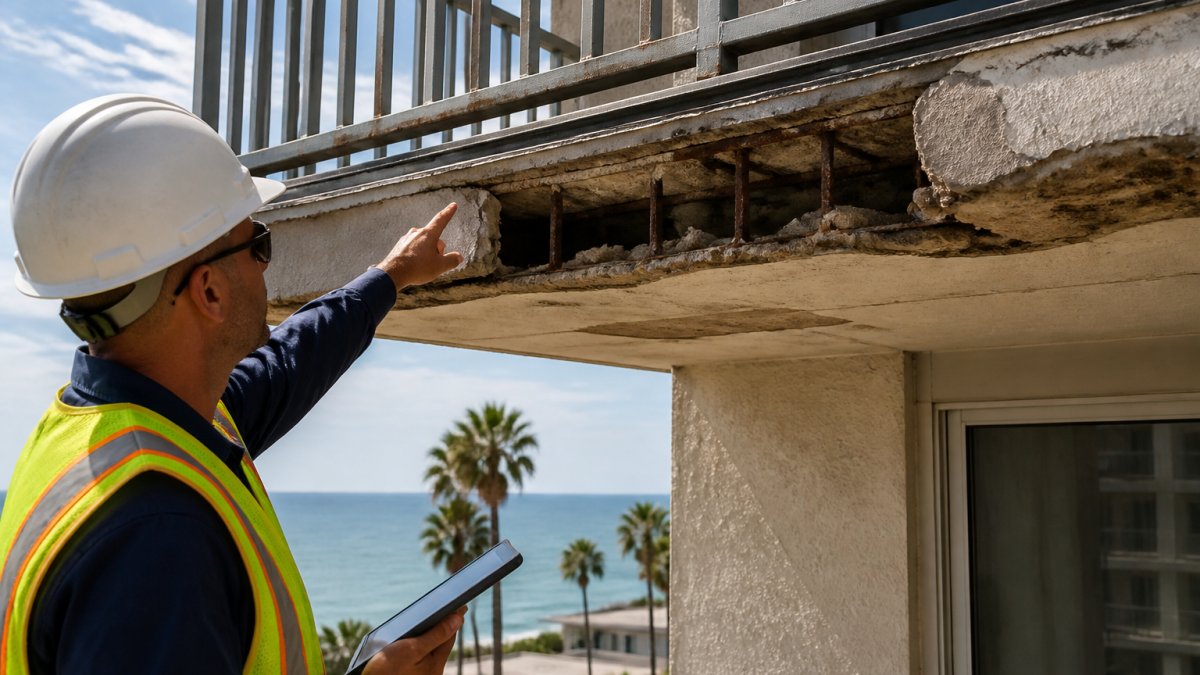
Minor repairs rarely stay minor once an inspector opens the assembly. Water intrusion hides behind stucco and tile, and what looks like a surface crack often signals deeper decay. That’s why a condition assessment comes before any cost estimate.
California building standards code overview
Balcony Replacement Cost: When Repair Is No Longer Viable
Replacement makes more sense than repair when the structural system has failed beyond economical patching. Three signals point to replacement:
- The waterproofing membrane has failed across the entire walking surface
- Wood framing shows widespread decay, not isolated rot
- Multiple balconies in the same building share identical failure patterns
Building-scale replacement is priced per square foot, and costs scale with the number of units. A 12-unit building replacing every balcony at once typically pays less per balcony than an owner replacing them one at a time, because demolition, scaffolding, and crew mobilization spread across more work. That economy of scale is worth factoring into your project budget.
| Scenario | Typical Triggers | Budget Approach |
|---|---|---|
| Minor repair | Isolated cracks, loose fasteners | Per-item pricing |
| Partial reconstruction | Localized decay, membrane failure | Per-balcony estimate |
| Full replacement | Widespread decay, failed waterproofing | Per square foot, building-wide |
Balcony Inspection Cost and SB 326 / SB 721 Compliance
Inspection costs are separate from repair costs, and getting this distinction right saves boards real money. SB 326 requires HOAs to inspect exterior elevated elements in buildings with three or more dwelling units, and SB 721 applies the same requirement to apartment owners. Both laws set inspection deadlines and require licensed professionals to perform the work.

What Drives Inspection Cost
Inspection pricing is driven by scope, not by a flat rate. The variables that move it most are:
- Building size and unit count, more units mean more elevated elements to document
- Number of elevated elements, balconies, stairways, landings, and walkways all count, and missing them means paying for a second inspection later
- Access difficulty, elements that require ladders, lifts, or swing stages take longer and cost more to reach
- Level of assessment, a visual inspection is cheaper than a closer assessment that opens the assembly or uses moisture testing
- Report requirements, photo documentation, element-by-element findings, and repair recommendations all add professional time
A small 12-unit building pays less than a large HOA with dozens of balconies, stairways, and landings. Apex Balcony works with both, and our licensed inspectors have decades of combined construction and design experience identifying early signs of structural failure.
What a Compliant Inspection Report Should Contain
A report that only says “pass” or “fail” is not enough to budget from. A useful report identifies each elevated element, describes its condition, notes the load-bearing components and waterproofing, flags any immediate safety concerns, and recommends a repair priority. That priority list is what turns an inspection into a repair scope, and a repair scope is what you send out for bids.
SB 326 and SB 721 balcony inspection requirements
How Inspection Findings Feed the Repair Budget
This is the connection most boards miss: the inspection report is the first draft of your repair budget. Elements flagged as immediate safety concerns become emergency work. Elements with early water intrusion become near-term repairs. Elements in good condition become reserve-planning line items for future cycles. Separating those three buckets lets a board fund the urgent work without over-assessing for everything at once.
Ask your inspector to document every elevated element, not just the balconies. Stairways and landings fall under the same statutes, and missing them means paying for a second inspection later.
Who Pays for Balcony Repairs in an HOA: Owner vs. Association Responsibility
Who pays for balcony repairs in an HOA comes down to one question: is the balcony a common area, an exclusive-use common area, or part of the owner’s separate interest? The answer lives in your governing documents, not in a general rule.
- Common area balconies are the association’s responsibility, funded from reserves or a special assessment
- Exclusive-use common areas are usually maintained by the owner but owned by the association, which splits responsibility in ways your CC&Rs define
- Separate-interest balconies are typically the owner’s cost entirely
Most disputes start when a board assumes all balconies are common area. Read the declaration before promising owners anything.
Repair vs. Replace: A Decision Framework for Property Owners
Use this framework to decide, in order:
- Has a licensed professional inspected the balcony? No inspection, no decision.
- Is the waterproofing membrane intact? If yes, repair is usually viable.
- Has decay reached the wood framing or structural connections? If yes, lean toward replacement.
- Do other balconies show the same damage? If yes, price the work building-wide.
- Does repair cost approach replacement cost? If yes, replace.
The repair-versus-replace decision is a structural question first and a financial one second. Owners who reverse that order usually pay twice.
Budgeting, Financing, and the Cost of Delaying Balcony Repairs
Delaying repairs is the most expensive option on the table. Water intrusion spreads, decay accelerates, and a repair that could have been scoped as minor becomes structural reconstruction. Boards that defer work for two or three years routinely face larger special assessments than if they had acted when the inspection report landed.
Funding options include reserve funding, special assessments spread across owners, and financing arrangements for larger projects. Apex Balcony has worked with hundreds of building owners, and the boards that manage this best do three things: they get the inspection done on schedule, they build a repair scope before soliciting bids, and they communicate the timeline to owners early.
Frequently Asked Questions
What factors affect the cost of structural balcony repairs in California?
Damage severity, repair scope, materials, labor rates by region, permit fees, and engineering requirements all affect the final cost. Minor crack filling and waterproofing cost far less than structural reinforcement or full reconstruction. Compliance with SB 326 and SB 721 may also require engineering design plans and licensed contractor work, which add to the project budget. Getting a condition assessment first helps you understand which cost tier applies to your building.
Who is responsible for paying for balcony repairs in an HOA?
Responsibility depends on whether the balcony is an exclusive-use common area or part of the unit. In most California HOAs, balconies are exclusive-use common areas, meaning the association handles structural repairs while the owner may cover cosmetic upkeep. Governing documents vary, so review your CC&Rs. If repairs stem from a structural defect, the HOA typically funds them through reserve funding or a special assessment.
How can I tell whether a balcony needs structural repairs?
Warning signs include cracks in concrete, spalling, rust stains, soft or spongy decking, loose railings, water intrusion, and visible wood decay. These indicate deterioration that a visual inspection can confirm. A licensed inspector performing a condition assessment will identify whether the issue is cosmetic or structural. Early detection usually means minor repair rather than major structural reconstruction, which saves significantly on the project budget.
How much should a property owner budget for balcony inspections and repairs?
Inspection fees depend on building size, number of exterior elevated elements, and whether engineering design plans are needed. Repair costs vary widely based on damage type and scope. Rather than guessing, request a condition assessment first. That report gives you a repair scope you can price accurately. Setting aside reserve funding for preventive maintenance and compliance work prevents emergency spending and special assessments later.
Balcony repair costs feel unpredictable because the damage is usually hidden until someone looks. Apex Balcony removes that uncertainty with comprehensive inspections of every elevated exterior element, including balconies, decks, and stairways. Our licensed inspectors specialize in SB 326 and SB 721 compliance and give you a clear path from findings to repairs. Book an inspection with Apex Balcony and walk into your next board meeting with real answers instead of guesses.