
Table of Contents
- Why Balcony Maintenance Matters More Than Ever in California
- California Balcony Inspection Requirements: SB 326, SB 721, and Civil Code 4775
- Your Balcony Maintenance Checklist: Seasonal Care for Coastal Salt, Sun, and Wildfire Ash
- Signs of Balcony Structural Damage You Should Never Ignore
- Waterproofing, Drainage, and Material-Specific Care
- HOA Balcony Repair Responsibility: Who Pays for What
- When to Call a Qualified Inspector (and What to Expect)
- Conclusion
- Frequently Asked Questions
Last Updated: October 6, 2026
Why Balcony Maintenance Matters More Than Ever in California
Balcony maintenance is the routine care that keeps elevated exterior elements safe, watertight, and compliant with state law. For California homeowners, it is no longer optional. The Berkeley balcony collapse of 2015, which killed six people, changed how the state regulates these structures forever.
At Apex Balcony, we have worked with hundreds of building owners across California. The pattern we see is consistent: small problems get ignored for years, then turn into structural failures that cost far more than routine care ever would.
The stakes are simple to understand:
- Balconies carry people. A failed guardrail or rotted beam can kill.
- Water damage spreads. A small crack becomes rot inside a load-bearing component.
- The law now requires inspections. New rules apply to most multi-unit buildings.
- Repairs cost more the longer you wait. Surface-level fixes are cheap; structural ones are not.
Below, we break down what California law requires, how to build a real maintenance schedule, and when to call a qualified inspector. The 5 core areas we cover apply to every balcony type, from wood to concrete.
Most balcony failures we see start as ignored water intrusion. Catch it early and you avoid the expensive structural work entirely.
California Balcony Inspection Requirements: SB 326, SB 721, and Civil Code 4775
California law now requires regular balcony inspections for most multi-unit residential buildings. Two statutes drive this: SB 326 for HOAs and SB 721 for rental properties. Both require inspections by a licensed professional on a set schedule.
SB 326 applies to homeowners associations. It requires inspection of elevated exterior elements, including balconies, decks, stairways, and walkways. The first inspection cycle applies to buildings with three or more units.
SB 721 applies to rental properties with three or more dwelling units. It covers similar elements and requires inspection by a qualified inspector.
Civil Code 4775 is the HOA disclosure rule. It requires associations to notify members about inspection results and any needed repairs.
| Law | Applies To | Key Requirement |
|---|---|---|
| SB 326 | HOAs, 3+ units | Periodic inspection of elevated elements |
| SB 721 | Rental properties, 3+ units | Inspection by qualified professional |
| Civil Code 4775 | HOAs | Disclosure of inspection findings |
The inspection interval is set by statute, and deadlines have been phased in. Because the exact dates and thresholds matter for compliance, check the California Legislature’s official bill text for the current requirements rather than relying on secondhand summaries.
Missing an inspection deadline can expose an HOA or landlord to liability if an injury occurs. It also weakens your position in any lawsuit.
Your Balcony Maintenance Checklist: Seasonal Care for Coastal Salt, Sun, and Wildfire Ash
A working balcony maintenance checklist follows the seasons and your microclimate, not the calendar alone. The same schedule does not fit a salt-sprayed building two blocks from the ocean, a sun-baked inland property, and a foothill home in a wildfire zone. Use the regional notes below to adjust the seasonal tasks.
Spring (March-May)
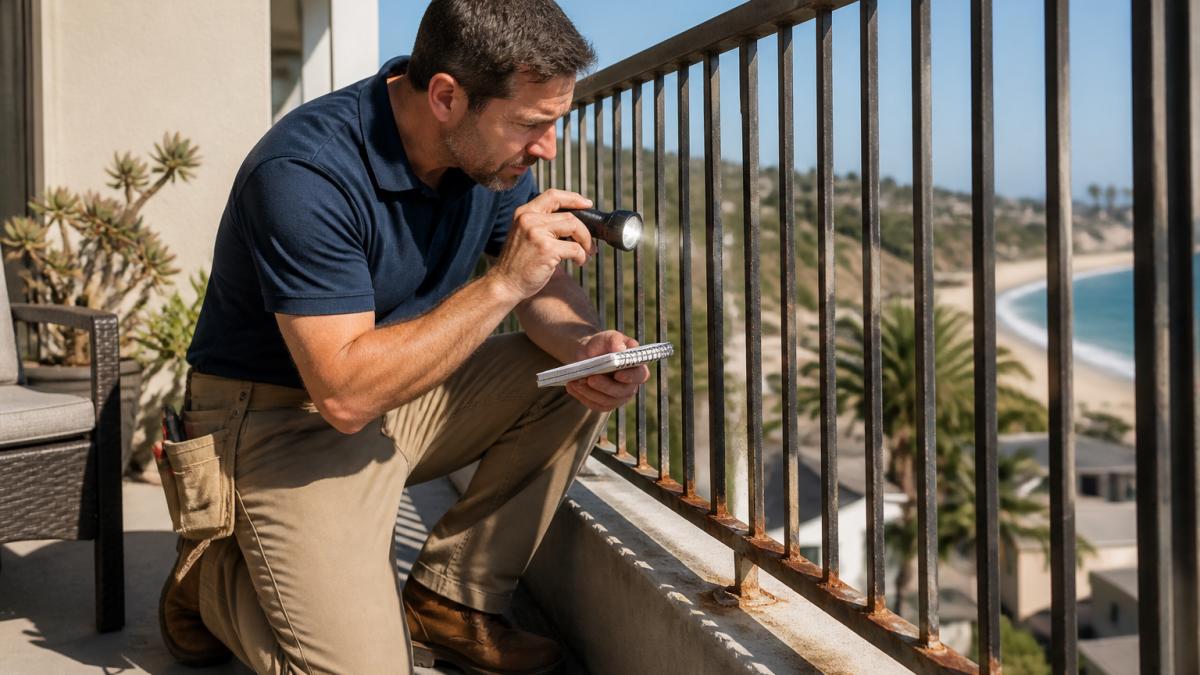
- Inspect for winter water damage, hairline cracks, and popped fasteners
- Clear all drainage paths, scuppers, and downspouts of debris
- Check sealant around rail posts, floor edges, and wall connections
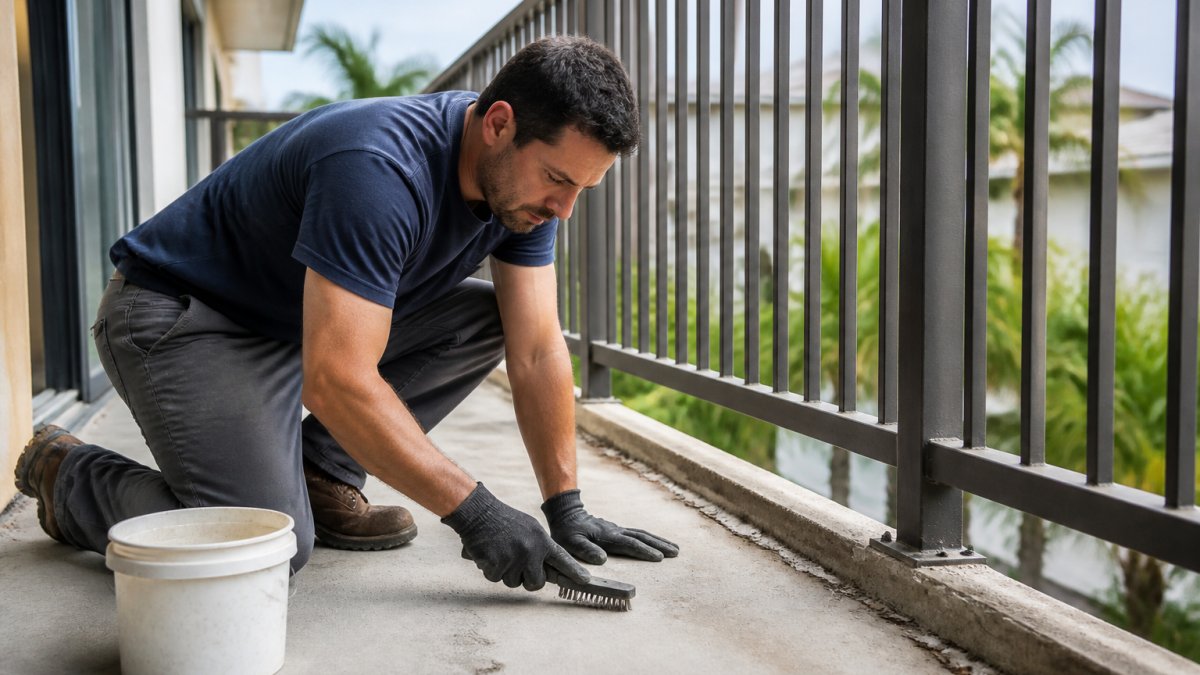
- Wash surfaces with mild detergent, a soft-bristle brush, and a garden hose
- Coastal: rinse salt residue from railings, brackets, and fasteners
- Wildfire zones: wash off ash before it becomes a caustic paste in joints
Summer (June-August)
- Watch for sun damage: chalking, fading, and brittle sealant
- Check for corrosion on metal railings, especially at welds and bases
- Reapply protective coating where it has worn thin
- Look for warping, cupping, or splintering on wood and composite decking
- Inland: schedule work early morning; heat makes sealants skin over too fast
Fall (September-November)
- Clear wildfire ash and leaf debris from drains before the first rain
- Inspect flashing and waterproofing components at wall and edge transitions
- Tighten loose fasteners on guardrails and stair connections
- Schedule any professional inspection before winter storms arrive
- Coastal: expect wind-driven rain to test every seal and flashing detail
Winter (December-February)
- Check for standing water within 24 hours after a storm
- Look for new cracks, water stains, or efflorescence on the underside
- Keep drains clear of leaves, ash, and debris
- Document any changes with dated photos
A simple maintenance chart helps you stay consistent:
| Task | Frequency | Who Does It |
|---|---|---|
| Visual inspection | Monthly | Owner or tenant |
| Drain clearing | Monthly and after every storm | Owner |
| Deep cleaning | Quarterly | Owner or pro |
| Sealant check | Twice a year | Owner or pro |
| Salt or ash rinse | After coastal storms or ashfall | Owner |
| Professional inspection | Per law | Qualified inspector |
Photograph the same angles each season. Side-by-side dated photos reveal slow changes, a widening crack or a new rust streak, that a single inspection misses.
Stop using the balcony and call a qualified inspector if you find a guardrail that moves when pushed, a soft spot in the floor, or a crack wider than a hairline at a connection point.
Signs of Balcony Structural Damage You Should Never Ignore
The clearest signs of balcony structural damage are cracks in concrete, soft spots in wood, rust streaks on metal, and water stains on the underside of the floor. Any of these means you should stop using the balcony until a professional looks at it.
Here is what to photograph and flag:
- Cracks wider than a hairline, especially at corners or where the balcony meets the building
- Wood decay that feels soft when you press a screwdriver into it
- Corrosion on bolts, brackets, or railing bases
- Rust streaks running down from a connection point
- Water stains or efflorescence on the underside
- Loose or wobbly guardrails that move when pushed
- Spongy or uneven balcony floor sections
- Separation between the railing and the wall
The U.S. Consumer Product Safety Commission tracks structural failure incidents nationwide, and the pattern is consistent: most failures show warning signs long before collapse.
Take dated photos every time you inspect. A photo log is your best defense if an HOA, insurer, or court ever asks what you knew and when.
Waterproofing, Drainage, and Material-Specific Care
Water is the number one enemy of every balcony. Waterproofing, drainage, and material care work together. If any one of them fails, the other two get overwhelmed.
Waterproofing relies on a waterproofing membrane, flashing, and sealant working as a system. The membrane sits under the floor covering. Flashing protects the edges and wall connections. Sealant fills the joints. When one part wears out, water finds a path in.
Drainage troubleshooting. Standing water is a red flag. Walk the balcony after a storm and note where water pools. Clear drains, scuppers, and strainers by hand or with a soft brush, never with a screwdriver or wire, which can puncture the membrane.
Safe cleaning methods by material. Match the cleaner to the surface. The wrong product or too much pressure causes the damage you were trying to prevent.
| Material | Safe Cleaning | Avoid | Key Risk |
|---|---|---|---|
| Wood | Mild detergent, soft brush, rinse; reseal annually | Pressure washing, bleach | Decay, rot, raised grain |
| Concrete | pH-neutral cleaner, stiff brush, rinse | Acid washes on sealed surfaces | Cracks, spalling |
| Metal | Mild soap, soft cloth, rinse; touch up paint | Abrasive pads, harsh acids | Corrosion, rust at welds |
| Tile | pH-neutral cleaner, soft brush; regrout as needed | Acid cleaners on grout | Loose or cracked tiles, failed underlayment |
| Composite | Mild soap, soft brush, rinse | Solvents, high-pressure spray | Fading, warping, surface scuffing |
Inspection steps for each material. On wood, press a screwdriver into suspect areas, if it sinks easily, that is decay. On concrete, mark cracks with a pencil and check whether they widen over a month.
A common mistake is pressure washing too aggressively. High pressure can force water past sealant and into the membrane, causing the exact damage you were trying to prevent.
Clean gently, inspect in a set order, and treat any water that lingers more than a day as a signal to call a professional.
If you see soft wood, a spongy floor, or a crack that keeps widening, stop cleaning and call a qualified inspector. Surface work will not fix a structural problem.
HOA Balcony Repair Responsibility: Who Pays for What
HOA balcony repair responsibility usually depends on whether the balcony is a common area or an exclusive-use common area. That distinction decides who pays.
In most California HOAs:
- Common area balconies are maintained by the association.
- Exclusive-use common areas are often the owner’s responsibility for surface care, but the HOA still owns the structure.
- Structural repairs typically fall to the HOA, even on exclusive-use balconies.
The governing documents control the details. Read them carefully before assuming anything. Many disputes start because an owner assumed a repair was the HOA’s job, or the reverse.
For landlords under SB 721, the owner holds the responsibility. You cannot pass a structural safety duty to a tenant.
If your HOA documents are unclear, get a legal read before you spend money on repairs. Paying for work the HOA should cover is money you will not get back.
When to Call a Qualified Inspector (and What to Expect)
Call a qualified inspector when you see warning signs, when your building hits an inspection deadline, or when you cannot tell whether damage is cosmetic or structural. A licensed inspector gives you a clear answer.
At Apex Balcony, our licensed inspectors bring decades of combined construction and design experience. We inspect all elevated exterior elements, including balconies, decks, and stairways. We specialize in SB 326 and SB 721 compliance, so our reports are built to hold up if you are ever audited or sued.
What to expect during an inspection:
- Documentation review of prior reports and repair records
- Visual inspection of every elevated element
- Close inspection of connections, waterproofing, and drainage
- Photo documentation of all findings
- Written report with urgency levels and repair recommendations
One concern we hear often: past inspectors left exposed framing and water damage behind. We minimize disruption by using non-invasive methods first and only opening surfaces when necessary.
On insurance: ask any inspector about their coverage before you hire them. A report that misses a defect is a serious problem, and you want to know who stands behind the work.
Conclusion
Balcony maintenance is not a chore you can push off. California law, water damage, and simple physics all work against you the longer you wait. The good news is that most failures are preventable with routine care and a real inspection schedule.
Apex Balcony helps building owners and HOAs stay compliant with SB 326 and SB 721. Our licensed inspectors identify early signs of structural failure, give you a clear path to necessary repairs, and help you keep residents safe. We have worked with hundreds of building owners across California.
Book an inspection with Apex Balcony and get a clear, compliant report you can act on.
Frequently Asked Questions
What is the new balcony law in California?
Two laws govern most California balconies. SB 326 requires HOAs to have elevated exterior elements inspected by January 1, 2025, then every nine years. SB 721 covers rental buildings with three or more units, requiring inspections every six years. Both require a licensed architect, structural engineer, or certified inspector to examine balconies, decks, and stairways and report on their condition.
How often should I inspect my balcony for damage?
Walk your balcony monthly and do a deeper check each season. Look for cracks, rust, wood decay, loose railings, and standing water. Schedule a professional inspection per your legal interval: every six years under SB 721, or every nine years under SB 326. After storms, wildfire ash exposure, or any earthquake, inspect sooner rather than waiting for the next scheduled visit.
Who is responsible for balcony repairs in a condominium or HOA?
It depends on your governing documents and what the declaration defines as common area versus exclusive-use common area. In most HOAs, the association handles structural repairs to load-bearing components and waterproofing membranes, while owners cover cosmetic items like paint or floor covering. Civil Code 4775 requires associations to provide maintenance guidelines, so request the chart that assigns each task before you spend money.
What should I do if I notice cracks, rust, or wood rot on my balcony?
Document the issue with photos and note the date. Report it to your HOA or landlord in writing and stop using the balcony until someone qualified reviews it. Surface cracks in paint or stucco are often cosmetic, but horizontal cracks, exposed rebar, soft wood, or rust stains near flashing point to structural deterioration. A licensed inspector can separate surface-level repairs from load-bearing problems before costs escalate.