
Last Updated: October 28, 2026
Quick Summary
Preventing balcony collapse in residential buildings means addressing the causes before they fail: construction defects and design flaws, rot and corrosion from moisture damage, and weak ledger board connections. Inspect balconies regularly, fix waterproofing and drainage problems, and restrict access immediately when you see ledger separation, sagging, or corroded anchors.
- Water is the slow killer: rot weakens wood beams and corrosion eats steel fasteners until they snap.
- The ledger board that ties the balcony to the building is the weak point in most failures.
- Clear drains and scuppers every season to stop standing water on the balcony.
- In California, SB 326 requires HOAs to inspect balconies and elevated elements on a set schedule.
- Any ledger separation, sagging, or corroded anchors means restrict access and call a licensed inspector.
Table of Contents
- Balcony Collapse Causes: What Actually Brings Structures Down
- Signs of Balcony Structural Damage Every Owner Should Recognize
- Ledger Boards, Fasteners, and Load-Bearing Failures
- Balcony Waterproofing and Maintenance That Prevents Decay
- Your Balcony Safety Inspection Checklist, Step by Step
- Who Is Responsible for Balcony Safety in a Residential Building
- Book a Licensed Balcony Inspection Before the Next Rainy Season
- Frequently Asked Questions
Balcony Collapse Causes: What Actually Brings Structures Down
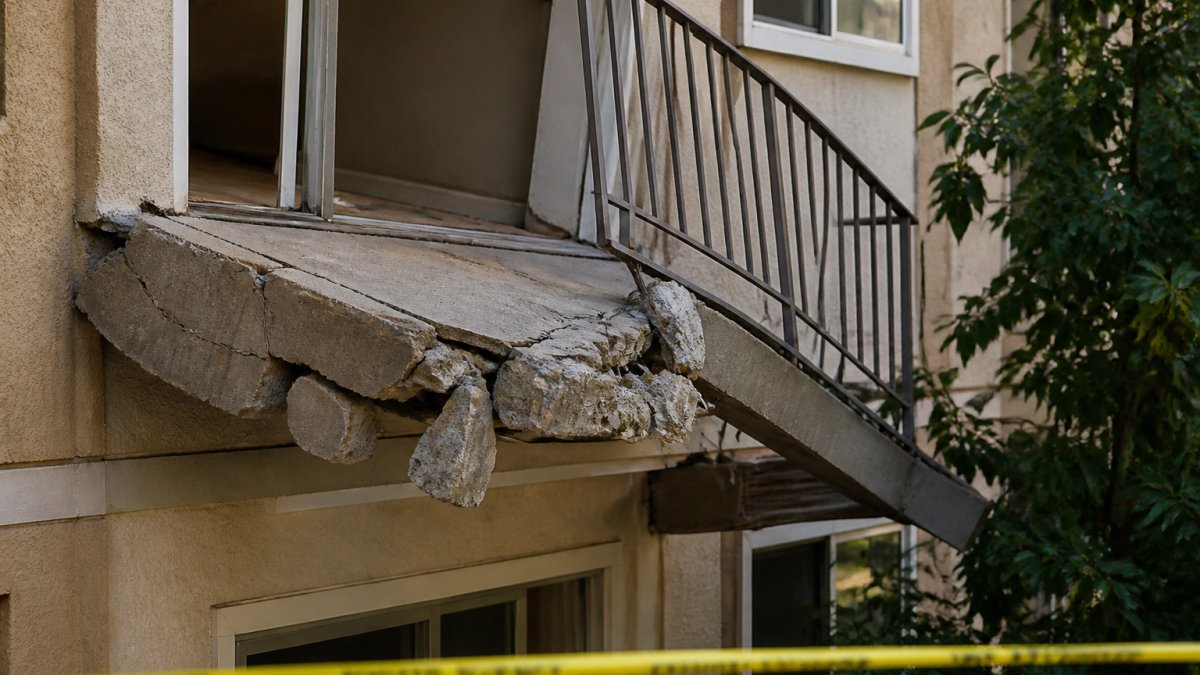
Preventing balcony collapse in residential buildings starts with understanding why they fail. Most failures are not random. They trace back to a small set of causes that show up again and again.
The 2015 Berkeley balcony collapse that killed six students is the case most property owners still remember. The 2021 Malibu collapse reminded everyone that this problem has not gone away. In both cases, investigators focused on the same suspects: water damage, weak connections, and materials that were never built to last.
Collapses rarely happen because of one dramatic event. They happen because small problems were ignored for years. For the full prevention playbook, see preventing balcony collapse in apartments.
Construction Defects and Design Flaws
A balcony is only as strong as the plan behind it. Many failures begin before anyone moves in. Common defects include:
- Missing or undersized anchors
- Ledger boards attached with the wrong fasteners
- Poor flashing that lets water behind the siding
- Railings that meet no building code standard
- Decks built for light loads but used for crowds
Building codes set minimum standards for load-bearing capacity, guardrails, and fasteners. A balcony built outside those rules may look fine for years. Then it fails under a normal load.
Rot, Corrosion, and Moisture Damage
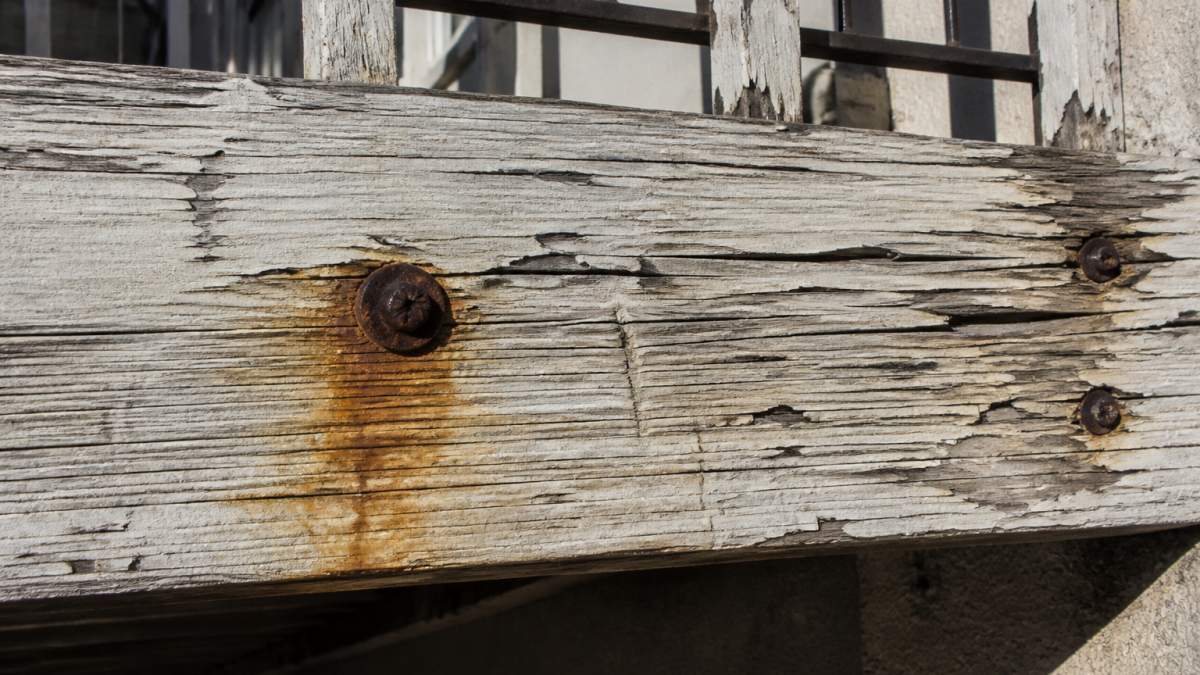
Water is the slow killer. Wood rot weakens beams from the inside. Corrosion eats at steel fasteners and anchors until they snap. Neither problem is visible from the street.
Watch out: a balcony that feels solid today can lose half its strength in a few wet seasons. Moisture protection is not cosmetic. It is structural.
Signs of Balcony Structural Damage Every Owner Should Recognize
The warning signs of balcony structural damage are usually visible to anyone who knows where to look. The problem is that most guidance stops at the list. Knowing what a sign means and what to do next is what prevents a collapse. Use the tiers below to decide whether to monitor, repair, or restrict access immediately.
Tier 1, monitor and schedule a repair
These are often cosmetic or early-stage, but they should be logged and rechecked within a season:
- Hairline cracks in stucco or paint at the balcony-to-building joint
- Peeling paint or bubbling on the underside of a slab
- Minor rust staining around fasteners
- Sealant that has cracked or pulled away from flashing
Tier 2, repair before the next wet season
These indicate active water intrusion or connection distress and should be fixed by a qualified contractor, not deferred:
- Cracks wide enough to admit a coin in a concrete slab
- Soft wood when probed at beams, posts, or the ledger
- Rust stains spreading from anchors or lag bolts
- Loose railings or balusters that move under hand pressure
- Water stains or efflorescence on the underside of the balcony
Tier 3, restrict access and call a licensed professional now
Any of the following means the balcony should not be used until a licensed inspector or structural engineer clears it:
- The ledger board is pulling away from the building, or you can see daylight between them
- The deck sags, or railings lean outward
- Anchors or bolts are visibly corroded through or missing
- Posts are out of plumb or have pulled away from their footings
- You can move the guardrail assembly by hand
- The balcony has been overloaded (a party, hot tub, or stored materials) and shows new deflection
Do not “monitor” a Tier 3 sign. Restrict access, document the condition with dated photos, notify the owner or manager in writing, and book a professional evaluation. A balcony that feels solid today can lose significant strength in a single wet season.
Why the response matters as much as the sign
A crack that has not changed in five years is a different risk from a crack that appeared last month. Date every observation and compare. Movement, spreading stains, and new deflection are the signals that separate a maintenance item from an emergency. For a deeper look at early warning signs, see our guide on early signs of structural failure.
Ledger Boards, Fasteners, and Load-Bearing Failures
The ledger board is the weak point in most deck and balcony failures. This is the board that ties the balcony to the building. If it rots, pulls away, or was installed with the wrong fasteners, the whole structure loses its anchor.
Load-bearing capacity depends on every connection working together. Occupancy load matters too. A balcony rated for a few people can fail when a party fills it.
A common mistake is replacing deck boards without checking the ledger connection. New boards on a rotten ledger do not make the balcony safe.
Balcony Waterproofing and Maintenance That Prevents Decay
Waterproofing is the cheapest insurance a property owner has. A good membrane, proper flashing, and clear drainage keep water away from wood and steel. Use this balcony waterproofing inspection checklist to act on that advice step by step.
Maintenance should follow a simple schedule:
| Task | Frequency | Why It Matters |
|---|---|---|
| Clear drains and scuppers | Every season | Stops standing water |
| Inspect sealant and flashing | Twice a year | Blocks water intrusion |
| Probe wood for rot | Annually | Catches decay early |
| Check fasteners for rust | Annually | Prevents loose connections |
| Full professional inspection | Per local rules | Confirms structural safety |
Your Balcony Safety Inspection Checklist, Step by Step
A balcony safety inspection checklist gives owners a repeatable way to catch problems before they become failures. The gap in most published guidance is that it lists what to look at but not what counts as a failure, what tools to bring, or when to stop using the balcony. This walkthrough closes that gap. It is written for a property owner, manager, or HOA board member doing a routine visual check, not a substitute for a licensed structural evaluation. Regular assessments should prioritize identifying early signs of concrete coating failures that expose underlying structural materials to moisture and accelerated decay.
Before you start: tools and records
Bring a flashlight, a flat-head screwdriver or awl for probing wood, a tape measure, a level, a camera or phone, and a notebook. Pull the original drawings or permit records if you have them. Knowing the design load and the connection details turns a visual walk into a real inspection.
Schedule the walk after a dry stretch, then repeat after the first heavy rain. Water intrusion and rust are far easier to spot when the structure has just been wet and is drying.
The eight-step walkthrough, with pass/fail criteria
- Review the drawings and permit history. Confirm the design occupancy load and how the balcony attaches to the building. If drawings are missing, note that as a finding, it limits what any later inspector can verify.
- Check the ledger board. Look for gaps between the ledger and the building, rot, missing anchors, and flashing that terminates above the ledger instead of over it. Any gap wider than a credit card, or any soft wood, is a fail.
- Probe the wood. Push the awl into beams, posts, joists, and the ledger at several points. Wood that yields easily or crumbles is decayed. Probe near connections and where water pools.
- Inspect fasteners and anchors. Look for rust bleeding, missing bolts, and nuts that have backed off. Corrosion that has eaten into the shank is a fail, replace, do not paint over.
- Test the guardrails. Measure height and baluster spacing against the code that applied when the balcony was built, then push firmly on the top rail. Any movement at the posts or loose infill is a fail.
- Check waterproofing and drainage. Look for standing water, failed sealant, ponding on the deck surface, and flashing that has pulled away. Water should leave the balcony, not sit on it.
- Document everything. Photograph each defect with a reference object for scale, note its location, and record the date. A dated photo log is what proves you acted on a warning sign.
- Escalate serious findings. Anything structural, ledger separation, sagging, corroded anchors, soft framing, means restrict access and call a licensed inspector or structural engineer. Do not wait for the next scheduled inspection.
What a visual check cannot tell you
A visual walk catches surface symptoms. It cannot confirm the capacity of an anchor embedded in concrete, the remaining section of a corroded bolt, or whether a connection was engineered for the load it carries. Those require a licensed professional, and in many jurisdictions the periodic inspection of elevated exterior elements must be performed or overseen by a qualified person.
Who Is Responsible for Balcony Safety in a Residential Building
Responsibility is shared, and that is where things fall apart. Property owners carry the legal duty. Property managers handle day-to-day checks. Residents report what they see. Inspectors confirm structural safety.
In California, SB 326 requires HOAs to inspect balconies and other elevated elements on a set schedule. SB 721 sets similar rules for multifamily properties. Both laws exist because inspections were skipped for too long.
A clear division of roles prevents gaps:
- Owners: fund inspections and repairs
- Managers: schedule checks and log issues
- Residents: report cracks, sagging, or loose railings
- Inspectors: assess structural safety and document findings
Book a Licensed Balcony Inspection Before the Next Rainy Season
Rain finds every weak point. A balcony that survived a dry summer can fail after a wet winter, and the risk climbs as buildings age.
Apex Balcony helps property owners and HOA boards stay ahead of that risk. Our licensed inspectors bring decades of construction and design experience to every property. We specialize in SB 326 and SB 721 compliance and inspect balconies, decks, and stairways in full. You get a clear path to necessary repairs.
If you are weighing your options, our guide on hiring a structural engineer for deck safety explains what to ask before you book.
Frequently Asked Questions
What are the warning signs that a balcony may be unsafe?
Look for sagging or springy decking, cracks in concrete slabs or stucco, rust stains or corrosion around fasteners, loose or wobbling railings, and water stains on the underside of the structure. Wood that crumbles or feels soft when probed is a serious red flag. These signs can warrant professional attention.
How often should residential balconies be inspected?
A visual walkthrough should happen annually, with a deeper professional inspection every three to five years depending on age, climate, and materials. In California, SB 326 requires qualifying HOAs to inspect elevated exterior elements like balconies and stairways every nine years, while SB 721 sets a six-year cycle for certain multifamily buildings. Buildings near the coast or with known moisture issues benefit from more frequent checks.
Can water damage cause a balcony to fail?
Yes. Water intrusion is one of the most common balcony collapse causes. When waterproofing membranes fail or drainage clogs, moisture reaches ledger boards and framing, causing wood rot and fastener corrosion. Over time, load-bearing capacity drops until the structure gives way. Proper balcony waterproofing and maintenance, including clearing drains and resealing surfaces, is the cheapest way to prevent this decay.
What should you do if you notice a cracked or sagging balcony?
Document the condition with photos and notify the property owner or manager in writing.
The hardest part is not the repair. It is the waiting. Every season you delay raises the chance that a small defect becomes a collapse. Apex Balcony can inspect your property, confirm compliance with SB 326 and SB 721, and flag early signs of structural failure before they turn into an emergency. Get started with Apex Balcony and protect your residents, your building, and your peace of mind.
