Preventing Balcony Collapse in Apartments: A 2026 Guide
Preventing balcony collapse in apartments starts with knowing the warning signs. Learn inspection steps, CA laws, and repair workflows to stay safe and.
Table of Contents
- Why Preventing Balcony Collapse in Apartments Demands Urgent Attention
- Balcony Safety Codes and Regulations: SB 721, SB 326, and Civil Code 5551
- Signs of Balcony Rot and Structural Decay to Watch For
- Apartment Balcony Maintenance Checklist for Property Managers
- Hiring a Structural Engineer for Balcony Inspection: What to Expect
- Post-Inspection Repair Workflow: From Report to Resolution
- How Preventing Balcony Collapse in Apartments Affects Insurance Premiums
- Conclusion
Last Updated: June 18, 2026
Balcony collapses are among the most preventable structural failures in residential buildings, yet they continue to injure and kill residents across California every year. At Apex Balcony, we’ve worked with hundreds of building owners and HOAs to identify the exact failure points that lead to catastrophic structural events. Below, we’ll show you exactly how to protect your residents, your property, and your legal standing under California’s current balcony safety laws.
The most important thing most property managers get wrong: they treat balcony maintenance as cosmetic upkeep rather than structural engineering. That distinction costs lives.
Why Preventing Balcony Collapse in Apartments Demands Urgent Attention
Balcony collapse is a structural failure event, not a maintenance inconvenience. Elevated exterior elements deteriorate silently, often with no visible surface warning until the structure is already compromised.
California has enacted two compliance laws specifically targeting balcony safety, with mandatory inspection deadlines that carry real legal consequences. Property owners who miss these deadlines face liability exposure, insurance complications, and in the worst cases, criminal negligence claims following an injury.
Wood rot, waterproofing failure, and structural decay develop behind walls and inside framing members that no routine visual check will catch. That’s exactly why California law now mandates professional inspection by licensed engineers.
Delaying balcony inspections beyond California’s statutory deadlines does not pause your liability. If a collapse occurs on an uninspected structure, courts treat that omission as negligence per se, meaning liability is presumed without requiring proof of specific fault.
The Berkeley Balcony Incident and Its Lasting Impact
The 2015 Berkeley balcony collapse killed six college students and injured seven others when a fifth-floor balcony gave way during a birthday party. Dry rot had consumed the structural framing to the point of complete failure, yet the balcony had passed visual inspection. The rot was hidden inside the ledger board and joist ends, invisible without probing.
That incident is the direct legislative origin of both SB 721 and SB 326. According to California Legislative Information on SB 721, the Berkeley collapse was explicitly cited as the catalyst for mandatory third-party inspection requirements. Visual inspections alone are structurally inadequate; licensed engineers using probing, borescope, and destructive testing are the only reliable detection method.
The Berkeley incident also changed how courts assess landlord liability. Property owners who cannot produce inspection records are now in a significantly weaker legal position following any balcony-related injury.
Balcony Safety Codes and Regulations: SB 721, SB 326, and Civil Code 5551
California’s balcony safety codes represent the most comprehensive regulatory framework for exterior elevated elements in the United States. SB 721 applies to multifamily rental housing; SB 326, codified under Civil Code 5551, governs condominium associations and HOAs. Both laws mandate inspection of all exterior elevated elements, including balconies, decks, stairways, and walkways, by licensed professionals.
Exterior Elevated Elements are defined under California law as load-bearing components that extend beyond the building’s exterior walls, are elevated more than six feet above grade, and are designed for human occupancy.
SB 721 vs SB 326: Who Is Covered and When
| Statute | Applies To | Inspector Requirement | Inspection Frequency |
|---|---|---|---|
| SB 721 | Multifamily rental buildings (3+ units) | Licensed architect, civil/structural engineer, or contractor with specific experience | Every 6 years |
| SB 326 / Civil Code 5551 | Condominium associations and HOAs | Licensed architect or structural engineer only | Every 9 years |
SB 721 covers apartment buildings owned by a single landlord; SB 326 covers common interest developments where individual units are owned separately. A mixed-use building may trigger both statutes depending on ownership structure.
If your building contains both rental units and owner-occupied condominiums under an HOA structure, consult a licensed structural engineer before your first inspection cycle. The applicable statute determines both who can inspect and how frequently, and getting this wrong creates compliance gaps that can void your insurance coverage.
Legal Deadlines and Compliance Consequences
Both SB 721 and SB 326 required buildings to complete their first inspection by January 1, 2025. If your building has not yet complied, you are already in violation. Non-compliance consequences include:
- Violation notices issued by local enforcement agencies
- Mandatory posting of the building as unsafe for occupancy in severe cases
- Civil liability exposure for any injuries occurring on uninspected structures
- Insurance claim denials when carriers discover inspection records are missing
- Permit holds on future construction or renovation projects
Local jurisdictions in California are actively beginning enforcement, and the liability exposure for non-compliant owners is substantial.
Signs of Balcony Rot and Structural Decay to Watch For
Most balcony failures don’t announce themselves. The signs that matter most are the ones you can’t see from the surface, but observable indicators should trigger immediate professional assessment.
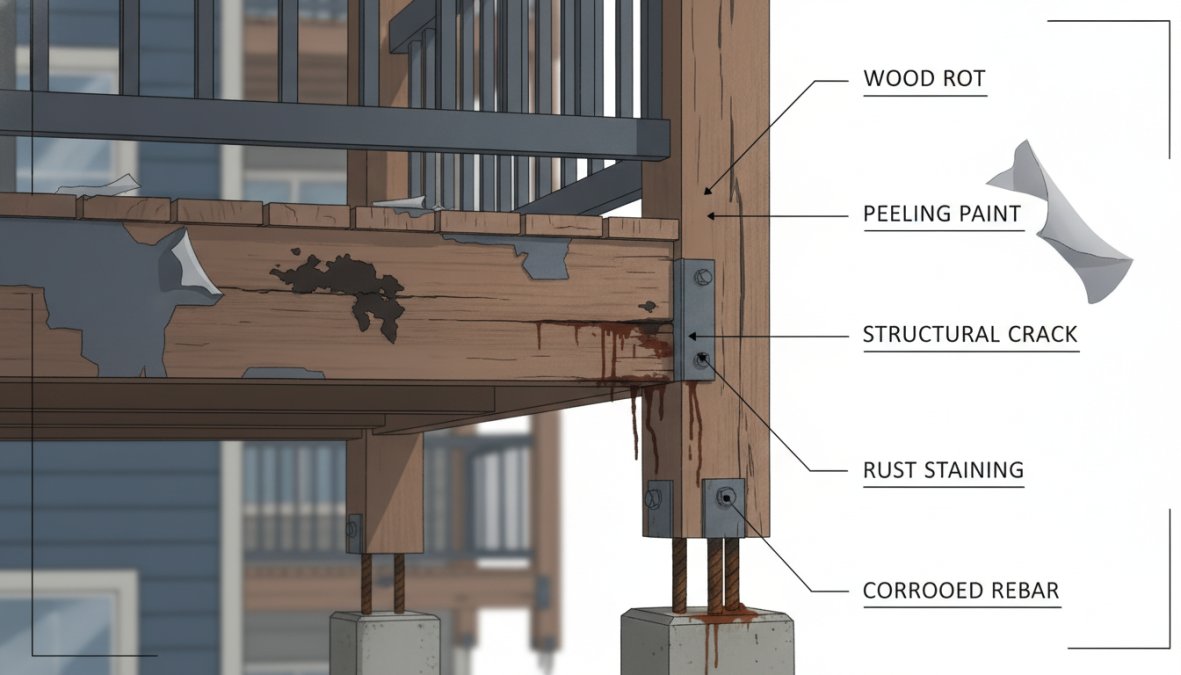
Surface indicators worth taking seriously include:
- Soft or spongy wood when pressed with a screwdriver or probe
- Discoloration, darkening, or staining on decking boards or fascia
- Peeling paint or bubbling coatings, signaling moisture intrusion beneath the surface
- Rust staining running from fasteners or metal hardware
- Cracks in concrete balconies, particularly horizontal cracks in the slab edge
- Efflorescence (white mineral deposits) on concrete surfaces indicating water migration
- Visible gaps between the balcony framing and the building wall
Visual Identification Guide: Surface Damage vs. Structural Failure
Surface damage includes cosmetic deterioration that doesn’t yet compromise load-bearing capacity: peeling sealant, minor surface cracking, or superficial wood weathering. Surface damage is repairable without structural intervention.
Structural failure indicators include deflection (visible sagging or bounce when weight is applied), rot extending into ledger boards or joist ends, corrosion of metal connectors or post bases, and delamination of concrete around rebar. These conditions require engineering assessment and often immediate load restrictions.
A common mistake is treating a failed waterproofing membrane as a cosmetic issue. Waterproofing failure is the primary driver of structural decay in wood-framed balconies, once water reaches the framing, rot progresses rapidly, particularly in California coastal climates.
Apartment Balcony Maintenance Checklist for Property Managers
The following apartment balcony maintenance checklist is designed for semi-annual property walkthroughs. This is not a substitute for statutory inspections under SB 721 or SB 326, but it catches problems between inspection cycles.
Semi-Annual Balcony Maintenance Checklist:
- Probe decking boards at joist locations for soft spots or spongy response
- Inspect all waterproofing membranes and sealant joints for cracking, separation, or bubbling
- Check drainage outlets and scuppers for blockage (standing water accelerates decay)
- Examine guardrails and handrails for lateral stability (apply lateral force of approximately 200 lbs)
- Inspect ledger board connections at the building wall for moisture staining or separation
- Check all metal hardware, connectors, and post bases for corrosion
- Look for efflorescence on concrete elements and note location and extent
- Review all balcony doors and thresholds for proper weatherstripping and flashing
- Document any changes in deflection or bounce compared to prior inspection
- Update maintenance records with date, inspector name, and findings
Maintenance records are not optional. Under SB 721 and SB 326, inspectors review prior maintenance history as part of their building assessment. Gaps in records signal deferred maintenance and can trigger expanded destructive testing.
Consistent semi-annual maintenance walkthroughs, documented in writing, reduce both your repair costs and your liability exposure. They also make your statutory inspection faster and cheaper because the inspector has a clear history to work from.
Hiring a Structural Engineer for Balcony Inspection: What to Expect
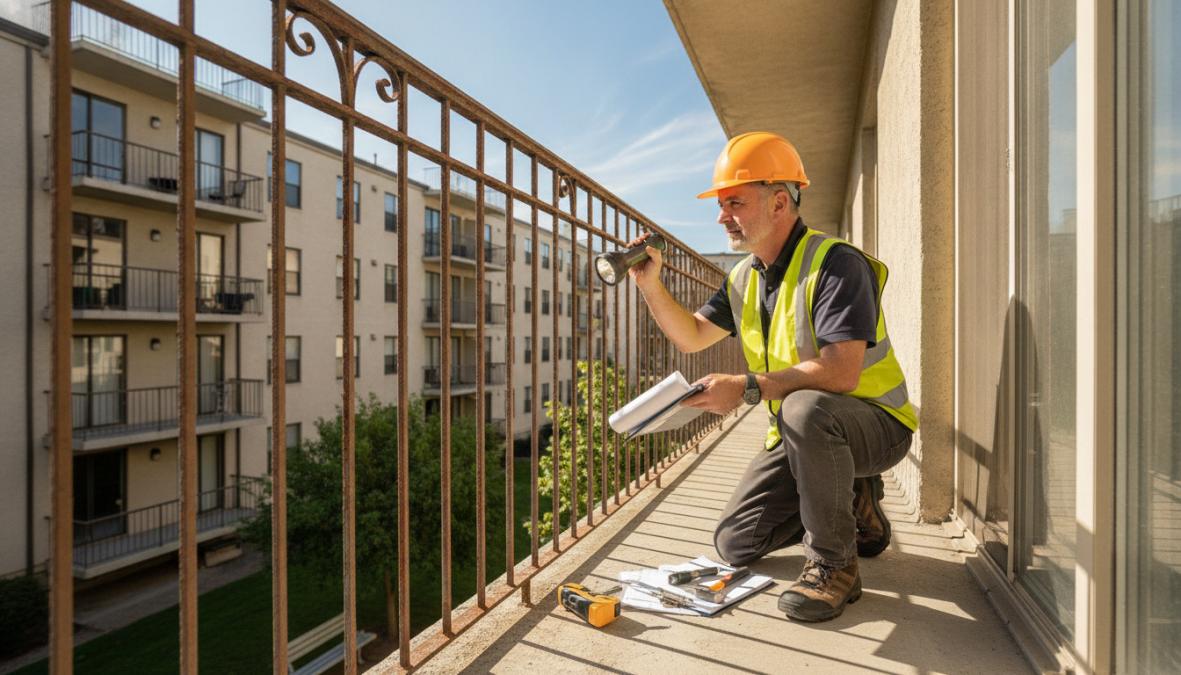
Hiring a structural engineer for balcony inspection is the legally required path under both SB 721 and SB 326 for most California multifamily properties. The inspection begins with a document review: the engineer will request prior maintenance records, available construction drawings, and records of previous repairs. Missing documentation often triggers expanded sampling requirements.
Inspector Qualifications and Inspection Methodology
Under SB 326, only licensed architects or licensed civil or structural engineers may perform the inspection. SB 721 allows a broader set of qualified inspectors, including licensed contractors with demonstrated experience in the relevant construction type.
What to verify before hiring:
- Active California PE (Professional Engineer) or architect license
- Specific experience with exterior elevated elements and wood-framed construction
- Familiarity with both SB 721 and SB 326 reporting requirements
- Errors and omissions insurance coverage
According to California Building Standards Commission guidance on EEE inspections, inspectors must document findings in a written report identifying each element inspected, the condition found, and the recommended action. That report becomes a legal record.
Non-Destructive vs. Destructive Testing: Borescope and Beyond
A borescope, a flexible fiber-optic camera inserted through a small drilled hole, allows inspectors to view concealed framing members without opening walls or removing decking, and is the most common tool for assessing ledger board and joist end conditions.
Where borescope findings are inconclusive, destructive testing is required, involving removal of decking sections or exposure of concealed connections. The decision between non-destructive and destructive testing is the inspector’s call, not the property owner’s. Attempting to limit testing scope to reduce costs is a documented pattern that courts treat unfavorably in subsequent litigation.
Post-Inspection Repair Workflow: From Report to Resolution
The inspection report is the beginning of the process, not the end. California law sets timelines for repairs based on the severity of findings, and ignoring those timelines after receiving a report eliminates any good-faith defense in subsequent litigation.
Prioritizing Repairs by Risk Level
Inspection reports typically classify findings into three categories:
Immediate Action Required: Elements posing an imminent threat to life safety. These require immediate load restrictions, posting of the element as unsafe, and emergency repair engagement.
Repair Within 120 Days: Significant deterioration that does not pose immediate danger. SB 721 requires repairs to be completed within 120 days of the inspection report for this category.
Maintenance Recommendations: Items to address in the next maintenance cycle that do not represent structural compromise.
The repair workflow that works in practice:
- Receive the inspection report and classify all findings by risk level
- For immediate action items, contact a licensed contractor within 24 hours and post elements as restricted
- Obtain repair permits from the local building department
- Engage a structural engineer to review contractor repair plans before work begins
- Complete repairs and schedule re-inspection by the original inspector or equivalent
- File the completion report with your local jurisdiction as required by SB 721
- Update your maintenance records with all repair documentation
As noted in California Department of Housing and Community Development compliance resources, property owners who fail to complete repairs within statutory timelines may be subject to city-initiated repairs with costs assessed against the property.
How Preventing Balcony Collapse in Apartments Affects Insurance Premiums
Preventing balcony collapse in apartments is no longer purely a safety and legal concern, it’s a direct factor in your property’s insurability and premium structure. Many property insurers now include specific questions about SB 721 and SB 326 compliance status in their underwriting questionnaires. Buildings that cannot produce current inspection reports are increasingly declined for coverage or rated at substantially higher premiums, with some California properties placed in the surplus lines market at materially higher costs.
A building with documented inspections and completed repairs represents a known and managed risk. A building with no inspection history represents an unknown structural condition, which insurers price accordingly. Beyond premiums, a liability claim following a collapse on an uninspected structure will face carrier scrutiny, and the property owner’s failure to inspect is frequently cited as a basis for claim limitation or denial.
For a full picture of how structural deficiencies affect property insurance in California, review California Department of Insurance guidance on property coverage.
If your property’s insurance renewal is approaching and you have not completed your SB 721 or SB 326 inspection, disclose this proactively to your broker rather than hoping the underwriter doesn’t ask. Misrepresentation on an insurance application is grounds for policy rescission, which leaves you with no coverage at all.
Inspection costs are a fraction of the premium increases, legal fees, and settlement exposure that follow a preventable collapse. The math favors action.
Balcony structural compliance in California is genuinely complex, with overlapping statutes, tight repair timelines, and insurance consequences that most property managers only discover after a problem has already developed. Apex Balcony works with building owners and HOAs across California to navigate this process from initial assessment through repair completion, with licensed inspectors who carry decades of combined construction and design experience. Our team specializes in SB 326 and SB 721 compliance, covering all exterior elevated elements including balconies, decks, and stairways. Book your inspection with Apex Balcony and get a clear, documented path to compliance before your next insurance renewal or enforcement deadline.
Frequently Asked Questions
What are the early warning signs of a balcony collapse?
Early warning signs of a balcony collapse include visible wood rot or soft spots in decking, rust stains around fasteners or railings, cracks in concrete or stucco, sagging or uneven flooring, loose or wobbly railings, and peeling waterproof coatings. Water pooling on the surface after rain is also a red flag, as prolonged moisture exposure accelerates structural decay. Property managers should document and report these signs immediately and restrict access until a licensed inspector evaluates the balcony.
How often should apartment balconies be inspected for safety?
Under California's SB 721, apartment buildings with three or more units must have exterior elevated elements inspected by a licensed professional every six years. SB 326 requires condominium associations to inspect balconies every nine years per Civil Code 5551. Beyond these legal minimums, property managers should conduct informal visual checks annually and after major weather events. Consistent maintenance records help demonstrate due diligence and reduce liability exposure in the event of an incident.
What is the difference between surface damage and structural failure in balconies?
Surface damage refers to cosmetic issues like peeling paint, minor cracks, or surface-level rust that do not immediately compromise load-bearing capacity. Structural failure involves deterioration of the load-bearing elements, joists, ledger boards, posts, or concrete, that support the balcony's weight. The distinction matters because surface damage can often be repaired with routine maintenance, while structural failure requires engineered repairs, possible permit requirements, and may necessitate immediate access restrictions to prevent a balcony collapse.
Are tenants responsible for reporting balcony safety concerns in apartments?
While tenants are not legally obligated to conduct formal inspections, they are generally encouraged, and in some lease agreements required, to report visible safety concerns to property management. Tenants should notify management immediately if they notice signs of balcony rot, loose railings, unusual movement underfoot, or visible cracking. Property owners and managers bear the primary legal responsibility for maintaining safe conditions and complying with SB 721 and SB 326 inspection requirements for exterior elevated elements.
Does completing a balcony inspection under SB 721 or SB 326 affect my building's insurance premiums?
Proactively completing balcony inspections and addressing identified repairs can positively influence insurance outcomes. Insurers assess liability exposure when underwriting multifamily housing policies, and documented compliance with SB 721 or SB 326 signals reduced risk. Conversely, a history of deferred maintenance or a violation notice from a non-compliant inspection can lead to higher premiums or coverage restrictions. Maintaining thorough inspection and repair records is a practical risk mitigation strategy that supports both safety and favorable insurance terms.