
Last Updated: November 19, 2026
Quick Summary
SB 721 inspection payment options include checks from HOA accounts, ACH bank transfers, credit cards, installment plans, and reserve fund draws. Accepted methods vary by provider, so confirm them directly with Apex Balcony, and tie final payment to delivery of the written report.
- An inspection fee covers the site visit and written report, not repairs.
- ACH transfers typically clear within 1-3 business days for larger buildings.
- Ask for the deposit amount and refund conditions in writing before paying.
- Release final payment only after receiving the complete report with photos.
- In condominium associations, the HOA typically pays from reserves or a special assessment.
Table of Contents
- What SB 721 Requires and Why Payment Comes Up First
- SB 721 Inspection Cost: What Drives the Fee
- Comparing Payment Methods for an SB 721 Inspection
- What a Complete SB 721 Inspection Quote Should Include
- SB 721 Inspection Deposit: When It Is Required and How to Protect It
- Reading Your SB 721 Inspection Invoice and Timing Final Payment
- Who Pays: Owners, HOAs, and Property Managers
- Book Your SB 721 Inspection With Clear Payment Terms
- Frequently Asked Questions
What SB 721 Requires and Why Payment Comes Up First
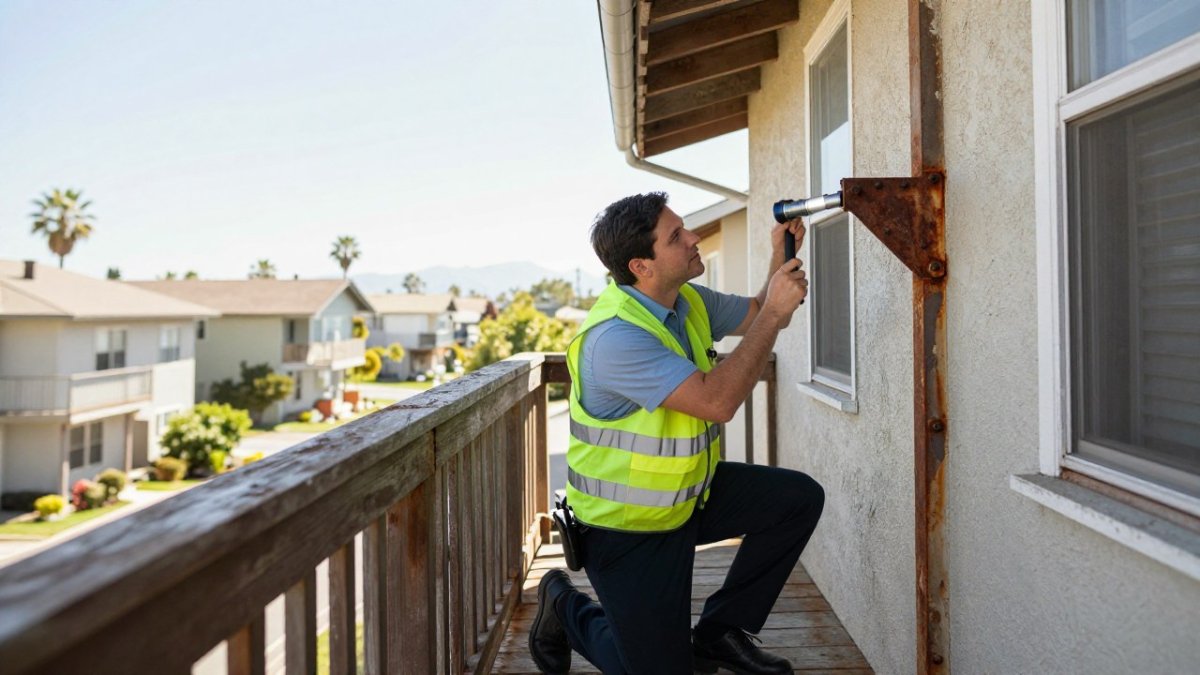
California’s SB 721 inspection payment options matter because the law itself is mandatory, not optional. SB 721 requires periodic inspection of exterior elevated elements (EEEs) on multi-unit residential buildings, and someone has to write the check.
The statute, documented in California Health and Safety Code Section 17973, requires that balconies, decks, stairways, and walkways be inspected by a qualified professional on a set schedule.
Below, we break down what drives the fee, how to pay it, and how to protect your money at every step.
SB 721 Inspection Cost: What Drives the Fee
An SB 721 inspection cost is not a single fixed number. Pricing depends on how many units you have, how many EEEs each unit carries, and how much documentation is required. Contact Apex Balcony directly for current pricing or a quote.
Three factors move the number most:
- Unit count and EEE count. More balconies and stairways mean more time on site.
- Access difficulty. Buildings where not every unit can be entered require more coordination.
- Report depth. Photo documentation and written findings add billable hours.
Per-Unit Versus Flat-Fee Pricing
Some inspectors quote per unit and others as a flat fee for the whole building. Pricing structure and current rates are best confirmed directly with Apex Balcony when requesting a quote.
What a Fee Does and Does Not Cover
An inspection fee generally relates to the site visit and written report, and does not cover repairs. That distinction trips up a lot of boards. If you want to understand how inspection dollars compare to corrective work, read our breakdown of what an SB 721 inspection actually costs versus repairs. For a fuller budgeting walkthrough, see how to budget for SB 721 compliance inspections.
Comparing Payment Methods for an SB 721 Inspection
Payment methods vary by provider. The table below summarizes common options and where each fits, but accepted methods should be confirmed with Apex Balcony directly.
| Payment Method | Timing | Best For | Watch Out For |
|---|---|---|---|
| Check from HOA account | On invoice due date | Boards needing a paper trail | Slow mail delays scheduling |
| ACH bank transfer | Within 1-3 business days | Larger buildings, faster clearing | Requires bank details on file |
| Credit card | At booking or on invoice | Small owners wanting points | Processing surcharges may apply |
| Installment plan | Split across milestones | Owners facing repair bills too | Confirm terms in writing |
| Reserve fund draw | After board vote | HOAs with funded reserves | Board approval adds lead time |
A common mistake is paying the full amount before the report is delivered. Tying final payment to receipt of the written findings is a practical safeguard.
Payment Timing: Deposit, Progress, and Final Balance
Inspection agreements vary by provider. Ask Apex Balcony to state the deposit, any progress payment, and the final balance trigger in writing. Ask your inspector to state each trigger in writing, “due on completion of fieldwork” and “due on delivery of report” are different dates, and the gap between them can be weeks.
Watch out: a quote that says only “50% deposit” without naming the trigger for the remaining balance leaves room for the provider to invoice before the report is in your hands.
Financing and Payment Plans
Before booking any inspection, ask the provider in writing whether installment options exist, whether any fee applies, whether a deposit is refundable if the inspection is rescheduled, and whether any personal guarantee is required.
Who Pays in Different Ownership Arrangements
Payment responsibility follows ownership and governing documents, not the inspection contract alone. In a condominium association, the HOA typically pays from reserves or a special assessment because the EEEs are usually common-interest property. Individual landlords of apartment buildings pay directly from operating funds. Property managers often coordinate scheduling and payment but disburse owner funds, so the owner remains the payer of record.
Budgeting and Cost Allocation
Separate the inspection fee from remediation costs in your budget. The inspection fee is a known, quotable expense; repair costs are unknown until the report identifies deficiencies. A practical framework is to budget the inspection fee in the current fiscal year, reserve a contingency line for follow-up visits and minor corrections, and treat major structural repairs as a separate capital item that may require a special assessment or reserve draw.
Payment Safeguards and Quote Comparison
Compare written quotes line by line, not by total alone. A lower total that excludes report photography, follow-up visits, or permit coordination is not a lower cost. Use this checklist before you send money:
- The quote states the number of units and EEEs to be inspected
- The fee structure is identified as per-unit or flat-fee
- The report deliverables and photographic documentation are described
- The deposit amount and refund conditions are in writing
- The final payment trigger is tied to report delivery
- Exclusions (repairs, follow-up visits, re-inspections) are listed
- The inspector’s license and insurance certificate are on file
- The cancellation and rescheduling policy is stated
Ask for the exclusions section in writing before signing any quote.
Payment Options for Urgent Repairs
If the inspection identifies a condition requiring prompt repair, payment planning shifts from the inspection fee to the repair contract. Obtain at least two separate bids for the repair work, confirm whether the repair contractor requires a deposit and what triggers the balance, and ask whether the inspector offers a re-inspection after repairs and how that is billed. Keep the inspection invoice and the repair invoices separate in your records so you can show which costs were diagnostic and which were corrective.
What a Complete SB 721 Inspection Quote Should Include
A complete SB 721 inspection quote states the scope, the fee structure, and the payment schedule in one document. If any of those three is missing, ask for a revised quote before signing.
Your quote should spell out:
- The number of units and EEEs to be inspected
- Whether the fee is per unit or flat
- What the written report and photographic documentation include
- The deposit amount and when it is due
- The final payment trigger
- Any exclusions, such as repairs or follow-up visits
Review the exclusions section of any quote carefully, since follow-up visits may be billed separately.
SB 721 Inspection Deposit: When It Is Required and How to Protect It
An SB 721 inspection deposit is common, and it is usually reasonable. Providers ask for it to reserve the schedule and cover initial labor. The question is not whether a deposit is fair, but how to protect it.
Ask for these before you send money:
- A written agreement naming the deposit amount and refund conditions
- Proof of the inspector’s license and insurance
- A clear cancellation and rescheduling policy
- Confirmation that the deposit is applied to the total fee, not added on top
Watch out: paying a large deposit to a provider who cannot show a license or insurance certificate is the fastest way to lose money. Verify credentials first, always.
Reading Your SB 721 Inspection Invoice and Timing Final Payment
An SB 721 inspection invoice should match the quote line for line. Compare the two before you pay. If the invoice shows charges the quote did not mention, pause and ask for an explanation in writing.
Final payment timing is your use. We recommend releasing final payment only after you receive the complete written report with photographic documentation. That gives you a chance to confirm every EEE was actually inspected. If something is missing, you still have room to resolve it. Hold back the final payment until the deliverable is in hand.
Who Pays: Owners, HOAs, and Property Managers
Responsibility for payment depends on how the building is owned and managed, and on what the governing documents say. The inspection statute creates the obligation to inspect; it does not by itself assign the invoice. That assignment comes from the ownership structure, the governing documents, and the contract you sign with the inspector.
Condominium Associations
In a condominium association, the HOA typically pays from reserves or a special assessment because the EEEs are usually common-interest property. The board’s authority to draw on reserves or levy an assessment is set by the governing documents and state law, and a board vote is usually required before funds are released. Confirm in the minutes that the board authorized the expenditure and the assessment methodology, so owners can see the basis for their share.
Individual Landlords and Apartment Owners
Individual landlords of apartment buildings pay directly from operating funds. The inspection fee is a business expense, and the owner is the payer of record even when a property manager handles scheduling. Keep the invoice in the owner’s name so the expense is documented for tax and accounting purposes.
Property Managers
Property managers often coordinate the process but pay from owner funds. The management agreement should state whether the manager has authority to commit the owner to an inspection contract and at what dollar threshold. A common pattern is a spending limit above which owner approval is required. Clarify that limit before the manager books the inspection. Once the approval threshold is clear, the manager can book a professional property inspection without exceeding the authority granted in the management agreement.
Common-Interest Developments
In common-interest developments, the board’s authority to draw on reserves or levy an assessment is set by the governing documents and state law. Some declarations assign responsibility for limited common elements to the unit owner rather than the association, which can shift the inspection cost. Read the declaration’s maintenance and repair provisions before assuming the association pays.
Legal Obligation Versus Contract Terms
Distinguish the legal obligation to inspect from the contract term that says who writes the check. The statute may place the duty on the owner or association, while the inspection contract may name a manager or agent as the payer.
Small buildings get overlooked here. If you own a three-unit property, our guide to SB 721 requirements for 3-unit buildings covers the specific rules and cost expectations. Property managers who need clarity on their own exposure should read about balcony inspection liability for property managers.
Book Your SB 721 Inspection With Clear Payment Terms
The real challenge is not finding an inspector. It is finding one who gives you clear payment terms, a written quote, and a report you can rely on. Apex Balcony handles all three.

If you are still weighing providers, our Balcony1 vs EmpireWorks inspection services comparison walks through how to verify credentials before you commit.
The worst outcome is paying for an inspection that leaves you with more questions than answers. Get a written quote, protect your deposit, and tie final payment to a complete report.
Frequently Asked Questions
Do you pay an SB 721 inspection company before or after the inspection?
It depends on the provider. Payment schedules vary by provider. Ask for the payment schedule in writing before you sign anything, and confirm current terms with Apex Balcony directly.
Can an SB 721 inspection company require a deposit?
Deposit requirements vary by provider. What matters is the terms: how much is due, whether it is refundable if you reschedule, and what triggers the balance. Get the deposit amount and refund policy in the written quote. For an HOA, confirm the board has approved the expenditure before anyone pays, since reserve fund withdrawals usually need a formal vote.
Are SB 721 inspection fees different from repair costs?
Yes, and they should never appear on the same line. The inspection fee pays for the assessment and the written report. Corrective work on balconies, decks, stairs, and walkways is a separate scope with its own quote.
What should an SB 721 inspection quote include?
When requesting a quote, ask that it state the buildings and exterior elevated elements covered, the report format, the payment schedule, and any exclusions. Comparing quotes line by line, not just by the total, helps clarify what is included.
