How to Budget for SB 721 Compliance Inspections
Budgeting for SB 721 inspections starts with knowing what drives cost. Learn the pricing factors and next steps after the report.
Last Updated: November 2, 2026
Quick Summary
The cost of SB 721 inspections is a bundled professional service fee covering document review, a visual examination of every exterior elevated element, and a stamped report. The inspection fee is typically the cheapest part of compliance, so your true budget must also absorb remediation, permits, and contingency.
- SB 721 requirements apply to buildings with three or more dwelling units and exterior elevated elements more than six feet above ground.
- Inspectors commonly price work as a base mobilization charge plus a per-EEE rate.
- Ask every bidder to list the EEE count and per-EEE rate so quotes can be compared.
- Budget remediation across four categories: structural repair, waterproofing restoration, railing replacement, and permits and professional fees.
- Approving an inspection without a repair contingency is the most common budgeting error we see.
Table of Contents
- What the Cost of SB 721 Compliance Inspections Actually Includes
- SB 721 Inspection Requirements Every Owner Should Know
- SB 721 Balcony Inspection Timeline and Compliance Deadlines
- What Drives the Price: Factors That Move Your Quote
- Hiring a Qualified SB 721 Inspector Without Overpaying
- Repair Costs After the Report: Planning for Remediation
- Insurance, Liability, and Tax Treatment of Inspection Costs
- Booking Your SB 721 Inspection with Apex Balcony
- Frequently Asked Questions
What the Cost of SB 721 Compliance Inspections Actually Includes
SB 721 inspections are not a single line item. The cost is a bundled professional service fee covering document review, a visual examination of every exterior elevated element, and a stamped report that satisfies the statutory requirements.
Most owners discover the hard way that the inspection fee is the cheapest part of the process. The report often triggers repairs, and repairs are where reserve funds go to die.
The Inspection Fee vs. the True Compliance Budget
The fee for an SB 721 inspection typically covers the inspector’s time and the report. For a breakdown of inspection fees versus repair costs, see our cost comparison. The true compliance budget must also absorb remediation, permits, and contingency. A board that approves only the inspection line item and stops there is budgeting for the diagnosis, not the treatment.
Watch out: approving an inspection without setting aside a repair contingency is the single most common budgeting error we see. The report arrives, findings are real, and the board has no authority to act until the next fiscal cycle.
SB 721 Inspection Requirements Every Owner Should Know
SB 721 inspection requirements apply to buildings with three or more dwelling units that have exterior elevated elements more than six feet above ground.
What Counts as an Exterior Elevated Element
A common mistake is assuming a decorative planter ledge counts. It does not, unless it carries people or transfers load.
SB 721 Balcony Inspection Timeline and Compliance Deadlines
Deferred maintenance is the enemy here. Buildings that skipped waterproofing upkeep for a decade tend to produce the longest punch lists and the largest remediation budgets.
What Drives the Price: Factors That Move Your Quote
Pricing depends on quantity, access, and condition. We do not publish fixed figures because a twelve-unit walk-up and a sixty-unit complex with interior-entry balconies are entirely different jobs. What we can do is show how each driver moves the number, so a board can sanity-check a quote instead of guessing whether it is high or low.
The factors that move a quote most are unit count, the number of EEE per unit, site access, and whether invasive testing is required. The table below translates each driver into the mechanism that changes the fee.
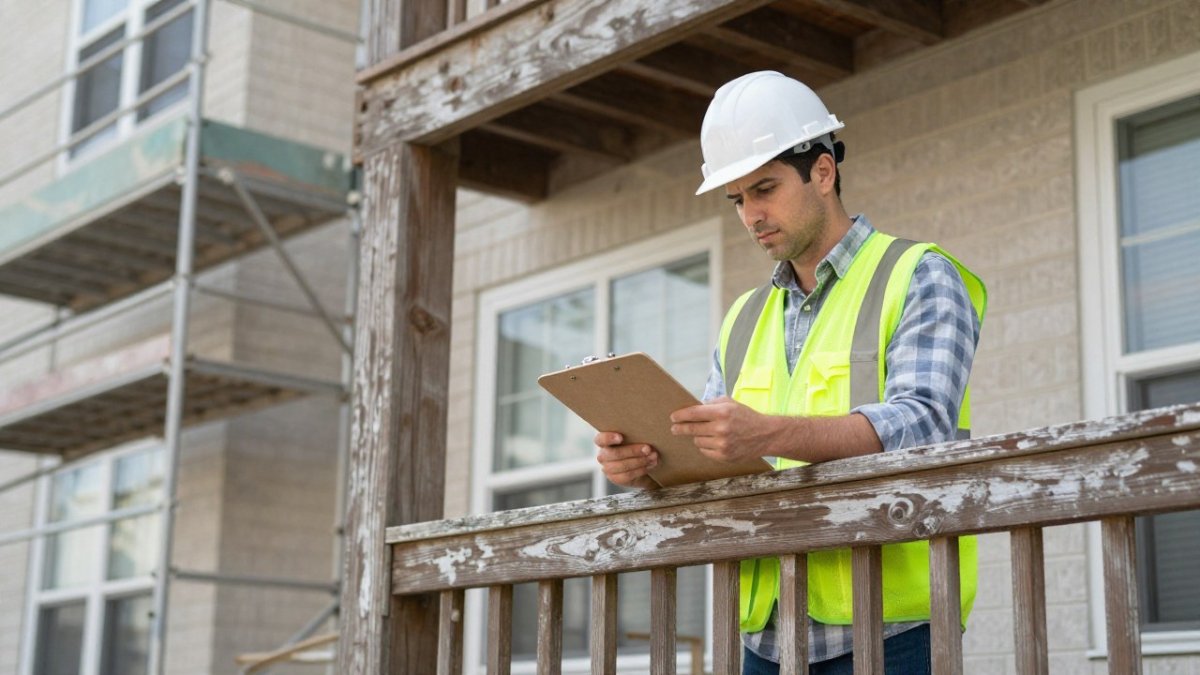
Because access, building size, and the scope of structural review can all shift an inspection quote, comparing those cost drivers with commercial building safety inspections can help clarify which expenses are specific to balcony compliance.
| Cost Driver | What It Changes | Budget Impact |
|---|---|---|
| Unit count and EEE per unit | Total inspection hours; most quotes scale per EEE, not per building | Higher |
| Site access and parking | Crew scheduling, ladder or lift setup, time on site | Moderate |
| Visible deterioration | Need for invasive testing (probing, moisture readings, limited opening of finishes) | Higher |
| Report turnaround | Priority scheduling and rush review | Moderate |
| Local jurisdiction requirements | Scope, filing format, and whether a stamped report must be submitted to the local building department | Varies |
How Inspectors Actually Price the Work
A common pattern is a base mobilization charge plus a per-EEE rate. The base covers travel, setup, and report preparation; the per-EEE rate covers the field time. Ask for both numbers separately so you can compare bids on the same basis.
The Per-Balcony Math Boards Should Run
Watch out: a quote that does not state the EEE count it is pricing cannot be compared to another quote. Ask every bidder to list the EEE they counted and the per-EEE rate before you sign.
What Invasive Testing Adds
For a fuller explanation of what pushes quotes up or down, our team points boards to this balcony inspection cost guide for HOAs.
Hiring a Qualified SB 721 Inspector Without Overpaying
When hiring an SB 721 inspector, it helps to verify licensure, insurance, and report format before signing. Our guide on how to hire a structural engineer for a balcony assessment walks through vetting and hiring.
A common mistake is choosing on price alone.
Repair Costs After the Report: Planning for Remediation
Remediation costs are often the largest part of SB 721 compliance budgets, so it can help to plan for them before a report lands. Our guide to balcony structural repair costs in California gives concrete figures to plan against.
The Four Repair Categories to Budget Against
Remediation scopes often fall into several categories, each with different cost behavior:
- Structural repair. Replacing or sistering framing, repairing ledger connections, and addressing rot at load-bearing points. This is the highest-variance category because the extent is hidden until finishes are opened.
- Waterproofing restoration. Flashing, sealants, membranes, and drainage corrections. Often the cheapest per unit and the highest-leverage, because waterproofing failures are what drive structural decay in the first place.
- Railing and guardrail replacement. Guardrails are part of the load path and are frequently cited when they fail height, spacing, or anchorage requirements. Replacement is a defined scope with a defined unit cost, which makes it the easiest category to estimate early.
- Permits and professional fees. Building permits, plan review, and any required engineering observation during construction. These stack on top of construction cost and are routinely left out of board budgets.
A Planning Sequence That Survives the Report
- Triage. Separate findings that are safety-critical (immediate shoring or closure) from findings that are deferred but documented. Safety-critical items get funded first regardless of fiscal cycle.
- Bundle. Group waterproofing and structural repairs at the same location into one scope. Opening a balcony once for both is cheaper than two mobilizations.
- Phase. Spread non-critical repairs across fiscal years, but put the phase schedule in the reserve study so the money is actually reserved.
Watch out: approving an inspection without a repair contingency is the single most common budgeting error we see. The report arrives, findings are real, and the board has no authority to act until the next fiscal cycle.
Why Deferred Maintenance Inflates the Repair Bill
The Malibu balcony collapse in 2021 and the Berkeley collapse in 2015 both reshaped how seriously boards treat deferred maintenance. Liability exposure after a failure is not theoretical, and the repair cost curve is not linear. A waterproofing failure caught in year one is a sealant and flashing job. The same failure caught in year ten is a framing replacement, because the water has been reaching the load path the whole time. Buildings that inspect early spend less on remediation because problems get caught while they are still small.
Getting a Repair Estimate Before You Have a Report
You do not have to wait for the inspection report to start budgeting.
Insurance, Liability, and Tax Treatment of Inspection Costs
Tax treatment is a question for a qualified tax professional. Owners also ask whether balcony wood decay is covered by insurance.
Booking Your SB 721 Inspection with Apex Balcony
The hardest part of compliance is not the law. It is the fear of what the report will reveal, and that fear is why so many boards delay for years. We have worked with hundreds of building owners.
Apex Balcony provides licensed inspectors with decades of combined construction and design experience. Our team specializes in SB 326 and SB 721 compliance, inspects elevated exterior elements including balconies, decks, and stairways, and aims to identify early signs of structural failure.
Get started with Apex Balcony and turn a compliance deadline into a manageable, budgeted plan.
Frequently Asked Questions
How much does an SB 721 inspection cost?
There is no single statewide price for SB 721 inspections. Pricing depends on quantity, access, and condition. For current pricing or a quote, visit the Apex Balcony website.
Who is legally qualified to perform an SB 721 inspection?
SB 721 requires the inspection to be done by a licensed architect, a licensed civil or structural engineer, or a certified building inspector, among other qualified professionals. General contractors without one of these credentials do not meet the statutory standard. When hiring a qualified SB 721 inspector, ask for the license type and number, and confirm the report will be signed by that individual. A report from an unqualified inspector may not satisfy your local jurisdiction.
What happens if the inspection finds structural issues?
The inspector documents the problem in the report and typically flags it as needing repair, with urgency levels. Minor items like loose fasteners or surface waterproofing failures may be handled by a contractor; serious load-bearing or structural defects may require an engineer’s repair specification and a building permit. Budget for remediation separately from the inspection fee. Deferring repairs raises liability exposure, and in a negligence claim, a documented unresolved defect is hard to defend.
Are there costs beyond the inspection fee itself?
For current pricing on inspection services and any add-ons, visit the Apex Balcony website.