
Table of Contents
- Step 1: Know When Your Deck Needs a Structural Engineer
- Step 2: How to Choose a Structural Engineer for Your Deck
- Step 3: Prepare Your Property for the Deck Inspection
- Step 4: What a Deck Inspection Covers and What It Does Not
- Step 5: Understanding the Deck Structural Inspection Report
- Step 6: What Deck Inspection Cost Includes and How to Compare Quotes
- Conclusion: Turning Your Engineer’s Findings Into Action
- Frequently Asked Questions
Last Updated: October 8, 2026
Step 1: Know When Your Deck Needs a Structural Engineer
Hiring a structural engineer for deck safety starts with one question: is your deck showing signs it can no longer carry its load?
At Apex Balcony, we have worked with hundreds of building owners. The pattern is consistent: problems hide underneath. A deck that looks fine from the living room can have a rotted ledger board or loose connection behind the siding.
California SB 326 balcony inspection requirements
Warning Signs That Call for Immediate Evaluation
Call an engineer right away if you notice any of these:
- Wobbly or springy deck boards underfoot
- Rust streaks or white powder on metal fasteners
- Cracks in posts, beams, or the ledger board
- Water stains or soft, spongy wood near the house
Any one of these points to possible structural failure. Do not wait for a scheduled inspection cycle.
Step 2: How to Choose a Structural Engineer for Your Deck
Choosing the right engineer comes down to three things: license, deck-specific experience, and a scope of work in writing. A licensed engineer carries legal responsibility for the report’s findings, which matters if a repair dispute or insurance claim lands on your desk.
Most ranking pages tell you to “hire a licensed structural engineer” and stop there. That advice is not enough to protect you.
Verify the License, Not Just the Title
Anyone can call themselves a structural engineer. In most states, the protected credential is a Professional Engineer (PE) license, and structural work is often performed under a civil PE with structural experience. A few states issue a separate Structural Engineer (SE) license for certain buildings.
- Ask for the engineer’s name and license number, then look it up in your state board’s online license lookup.
- Confirm the license is current, in good standing, and covers the work you need.
- Check whether the license belongs to the person who will actually visit your deck, or only a firm principal who never sets foot on the property.
A stamp on a report is only as good as the license behind it. If the person signing cannot produce a verifiable number, walk away.
Confirm Deck-Specific Experience
A structural engineer who designs office buildings may never have inspected a residential deck ledger connection. Deck failures cluster around a few details, ledger attachment, flashing, joist hangers, post-to-footing connections, and guardrail anchorage, and an engineer who works on them regularly spots problems faster.
Ask:
- How many elevated decks, balconies, and exterior stairways have you inspected in the past year?
- Have you worked on decks with the same construction as mine (wood-framed, composite, cantilevered, or hillside)?
- Can you describe a recent deck repair you recommended and why?
A vague answer here is a warning sign. A specific one, naming a connection type or a failure mode, tells you the engineer has actually done the work.
Check Insurance and Business Standing
Ask for a certificate of insurance showing general liability and, if they have employees, workers’ compensation coverage. This protects you if someone is injured on your property or a finding is later challenged. Confirm the firm has a real business address and serves your area; an engineer who travels hours to reach you may charge more or rush the visit.
Ask for References and a Sample Report
Request two or three references from similar properties, ideally another elevated deck or a multi-unit building. Then ask to see a sample report, the single most useful step in the process. A strong report names each defect, shows dated photos, cites the relevant code section, and ranks repairs by urgency. A weak one says the deck “appears serviceable” with no supporting detail.
Seven Questions to Ask Before Booking
- Are you licensed in this state, and what is your license number?
- How many deck and balcony inspections have you completed in the last year?
- What exactly does your inspection include, and what does it leave out?
- Will you inspect the connections and framing, or just the visible surfaces?
- How long until I receive the written report, and does it include repair recommendations and photos?
- Are you insured, and can you provide a certificate of insurance?
- Can you provide stamped plans or a letter if my repair or permit requires one?
Ask for the sample report before you book. A good report names each defect, shows photos, and ranks repairs by urgency. A vague one-page summary will not hold up if you are audited or sued.
Red Flags to Avoid
- No verifiable license number
- No sample report or references available
- A quote given without ever seeing the property or asking about its construction
- Pressure to skip the written report and “just tell you what’s wrong”
Taking an extra hour to vet the engineer is far cheaper than paying twice, once for a report you cannot use and again for a qualified engineer to redo the work.
Step 3: Prepare Your Property for the Deck Inspection
Preparation saves time and prevents damage. Clear the deck of furniture, grills, and planters so the engineer can reach every surface, and make sure someone can open the door to the space below the deck if accessible.
Skipping this step often means paying for a second visit. Engineers who cannot reach the framing may note it as “not inspected,” which weakens your documentation.
A short prep list:
- Remove all furniture and stored items
- Trim plants blocking the deck edge or posts
- Unlock gates and access panels
- Gather past permits and repair receipts
Step 4: What a Deck Inspection Covers and What It Does Not
A deck inspection covers the structure, connections, and safety features. It does not cover cosmetic finishes, and it is not a repair job. Understanding that line keeps expectations realistic.
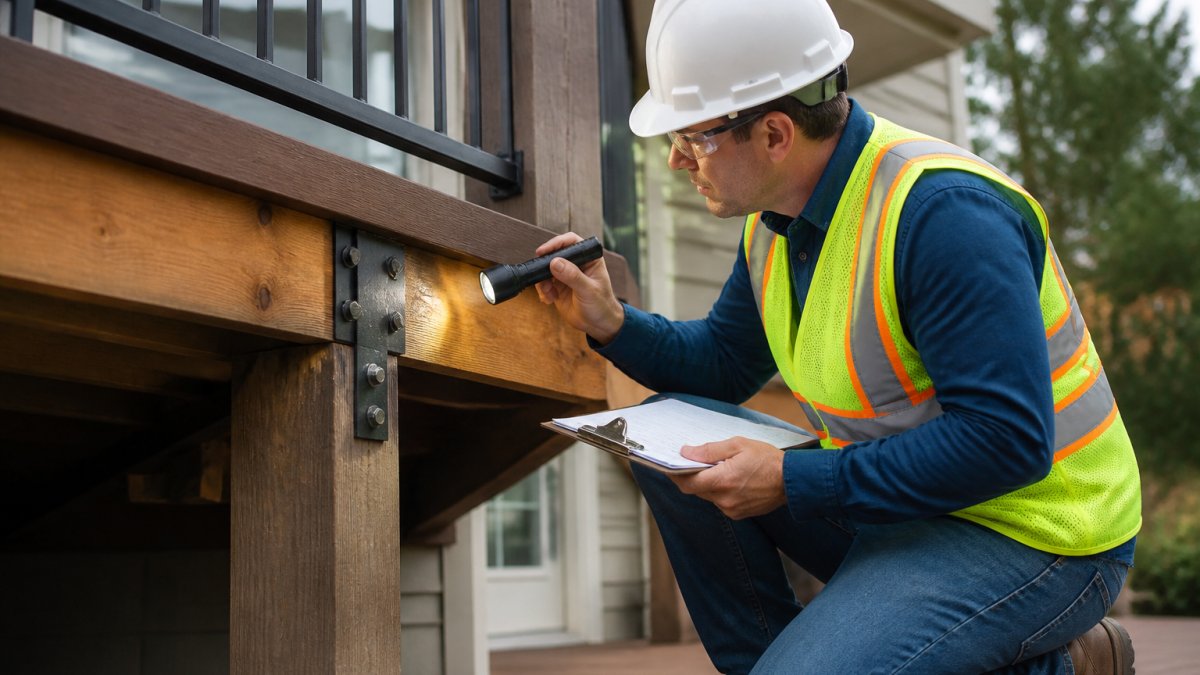
A typical inspection includes:
- Ledger board attachment to the house
- Joists, beams, and posts
- Footings and their connection to the ground
- Fasteners, bolts, and metal connectors
What it does not include: paint and stain condition, furniture, and anything buried or hidden without access. For a hillside or elevated deck, the engineer may note limits in the report.
Deck Safety Inspection Checklist
Use this checklist to track what a thorough inspection should confirm:
- Ledger board is securely fastened with proper bolts
- No rot, cracking, or splitting in framing members
- Posts are plumb and rest on solid footings
- Metal connectors show no corrosion
Step 5: Understanding the Deck Structural Inspection Report
A deck structural inspection report is the written record of what the engineer found and what needs fixing. This document is your proof of compliance and your repair roadmap. It should name each defect, show photos, and state whether the deck is safe for its intended use.
Read it in this order:
- The summary, which states overall condition
- The list of defects, ranked by urgency
- The repair recommendations and any load limits
- The photos that back up each finding
If a report only says “deck is safe” with no detail, ask for more. A vague report will not protect you.
Do not start repairs before you have the written report in hand. Repairing first and documenting later leaves you with no record of the original condition, which can hurt you in an audit or claim.
Step 6: What Deck Inspection Cost Includes and How to Compare Quotes
Deck inspection cost depends on the size of the property, the number of units, and how much of the structure is accessible.
Most pages on this topic either skip cost entirely or quote a single meaningless number. Deck inspection fees vary widely by region, property type, and scope, so the useful skill is knowing what drives the price and what a quote should include.
What Drives the Cost
- Number of structures. One deck is a single visit; a building with twenty balconies and shared stairways is a multi-day project.
- Access. An engineer who can walk the underside works faster than one who must document inaccessible framing as “not inspected.”
- Elevation and site conditions. Hillside decks, cantilevers, and tight lots take longer to assess safely.
- Report depth. A photo-documented report with ranked repairs and code citations takes more time than a summary letter.
- Turnaround. Rush timelines and compliance deadlines can add cost.
What a Quote Should Include
A written quote should spell out deliverables, not just a price. Ask for these in writing:
- Scope of inspection: which structures, which components, and what is excluded
- Whether the underside, connections, and framing are included or optional
- Whether the fee covers a written report, photos, and repair recommendations
- Whether the engineer can provide stamped plans or a letter if a permit or repair requires one
- Turnaround time and the final report format
How to Compare Quotes
When you compare quotes, look past the bottom line. A low quote often means a shorter inspection or a thinner report.
| What to Compare | Why It Matters |
|---|---|
| Scope of inspection | Confirms framing and connections are checked, not just surfaces |
| Report detail | Photos and ranked repairs protect you later |
| Turnaround time | Delays can push you past a compliance deadline |
| Insurance and license | Protects you if a finding is ever challenged |
| Repair recommendations | Tells you the real cost of what comes next |
| Stamped plans or letter | Some repairs and permits require a sealed document |
| Re-inspection terms | Confirms whether a follow-up visit is included or billed separately |
A cheaper quote that skips the framing is not a bargain. It is a gap in your documentation.
Do not compare quotes on price alone. Two quotes for the same deck can differ by hundreds of dollars because one includes the underside and connections and the other does not. Ask each engineer to confirm in writing what is included before you decide.
Questions to Ask About Any Quote
- Does this price include the underside and the ledger connection?
- Is the written report and photo documentation included, or billed separately?
- What is the turnaround time, and is there a rush option?
- If repairs are needed, can you provide stamped plans or a letter?
- Is a follow-up or re-inspection included, and at what cost?
Getting these answers in writing before you book turns a vague estimate into a comparable, defensible quote, and protects you from paying twice for the same deck.
Conclusion: Turning Your Engineer’s Findings Into Action
The hard part is not the inspection. It is acting on what the report finds, especially when repairs look expensive and the board is nervous.
That is where Apex Balcony helps. Our licensed inspectors bring decades of construction and design experience to every deck, balcony, and stairway we review. We specialize in SB 326 and SB 721 compliance, and we give you a clear path from findings to repairs.
Frequently Asked Questions
How much does it cost to hire a structural engineer for a deck inspection?
Deck inspection cost depends on the number of decks, their height, and site access. Multi-unit properties with elevated decks cost more because the engineer inspects more connections, footings, and guardrails. Apex Balcony does not publish fixed prices; request a written quote that lists the number of decks, estimated hours, and what the report includes so you can compare bids fairly.
What qualifications should a structural engineer have for a deck inspection?
Look for a licensed professional engineer (PE) in your state, ideally with experience in residential deck design and inspection. Ask whether they carry professional liability insurance, whether they have worked on elevated decks or hillside properties, and how their report documents load capacity, connections, and repair recommendations. In California, engineers who inspect balconies for SB 326 and SB 721 compliance must meet specific licensing and experience requirements, so confirm that before booking.
What does a structural engineer check during a deck inspection?
A deck structural inspection covers the ledger board attachment, joists, beams, posts, footings, and connections. The engineer checks for wood rot, corrosion, cracking, deflection, and settlement, then evaluates load capacity against anticipated live load and dead load. Guardrails, stairs, and fall prevention details are also reviewed. The final deck structural inspection report lists each deficiency, its severity, and recommended repairs so you can bid the work accurately.
What should I do if an engineer finds a safety problem with my deck?
Do not wait. Restrict access to the deck immediately, then review the deck structural inspection report with your board or ownership team. Prioritize repairs that affect structural integrity, such as failed ledger board connections or rotted posts, before cosmetic items. Get repair quotes from licensed contractors, and keep the engineer’s written documentation on file. If your property falls under SB 326 or SB 721, report compliance status to the required parties within the deadlines.