
Last Updated: November 11, 2026
Quick Summary
Coastal deck longevity depends on removing salt residue and debris before they trap moisture, which fuels rot and corrosion. Clean the deck regularly, rinse thoroughly after storms, keep board gaps clear, and reseal on a schedule based on exposure rather than the calendar.
- Sweep debris weekly and after storms, since trapped debris holds moisture and invites rot.
- Give the deck a full rinse after storms or onshore wind, because salt spray can coat hidden surfaces.
- Rinse board gaps, post bases and the ledger connection every few weeks during the wet season.
- Wash and degrease before sealing, because salt left on the boards can prevent sealer from bonding.
- Replace corroded fasteners with marine-grade stainless steel or hot-dip galvanized hardware rated for coastal exposure.
Table of Contents
- Why Salt Air Shortens the Life of a Coastal Deck
- Signs of Dry Rot in Exterior Decks You Should Never Ignore
- Routine Cleaning and Debris Removal for Salt-Exposed Surfaces
- Coastal Deck Waterproofing Best Practices, Step by Step
- Material-Specific Care: Composite Versus Wood Decking
- SB 326 Balcony Inspection Requirements and Your Inspection Schedule
- What a Structural Inspection Costs and Booking Yours With Apex Balcony
- Frequently Asked Questions
Why Salt Air Shortens the Life of a Coastal Deck
If you own a deck within a few miles of the ocean, salt is quietly working against your investment every day, and protecting your coastal deck longevity starts with understanding that threat. Salt air carries chloride particles that settle on boards, fasteners and railings, then absorb moisture and accelerate corrosion and wear. Coastal homeowners often find that decks wear out faster than the same materials inland, and the damage starts at the hardware and surface long before it shows up structurally.
Salt and humidity together create the conditions that make maintenance urgent. Damp salt residue keeps wood fibers saturated for longer, which invites rot and mildew, while the same salt deposits eat into unprotected steel and galvanized fasteners. Elevated exterior elements in California are best kept in good condition when owners treat salt exposure as an ongoing maintenance problem rather than an occasional cleaning task.
Signs of Dry Rot in Exterior Decks You Should Never Ignore
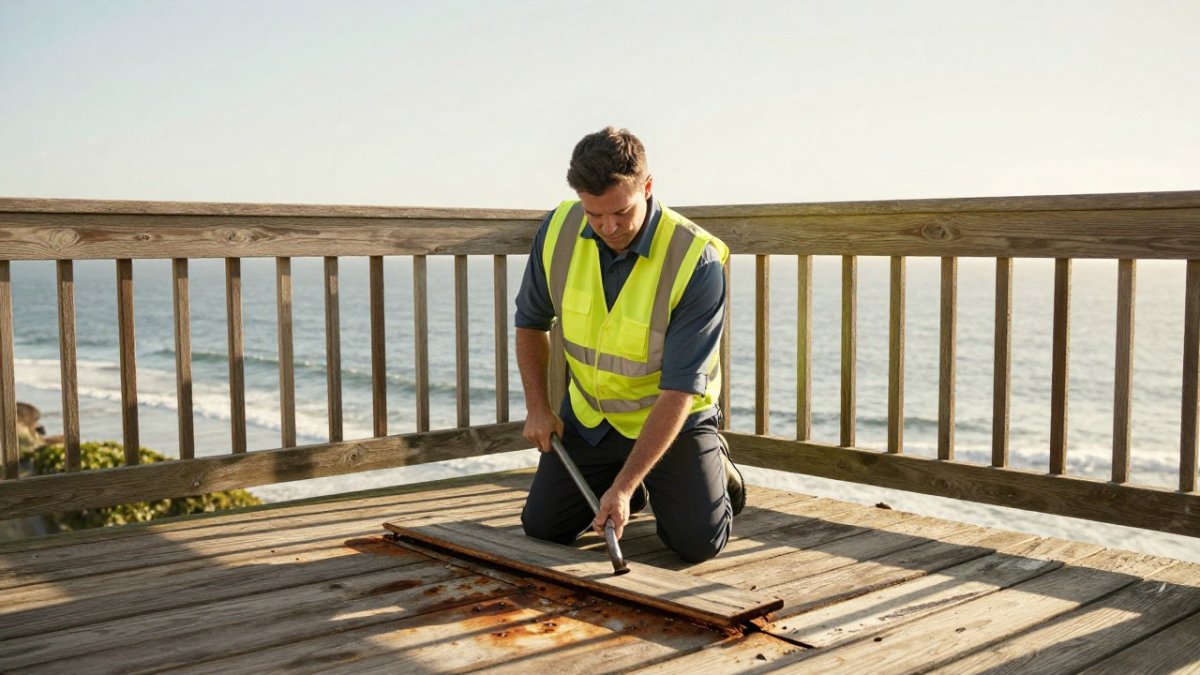
Dry rot is a fungal decay that consumes wood from the inside, so the warning signs can be easy to miss until the damage is advanced. Watch for soft spots that give under foot, boards that look darker or grayer than their neighbors, and fasteners that have popped up or no longer hold firmly. Cracking along the grain and a crumbly texture when you press a screwdriver into the wood are strong indicators that decay has set in.
Check the underside as well as the walking surface. Joists, ledgers and post connections are where moisture collects and where rot causes the most serious structural risk. Any suspected rot should be assessed promptly, since affected framing can compromise the entire deck and create a safety hazard for everyone who uses it.
Routine Cleaning and Debris Removal for Salt-Exposed Surfaces
Regular cleaning is the highest-leverage maintenance task for coastal deck longevity, but the cadence and technique differ from inland care. Salt residue is hygroscopic, it pulls moisture out of the air and holds it against the wood and hardware, so a deck that looks clean can still be sitting under a film of damp chloride. The goal is to remove salt and organic debris before either can do damage, and to do it without pushing runoff into the coastal ecosystem.
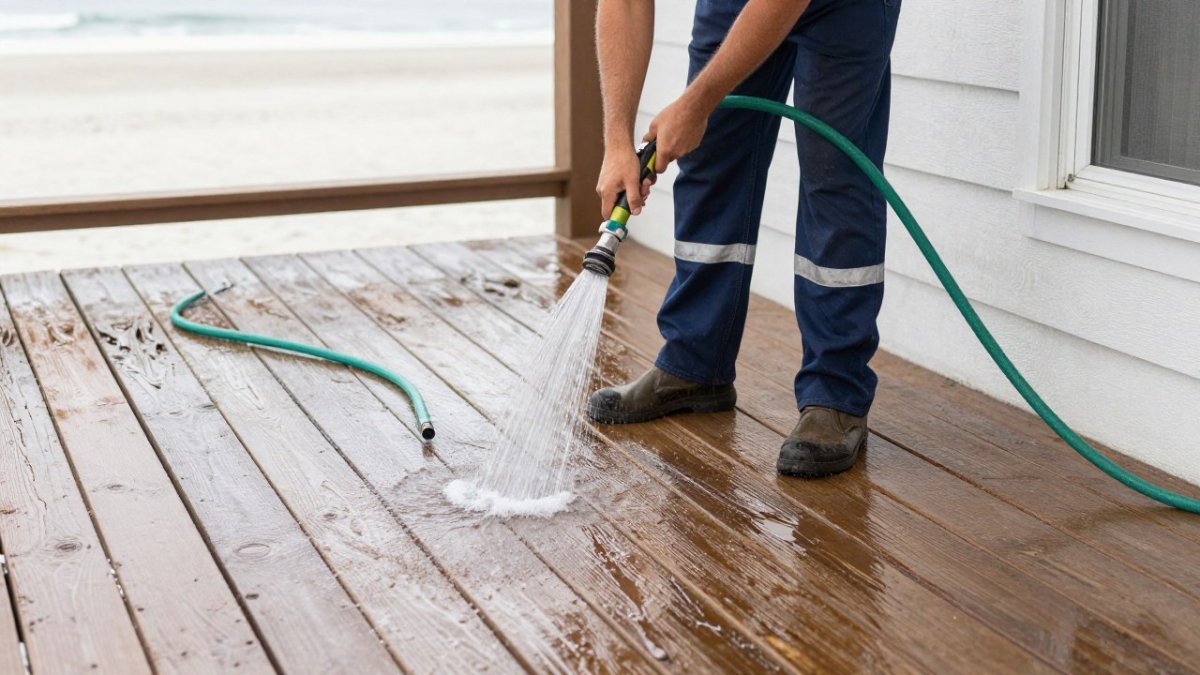
Weekly and after storms: Sweep or blow off sand, leaves, pine needles, and seed pods. Debris trapped between boards and against the ledger holds moisture and creates a direct path for rot. After a storm or a stretch of onshore wind, do a full rinse rather than a spot sweep, because salt spray can coat surfaces you cannot see.
Every few weeks during the wet season: Rinse the deck with fresh water, working from the top down and paying attention to board gaps, the underside of railings, post bases, and the ledger connection at the house. These are the places salt and moisture collect and the places rot starts. A garden hose with a nozzle is usually sufficient; a pressure washer should be reserved for periodic deep cleaning and used at a low setting with the nozzle kept moving so it does not gouge the wood or drive water into gaps.
Managing board gaps and drainage: Coastal decks need clear gaps between boards so water and air can move. Check that gaps are not clogged with sand, pollen, or finish buildup, and clear them with a putty knife or a gap tool. Confirm that the deck slopes away from the house and that downspouts and gutters are not dumping water onto the deck surface. Standing water is the single fastest route to rot and mildew.
Mildew and surface grime: Use a mild cleaning solution rather than harsh bleach or solvent-heavy products. Plant-based or biodegradable deck cleaners are one option that can reduce runoff into soil, storm drains, and nearby waterways. Scrub with a soft-bristle brush, rinse thoroughly, and let the surface dry before walking on it or applying any finish.
Eco-friendly cleaning for coastal ecosystems: Runoff from deck cleaning can reach sensitive shoreline habitat, so choose biodegradable cleaners, avoid cleaning right before rain, and rinse onto landscaping rather than directly into storm drains where local rules allow. This is a maintenance practice worth considering on properties near the water.
Watch out: never mix cleaning chemicals (Hazard Communication for Disinfectants Used Against Viruses | NIOSH). Dilute cleaners according to the label and test on an inconspicuous area first.
The article lays out a cleaning cadence that changes with conditions, from weekly sweeping to a full rinse after storms.
| Task | Frequency | Why it matters |
|---|---|---|
| Sweep or blow off debris | Weekly and after storms | Debris holds moisture and creates a path for rot |
| Full rinse after storms | After storms or onshore wind | Salt spray can coat surfaces you cannot see |
| Rinse board gaps, post bases, ledger | Every few weeks in wet season | Salt and moisture collect in these spots |
| Clear clogged board gaps | Regular checks | Gaps need to move water and air |
| Pressure wash on low setting | Periodic deep cleaning | Avoids gouging wood or driving water into gaps |
Coastal Deck Waterproofing Best Practices, Step by Step
Waterproofing is a coastal deck’s primary defense against moisture, but salt air changes the rules. Chloride residue left on the surface can interfere with adhesion, UV intensity breaks down finishes faster than inland exposure, and film-forming coatings that trap moisture are a common failure point. The steps below are sequenced for salt-exposed decks rather than generic inland conditions.
- Wash and degrease before anything else. Scrub the surface with a mild detergent and fresh water to remove salt film, sand, and organic residue, then rinse thoroughly. Salt left on the boards can prevent sealer from bonding.
- Let the wood dry to an appropriate moisture content. Pressure-treated lumber typically needs several days of dry weather before it will accept a penetrating finish; confirm the specific moisture range on the product label. Composite and PVC decking have their own manufacturer drying and cleaning requirements, so follow those instead.
- Repair and re-fasten first. Replace popped or corroded fasteners with marine-grade stainless steel or hot-dip galvanized hardware rated for coastal exposure, and set any protruding nail or screw heads below the surface. A finish applied over failing hardware will not last.
- Choose the right product for the material and exposure. Penetrating sealers soak into wood fibers, while film-forming stains and paints can crack and trap moisture on coastal decks, especially on horizontal surfaces that take full sun. For composite and PVC, use only products the manufacturer approves; many composite makers specify a UV-stabilized sealer or none at all.
- Apply with the grain and back-brush. Work in manageable sections, keep a wet edge, and back-brush to drive product into the grain rather than letting it pool. Pay extra attention to end grain, board edges, and joints, which wick water fastest.
- Recoat on a coastal schedule, not a calendar guess. Recoating frequency depends on exposure, and exposed horizontal surfaces in salt air generally need recoating more often than shaded vertical surfaces. Test by sprinkling water on the surface: if it beads, the finish is still working; if it soaks in, it is time to recoat.
Watch out: applying sealer over damp, dirty, or salt-filmed wood traps moisture and salt underneath, which accelerates the rot and finish failure you are trying to prevent. Confirm the surface is clean, dry, and within the product’s moisture spec before every coat.
Consider scheduling waterproofing for a stretch of dry, moderate weather rather than the hottest week of summer, since high surface temperatures can cause solvents to flash off too quickly.
Material-Specific Care: Composite Versus Wood Decking
Wood and composite decks need different care in salt air. Wood requires regular sealing and attention to rot. Composite decking resists rot, but it can still trap salt and mildew in its textured surface, so periodic washing matters.
Hardware is where many coastal decks fail regardless of material. Choose corrosion-resistant fasteners such as stainless steel or hot-dip galvanized options rated for marine or coastal exposure, and avoid mixing metals, which can accelerate galvanic corrosion. Replacing standard fasteners with corrosion-resistant ones during a repair is a worthwhile upgrade for a coastal homeowner.
SB 326 Balcony Inspection Requirements and Your Inspection Schedule
California’s SB 326 establishes inspection requirements for certain elevated exterior elements in multifamily buildings, and HOA boards and property managers should verify current obligations with the official text of the bill on California Legislative Information, SB 326 bill text. Compliance deadlines and the scope of covered structures depend on building type and age, so confirm which elements apply to your property before scheduling work.
Build inspections into your maintenance calendar rather than waiting for a complaint or an incident. A recurring schedule, reviewed annually by the board, keeps decks, balconies and stairways visible to the people responsible for them. Keeping dated records of each inspection and the repairs that follow also helps demonstrate good-faith maintenance.
What a Structural Inspection Costs and Booking Yours With Apex Balcony
Pricing depends on the size of the property, the number of elevated elements, and how much access work is needed. Request a quote from Apex Balcony for current pricing tailored to your property.
Apex Balcony’s licensed inspectors evaluate elevated exterior elements for structural integrity and signs of damage. To review what an inspection covers and arrange one for your building, book a balcony inspection with our team. If you are already weighing repair options, our balcony waterproofing cost guide explains how pricing is typically structured.
Salt air will keep working on your deck whether or not you act, so the advantage goes to owners who maintain on a schedule. Start with a clean, inspection, and repair cycle this season, and let Apex Balcony help you confirm where your property stands. Get a clear picture of your deck’s condition with Apex Balcony and plan repairs before small problems become structural ones.
Frequently Asked Questions
How often should a coastal deck be professionally inspected?
Most coastal decks benefit from a professional inspection at least once a year, with an additional check after storm seasons or heavy winter rain. Salt air accelerates corrosion of fasteners and brackets and speeds up moisture penetration into framing, so problems can develop between visual checks. For multi-unit California properties, an inspection schedule should also account for SB 326 and SB 721 requirements. Apex Balcony can recommend an interval based on your building’s exposure and age. Pricing depends on property size and scope, so request a quote from Apex Balcony for current rates.
Do SB 326 and SB 721 apply to coastal residential decks?
SB 326 and SB 721 address elevated exterior elements such as balconies, decks and stairways in multi-unit residential buildings in California. Whether a specific deck is covered depends on the building type, number of units and the element’s construction. Coastal location does not remove the obligation, and salt exposure often makes compliance inspections more important. A qualified inspector can review your property and confirm which requirements apply before you commit to any work. Contact Apex Balcony for a consultation on your building.
What are the signs of wood rot in coastal decks?
Look for soft spots when you press a board with a screwdriver, dark or discolored wood, cracking or splintering along the grain, and popped or loose fasteners. Mildew that persists after cleaning can also signal moisture trapped below the surface. Check joists, ledgers and post bases where water collects, not only the visible deck boards. Early detection usually means a smaller repair, so document findings and schedule a professional structural inspection if you see any of these signs.
Does salt air affect the structural integrity of a deck?
Yes. Salt particles hold moisture against surfaces and accelerate corrosion in untreated steel fasteners, brackets and connectors. Over time this weakens connections and can lead to structural failure if the hardware is not corrosion-resistant. Using stainless steel or hot-dip galvanized hardware, rinsing surfaces regularly and inspecting connections each season helps protect structural integrity in a coastal environment.
