
Table of Contents
- How Salt-Laden Air Accelerates Balcony Structural Decay
- Moisture Intrusion and Water Seepage in Coastal Environments
- Corrosion of Metal Components and Fasteners
- Signs of Dry Rot in Exterior Decks and Load-Bearing Joists
- SB 326 Balcony Inspection Requirements and Safety Compliance
- Cost of Balcony Structural Inspection and What to Expect
- Preventative Maintenance and Early Detection Strategies
- Frequently Asked Questions
Last Updated: October 1, 2026
How Salt-Laden Air Accelerates Balcony Structural Decay
Salt-laden air is one of the primary culprits behind balcony structural decay in coastal environments. When salt spray from ocean water becomes airborne and settles on metal components, concrete, and wood, it initiates a cascade of corrosion and deterioration that compounds over time. This process doesn’t happen overnight, it’s gradual, relentless, and often invisible until significant damage has already occurred.
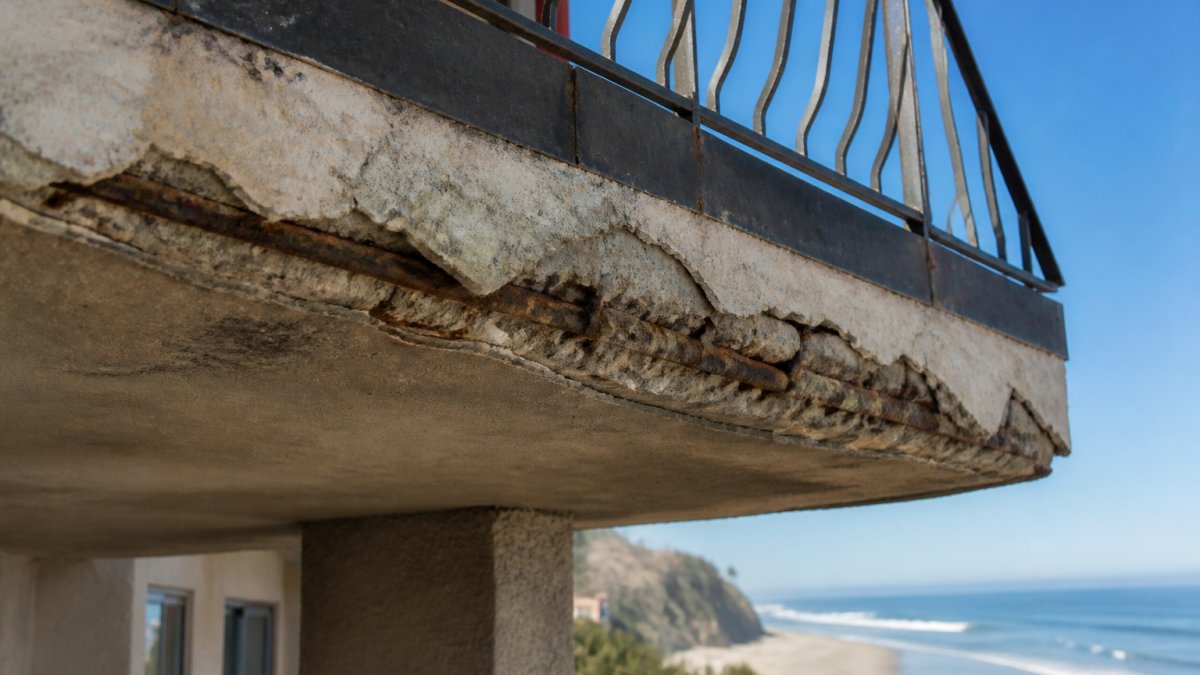
The chemistry is straightforward: airborne chlorides penetrate protective coatings and bind to metal surfaces, creating an electrochemical reaction that breaks down the material. Galvanized steel, which is common in balcony construction, offers some resistance, but even galvanized components succumb to salt spray exposure over years. Wood absorbs salt-laden moisture, leading to swelling, shrinkage, and eventual dry rot. Concrete experiences similar salt intrusion, which corrodes embedded rebar and accelerates structural failure.
Apex Balcony has worked with hundreds of building owners. The closer a property sits to the ocean, the more aggressive the environment becomes. Buildings within a quarter-mile of the shoreline face the most severe conditions.
Prevention starts with understanding your micro-climate. A building on a cliff overlooking the Pacific faces different salt exposure than one a mile inland. Wind patterns, building orientation, and surrounding structures all influence how much salt spray reaches your balcony. Identifying your specific exposure level is the first step toward effective maintenance.
Moisture Intrusion and Water Seepage in Coastal Environments
Moisture intrusion is the second major driver of balcony structural decay, and it works in tandem with salt exposure to accelerate failure. Water seepage penetrates the building envelope through cracks, failed sealants, and gaps in flashing. Once inside, moisture becomes trapped within the structural assembly, creating conditions for rot, corrosion, and mold growth.
Coastal environments amplify this problem. Higher humidity, frequent fog, and salt spray-laden moisture create persistent dampness that inland properties rarely experience. Water doesn’t simply evaporate, it lingers, soaking into wood joists, concrete, and the spaces between structural components. The combination of salt and moisture is particularly destructive: salt accelerates corrosion while moisture keeps the metal surface wet enough for the reaction to continue.
Flashing failures are the most common source of water seepage in balconies. Flashing is the metal or rubber seal that directs water away from the building. When flashing deteriorates, cracks, or pulls away from the structure, water runs directly into the assembly below. Over time, this water seeps into ledger boards, joists, and the rim joist, the critical load-bearing components that hold the balcony to the building.
Sealants around penetrations, joints, and edges are equally important. Coastal UV exposure and salt spray degrade sealants faster than in mild climates. A sealant that might last 10 years inland may fail in 5-7 years at the coast. Once sealants fail, water finds its way into every gap.
The real danger emerges when moisture reaches the ledger board, the horizontal member that attaches the balcony to the house. If water intrudes here and remains trapped, the wood begins to rot from the inside out. By the time visible damage appears on the surface, significant structural compromise may already exist.
Corrosion of Metal Components and Fasteners
Metal corrosion is the third pillar of coastal balcony failure. Balconies rely on metal fasteners, brackets, handrails, and reinforcement to function safely. In coastal environments, these components corrode at accelerated rates, losing structural capacity and integrity.
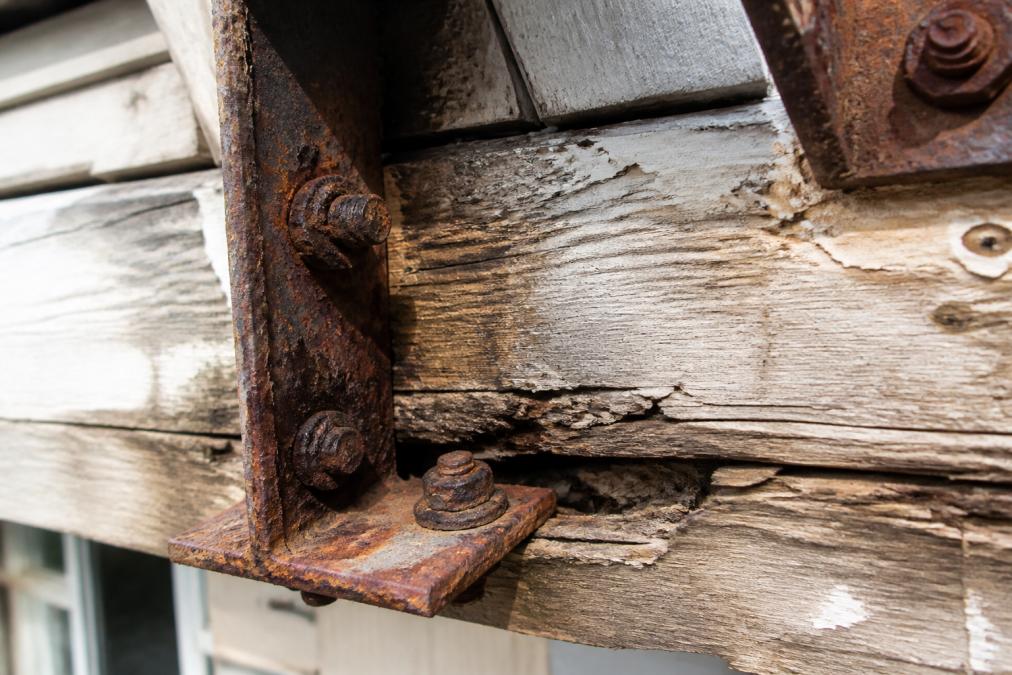
Galvanized steel is the standard for coastal construction because it offers better corrosion resistance than bare steel. However, galvanizing is not permanent. Salt spray and chloride exposure gradually break down the zinc coating, exposing the underlying steel to rust. Once rust begins, it accelerates, rust is porous and traps moisture, creating a cycle of continued corrosion.
Stainless steel offers superior corrosion resistance but is expensive and not universally used. Some builders cut corners by using standard galvanized fasteners in coastal applications. These fasteners corrode within 5-10 years, weakening the connections that hold the balcony together.
Handrails, brackets, and support posts face the same threat. Corroded fasteners lose their grip. Corroded metal loses thickness and strength. A bracket that was once capable of supporting 500 pounds of lateral force might only handle 300 pounds after years of corrosion. This degradation is invisible from ground level but critical to safety.
Metal oxidation also creates expansion problems. As steel rusts, it expands. This expansion can crack concrete, push against adjacent materials, and create stress points that lead to failure. The rust itself is weaker than the original steel, making the corroded area a point of structural weakness.
Signs of Dry Rot in Exterior Decks and Load-Bearing Joists
Dry rot is the term commonly used for wood decay in exterior structures, though the wood is rarely truly “dry”, it’s usually damp enough to support fungal growth. Dry rot begins when wood moisture content exceeds 20-25%, which is common in coastal environments. Fungal spores germinate, spread through the wood, and break down the cellulose that gives wood its strength.
The early signs are subtle. Discoloration appears first, wood turns darker or develops a grayish cast. The surface may feel soft or spongy. Paint may blister or peel because the underlying wood is moving as it swells and shrinks with moisture changes. Cracks may appear in a distinctive cube-like pattern as the wood shrinks.
By the time structural failure becomes obvious, significant decay has usually occurred. A joist that looks solid on the surface may be 50% compromised internally. When load-bearing joists fail, the entire balcony is at risk of collapse.
Load-bearing joists are the horizontal members that span from the ledger board to the outer rim joist, supporting the weight of the deck and occupants. These are among the most critical components. If they fail, the balcony fails. Coastal properties must pay particular attention to joist condition because the combination of moisture, salt, and temperature cycling accelerates decay dramatically.
Preventative inspection is essential. A professional inspector can probe suspect wood to assess decay depth and structural capacity. Early detection allows for targeted repairs before failure becomes imminent. Many property owners wait until visible damage appears, by which time repairs are more expensive and the safety risk is higher.
SB 326 Balcony Inspection Requirements and Safety Compliance
California’s Senate Bill 326 (SB 326) mandates structural inspections of exterior elevated elements, balconies, decks, and stairways, on residential buildings with three or more units. The law applies to properties constructed before January 1, 2008, and requires inspections to be completed by January 1, 2025, with a five-year cycle thereafter. These mandatory assessments serve as a critical baseline for identifying early signs of deterioration, yet consistent maintenance remains the most effective strategy for preventing exterior damage through the regular removal of salt and moisture buildup.
SB 326 exists because of balcony failures and collapses that resulted in injuries and deaths.
Missing the SB 326 inspection deadline or failing to address identified deficiencies exposes property owners to significant legal and financial liability. If an incident occurs on an uninspected balcony, the property owner’s negligence becomes indefensible.
Cost of Balcony Structural Inspection and What to Expect
The cost of a balcony structural inspection depends on building size, complexity, and accessibility. A professional inspection typically includes a visual assessment of all exterior elevated elements, probe testing of wood for decay, fastener evaluation, and a detailed written report documenting findings and recommendations. Pricing depends on quantity, dates, and delivery. Please visit our website for current prices or a quote.
Request references from past clients and ask specifically about properties in coastal environments. An inspector with experience in your area understands the unique challenges your building faces and can spot problems early.
Preventative Maintenance and Early Detection Strategies
The most cost-effective approach to managing balcony structural decay is prevention. Preventative maintenance catches problems early, when repairs are less expensive and less disruptive. Early detection also reduces safety risk, a failing balcony that is identified before collapse is far preferable to one that fails unexpectedly.
Visual inspection checklist for property managers:
- Check flashing and sealants around balcony edges and penetrations
- Look for paint blistering, cracking, or peeling on wood surfaces
- Inspect metal handrails and brackets for rust or corrosion
- Check for water staining or evidence of seepage on the building facade below balconies
- Look for soft or spongy wood when probing with a screwdriver (light pressure only)
- Inspect the ledger board connection to the building for gaps or movement
- Check for visible cracks in concrete or mortar
- Look for mold, mildew, or algae growth indicating moisture problems
Frequently Asked Questions
How does salt air accelerate structural decay in balconies?
Airborne chlorides from ocean spray deposit on metal fasteners, railings, and structural components, triggering oxidation and corrosion. These salt particles penetrate paint and sealants, exposing steel and galvanized surfaces to accelerated rust formation. Combined with humidity and temperature cycling, salt-laden air weakens the structural integrity of balcony support systems within just a few years.
What are the early warning signs of balcony rot and structural failure?
Look for soft or spongy wood when you press on joists and ledger boards, visible discoloration or darkening of wood surfaces, paint peeling or blistering, rust stains on metal components, water pooling or staining on concrete, gaps between the balcony and house, and visible separation of flashing. Moisture intrusion often causes dry rot to develop inside wood before exterior damage becomes obvious. If you notice any of these signs, a professional structural inspection is essential to assess load-bearing capacity and safety.
Which law applies to my building, SB 326 or SB 721?
SB 326 applies to residential buildings with three or more units built before January 1, 2008, and requires inspection of balconies and exterior elevated elements. SB 721 applies to the same building types and requires the same inspections. Both laws mandate that you hire a licensed architect, structural engineer, or certified inspector to assess structural integrity and code compliance. Contact your local building department or a licensed inspector to confirm which statute applies to your specific property.
How often should coastal balconies be inspected for structural integrity?
Coastal balconies should be inspected annually by property owners. However, salt spray and humidity accelerate decay, so many coastal property managers conduct professional inspections every 3 to 5 years to catch corrosion and moisture damage early. After major storms, saltwater intrusion events, or visible damage, request an immediate inspection. Preventative inspections are far less costly than emergency repairs or structural replacement.