
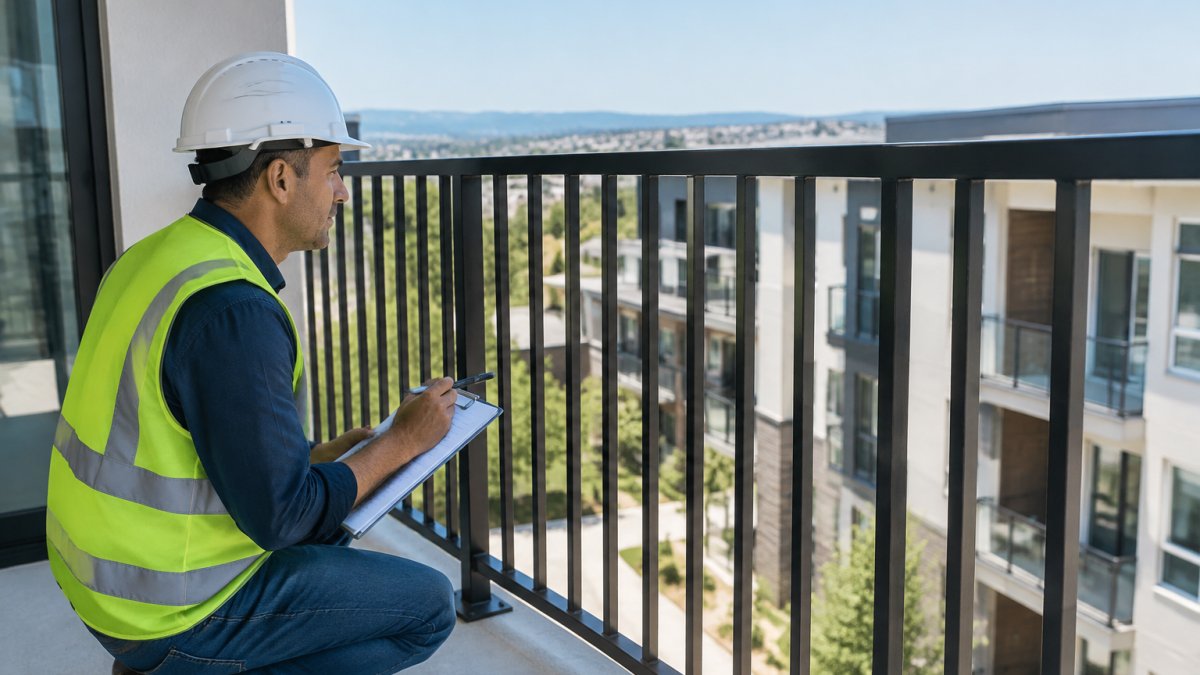
Last Updated: November 5, 2026
Quick Summary
Balcony railing safety and code compliance requires a minimum guard height of 42 inches, measured vertically from the finished deck surface to the top of the guard under the International Residential Code. The 36-inch figure applies only in narrower cases, such as certain commercial occupancies and some existing-building conditions.
- Measure guard height from the finished deck surface, not the structural slab, since tile or pavers can add an inch or more.
- SB 326 covers condominium-style associations and SB 721 covers apartment buildings with three or more dwelling units.
- Test every opening with a four-inch sphere, since no opening in a guard may allow that sphere to pass through.
- Bring in a licensed structural engineer when a post moves under hand pressure or anchorage is into spalling concrete.
- A compliance letter should name the inspector and list their license or certification number to survive an audit.
Table of Contents
- Balcony Railing Height Requirements: The 42-Inch Rule and When 36 Inches Applies
- Balcony Railing Code Requirements California: SB 326, SB 721, and Local Amendments
- Balcony Railing Safety and Code Compliance Checklist for Property Managers
- Guardrail Openings, the Four-Inch Sphere, and Fall Prevention
- Structural Load, Anchorage, and When to Call an Engineer
- Balcony railing safety and code compliance letter: What It Should Contain and Who Signs It
- Repair, Retrofit, or Replace: Making the Call Before a Violation Forces It
- Book Your Balcony Railing Inspection with Apex Balcony
- Frequently Asked Questions
Balcony Railing Height Requirements: The 42-Inch Rule and When 36 Inches Applies
Balcony railing safety and code compliance starts with one number most property managers already half-know: 42 inches. That is the minimum guard height for balconies, decks, and other elevated surfaces in residential construction under the International Residential Code, measured vertically from the finished deck surface to the top of the guard.
The 36-inch figure applies in narrower cases: certain commercial occupancies, some existing-building conditions, and interior guards where the code edition in force allows it. The trap is assuming your building falls into the exception. Most multi-unit residential balconies do not.
Measuring From the Finished Deck Surface
Measure from the finished surface, not the structural slab. A tile assembly, paver system, or coating build-up can add an inch or more, and that changes whether a guard passes. We see this constantly on older buildings where a deck was re-surfaced years after the railing went in. The railing was compliant when installed. The new surface quietly made it short.
Handrail Versus Guardrail Height
A guardrail keeps people from falling off an edge. A handrail gives them something to grip on a stair. They are different components with different rules, and a single assembly can serve both roles if it meets both sets of dimensions.
For the full set of dimensional rules, including when a 36-inch guard is permitted, see our California building code balcony standards compliance guide.
Balcony Railing Code Requirements California: SB 326, SB 721, and Local Amendments
State law layers on top of the model codes, and this is where the balcony railing code requirements property owners actually face get complicated. SB 326 governs balconies, decks, stairways, and other elevated exterior elements on condominium-style associations.
Local amendments add a third layer. Some jurisdictions adopt stricter guard heights, different inspection intervals, or their own reporting formats. A building that passes under the state rule can still fail a municipal review.
How to Identify Which Code Edition Applies to Your Building
Start with the date the building was permitted, not the date it was built. That date tells you which code edition was in force when the structure was approved, and existing buildings are generally held to the code of their era unless a renovation triggers an upgrade requirement. Then work through four questions in order:
- What was the permit date? Pull the original permit from the building department records. The edition in force on that date is your baseline.
- Has the jurisdiction adopted a newer edition since? Adoption lags publication by months or years, and some jurisdictions skip editions entirely. A building permitted under one edition may now be reviewed against a later one for new work.
- Has the building been altered? A renovation that replaces the guard, changes the deck surface, or changes occupancy can trigger a requirement to bring the affected assembly up to the current edition. Re-surfacing a deck is the classic trigger: the added thickness can drop a formerly compliant guard below the minimum height.
- Is there a local amendment? Check the jurisdiction’s amendment ordinance, not just the state adoption. Amendments can raise the guard height, change the sphere size, add inspection intervals, or prescribe a reporting format.
Adoption Dates, Grandfathering, and Renovation Triggers
Grandfathering is widely misunderstood. An existing guard that complied when installed is generally not required to be upgraded solely because a new edition was adopted. But the protection is not absolute. A change of use, a substantial alteration, or a repair that replaces a significant portion of the assembly can pull the work into the current code. The safe assumption for a property manager is that any work beyond routine maintenance will be reviewed against the edition in force at the time of the permit, and that the inspector will measure from the finished surface as it exists after the work.
Permits, Enforcement, and the Authority Having Jurisdiction
The authority having jurisdiction, usually the local building department, decides what counts as a repair versus an alteration and what documentation it will accept. For statutory inspection programs, the enforcement mechanism is separate from the building permit process, and the report format may be prescribed. Our guide to SB 326 and SB 721 deadlines walks through which law and timeline governs your property.
Balcony Railing Safety and Code Compliance Checklist for Property Managers
A working balcony railing safety and code compliance checklist saves you from re-walking the same building twice. Here is the sequence we use:
- Confirm the applicable code edition and any local amendment
- Measure guard height from the finished deck surface at multiple points
- Test every opening with a four-inch sphere
Property managers who want a printable version can use our balcony safety inspection checklist.
Guardrail Openings, the Four-Inch Sphere, and Fall Prevention
Fall prevention comes down to a sphere four inches in diameter. No opening in a guard may allow that sphere to pass through at any point, which means baluster spacing, decorative infill, and the gap under the bottom rail all get tested. A gap that looks fine from standing height can swallow a child’s torso at floor level. We check every opening, not a sample. Checking every opening is the first step in making railings child safe, but metal railings may need other adjustments to reduce risks for young children.
The four-inch rule is the one most often violated during retrofits. Homeowners add decorative panels, swap balusters, or install mesh without checking spacing. Any of those changes can reopen a compliant guard.
Structural Load, Anchorage, and When to Call an Engineer
A guard that is the right height but bolted into rotten wood is not a guard. The dimensional rules in the model codes are only half the requirement; the other half is that the assembly resists a lateral load applied at the top rail and transfers that load through the posts into sound structural framing.
What the Load Requirement Actually Means
Model codes express guard loads as a concentrated lateral force applied at the top of the guard, in any direction, plus a smaller load on the infill. The exact values differ between the residential and commercial model codes and between editions, so confirm the number in the edition your jurisdiction has adopted rather than relying on a remembered figure. What matters for inspection is the mechanism: the load enters at the top rail, travels through the balusters or infill into the posts, and exits through the base connection into the framing or slab.
Connection and Anchorage Failure Modes to Look For
Most field failures we see are connection failures, not rail failures. The common patterns:
- Base-plate corrosion. Look at the plate-to-concrete interface, not just the top of the plate. Packed debris and standing water at the base accelerate section loss where you cannot see it from standing height.
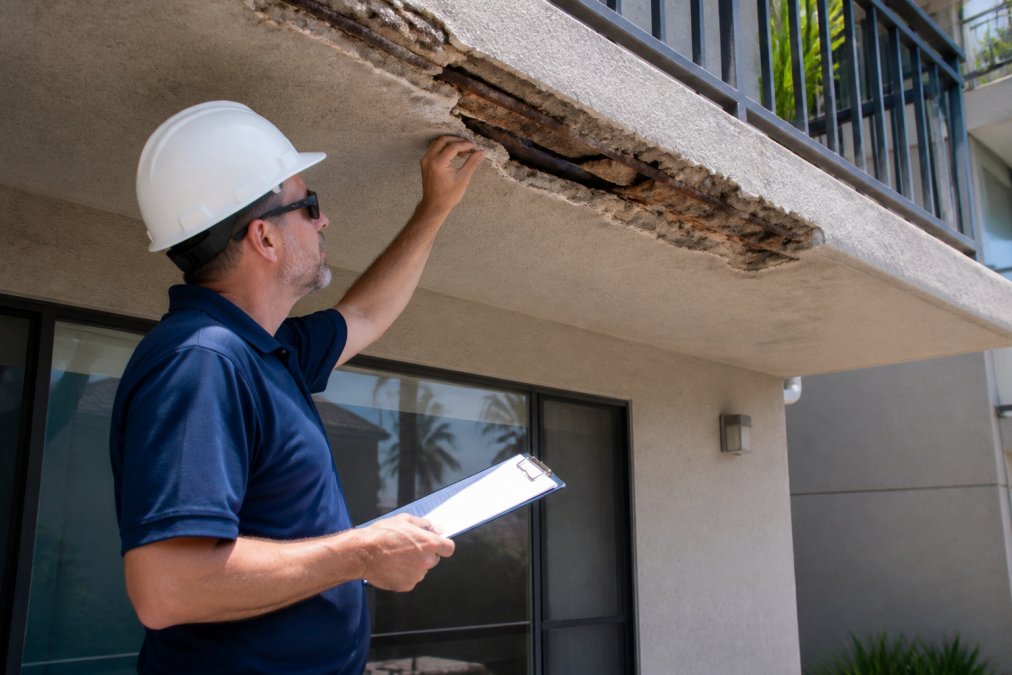
- Anchor pullout or elongation. Wedge anchors and adhesive anchors in cracked or spalled concrete lose capacity quickly. A post that rocks under hand pressure is telling you the anchor is no longer developing load.
- Fastener corrosion at baluster-to-rail connections. Stainless fasteners in a coastal environment behave very differently from galvanized or coated carbon steel. Mixed metals create galvanic corrosion at the joint.
When a Licensed Engineer Is Needed
Bring in a licensed structural engineer when any of the following is true: the anchorage is into concrete with visible spalling or exposed rebar; a post moves under hand pressure; the guard is being raised or extended beyond its original design; the building has changed occupancy or use; or the inspection is being performed to satisfy a statutory facade or balcony inspection program that requires an engineer’s signature.
Corrosion and Service-Life Considerations
Corrosion is a service-life issue, not a one-time pass/fail. Coastal salt spray, irrigation overspray, and planter runoff all shorten the interval between inspections. Where the original coating system is failing, spot repair rarely restores the intended service life; plan for recoating or replacement on a schedule tied to the exposure rather than waiting for section loss to become visible.
Balcony railing safety and code compliance letter: What It Should Contain and Who Signs It
A balcony railing safety and code compliance letter is the document that proves you inspected, and it needs to survive a challenge.
The signature matters as much as the content. The letter should be signed by the qualified inspector who performed the work, with their license or certification number listed. Our balcony safety inspection services produce documentation built to that standard.
Repair, Retrofit, or Replace: Making the Call Before a Violation Forces It
Three paths exist, and the right one depends on what failed. A height deficiency usually means a retrofit: add a rail extension, raise the guard, or replace the top assembly. Spacing violations call for new infill or re-spaced balusters. Corroded anchorage into failing concrete is a structural repair, and sometimes the honest answer is full replacement.
The decision framework we use:
| Finding | Typical Path | Urgency |
|---|---|---|
| Guard under 42 inches | Retrofit or raise | High |
| Openings over four inches | Re-space or add infill | High |
| Loose post, sound framing | Re-anchor | Medium |
| Corroded anchorage, spalling concrete | Structural repair, engineer review | Critical |
| Widespread section loss | Replace | Critical |
If you are weighing a fix on a wobbly rail, our guide on how to fix wobbly balcony railings safely covers the sequence.
Book Your Balcony Railing Inspection with Apex Balcony
The hardest part of balcony railing safety and code compliance is not the code. It is starting before a violation, a fine, or an injury forces the issue. Apex Balcony has worked with hundreds of building owners, and our licensed inspectors bring decades of combined construction and design experience to every property.
We identify early signs of structural failure and document our findings. Get started with Apex Balcony and put your balconies on a compliant footing.
Frequently Asked Questions
What is the standard height for a balcony railing?
The International Residential Code and International Building Code set a minimum guard height of 42 inches, measured vertically from the finished deck surface to the top of the guard. A handrail on a stair inside the guard can sit lower, typically 34 to 38 inches above the stair nosing. Some jurisdictions accept 36 inches for certain one- and two-family dwellings, so confirm the edition your local building department enforces before ordering materials.
What building code requirements apply to balcony railings?
A compliant guard must resist a concentrated lateral load applied at the top, keep openings small enough that a four-inch sphere cannot pass through, and be anchored to resist lateral forces. Balusters, infill panels, and posts all count toward those limits. In California, SB 326 and SB 721 add inspection obligations for multi-unit buildings on top of the model code requirements, and local amendments can tighten them further.
How can I tell if a balcony railing is unsafe?
Look for a railing that moves when you push it, rust bleeding from post bases, cracked or spalled concrete at anchor points, missing or loose balusters, and gaps wider than four inches. Water staining on the wall below the balcony often signals a hidden problem. Any movement or corrosion at the anchorage is a reason to stop using the balcony and call a licensed inspector rather than tighten a few bolts.
How often should balcony railings be inspected?
California’s SB 326 and SB 721 set periodic inspection requirements for balconies, decks, stairways, and guardrails on covered multi-unit residential buildings; confirm current intervals with the official statute text. Between formal inspections, owners and property managers should do a visual walk-through at least annually and after any earthquake, storm, or report of movement.
What gaps are allowed between balcony railing components?
The four-inch sphere rule governs most guards: a sphere four inches in diameter must not pass through any opening in the guard, including the space between balusters, between the bottom rail and the deck, and around decorative panels. Stairs are stricter at six inches between the tread and the bottom of the guard, measured on the incline. Measure at the widest point of each opening, not at the narrowest.
Who is responsible for fixing an unsafe balcony railing?
The building owner carries the legal duty, and HOA boards carry it on behalf of the association for common-area balconies. Property managers usually coordinate the work but do not absorb the liability. Owners should confirm the repair timelines that apply to their property under current California law. Put the decision and the funding approval in writing so responsibility is clear if a dispute arises later.
Do balcony railing requirements vary by building type and location?
Yes. The International Residential Code governs one- and two-family dwellings and townhouses, while the International Building Code covers most multifamily and commercial buildings. Local jurisdictions then amend those model codes, and California adds SB 326 and SB 721 inspection mandates for covered multifamily properties. The same railing detail can pass in one city and fail in the next, so check the code edition your authority having jurisdiction actually enforces.
If you have been deferring inspection because you are unsure what it will turn up, that uncertainty is the risk. Book an inspection with Apex Balcony and replace guesswork with a documented, defensible record of your property’s condition.
