
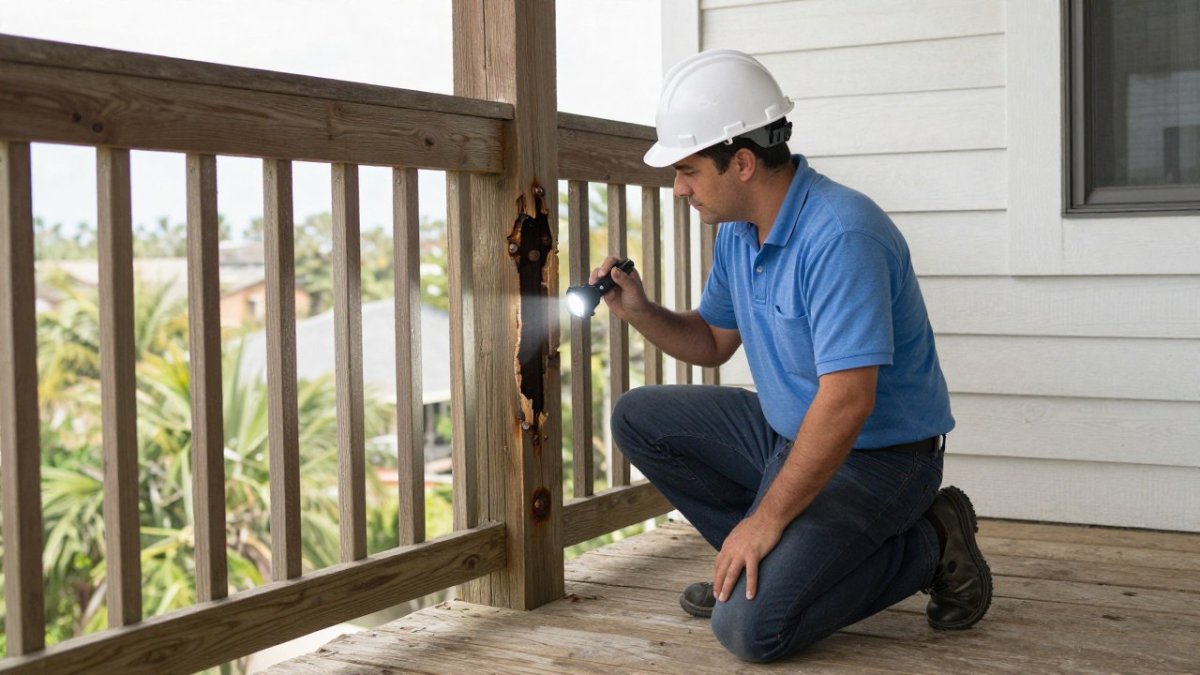
Last Updated: November 18, 2026
Quick Summary
Hidden balcony framing damage shows up as cracks or bulges in stucco near the balcony, rust streaks below railing bases, soft or spongy deck areas, sagging, and wobbly railing posts. Water entering at the ledger, flashing, or post penetrations is the usual cause, so any of these signs warrants a qualified inspection.
- Cracks along the wall-to-deck line often follow the ledger connection.
- Rust streaks below railing bases point to a failed seal at the post penetration.
- A hollow-sounding bulge in stucco often means moisture is trapped behind the finish.
- Soft spots or bounce can signal rot in the joists or beams underneath the deck.
- Do not probe soft spots with a screwdriver or knife; note the location and call an inspector.
Table of Contents
- Why Hidden Balcony Framing Damage Is So Hard to Spot
- Visual Warning Signs of Hidden Balcony Framing Damage
- Balcony Water Damage and Wood Rot Behind the Surface
- Loose Balcony Railing Warning Signs You Should Not Ignore
- How to Inspect a Balcony for Safety Without Disturbing the Structure
- California Balcony Inspection Requirements and Who Must Comply
- Scheduling a Professional Inspection Before Damage Gets Worse
- Frequently Asked Questions
Why Hidden Balcony Framing Damage Is So Hard to Spot
Hidden balcony framing damage is often invisible from the street. Water gets into the wood or steel inside the balcony structure while the exterior finish can look fine for years.
Most balconies have a wood or steel frame, a waterproof membrane, and a finish layer such as stucco, tile, or coating.
A few things make this hard for owners and boards to catch:
- Damage is concealed behind finishes and under the deck surface
- Early rot and corrosion can look like normal weathering
- Residents often report problems only after something feels wrong
Knowing the signs early gives you time to act before a repair becomes a safety issue.
Visual Warning Signs of Hidden Balcony Framing Damage
Many hidden framing problems leave visible clues, but location matters more than the clue itself. A crack near a railing post tells a different story than one along the wall line where the balcony attaches.
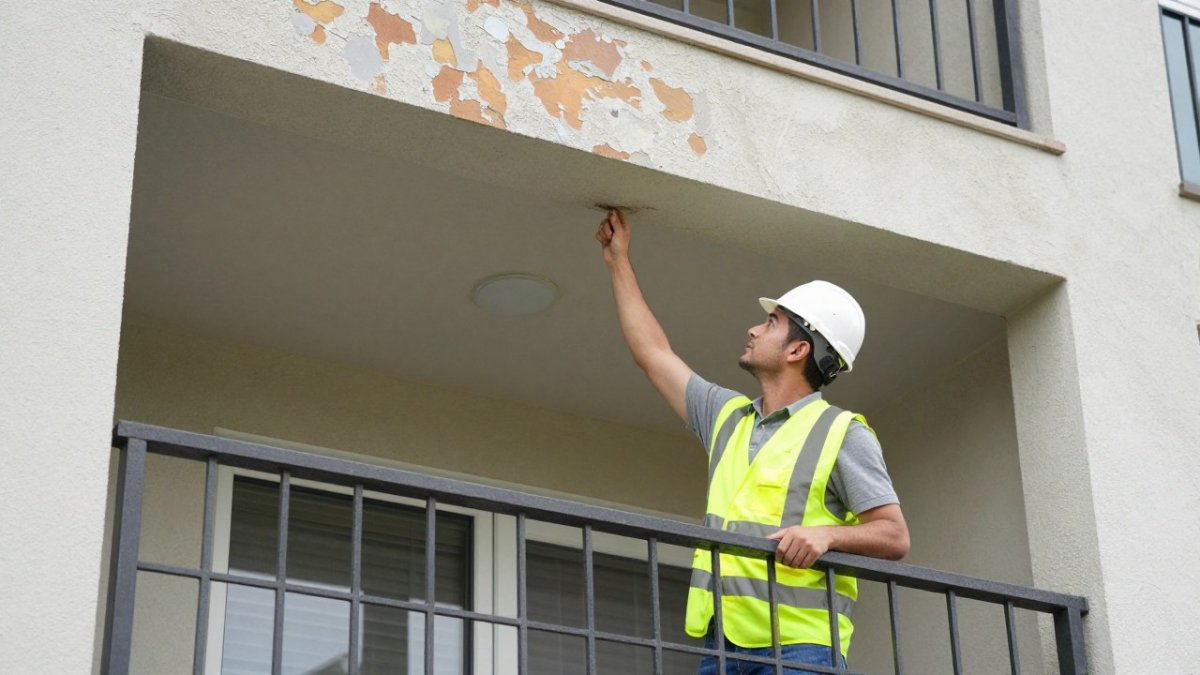
| Visible sign | Likely concealed location | Framing member most often involved |
|---|---|---|
| Crack or gap along the wall-to-deck line | Ledger connection | Ledger board, rim board, joist ends |
| Rust streaks below railing bases | Post penetrations | Railing posts, blocking, joist tops |
| Bulge or hollow sound in stucco near the edge | Rim board and joist ends | Rim board, band joist, ledger flashing |
| Sag or dip in the deck surface | Mid-span or cantilever | Joists, beams, cantilever framing |
| Soft or spongy deck area | Decking over joists | Joist tops, decking, fasteners |
| Dark staining on the underside | Water path from above | Joists, beams, subfloor, hangers |
| Leaning or wobbling railing post | Post base and blocking | Post base, blocking, deck framing |
These signs tell you where to look next. Rust near a fastener may mean water is reaching the connection. A crack along the ledger line can mean structural movement.
Stucco and Siding Clues
Stucco and siding often show hidden damage first because they sit directly over the rim board, ledger, and joist ends. Water behind the finish can cause cracking, bulging, or staining, often in straight lines along framing members or around fasteners.
Check the wall above and beside the balcony for these clues:
- Hairline cracks that widen over time
- Bulges that feel hollow when tapped
- Staining that starts at the balcony edge and runs down the wall
A bulge or hollow sound can mean moisture is trapped behind the finish. Do not poke or pry at the stucco. Note the location, take photos, and have a qualified inspector look at it.
Sagging, Bounce, and Soft Spots
Sagging and bounce are signs the framing may be losing strength. A balcony should feel firm underfoot. If the floor dips, flexes more than it used to, or feels spongy, the structure may be failing.
Watch for these signs:
- A visible dip or slope in the deck surface
- Floor boards that move, bounce, or creak under normal weight
- Soft or spongy spots on the deck surface
Soft spots and bounce often point to rot in the joists or beams underneath. Bounce in one area usually points to a single joist or short span; bounce across the whole deck can point to beam or ledger movement.
Cracks, Spalling, and Bulging Finishes
Cracks and spalling are easy to dismiss as cosmetic, but direction and location matter. A hairline crack in a field of stucco is usually not structural. A crack along the ledger line, wrapping a railing post, or following a joist is more likely to track a framing problem.
- Cracks that run horizontally along the wall-to-deck line often follow the ledger.
- Cracks that radiate from a railing post base often follow the post blocking.
- Spalled concrete or tile that has separated from the substrate can indicate movement or water behind the finish.
Rust, Corrosion, and Fastener Clues
Rust is a directional clue. Rust streaks running downward from a fastener mean water is reaching it from above. Rust around a railing base means water is entering the post penetration.
- Rust streaks below a railing base point to a failed seal at the post penetration.
- Rust on joist hangers or ledger brackets points to moisture at the connection.
- White or powdery corrosion on galvanized hardware means the coating has failed.
These signs tell you where to look next, but they cannot confirm how far damage has spread. Visual clues are a reason to call a qualified inspector, not a substitute for one.
Balcony Water Damage and Wood Rot Behind the Surface
Water is the most common cause of hidden balcony framing damage. Wood that stays wet for long periods begins to rot, and rot spreads quietly through the framing.
Water usually enters through a few common paths:
- Gaps at the ledger where the balcony attaches to the building
- Failed or missing flashing and waterproofing membranes
- Cracks in the deck surface that let water seep in
Once water is inside, it can stay trapped for months, and that constant moisture drives rot and corrosion.
Signs of water damage and rot include:
- Black or dark stains on wood or stucco near the balcony edge
- Wood that feels soft, spongy, or crumbles when pressed
- A musty smell near the balcony underside
Wood rot often starts out of sight.
A repair plan usually depends on how far the rot has spread, and that takes a qualified inspection to determine.
Loose Balcony Railing Warning Signs You Should Not Ignore
Railings are part of any balcony’s safety system. A railing that moves or pulls away from the structure can be a serious hazard, often pointing to damage in the posts, fasteners, or the surface they attach to.
Check the railing for these warning signs:
- Wobbling or movement when pushed firmly
- Posts that lean, tilt, or pull away from the deck
- Loose or missing bolts, screws, or brackets
A railing that moves should be treated as unsafe until a qualified person has checked it. Do not lean on it, climb on it, or let children play near it.
Loose railings can result from rotted wood around the base, corroded steel connections, or fasteners pulled out of weakened framing. Because a loose railing can signal weakened framing below the deck, a timber deck inspection guide can help keep the focus on checking the structure rather than just tightening the fasteners.
How to Inspect a Balcony for Safety Without Disturbing the Structure
Owners, board members, and property managers can do a basic visual check without touching the structure, but it has clear limits. This section covers what you can safely observe, what you should never probe or dismantle, how a qualified inspector assesses concealed framing, and how to triage an urgent safety condition.
What a Safe Visual Check Can and Cannot Tell You
A visual check from the ground or a stable vantage point can tell you where to look and whether a problem is changing over time. It cannot confirm whether framing is rotted, whether a ledger is pulling away, or whether a railing will hold.
What a safe check can do:
- Identify the location of cracks, stains, bulges, and rust streaks
- Compare current conditions against photos from prior months or years
- Document whether a sign is spreading or stable
What a safe check cannot do:
- Confirm rot, corrosion, or section loss inside framing
- Measure moisture content in wood or stucco
- Assess fastener embedment or ledger attachment
Step-by-Step Safe Visual Checklist
Follow these steps from the ground or a stable, safe surface. Do not climb onto a balcony you suspect is unsafe.
- Stay on the ground or on a stable, safe surface. Do not climb onto a balcony to check it.
- Look at the balcony from the street or from a neighbor’s safe vantage point.
- Check the wall and stucco above and beside the balcony for cracks, bulges, and staining.
- Look at the balcony underside for rust, peeling paint, dark spots, and water staining.
- Note any sagging or uneven lines along the deck edge.
- Check railings from a distance for leaning, gaps, or rust at the base.
- Take photos of anything that looks wrong and date them.
- Record each finding with its location, so a professional can review it.
Watch out: Do not probe soft spots with a screwdriver, awl, or knife. Probing can push through a finish that is holding back water, enlarge a small defect, and create a safety hazard where none existed. Note the location and let a qualified inspector probe where appropriate.
Where Hidden Framing Actually Lives
The keyword concerns framing, so it helps to know where concealed members sit. On a typical wood-framed balcony, the framing you cannot see includes:
- Joist ends where they bear on the ledger or rim board
- The ledger board itself, where it attaches to the building
- Rim boards and band joists at the outer edge
These are the locations where water collects and where rot and corrosion start. A crack or stain near one of them is more significant than a crack in the middle of a finish field.
How a Qualified Inspector Diagnoses Concealed Damage
A qualified inspector uses a combination of visual assessment, moisture readings, and selective access. The exact approach depends on the building type, the finish, and the reported symptoms.
- Moisture readings: A pin-type or pinless meter is used on wood, stucco, and concrete to find elevated moisture behind finishes, with readings compared across the structure to find wet zones.
- Probing where appropriate: An inspector may selectively probe wood at concealed locations, such as joist ends or post bases, to check for softness, with the owner’s knowledge.
- Borescopes: A small camera inserted through a drilled hole or existing gap can view concealed framing without major demolition.
Visual signs alone cannot confirm structural condition, which is why a diagnostic inspection matters.
Triage by Urgency: When to Restrict Access
Some conditions warrant immediate action before any inspection is scheduled. Use the following triage guide.
- Severe sagging or a visible dip that has appeared suddenly: Restrict access to the balcony and any area below it. Contact a qualified professional the same day.
- Sudden movement, a new gap at the wall, or a railing that has pulled loose: Keep people off the balcony and away from the area below. Contact a qualified professional immediately.
- Falling material, spalled concrete, or loose stucco: Cordon off the area below and contact a qualified professional.
Watch out: Do not assume a balcony is safe because it looks solid from below. A failed deck can fall without warning, and the underside often shows the first sign of a problem.
Keep a Simple Log
Keep a simple log of what you observed. Include the date, the balcony location, and what you saw. Over time, this log shows whether a problem is getting worse, which helps when you call for an inspection. A dated photo log is often the most useful document an owner or board can hand to an inspector.
California Balcony Inspection Requirements and Who Must Comply
In California, balcony safety rules are shaped by state law.
Who usually needs to pay attention to these rules?
- Homeowners associations managing multi-unit developments
- Owners of multifamily residential buildings
- Property management companies overseeing apartment complexes
For condominium and HOA buildings, the association board usually has the duty to arrange inspections and keep records.
Good record keeping matters. Keep inspection reports, repair records, and notices to residents in one place.
The California Department of Housing and Community Development and local building departments publish guidance on building safety.
Scheduling a Professional Inspection Before Damage Gets Worse
Visual checks help, but they cannot see inside the framing. A qualified professional inspection is the most reliable way to confirm whether hidden damage is present and how serious it is.
Call a qualified professional when you see any of the following:
- Sagging, bounce, or soft spots in the deck
- Cracks or bulges in stucco that connect to the balcony
- Rot, black spots, or soft wood near the balcony edge
Acting early gives you more choices. A professional can identify the source of water intrusion and estimate the extent of damage.
To schedule an inspection, book an inspection with Apex Balcony.
Frequently Asked Questions
What are the signs of structural damage in a balcony?
The most common signs are a balcony that feels soft or bouncy underfoot, visible sagging or a dip in the deck surface, cracked or bulging stucco near where the balcony attaches to the building, rust streaks or stains on metal brackets, and wood that crumbles or splinters when pressed with a screwdriver. Water stains on the ceiling below the balcony often point to moisture moving through the framing. Any of these signs warrants a professional structural evaluation, because hidden rot and corrosion can progress well beyond what is visible at the surface.
Can balcony framing rot behind stucco or siding?
Yes. When water gets past stucco cracks, failed sealant, or poorly flashed connections, it can soak into the wood framing and fasteners behind the finish without showing obvious surface damage for a long time. Fungal decay can weaken joists and ledger connections while the exterior still looks intact. This is why a visual check alone is not enough, and why a qualified inspector may need to examine concealed areas where access is safe and permitted.
Can a loose railing indicate hidden balcony damage?
A railing that moves, rocks, or pulls away from the deck can indicate that the posts, base plates, or fasteners anchoring it are corroded, rotted, or pulled from weakened framing. Loose railings are a serious safety concern because they are expected to resist people leaning or falling against them. If a railing moves, keep people off the balcony and arrange a professional inspection promptly rather than tightening it and assuming the problem is resolved.
When should a balcony be inspected by a professional?
A professional inspection is warranted when you notice sagging, soft or spongy boards, cracked or bulging stucco at the balcony connection, rusted fasteners, loose railings, or water stains below the balcony. Multi-unit properties in California also have inspection obligations under state balcony laws, so owners and HOA boards should not wait for visible failure. If you are unsure whether a condition is serious, treat it as urgent until a qualified person has evaluated it.
