
Last Updated: October 27, 2026
Quick Summary
Preventative maintenance for EEE compliance requires proving that electrical equipment has been inspected, tested, and maintained on a documented schedule. You need a written checklist, a risk-based schedule, and records that trace each task from requirement to verified closure.
- A practical checklist covers visual inspection, thermal scanning, cleaning, testing, and functional testing of backup systems.
- Score each asset on failure consequence, likelihood, detectability, and regulatory or insurer requirement to set intervals.
- Records must show measured readings, not pass/fail checkmarks, plus competence, asset identity, and closure evidence.
- Rescore the portfolio at least annually and after any failure, near-miss, major renovation, or occupancy change.
- Only qualified workers open panels, and lockout and tagout procedures apply to every task.
Table of Contents
- What EEE Compliance Actually Means for Your Building
- The Electrical Preventive Maintenance Checklist Every Facility Needs
- Building an Electrical Preventive Maintenance Schedule Around Risk
- Electrical Maintenance Documentation That Holds Up in an Audit
- Electrical Preventive Maintenance Best Practices for Safety and Continuity
- Common Mistakes That Undermine Preventative Maintenance for EEE Compliance
- Who Should Perform the Work and How to Vet Them
- Scheduling Your First Compliance Inspection
- Frequently Asked Questions
What EEE Compliance Actually Means for Your Building
EEE compliance means proving that the electrical equipment in your building has been inspected, tested, and maintained on a documented schedule. Understanding preventative maintenance vs reactive repairs helps explain why a proactive program beats fixing failures after they happen. The term covers electrical systems and equipment, and for property owners it boils down to one thing: can you show a paper trail that your building’s electrical infrastructure is safe?
Which Electrical Equipment Falls Under the Scope
Most multifamily buildings carry more electrical equipment than boards realize. The scope usually includes:
- Service panels and switchgear that distribute power through the building
- Circuit breakers and protective devices that stop overloads
- Wiring and electrical connections in common areas and units
- Low-voltage systems such as fire alarms, emergency lighting, and door access
- Motors and controls on elevators, pumps, and HVAC equipment
Any piece of electrical equipment that could fail and cause a hazard belongs on your list.
The Regulations and Standards That Apply
No single federal rule governs building electrical maintenance. Instead, several layers apply at once:
- Local electrical codes, which typically adopt the National Electrical Code published by NFPA
- OSHA electrical safety standards for buildings with employees on site
- State and local inspection rules for rental and multifamily property
- Insurer requirements written into your policy
Check with your local building department to confirm which edition of the code your area enforces. Rules vary by jurisdiction, and the edition matters.
The Electrical Preventive Maintenance Checklist Every Facility Needs
An electrical preventive maintenance checklist is a written list of every inspection, test, and cleaning task your team performs, with a date and initials beside each one. The checklist is the backbone of your whole program.
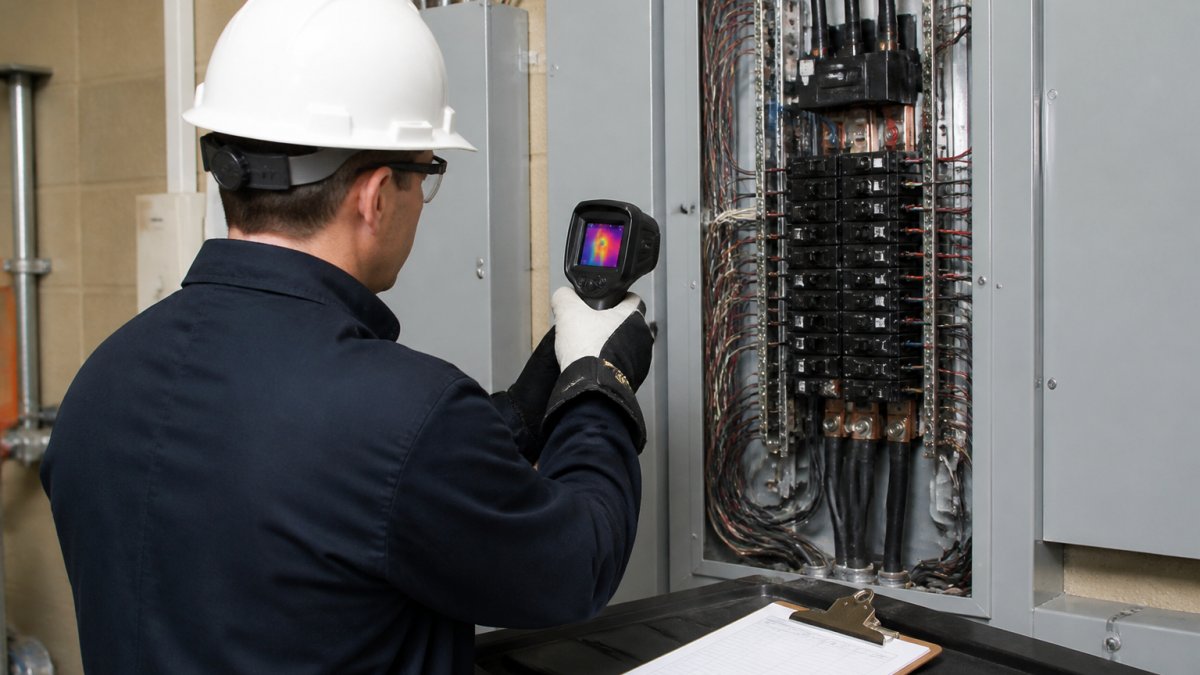
A practical checklist covers five task groups:
- Visual inspection of panels, wiring, and connections for damage or corrosion
- Thermal scanning to catch overheating joints before they fail
- Cleaning of dust and debris from panels and equipment
- Testing of breakers, protective devices, and ground-fault protection
- Functional testing of emergency lighting and backup systems
Build the checklist around the equipment you actually have. A generic template misses the panels that matter most.
Building an Electrical Preventive Maintenance Schedule Around Risk
An electrical preventive maintenance schedule sets how often each task happens and, just as importantly, why. The defensible way to build one is to rank equipment by risk using explicit inputs, then document the reasoning so an auditor can follow it.
The Four Inputs That Drive Intervals
A workable risk score uses four inputs, each scored on a simple scale:
- Failure consequence, life safety, property damage, business interruption, or nuisance
- Likelihood of failure, age, duty cycle, environment (dust, moisture, heat), and known failure history
- Detectability, whether a failure would be caught before it causes harm
- Regulatory or insurer requirement, any mandated interval that overrides your own judgment
Score each asset, sort the list, and let the ranking set frequency. For practical ways to streamline maintenance scheduling across a property, see this guide. High-consequence, low-detectability assets get the shortest intervals. Low-consequence assets with strong redundancy can stretch.
A Worked Example
Consider three assets in the same building:
| Asset | Consequence | Likelihood | Detectability | Resulting interval |
|---|---|---|---|---|
| Main service switchgear | High (whole-building outage, arc-flash risk) | Medium | Low | Annual thermal scan and torque check; quarterly visual |
| Emergency generator and ATS | High (life safety during outage) | Medium | Medium | Monthly exercise; annual load test |
| Common-area receptacle circuits | Low | Low | High | Visual inspection on a multi-year cycle |
The intervals above are illustrative. Actual intervals depend on manufacturer guidance, the edition of the applicable code your jurisdiction enforces, and any insurer conditions in your policy. Document the source for each interval so the schedule is defensible.
Fixed, Risk-Based, and Hybrid Cycles
| Approach | How It Works | Best For | Main Weakness |
|---|---|---|---|
| Fixed calendar | Same tasks on the same dates yearly | Small buildings with simple systems | Wastes time on low-risk gear; misses high-risk drift |
| Risk-based | Frequency set by scored failure impact | Larger or older buildings | Requires an initial risk review and periodic rescoring |
| Hybrid | Calendar baseline plus extra checks on critical gear | Most multifamily properties | Needs discipline to maintain and document |
Defending an Interval to an Auditor
An interval is defensible when you can show three things: the input data used to set it, the standard or manufacturer guidance it aligns with, and the review date when it will be reassessed. A schedule that says “annual” with no rationale is a schedule an auditor can challenge. A schedule that says “annual per manufacturer guidance and insurer condition, reassessed each January” is one they generally cannot.
Rescore the portfolio at least annually and after any significant event, a failure, a near-miss, a major renovation, or a change in occupancy. Intervals that never change are a sign the risk review is not actually happening. Dynamic scheduling ensures that your facility remains aligned with evolving electronic waste compliance requirements as operational conditions shift over time.
Electrical Maintenance Documentation That Holds Up in an Audit
Electrical maintenance documentation is the evidence file that proves the work happened, who did it, what they found, and how each defect was resolved. An auditor does not evaluate your intentions.
Most programs fail audits not because work was skipped but because the record cannot answer three questions: Was this task required? Was it performed by a competent person? Was the result acted on?
What an Auditor Actually Tests
A practical evidence file answers these questions for every asset:
- Requirement traceability, which code edition, insurer condition, or internal procedure required the task
- Competence, the name, license or certification number, and employer of the person who performed the work
- Asset identity, a unique tag or location that matches the physical equipment, not just a panel name
- Measured results, actual readings (insulation resistance, torque values, trip times, thermal deltas) rather than pass/fail checkmarks
- Defect classification, severity, owner, target date, and interim controls
- Closure evidence, the repair performed, the retest result, the approver, and the return-to-service date
A record missing any one of these links is a finding waiting to happen. A log with blank result fields or signatures added days later is worse than no log, because it suggests the work was penciled in after the fact.
Retention and Format
Retention periods are set by your insurer, your lease obligations, and any applicable local rules, they are not uniform.
Store records in a system that timestamps entries, prevents silent edits, and preserves the original file. If you are weighing options, these property management software for compliance tracking can help. Scanned paper logs are acceptable if they are legible and indexed by asset. Spreadsheets are acceptable only if access is controlled and version history is retained.
A record that cannot be produced within the auditor’s requested window is treated as missing. Test your own retrieval process annually by asking for a random asset’s full history and timing how long it takes to assemble.
Building the Chain From Finding to Closure
Each defect should generate a single record that travels with it until verified repair:
- Open, date, asset, description, severity, discoverer
- Assign, owner, target completion date, interim control (e.g., restricted access, reduced load)
- Repair, work performed, parts, technician, date
- Verify, retest or reinspection result, approver, return-to-service date
- Close, final sign-off and link to the original finding
When a defect is deferred, the record must show the risk acceptance decision and who made it. Auditors treat undocumented deferrals as unaddressed hazards.
Electrical Preventive Maintenance Best Practices for Safety and Continuity
Electrical preventive maintenance best practices come down to three priorities: keep people safe, keep power on, and keep proof.
Start with safety. Only qualified workers open panels. Lockout and tagout procedures apply to every task. Personal protective equipment is not optional.
Next, protect continuity. Unplanned downtime costs money and disrupts residents.
Finally, keep proof. File every record the same day the work happens.
A few habits separate strong programs from weak ones:
- Photograph equipment before and after cleaning
- Log readings, not just pass or fail
- Review open issues at every board meeting
- Close corrective actions with a date and a name
Common Mistakes That Undermine Preventative Maintenance for EEE Compliance
The biggest mistake is treating maintenance as a box to check. Understanding why property management compliance is critical for safety shows how these failures put people at risk. Programs fail when the paperwork outruns the actual work. Auditors can tell the difference.
- Skipping low-voltage systems because they seem minor
- Cleaning without inspecting so corrosion goes unnoticed
- Ignoring small faults until they become equipment failure
- No corrective-action tracking, so the same issue reappears yearly
- Using unqualified staff for tasks that require a licensed electrician
Who Should Perform the Work and How to Vet Them
- Current state electrical license, verified on the state board site
- Liability insurance and workers’ compensation certificates on file
- Experience with multifamily or commercial buildings
- Sample reports that show readings, not just checkmarks
- Written scope that names each task and each piece of equipment
- Clear process for reporting urgent hazards the same day
Scheduling Your First Compliance Inspection
- List every piece of electrical equipment on the property
- Assign a risk level to each item
- Draft your checklist and schedule
- Vet and select a qualified contractor
- Run the first inspection and photograph everything
- File records and open corrective actions
- Set review dates for the next cycle
At Apex Balcony, we help property owners and HOA boards with licensed inspectors, decades of combined construction and design experience, and comprehensive inspections of balconies, decks, stairways, and elevated exterior elements. Our reports give you a clear path to necessary repairs. Get started with Apex Balcony and book an inspection.
Frequently Asked Questions
What is electrical preventive maintenance?
Electrical preventive maintenance is the scheduled inspection, cleaning, testing, and servicing of electrical systems before faults develop. It covers panels, switchgear, circuit breakers, wiring, connections, and protective devices. The goal is to catch wear, corrosion, loose connections, and overheating early, before they cause equipment failure, unplanned downtime, or a safety hazard. For EEE compliance, the work must also be documented so you can show a regulator, insurer, or auditor that inspections happened on schedule and defects were corrected.
How often should electrical equipment be inspected and maintained?
Inspection frequency should follow a risk assessment rather than a single fixed rule. High-load equipment, older panels, and gear in damp or dusty environments typically need more frequent checks, while low-demand equipment can go longer between services. Many maintenance plans combine monthly visual inspections with annual functional testing and cleaning. Document the reasoning behind each interval so an auditor can see the schedule was set deliberately, not guessed.
What should an electrical preventive maintenance checklist include?
A working checklist covers visual inspection of panels and wiring, thermal scanning for overheating, torque checks on electrical connections, cleaning of components, testing of circuit breakers and protective devices, and verification of labeling and grounding. Each item should have a pass/fail result and space for notes on defects found. Pair the checklist with a corrective-action log so any issue flagged during inspection is tracked to closure, which is what turns a checklist into evidence of EEE compliance.
How do you document electrical maintenance for compliance?
Keep a record for every inspection that includes the date, the equipment inspected, the tasks performed, the technician’s name and qualifications, results, and any defects found with the corrective action taken. Store records centrally and retain them for the period your insurer or regulator requires. Audit-ready documentation means someone unfamiliar with the building can pull a file and confirm the maintenance program ran as planned, which is the standard EEE compliance reviews apply.
