How to Update Reserve Study for SB 326: Step-by-Step Guide
How to update reserve study for sb 326: Learn how to update your reserve study for SB 326 compliance. Step-by-step guide for HOA boards managing balcony.
Table of Contents
- Understanding SB 326 Requirements and Reserve Study Updates
- Step 1: Conduct Your Structural Inspection of Exterior Elevated Elements
- Step 2: Create Your SB 326 Compliance Checklist for HOAs
- Step 3: Document Findings and Calculate Replacement Costs
- Step 4: Understand the Cost of SB 326 Balcony Inspections and Budget Impact
- Step 5: Integrate Inspection Findings into Your Reserve Study Funding Plan
- Step 6: How to Fund EEE Repairs in Reserve Studies and Handle Assessment Spikes
- Maintaining Compliance: Documentation, Audit Trails, and Board Fiduciary Duty
Last Updated: August 6, 2026
Understanding SB 326 Requirements and Reserve Study Updates
California’s SB 326 law requires residential buildings with three or more units to conduct inspections of exterior elevated elements (balconies, decks, stairs, and similar structures) and integrate those findings into reserve studies. The core challenge is coordinating physical inspections with financial planning to protect both residents and the building’s long-term viability.
The relationship between balcony inspections and reserve studies is direct and mandatory. Your reserve study must reflect the actual condition of elevated exterior elements, and your funding plan must account for identified repairs. Boards that fail to integrate inspection findings face liability exposure, special assessments, and potential legal consequences.
The real work isn’t the inspection itself, it’s translating findings into a realistic funding strategy that doesn’t bankrupt your reserve fund or trigger unexpected assessment spikes.
Step 1: Conduct Your Structural Inspection of Exterior Elevated Elements
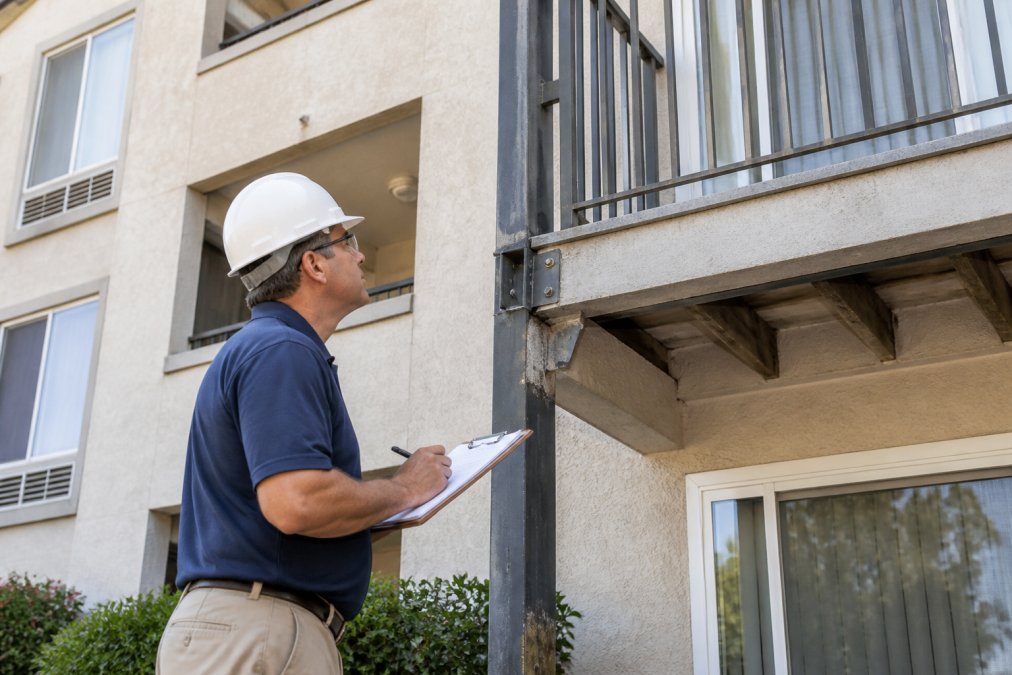
Before updating a reserve study for SB 326, you need current structural inspection data. Hire a qualified reserve professional or licensed inspector to examine all balconies, decks, stairs, and other elevated exterior elements. The inspection identifies deferred maintenance, structural defects, and remaining useful life estimates for each component.
A Level I reserve study inspection focuses on visual assessment without destructive testing. The inspector documents railings, connections, decking surfaces, ledgers, and structural supports, looking for rot, corrosion, settlement, or material failure that could compromise safety.
The inspection report becomes the foundation for your reserve study update. Without accurate inspection data, your reserve calculations are guesses. With it, you have evidence to justify funding decisions and defend them if audited.
Common findings in California multi-unit buildings include ledger board separation, deck post deterioration, railing code violations, and water intrusion damage. The question isn’t whether your building has deferred maintenance, it’s how much and how urgently repairs are needed.
Schedule inspections during dry weather when inspectors can safely access all areas. Plan for the inspection to take 1-2 days depending on building size, and budget time for the inspector to access interior walls if ledger board assessment is needed.
Step 2: Create Your SB 326 Compliance Checklist for HOAs
A structured checklist ensures you don’t miss critical compliance steps. Your SB 326 compliance checklist for HOAs should cover inspection scheduling, documentation requirements, reserve study integration, and board communication timelines.
Start with a timeline. Buildings constructed before January 1, 2018 had until January 1, 2026 to complete their first triennial reserve study with inspection findings integrated. Know your building’s deadline, missing it creates legal exposure.
Document inspection scope by specifying which exterior elevated elements must be inspected: all balconies, decks, exterior stairs, walkways at height, and any other elements that meet the definition.
Establish documentation requirements: inspection report, photographs, condition assessments for each component, remaining useful life estimates, and replacement cost projections. These documents become part of your official reserve study and must be retained for audit purposes.
Plan reserve study integration so inspection findings are reflected in your reserve component list, funding plan, and cash flow analysis.
Set board communication deadlines so your board has time to review findings, discuss funding implications, and present options to residents before finalizing the reserve study.
| Compliance Task | Timeline | Responsibility | Documentation |
|---|---|---|---|
| Schedule inspection | 6-12 months before deadline | Property manager | Inspection contract |
| Complete inspection | Per contract terms | Licensed inspector | Inspection report with photos |
| Obtain cost estimates | Within 30 days of inspection | Property manager/contractor | Repair quotes and specifications |
| Update reserve study | Within 60 days of inspection | Reserve professional | Revised reserve study document |
| Board review and approval | Before resident disclosure | Board | Board meeting minutes |
| Resident disclosure | Per state law | Property manager | Delivery confirmation |
Step 3: Document Findings and Calculate Replacement Costs
Once the inspection is complete, documentation becomes critical. Every finding must be recorded with photographs, condition descriptions, and cost projections to create an audit trail that protects your board.
A quality inspection report includes photographs of each structure from multiple angles, written descriptions of condition, identification of specific defects, and recommendations for repair or replacement. Reference building components by location so findings are traceable to specific areas.
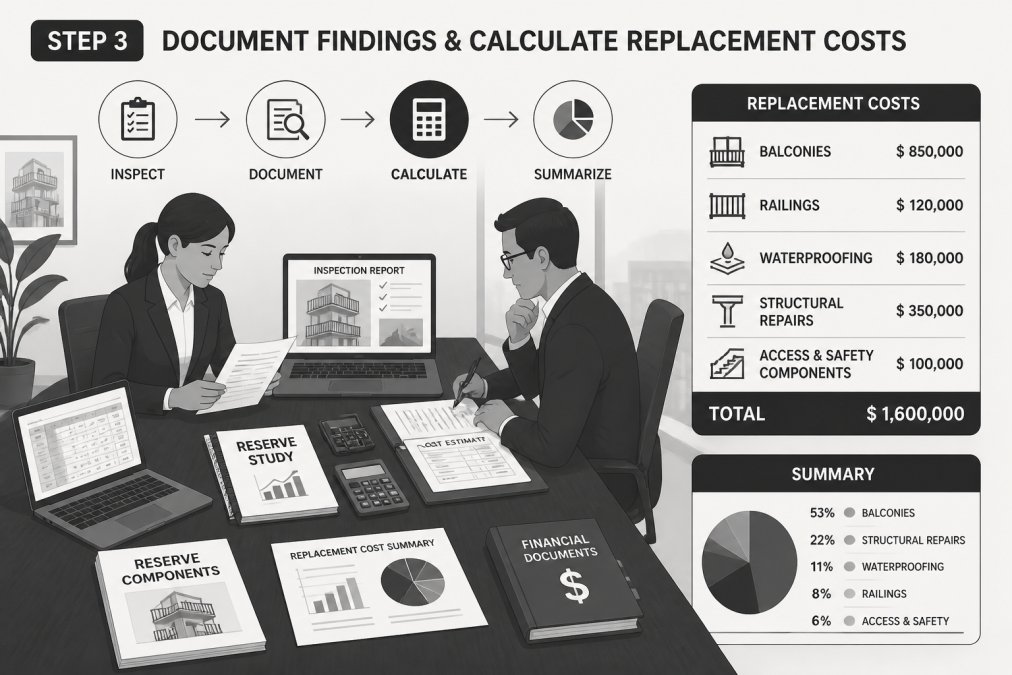
Obtain repair cost estimates from contractors specializing in the needed work. Get multiple quotes to establish realistic pricing. Calculate replacement costs for entire components, not just repairs. If a balcony deck shows significant deterioration, the reserve study should reflect the cost to replace the entire deck, not just patch it.
Document the useful life and remaining useful life for each component. A wood deck might have a 20-year useful life but only 5 years remaining if it’s 15 years old. These estimates drive your funding timeline.
Create a component inventory with condition ratings using a standardized scale: excellent, good, fair, poor, or failed. This inventory becomes part of your official reserve study documentation.
Step 4: Understand the Cost of SB 326 Balcony Inspections and Budget Impact
Inspection costs vary based on building size, complexity, and accessibility. Smaller buildings (12-25 units) with straightforward layouts generally cost less than large complexes with multiple buildings or rooftop decks.
What many boards underestimate is the downstream cost. The inspection itself is one expense. The real budget impact comes from repairs and replacements the inspection identifies. A thorough inspection often reveals deferred maintenance, water damage, structural deterioration, and code violations that drive reserve study updates increasing funding requirements.
If your reserve study was previously underfunded, integrating inspection findings often reveals a significant shortfall. Your reserve fund might have $500,000 but need $1.2 million to address identified repairs over the next 10 years. This gap must be addressed through increased reserves, special assessments, or extended funding timelines.
Boards that delay inspections hoping to avoid bad news often face worse outcomes. Deferred maintenance compounds. A balcony problem costing $50,000 to fix today might cost $150,000 if water damage spreads for three more years. Early detection saves money long-term, even if it increases short-term funding requirements.
Plan for the inspection cost as a separate line item, but budget for the repair costs that follow.
Step 5: Integrate Inspection Findings into Your Reserve Study Funding Plan
Integrating inspection findings into your reserve study funding plan means updating three critical elements: the component list, the funding analysis, and the cash flow projections.
Update your reserve component list by adding new components the inspection identified and revising condition ratings for existing components based on findings. If balcony railings were rated "good" but the inspection shows code violations and deterioration, update the rating to "poor" and adjust remaining useful life downward.
Revise your percent funded calculation. This metric shows what percentage of the reserve fund you need to meet future obligations. If your reserve study previously showed 70% funding but inspection findings increase the total reserve need, your percent funded drops, signaling to residents and auditors whether your funding plan is adequate.
Update your cash flow analysis to show when major expenses will occur and how they’ll be funded. If inspection identifies that three buildings need deck replacement within five years, your cash flow projection must show those expenses and the funding source.
The funding plan update is where board fiduciary duty becomes concrete. You must propose a realistic funding strategy that addresses identified defects. Options include increasing monthly reserves, implementing special assessments, extending repair timelines, or combinations thereof. Each option has trade-offs that must be documented.
Many boards propose funding plans that don’t fully address identified needs, creating liability. If the reserve study identifies $1.2 million in needed repairs but the funding plan only addresses $800,000, the board is knowingly underfunding, violating fiduciary duty.
Step 6: How to Fund EEE Repairs in Reserve Studies and Handle Assessment Spikes
Funding exterior elevated element repairs creates tension between protecting residents and maintaining affordability.
The most common funding strategy is increased monthly reserves. If your building currently collects $150 per unit monthly for reserves, the updated reserve study might recommend $220 per unit. This spreads the cost over time and avoids a single large special assessment.
Special assessments create immediate impact but address funding shortfalls faster. A $5,000 per unit special assessment for a 30-unit building raises $150,000 immediately. The challenge is handling assessment spikes without triggering resident resistance. Phase assessments over multiple years: instead of a single $5,000 assessment, implement $2,000 in year one and $3,000 in year two.
Some boards use a hybrid approach: increase monthly reserves modestly and implement a smaller special assessment for urgent repairs.
The key to managing assessment spikes is transparency and advance notice. Residents who understand why assessments are necessary and see the inspection report backing the decision are more likely to accept increases.
Another funding option is extending repair timelines. If inspection identifies deferred maintenance but nothing is immediately dangerous, the board might extend the timeline from three years to seven years, reducing annual funding requirements while documenting that extended timelines don’t create safety risks.
Maintaining Compliance: Documentation, Audit Trails, and Board Fiduciary Duty
Compliance doesn’t end when the reserve study is updated. Ongoing documentation and audit trails protect the board and demonstrate that fiduciary duties were fulfilled.
Maintain a complete file of all inspection reports, contractor quotes, board meeting minutes discussing reserve findings, and correspondence with residents about reserve funding. Board minutes should document the discussion of inspection findings, options considered, and reasoning for choices made.
The reserve professional should provide an annual update to the reserve study even in non-triennial years. This keeps the document current and shows that the board is actively monitoring reserve adequacy.
Fiduciary duty requires that boards act in the best interest of the community, not individual residents or board members. A board that underfunds reserves to avoid resident opposition breaches fiduciary duty. A board that makes decisions transparently, with documentation, and based on professional advice fulfills its duties.
The consequences of non-compliance are real. Boards that fail to conduct required inspections, fail to integrate findings into reserve studies, or fail to disclose reserve information face liability. Residents can sue for breach of fiduciary duty. Buildings can be placed in receivership if governance failures are severe.
How to update reserve study for SB 326 ultimately means creating a process that coordinates inspection findings with financial planning, documents decisions thoroughly, and maintains transparency with residents. This is protection for the building, the residents, and the board members themselves.
Managing SB 326 compliance creates real challenges for boards managing aging buildings with deferred maintenance. The inspection process identifies problems that must be addressed, and the reserve study update translates those problems into a funding strategy. Apex Balcony’s licensed inspectors help building owners navigate this process by providing comprehensive inspection reports that clearly document conditions and support realistic reserve funding decisions. If your building needs an inspection to meet SB 326 requirements or update an existing reserve study, book an inspection with Apex Balcony and get the documentation your board needs to make confident decisions.
Frequently Asked Questions
Does SB 326 require a reserve study update?
Yes. SB 326 mandates that HOAs update their reserve studies to include exterior elevated elements (balconies, decks, stairs) and their structural condition. The triennial reserve study must reflect current replacement costs and remaining useful life of these components. Annual budget reports must also address any deferred maintenance identified during inspections, ensuring your funding plan accounts for repairs and compliance costs.
What is included in an SB 326 compliance checklist for HOAs?
Your SB 326 compliance checklist must verify that your reserve study identifies all exterior elevated elements, documents their condition from visual inspection, lists replacement costs and useful life, shows percent funded for each component, includes a cash flow analysis for repairs, and establishes a maintenance schedule. You should also confirm the reserve professional consulted inspection reports, the board reviewed fiduciary duty obligations, and you have documentation of all inspection findings and reserve funding decisions for audit purposes.
How often must an HOA perform a balcony inspection under SB 326?
SB 326 requires a Level I visual inspection at least once every three years for buildings with three or more units. However, if an inspection identifies defects or deferred maintenance, the statute may require a more detailed Level II structural inspection. Your reserve study must be updated triennial, with annual budget reports addressing any new findings. Between inspections, maintain detailed records of all repairs and maintenance to support your reserve funding plan and demonstrate ongoing compliance.
What happens if we don't update our reserve study for SB 326?
Failure to comply with SB 326 exposes your HOA to significant liability. The Davis-Stirling Act requires boards to fulfill fiduciary duties by maintaining adequate reserves for structural safety. Non-compliance can result in special assessments, litigation from residents, regulatory penalties, and personal liability for board members. If a balcony failure occurs and inspections were not documented or reserves were inadequate, your HOA faces catastrophic liability. Updating your reserve study demonstrates good faith compliance and protects residents, assets, and the board.