Why Balcony Inspections Are Mandatory in California: 2026 Guide
Why balcony inspections are mandatory in California: Balcony inspections are mandatory in California under SB 721 and SB 326. Learn why, who must comply.
Table of Contents
- Why Balcony Inspections Are Mandatory in California: The Legal Foundation
- SB 721 vs SB 326 California: Understanding Which Law Applies to Your Property
- Exterior Elevated Elements (EEEs) and Mandatory Inspection Scope
- Balcony Inspection Checklist California: What Inspectors Evaluate
- Inspection Deadlines and Recurring Compliance Requirements
- Cost of Balcony Inspection California and Long-Term Financial Planning
- Consequences of Non-Compliance California Balcony Inspection: Fines, Liability, and Insurance
- Building Compliance for Smaller Properties and Self-Managed HOAs
Last Updated: July 22, 2026
Why Balcony Inspections Are Mandatory in California: The Legal Foundation
In 2015, a balcony collapse in Berkeley killed six people, exposing a critical gap in California’s regulation of elevated exterior structures. That tragedy prompted two landmark laws, SB 721 and SB 326, requiring property owners to inspect, document, and maintain balconies, decks, and other elevated elements. California’s balcony inspection laws are enforceable legal requirements with real consequences: substantial fines, potential criminal liability, and voided insurance coverage. These laws exist because balconies fail silently, water intrusion, dry rot, and corrosion damage load-bearing components invisibly for years until catastrophic failure occurs.
The Berkeley Balcony Collapse: The Catalyst for SB 721 and SB 326
On June 16, 2015, a wooden balcony on the fourth floor of a Berkeley apartment building collapsed during a birthday party, killing six people and injuring seven. Investigation revealed the balcony’s wood-framed structure had been rotting for years, invisible to residents and landlords. Water had penetrated the waterproofing system, and no inspection had ever been conducted. Within months, legislators introduced bills to mandate regular inspections. SB 721 passed in 2016, followed by SB 326 in 2018. A second tragedy, the Malibu balcony collapse in May 2021, reinforced the urgency.
How These Laws Protect Residents and Property Owners
Mandatory inspections create a documented record of structural condition. If an inspection is conducted, documented, and repairs are made in good faith, a property owner has legal protection. If an inspection is never conducted or findings are ignored, the property owner has no defense. Courts view non-compliance as gross negligence. Inspections also identify problems early, when repair costs are manageable. A balcony with early-stage dry rot caught during inspection might cost $15,000 to repair. The same balcony left unchecked for five years could require complete reconstruction at $80,000 or more.
SB 721 vs SB 326 California: Understanding Which Law Applies to Your Property
Determining which law governs your building is the first critical step in compliance. SB 721 and SB 326 target different property types, have different inspection timelines, and impose different requirements.
SB 721: Multifamily Rental Properties and Condominium Associations
SB 721 applies to multifamily residential rental buildings with five or more units constructed before January 1, 2008. The law requires a visual inspection of all exterior elevated elements, balconies, decks, walkways, stairways, and landings, by January 1, 2025. After the initial inspection, SB 721 requires recurring inspections every six years. Documentation must be thorough and filed with the local building department. If defects are found, the property owner must notify residents in writing and provide a repair timeline.
SB 326: HOAs and Common Interest Developments
SB 326 applies to common interest developments, HOAs, condominiums, and planned communities, focusing on common area balconies and elevated elements. The initial inspection deadline was January 1, 2025, for buildings constructed before January 1, 2008. Recurring inspections are required every six years. A critical difference: SB 326 requires the HOA to reserve funds for repairs. If the inspection identifies structural defects, the HOA cannot defer repairs indefinitely.
Determining Which Law Governs Your Building
Is the building a rental property (landlord owns units, tenants rent)? If yes, SB 721 applies.
Is the building a common interest development (HOA, condo, planned community)? If yes, SB 326 applies.
Does the building have five or more residential units? Both laws apply only to multifamily properties. Single-family homes and duplexes are exempt.
When was the building constructed? Both laws apply to buildings constructed before January 1, 2008.
| Building Type | Applicable Law | Initial Deadline | Recurring Frequency | Responsible Party |
|---|---|---|---|---|
| Multifamily rental (5+ units) | SB 721 | Jan 1, 2025 | Every 6 years | Building owner/property manager |
| Condo/HOA common areas | SB 326 | Jan 1, 2025 | Every 6 years | HOA board |
| Single-family/duplex | Neither | N/A | N/A | Local code may apply |
| Buildings constructed after 2008 | SB 721 or SB 326 | Extended timeline | Every 6 years | Owner/HOA |
If your building has passed the initial deadline without an inspection, you are out of compliance. Code enforcement can issue citations, and fines accumulate rapidly.
Exterior Elevated Elements (EEEs) and Mandatory Inspection Scope
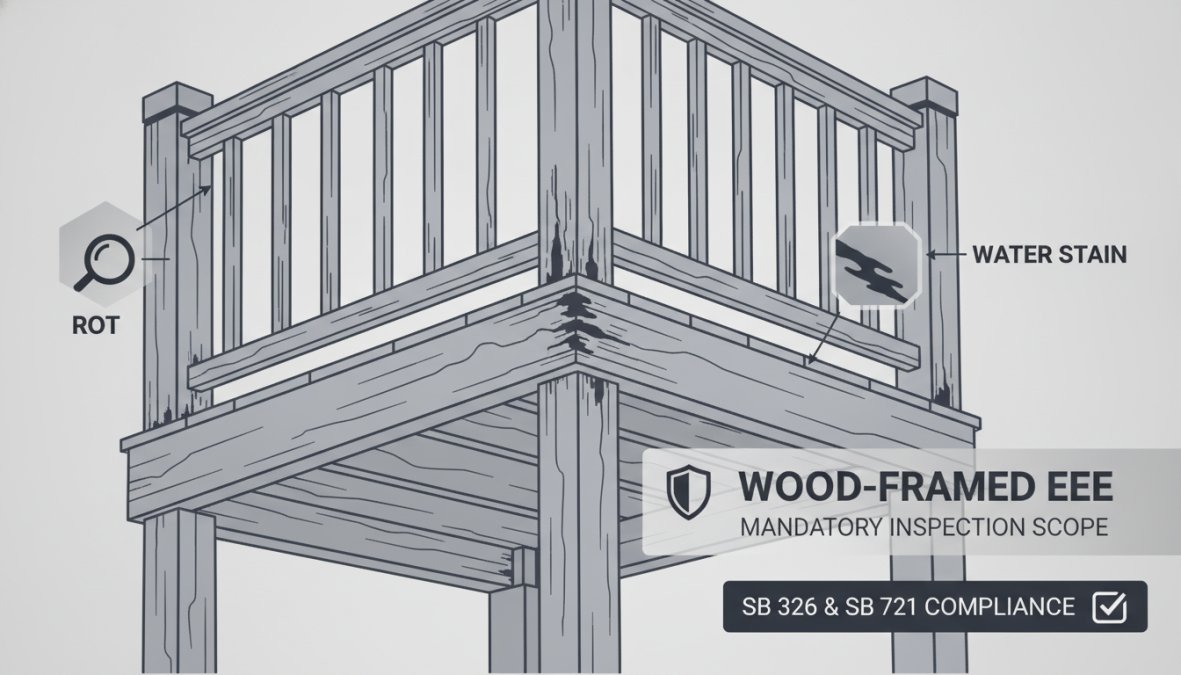
Exterior elevated elements (EEEs) include balconies, decks, patios, porches, stairs, landings, and walkways attached to residential buildings and elevated above ground level. They also include railings, guards, and safety barriers. EEEs include not just visible surfaces but also structural components hidden behind walls and finishes, the ledger board, joist connections, fasteners, and support structure. Waterproofing systems, membranes, sealants, flashing, and drainage, are also part of the EEE definition.
Structural Integrity and Common Defects: Dry Rot, Corrosion, and Water Intrusion
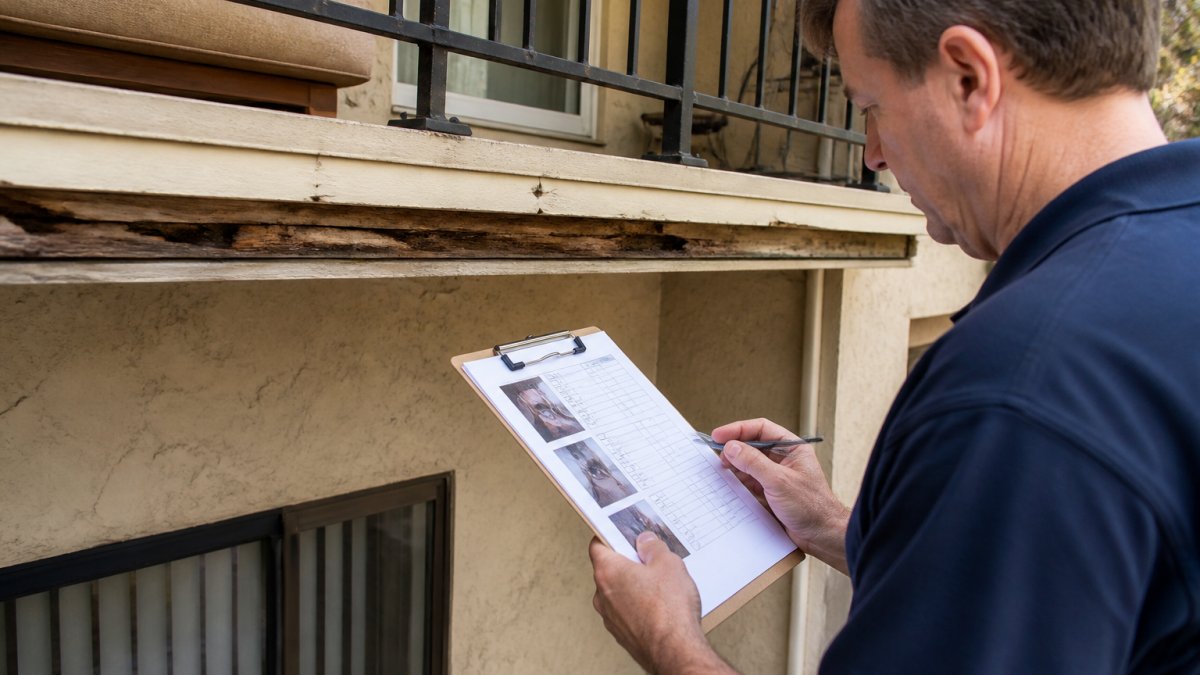
Dry rot is the silent killer of wooden balconies in California. The fungus thrives in wood that is consistently damp but not saturated. By the time visual signs appear, structural capacity may already be severely compromised. Corrosion of metal components is equally insidious. Steel fasteners and structural connections corrode when exposed to moisture and salt air. A connection rated for 10,000 pounds of load-bearing capacity might retain only 40% of that capacity after years of corrosion.
Water intrusion is the root cause of both dry rot and corrosion. Inspection protocols require assessment of waterproofing membranes, sealant integrity, flashing condition, and drainage systems. A failed sealant joint or flashing gap that is only one-quarter inch wide can allow enough water penetration to trigger structural failure within five to ten years.
Balcony Inspection Checklist California: What Inspectors Evaluate
Visual Inspection vs. Destructive Testing: Methodology and Standards
A visual inspection is the foundation of every balcony assessment. The inspector examines visible surfaces, checks sealants and flashing, looks for signs of water staining or discoloration, and assesses railings, fasteners, and attachment points. Destructive testing involves opening finished surfaces to inspect hidden components, cutting drywall to examine the ledger board attachment, or removing decking to inspect joist connections. Destructive testing is more expensive but provides definitive information about structural condition.
The inspection report documents findings using a standardized format. Defects are categorized as "immediate threat to public safety" (requiring urgent repair), "significant structural defect" (requiring repair within a specified timeframe), or "minor defect" (requiring repair but not urgent).
Licensed Professionals: Who Can Perform Inspections
California law specifies that the inspector must be a licensed architect, licensed engineer, or a general contractor with an A, B, or C-5 license. This requirement ensures the person conducting the inspection has formal training in structural assessment and understands load-bearing principles and failure modes.
Load-Bearing Components and Waterproofing Systems Assessment
The inspection protocol requires assessment of all load-bearing components. For wood-framed balconies, this includes the ledger board, joists, rim joist, and all fasteners and connections. The inspector must determine whether these components can support the design load, typically 40 pounds per square foot for residential balconies. Waterproofing system assessment includes evaluation of membranes, sealants, flashing, and drainage.
Inspection Deadlines and Recurring Compliance Requirements
Missing an inspection deadline is a legal violation that triggers enforcement action, fines, and potential building closure.
Initial Inspection Deadlines: When Your Building Must Be Inspected
The initial inspection deadline for most buildings was January 1, 2025. This applied to multifamily rental buildings with five or more units (SB 721) and to common interest developments (SB 326) constructed before January 1, 2008. If your building met these criteria and has not yet conducted an inspection, you are currently out of compliance. Code enforcement agencies are issuing citations and fines to non-compliant buildings.
Buildings constructed after January 1, 2008, have extended timelines but are still subject to inspection requirements. The deadline for these buildings varies by jurisdiction, but most are required to complete inspections by January 1, 2026, or 2027.
Recurring Inspection Frequency and Long-Term Planning
After the initial inspection, both SB 721 and SB 326 require recurring inspections every six years. A building that completed its initial inspection in 2024 must schedule its next inspection by 2030. Recurring inspections follow the same protocol as the initial inspection. Defects identified in the initial inspection must be tracked and repaired on schedule. Failure to complete repairs between inspections is a compliance violation.
Cost of Balcony Inspection California and Long-Term Financial Planning
The cost of a balcony inspection varies based on building size, complexity, and the extent of destructive testing required. Rather than focus on the inspection fee alone, property managers should view inspections as part of a comprehensive financial strategy that includes reserve planning and repair budgeting.
Factors Affecting Inspection Pricing and Budget Considerations
The primary cost driver is the number of balconies and the complexity of the structure. A 12-unit building with simple, ground-level balconies costs less to inspect than a 50-unit building with multiple levels and complex wood-framed structures. Property owners should not make inspection decisions based solely on cost. A qualified, experienced inspector might cost more upfront but provides a thorough, defensible report that protects the property owner legally.
Reserve Study Integration and Repair Cost Projection
The inspection report should feed directly into the building’s reserve study. If an inspection identifies a significant structural defect requiring $100,000 in repairs within five years, the reserve study must allocate funding to cover that repair. HOAs are required by law to maintain adequate reserves. For rental properties, the inspection findings inform maintenance budgeting.
Managing Inspection Damage and Minimizing Disruption
Destructive testing creates temporary damage to finished surfaces that must be repaired after the inspection. Property owners should budget for restoration costs and plan to minimize disruption to residents. Advance notice to residents is essential, and the inspection contractor should be required to clean up after destructive testing.
Consequences of Non-Compliance California Balcony Inspection: Fines, Liability, and Insurance
The consequences of non-compliance are severe and escalate quickly.
Regulatory Penalties and Local Building Department Enforcement
Local building departments are actively enforcing balcony inspection requirements. A building that has not conducted a required inspection is subject to code violation citations. The initial fine might be $250 to $500 per violation. However, fines escalate if the violation is not corrected. Many jurisdictions impose daily fines, $100 to $500 per day, for each day the building remains out of compliance. A building that missed the January 1, 2025, deadline and has not yet conducted an inspection could accumulate fines of $3,000 to $15,000 per month.
Legal Liability and Insurance Coverage Implications
A property owner who knew about a structural defect and failed to repair it faces personal liability if someone is injured. A property owner or HOA board member can be personally sued and held personally liable for negligence. Insurance coverage becomes problematic for non-compliant buildings. Many insurance companies now require proof of balcony inspection compliance as a condition of coverage renewal. Some insurance policies include explicit exclusions for balcony-related claims if the property owner failed to comply with SB 721 or SB 326 requirements.
Real-World Impact: The Malibu Balcony Collapse and Lessons Learned
In May 2021, a residential deck in Malibu collapsed, killing one person and injuring others. The property owner had not conducted any balcony inspection. The deck had significant structural defects that would have been identified by a qualified inspector. A relatively modest deck repair cost of $30,000 to $50,000 if identified early would have prevented the collapse. Instead, the property owner faced criminal charges, civil litigation, and financial ruin.
Building Compliance for Smaller Properties and Self-Managed HOAs
Smaller property owners and self-managed HOAs often feel overwhelmed by compliance requirements. However, compliance is not optional, and smaller buildings face the same legal requirements as larger ones.
Scaled Inspection Approaches for 12-Unit and Mid-Size Buildings
A 12-unit building requires the same inspection protocol as a 100-unit building, but the inspection can be more efficient due to simpler structure and fewer balconies. A qualified inspector can typically complete an inspection of a 12-unit building in one to two days. For smaller buildings, the inspection cost is lower in absolute terms but represents a larger percentage of the building’s operating budget. Smaller property owners should plan ahead by setting aside $500 to $800 per unit annually for inspection and repair reserves.
For self-managed HOAs, the board should hire a professional property management company or inspector to conduct the inspection. Attempting to conduct a balcony inspection without a qualified professional is illegal and creates liability.
Documentation and Reporting Standards That Hold Up to Audit
The inspection report is a critical legal document. A proper inspection report should include the date and scope of inspection, inspector credentials, detailed findings for each balcony, photographs documenting condition and defects, recommendations for repair or monitoring, categorization of defects by urgency, and timeline for required repairs. The property owner or HOA should maintain the inspection report in a central file, along with documentation of any repairs completed in response to the report.
Frequently Asked Questions
What is the difference between SB 721 and SB 326?
SB 721 applies to multifamily rental properties and condominium associations, requiring inspections of exterior elevated elements like balconies and decks. SB 326 governs homeowners associations and common interest developments. Both mandate regular inspections to identify structural defects, water intrusion, dry rot, and corrosion. The specific deadlines and compliance requirements differ based on property type, so determining which law applies is critical for your balcony inspections mandatory schedule.
How often are balcony inspections required in California?
Initial inspections must be completed by specific deadlines set by SB 721 and SB 326, depending on your property type and when it was constructed. After the initial inspection, recurring inspections are typically required every 6 years for wood-framed balconies and decks. However, if significant defects are found, more frequent inspections or immediate repairs may be mandated. Your licensed architect or engineer will recommend the appropriate inspection frequency based on structural integrity findings.
What happens if you don't comply with California balcony inspection laws?
Non-compliance with balcony inspection requirements can result in significant fines from local building departments, legal liability if injuries occur, and potential insurance coverage denial. Property owners face escalating penalties for delayed inspections and unrepaired defects. In worst-case scenarios, like the 2015 Berkeley balcony collapse that killed six residents, failure to address structural issues leads to catastrophic consequences. Compliance protects residents, avoids legal exposure, and maintains your property's insurability and value.
Can I hire any contractor to perform a balcony inspection in California?
No. California law requires that balcony inspections be performed by licensed professionals: a licensed architect, licensed engineer, or general contractor with an A, B, or C-5 license. These professionals have the expertise to assess load-bearing components, waterproofing systems, and structural integrity using both visual inspection and destructive testing methods. Using an unqualified inspector puts your property at legal risk and may not satisfy compliance requirements. Always verify credentials before hiring.