How to Interpret Balcony Inspection Reports: A 2026 Guide
Learn how to interpret balcony inspection reports. Understand SB 326 & SB 721 compliance, identify structural issues, and take action. Get started today.
Table of Contents
- Understanding California Balcony Inspection Laws
- What Inspectors Look For: Exterior Elevated Elements Explained
- Decoding Balcony Inspection Report Terminology
- Common Balcony Inspection Issues and What They Mean
- Reading a Real Balcony Inspection Report Sample
- How to Interpret Balcony Inspection Reports: Step-by-Step Process
- Common Mistakes When Interpreting Reports and How to Avoid Them
- Post-Report Action Checklist for Property Managers and HOA Boards
Last Updated: July 31, 2026
Understanding California’s balcony inspection laws is essential for protecting your residents and avoiding costly fines. At Apex Balcony, we’ve guided hundreds of California property owners through the inspection process. This guide breaks down the technical language, explains what matters most, and shows you exactly how to read your inspection report like a professional.
A 2015 balcony collapse in Berkeley killed six people, and a 2021 incident in Malibu reinforced how quickly structural failure can turn tragic. California responded with two critical laws: SB 326 and SB 721. If you own a residential building with three or more units in California, one of these laws almost certainly applies to you.
Understanding California Balcony Inspection Laws
California’s balcony safety laws mandate specialized inspections focused specifically on balconies, decks, stairs, and similar structures that pose the highest risk.
SB 326 applies to residential buildings with three or more units built before January 1, 2008, requiring initial inspections by January 1, 2025, with subsequent inspections every six years. SB 721, which took effect in 2019, applies to buildings built on or after January 1, 2008, and requires inspections every nine years.
Missing an SB 326 deadline creates immediate legal exposure. Local building departments conduct compliance sweeps, and fines start at $500 per day of non-compliance. A six-month delay can cost $90,000 before you even address repairs.
These laws differ from standard building code compliance by focusing specifically on exterior elevated elements. An SB 326/SB 721 inspection evaluates load-bearing connections, moisture penetration patterns, structural integrity of fasteners, and early signs of deterioration that could lead to failure.
What Inspectors Look For: Exterior Elevated Elements Explained
Exterior elevated elements (EEEs) are the specific structures that trigger inspection requirements: balconies, decks, exterior stairs, fire escapes, and any other elevated platform attached to the building that residents use.
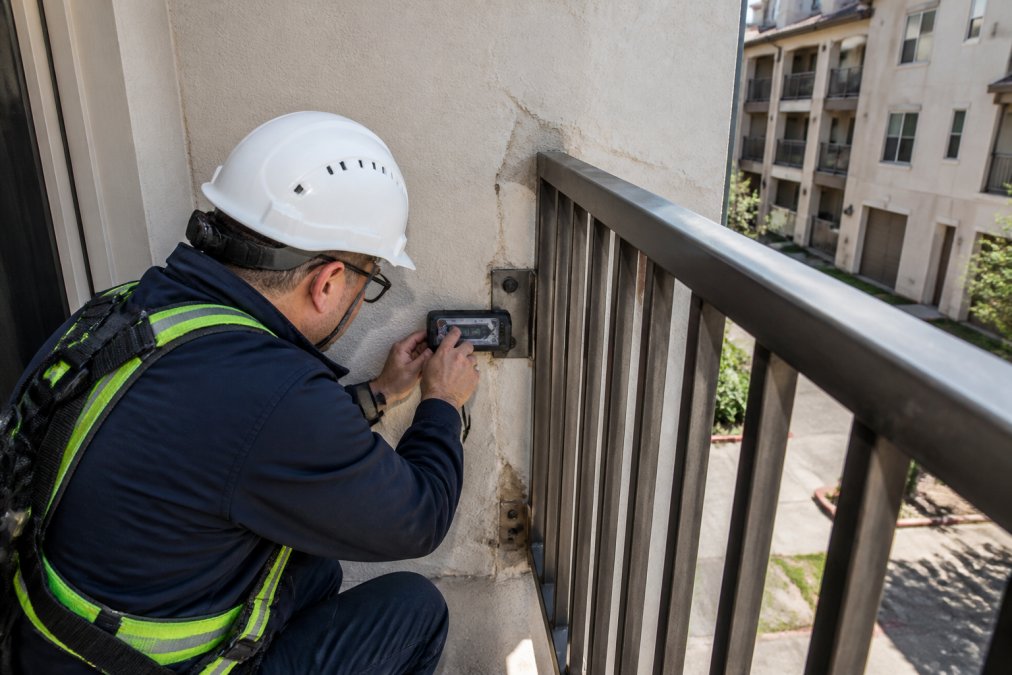
The key distinction is "elevated." A ground-level patio doesn’t require SB 326/SB 721 inspection. A second-story balcony does. Elevated elements experience different stresses, wind loads, repeated freeze-thaw cycles, and concentrated loads that accelerate deterioration.
Load-bearing connections and structural integrity
Load-bearing connections are where the balcony physically attaches to the building, transferring weight back into the main building frame. When these connections fail, the entire balcony can separate from the building.
Inspectors evaluate several connection types: bolted connections (steel bolts through the rim joist or ledger beam), welded connections (steel plates welded to the building frame), and embedded connections (metal connectors set into concrete). A common finding is "fastener corrosion with loss of thread engagement," meaning bolts have rusted so much they’ve lost their ability to hold load.
Structural integrity also includes the balcony’s primary beams and joists. Inspectors use non-destructive evaluation techniques, probing with specialized tools, moisture meters, and sometimes infrared imaging, to assess wood condition without cutting into the structure.
Water intrusion, corrosion, and deterioration signs
Water intrusion is the root cause of nearly every balcony failure in California. When water penetrates the building envelope and reaches structural components, it triggers corrosion in steel and decay in wood.
Inspectors look for visible signs of moisture penetration: staining on ceilings below balconies, efflorescence (white powder deposits on concrete), paint bubbling or peeling, and soft spots in wood when probed. They examine the balcony’s waterproofing system, membrane, sealants, and drainage details.
A critical finding is "statistically significant water intrusion," meaning the inspector found water damage in multiple locations, suggesting a systemic problem rather than a single isolated issue. This changes the repair timeline significantly.
Decoding Balcony Inspection Report Terminology
Inspection reports use specific language that confuses most property owners. Understanding these terms transforms a dense technical document into actionable information.
Visual glossary of technical terms and findings
Non-destructive evaluation (NDE): Testing methods that assess structural condition without damaging the component, including visual inspection, moisture meters, wood hardness testing, and infrared thermography.
Load-bearing components: Structural elements that carry weight. When an inspector flags a "deteriorated load-bearing component," they’re identifying something that’s supposed to be strong but is weakening.
Service life: The expected lifespan of a material or assembly under normal conditions. A waterproofing membrane might have a 15-year service life. If your membrane is 20 years old, it’s past service life and likely failing.
Remediation: The repair work required to fix the problem.
Invasive testing: When the inspector cuts into the structure to examine interior conditions, providing more thorough assessment than non-destructive testing.
Dry rot: Wood decay caused by fungus that breaks down cellulose. Despite the name, it requires moisture to develop. Once dry, the fungus dies, but the damage remains.
Fungal growth: Visible mold or mildew on surfaces, indicating moisture problems that will eventually cause structural damage.
Statistically significant sample: When the inspector finds similar problems in multiple locations, it indicates a pattern rather than an isolated issue.
When you see “statistically significant” in your report, it means the problem is widespread and requires comprehensive repair, not just patching the most visible spots.
Common Balcony Inspection Issues and What They Mean
Moisture penetration is almost always present in older balconies. An inspector might note "moisture detected in rim joist at ledger connection." This is serious because the rim joist is a primary load-bearing component. Water there accelerates decay and weakens the connection.
Dry rot findings trigger immediate concern. Unlike surface fungal growth, dry rot has already destroyed wood’s structural capacity. An inspector might describe "advanced dry rot in ledger board with estimated 40% loss of cross-section." This means the ledger is only 60% as strong as it should be.
Fungal growth on surfaces often accompanies moisture problems. It’s visible and alarming, but it’s sometimes less critical than hidden moisture in structural components. However, visible fungal growth signals that moisture conditions are right for decay to develop in hidden areas.
A load capacity concern means the inspector calculated that the remaining structural material may not safely support expected loads. When an inspector notes "load capacity concern," the safety factor has dropped below acceptable levels.
Structural hazards are more immediate. These include visible separation between the balcony and building, cracked beams, bent fasteners, or deterioration so advanced that failure is likely without repair.
Reading a Real Balcony Inspection Report Sample
A typical SB 326/SB 721 inspection report contains standard sections that convey information in a consistent format. The report opens with property information, inspection date, inspector credentials, and scope of work. The findings section describes what the inspector observed, organized by location or component type. The report concludes with recommendations identifying which elements need repair, which need further evaluation, and which are acceptable.
| Report Section | What It Tells You | Key Questions to Ask |
|---|---|---|
| Inspector Credentials | Whether the inspector is qualified | Is the inspector licensed? Do they have SB 326/SB 721 specific certification? |
| Property Information | Scope of inspection | Which buildings were inspected? Which units? |
| Findings by Location | Condition of each balcony/element | What’s the severity? Is it widespread or isolated? |
| Severity Ratings | Priority for repairs | What needs immediate attention vs. routine maintenance? |
| Recommendations | Required next steps | What repairs are necessary? What needs further evaluation? |
| Photos & Documentation | Visual evidence of conditions | Can I see the problems the inspector describes? |
How to Interpret Balcony Inspection Reports: Step-by-Step Process
Step 1: Verify inspector qualifications and compliance documentation
Before trusting the findings, confirm the inspector is qualified to conduct SB 326/SB 721 inspections. California requires inspectors to be licensed architects, structural engineers, or registered engineers with specific training in balcony inspection.
Check the inspector’s credentials in the report header for a Professional Engineer (PE) license number, Architect license number, or specific SB 326/SB 721 certification. Verify the inspection scope matches your building and check the inspection date against the legal deadline.
Request a copy of the inspector’s PE license or certification before paying for the inspection. A qualified inspector will provide this immediately.
Step 2: Identify statistically significant findings and severity ratings
Scan the findings section for severity language and frequency patterns. Look for words like "widespread," "multiple locations," "statistically significant," or "throughout the building."
Count how many findings fall into each severity category. Pay particular attention to findings affecting load-bearing components. A "cosmetic crack in concrete decking" is less urgent than "moisture and corrosion in ledger fasteners."
Look for patterns in the findings. If every balcony has moisture intrusion at the same location, it suggests a building-wide design or installation flaw.
Step 3: Understand repair timelines and remediation priorities
The inspection report should indicate repair timelines. "Immediate Attention Required" findings typically need repair within 30-90 days. "Needs Repair Within 12 Months" findings can be scheduled during normal maintenance cycles. "Monitor and Reassess" findings require follow-up inspection but not immediate repair.
Inspection findings don’t automatically specify repair methods. An inspector identifies that a ledger connection has corroded fasteners and moisture intrusion. An engineer then designs the repair. Prioritize based on structural safety first, then water intrusion patterns, then cosmetic issues.
Step 4: Review maintenance plans and service life expectations
Quality inspection reports include recommendations for ongoing maintenance: annual sealant inspection, drain cleaning, waterproofing reapplication schedules, or specific monitoring protocols.
Service life information tells you when components will need replacement regardless of current condition. A waterproofing membrane with a 15-year service life installed in 2015 is nearing end of life in 2026, even if it’s not currently failing.
Common Mistakes When Interpreting Reports and How to Avoid Them
The first mistake is ignoring non-destructive evaluation findings. When an inspector notes "moisture detected via meter at rim joist" or "wood hardness reduced indicating decay," they’re describing hidden damage that visual inspection alone would miss.
The second mistake is confusing cosmetic issues with safety hazards. Visible fungal growth on a railing looks alarming but might be less critical than invisible moisture in a load-bearing ledger.
The third mistake is delaying action on liability reduction opportunities. Once you have an inspection report, you have documented knowledge of conditions. If you don’t act on critical findings and someone is injured, that documentation becomes evidence of negligence.
A fourth mistake is treating all "Needs Repair Within 12 Months" findings as equally urgent. Prioritize based on structural impact, not just severity rating.
Post-Report Action Checklist for Property Managers and HOA Boards
Immediate Actions (within 7 days):
- Distribute the report to your board, ownership, or management team
- Identify any "Immediate Attention Required" findings
- Contact a structural engineer for findings involving load capacity concerns
- Photograph and document current conditions for your records
- Create a timeline for addressing critical findings
Short-term Actions (within 30 days):
- Obtain repair estimates for critical findings from licensed contractors
- Schedule invasive testing or engineering evaluation if recommended
- Review your building insurance policy for adequate balcony liability coverage
- Assess your reserve fund to determine if special assessments are needed
- Communicate with residents about findings and repair timeline
Medium-term Actions (within 90 days):
- Complete repairs on all "Immediate Attention Required" findings
- Develop a detailed maintenance plan based on inspection recommendations
- Document all repair work with photos and contractor invoices
- Update your building’s maintenance records
Long-term Actions (within 12 months):
- Complete all "Needs Repair Within 12 Months" findings
- Implement the maintenance plan with documented annual inspections
- Schedule the next full SB 326/SB 721 inspection (6 years for SB 326, 9 years for SB 721)
- Review and update your reserve fund study to account for balcony repair needs
Interpreting your balcony inspection report accurately is the foundation for protecting your residents and managing liability. The technical language and severity ratings might seem overwhelming at first, but breaking them down systematically reveals a clear picture of your building’s condition and what needs attention.
At Apex Balcony, our team of licensed inspectors doesn’t just identify problems, we help you understand what they mean and develop repair strategies that protect your residents while respecting your budget. We’ve worked with hundreds of California property owners navigating SB 326 and SB 721 compliance. Book an inspection with Apex Balcony today and get clarity on your building’s actual condition and the most cost-effective path to compliance and safety.
Frequently Asked Questions
What's the difference between SB 326 and SB 721, and which one applies to my California property?
SB 326 applies to residential buildings with three or more units built before January 1, 2008, requiring visual inspections of balconies and exterior elevated elements every six years. SB 721 applies to buildings built on or after January 1, 2008, with the same inspection requirements. If your building has three or more residential units and includes balconies, decks, or elevated stairways, at least one of these laws applies. Check your building's construction date and unit count to determine which statute governs your property.
What are the most common balcony inspection issues found in California residential buildings?
The most frequently identified issues include water intrusion and moisture penetration in the building envelope, dry rot in wood components, corrosion of metal load-bearing connections, and fungal growth on structural elements. Inspectors also commonly find deterioration risks related to the service life of materials, compromised load-bearing components, and weatherproofing failures. These findings vary by building age, climate zone, and maintenance history. Understanding whether findings are cosmetic or pose genuine safety hazards is critical to prioritizing remediation.
How do I know if a balcony inspection report is thorough and credible?
A credible report includes detailed compliance documentation, clearly identifies the inspector's qualifications and certifications, documents both visual inspection and non-destructive evaluation findings, and provides a statistically significant sample of tested components. The report should explain severity ratings, specify repair timelines, reference building code compliance standards, and include photographs or diagrams. Verify that the inspector holds appropriate state licensing and has experience with SB 326 and SB 721 requirements. If findings are unclear or lack supporting detail, request clarification before approving repairs.
What should I do immediately after receiving a balcony inspection report?
First, review the report for clarity and verify inspector credentials. Second, categorize findings by severity and statutory deadline, some repairs may be required within 30 days, others within one year. Third, obtain repair quotes from qualified contractors and assess cost-benefit implications for your reserve fund. Fourth, document all findings and communicate them to your HOA board, property management team, or legal counsel. Finally, establish a maintenance plan and remediation timeline. If you disagree with findings, consider a second opinion from another licensed inspector before proceeding with costly repairs.