SB 326 Non-Compliance: Insurance Implications Explained
Insurance implications sb 326: Discover how SB 326 non-compliance affects your insurance coverage, premiums, and liability. Learn penalties, coverage.
Table of Contents
- Insurance Implications of SB 326 Non-Compliance: What You Need to Know
- SB 326 Penalties and Risks for Property Owners
- Coverage Exclusions: What Your Insurance Won’t Cover
- SB 326 Inspection Requirements and Deadlines
- SB 326 Repair Costs and Financial Impact on Insurance
- SB 326 Compliance Checklist for HOA Boards
- Individual Unit Owner Insurance: HO-6 Policy Implications
- Protecting Your Property: Risk Management and Remediation
Last Updated: July 24, 2026
California’s SB 326 balcony inspection law creates complex compliance obligations for property owners and HOAs. Non-compliance doesn’t just expose you to fines, it can void coverage, trigger claims denials, and leave your property and residents at serious legal risk. This guide covers the real financial and legal consequences of SB 326 non-compliance through the lens of insurance risk.
How Non-Compliance Affects Your Coverage
Insurance companies treat SB 326 compliance as a material underwriting factor. When you apply for or renew general liability or property insurance, underwriters ask whether your building meets current safety codes and statutory requirements. Non-compliance raises a red flag because it signals unverified structural integrity in elevated exterior elements.
If your policy includes exclusions for statutory violations or negligent maintenance, non-compliance gives insurers explicit grounds to deny claims related to balcony failures. A balcony collapse or injury occurring while your building violates SB 326 may fall outside your coverage entirely.
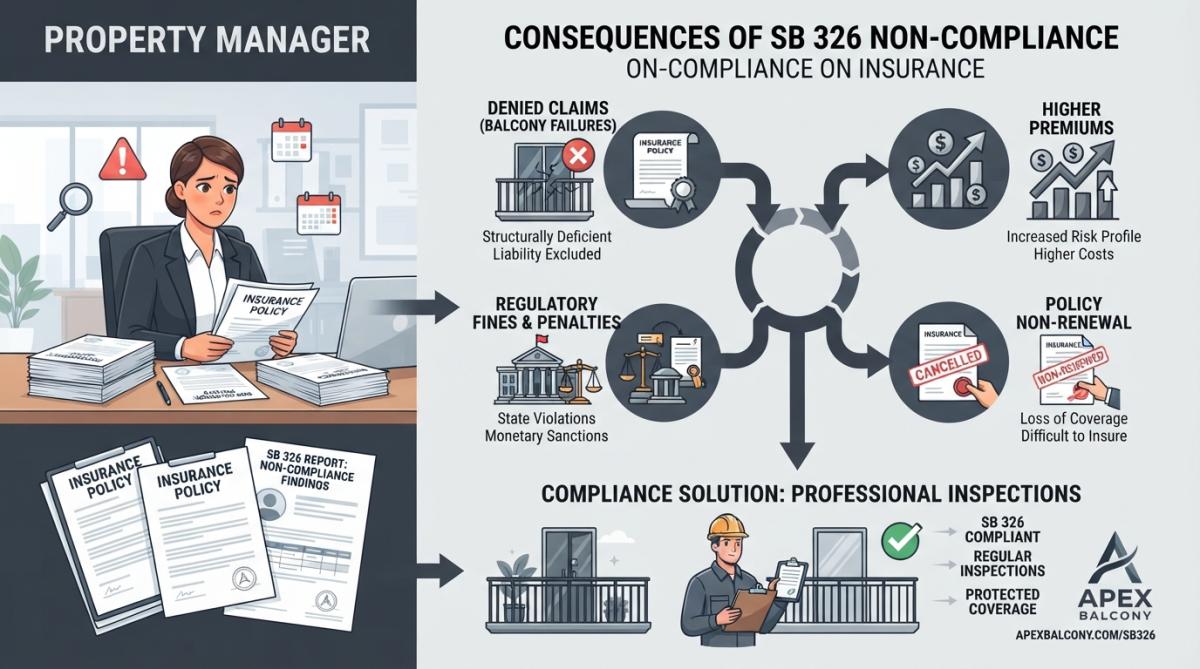
Failing to disclose SB 326 non-compliance on an insurance application can be treated as material misrepresentation, giving insurers grounds to cancel coverage retroactively and deny all related claims.
Premium Increases and Underwriting Risk
Once non-compliance is discovered, insurance costs rise sharply. Underwriters classify non-compliant properties as higher risk, translating to premium increases of 15-25% at renewal. Some insurers decline to renew coverage altogether, forcing you into the residual market where rates are significantly higher and coverage is more limited.
Insurers now conduct their own investigations into SB 326 status, sometimes hiring third-party inspectors to verify compliance before issuing or renewing policies. If they discover violations not disclosed in your application, they may cancel coverage retroactively or deny claims based on material misrepresentation.
For HOAs, this compounds the problem. If your building loses standard market coverage, individual unit owners’ HO-6 policies may also face coverage gaps, since those policies often exclude coverage for negligent HOA maintenance decisions.
SB 326 Penalties and Risks for Property Owners
SB 326 non-compliance carries escalating statutory penalties that compound over time. Daily civil fines start at $100 per day for failure to conduct required inspections by the statutory deadline. Fines escalate to $500 per day once a structural engineer or architect has identified hazardous conditions requiring repair. These penalties appear in public records, affecting your property’s marketability, refinancing ability, and insurance underwriting profile.
Negligence Claims and Third-Party Lawsuits
The real financial exposure comes from third-party liability. If someone is injured due to a balcony failure and your building was in violation of SB 326, you’re defending a negligence claim with a massive credibility problem. A plaintiff’s attorney will argue you had a statutory duty to inspect and maintain balconies, knew about that duty, and failed to fulfill it. If your insurance claim is denied due to non-compliance, you’re defending the negligence claim with no insurance coverage. Damages come directly from your building’s reserves or personal liability.
Coverage Exclusions: What Your Insurance Won’t Cover
Insurance policies contain specific exclusions for statutory violations. Most commercial general liability policies exclude coverage for claims arising from violations of law or regulation. SB 326 is a statute, if your building violates it and someone is injured as a result, the insurer can invoke this exclusion to deny coverage.
Some policies also include specific exclusions for "failure to maintain" or "deferred maintenance." Non-compliance with SB 326 inspection and repair requirements falls squarely within these exclusions.
Review your commercial general liability policy specifically for language about statutory compliance, code violations, and maintenance failures. Request clarification from your broker about how SB 326 compliance status affects your coverage before a claims situation arises.
Claims Denial Due to Non-Compliance
When a claim is submitted and the insurer discovers your building was in violation of SB 326 at the time of loss, the denial process typically follows a predictable pattern. The insurer investigates the building’s compliance status by requesting inspection reports and remediation records. If those records don’t exist or show violations, the insurer’s claims counsel reviews the policy language and applies the statutory violation exclusion, issuing a reservation of rights letter. If the claim involves injury or property damage plausibly connected to the non-compliant condition, the insurer denies the claim, citing the statutory violation exclusion. At this point, you have limited recourse.
SB 326 Inspection Requirements and Deadlines
Understanding SB 326’s inspection timeline is essential because missing deadlines triggers both penalties and insurance complications.
Inspection Timeline and Compliance Deadline
SB 326 requires all buildings with exterior elevated elements (balconies, decks, stairways) to undergo structural inspection by a licensed structural engineer or architect. The inspection deadline depends on construction date:
- Buildings constructed before January 1, 2018: First inspection required by January 1, 2025
- Buildings constructed between January 1, 2018, and January 1, 2020: First inspection required by January 1, 2026
- Buildings constructed after January 1, 2020: First inspection required by January 1, 2027
Subsequent inspections are required every six years from the most recent inspection date. Once hazards are identified, the property owner must notify residents and begin remediation planning. The law does not specify a repair deadline, but once hazards are identified, the daily civil fine escalates to $500 per day until repairs are complete.
Licensed Structural Engineer and Architect Requirements
SB 326 specifies that inspections must be conducted by a licensed structural engineer or architect. An unlicensed inspector’s report carries no legal weight and does not satisfy the statutory requirement. The inspector must prepare a written report describing each exterior elevated element, its current condition, and any structural hazards. The report must be signed and stamped by the licensed professional and becomes part of your building’s permanent record, discoverable in any subsequent litigation.
SB 326 Repair Costs and Financial Impact on Insurance
Once an inspection identifies deficiencies, repair costs accumulate rapidly. The financial impact extends beyond direct repair costs to affect your building’s financing, reserve fund, and insurance profile.
Reserve Fund Depletion and Financing Challenges
Balcony repairs are expensive. Waterproofing, structural reinforcement, and component replacement can cost thousands of dollars per unit. For a 50-unit building, total remediation costs can easily exceed $500,000. HOAs typically fund repairs through special assessments or reserve fund withdrawals. If your building has inadequate reserves, you’ll need to impose a special assessment on unit owners. Reserve fund depletion creates a secondary problem: buildings with depleted reserves struggle to obtain financing.
Impact on HOA and Condo Financing and Loan Approval
Lenders now include SB 326 compliance as a condition of loan approval. When an HOA applies for financing, the lender requires proof of SB 326 compliance. If your building is non-compliant, the lender will deny the application or require completion of all outstanding inspections and repairs before funding is released. For individual unit owners seeking to purchase or refinance, the building’s SB 326 status affects their ability to obtain financing. Breaking this cycle requires taking action on inspections and remediation.
SB 326 Compliance Checklist for HOA Boards
Compliance requires systematic action. The following checklist outlines key steps your HOA board should take to meet SB 326 requirements and minimize insurance risk.
Step-by-Step Compliance Actions
Determine your inspection deadline. Review your building’s construction date and confirm which SB 326 deadline applies. Mark the deadline on your board calendar and set a reminder at least 90 days before.
Obtain quotes from licensed inspectors. Contact multiple licensed structural engineers or architects with SB 326 experience. Request itemized quotes including scope, timeline, and deliverables.
Schedule the inspection. Book well in advance of your deadline. Licensed professionals often have full schedules, and waiting until the last minute may result in missed deadlines.
Prepare for the inspection. Ensure all exterior elevated elements are accessible. Remove obstacles, stored items, or debris that might prevent thorough inspection.
Receive and review the inspection report. Obtain a copy of the signed report. Review findings with your board and legal counsel. Understand which conditions are classified as hazardous.
Develop a remediation plan. For identified hazards, create a written plan specifying repairs needed, estimated cost, timeline, and funding mechanism. Communicate this plan to residents.
Obtain repair quotes. Contact licensed contractors specializing in balcony and deck repairs. Obtain multiple quotes and compare pricing, timeline, and warranty terms.
Complete repairs and document compliance. Once repairs are complete, obtain signed certifications from the contractor and licensed professional. Maintain copies in your building’s permanent record.
| Compliance Step | Timeline | Responsible Party | Documentation |
|---|---|---|---|
| Determine deadline | Immediately | Board Secretary | Board resolution confirming deadline |
| Obtain inspector quotes | 90 days before deadline | Property Manager | Written quotes from 3+ inspectors |
| Schedule inspection | 60 days before deadline | Property Manager | Inspection agreement and confirmation |
| Conduct inspection | By statutory deadline | Licensed Professional | Signed inspection report |
| Review findings | Within 2 weeks of report | Board + Legal Counsel | Board meeting minutes documenting review |
| Develop remediation plan | Within 30 days of report | Board + Contractor | Written remediation plan with cost estimates |
| Complete repairs | Within 6-12 months | Licensed Contractor | Contractor certification and lien release |
| Document compliance | Upon completion | Property Manager | Master file with all inspection and repair records |
Documentation and Indemnification Strategy
Documentation is your defense. In any claims situation or regulatory inquiry, your paper trail proves you acted reasonably and in good faith to comply with SB 326.
Maintain a master file that includes: board resolutions authorizing the inspection and repairs, copies of the inspection agreement and inspection report, all contractor quotes and selection rationale, repair contracts and change orders, completion certifications and lien releases, proof of special assessments or reserve fund withdrawals, and resident communications about the inspection and repairs.
Consider obtaining an indemnification agreement from your contractor specifying that the contractor is responsible for any defects in workmanship or materials and will defend and indemnify the HOA for any claims arising from the contractor’s work.
Individual Unit Owner Insurance: HO-6 Policy Implications
Individual unit owners in condominiums carry HO-6 insurance covering personal property, personal liability, and unit improvements. However, HO-6 policies typically exclude coverage for claims arising from HOA-level negligence or breach of statutory duty. If your HOA fails to comply with SB 326 and a resident is injured as a result, the resident’s HO-6 policy will likely deny coverage for any personal liability claim arising from the HOA’s negligence. Individual unit owners need to understand that the HOA’s SB 326 compliance directly affects their personal insurance coverage and liability exposure.
Protecting Your Property: Risk Management and Remediation
Beyond compliance, a proactive risk management approach minimizes the likelihood of catastrophic failures and the insurance complications that follow.
Waterproofing and Structural Integrity Assessment
Balcony failures often begin with water intrusion. Water penetrates the concrete or wood structure, corrodes reinforcing steel, and compromises structural integrity. Waterproofing maintenance is preventive and far less expensive than structural repair. A licensed structural engineer can assess the current condition of waterproofing systems and recommend maintenance or replacement. Incorporating waterproofing maintenance into your building’s annual maintenance budget is cost-effective risk management.
Remediation Planning and Lien Prevention
Once repairs are identified, timely remediation is essential. Delays increase costs, compound liability exposure, and trigger escalating SB 326 penalties. Develop a realistic remediation timeline accounting for contractor availability, financing, and resident coordination. Protect your building from mechanic’s liens by ensuring contractors are paid promptly and lien releases are obtained before final payment. Keep your insurer informed of the remediation plan and progress to demonstrate good faith and help preserve coverage if a claim arises during remediation.
SB 326 compliance isn’t optional, and the insurance implications of non-compliance are severe. The combination of coverage exclusions, claims denials, premium increases, and statutory penalties creates financial and legal exposure far exceeding the cost of compliance. Apex Balcony provides professional inspection services that identify structural hazards early, document compliance for your insurer, and give you a clear roadmap for necessary repairs. Our licensed inspectors have decades of combined construction and design experience and specialize in helping HOA boards and property owners navigate the SB 326 inspection process with confidence. Book an inspection today and protect your property, your residents, and your insurance coverage.
Frequently Asked Questions
What are the penalties for SB 326 non-compliance?
California law imposes daily civil fines ranging from $100 to $500 per day for non-compliance with SB 326. These fines accumulate continuously until the property achieves compliance. Beyond financial penalties, non-compliance exposes HOAs and property owners to negligence liability if balconies or exterior elevated elements fail, potentially resulting in third-party lawsuits. Insurance coverage may also be denied if claims stem from statutory violations, leaving owners personally liable for damages.
Can SB 326 non-compliance lead to increased insurance premiums?
Yes. Insurance underwriting explicitly considers SB 326 compliance status during policy renewal or new applications. Non-compliant properties are viewed as higher risk, leading to premium increases, stricter coverage terms, or policy cancellations. Lenders and financial gatekeepers also flag non-compliance during loan approval processes, which can trigger additional insurance requirements or denial of financing. Compliance demonstrates risk management and can help stabilize or reduce premium costs.
Will my HOA's insurance cover damages if we are not SB 326 compliant?
General liability insurance policies often include exclusions for claims arising from statutory violations or negligence related to building code non-compliance. If a balcony collapse or injury occurs and your property is not SB 326 compliant, insurers may deny coverage based on policy language that excludes liability for violations of law. This leaves your HOA and individual unit owners personally responsible for repair costs, medical claims, and legal fees, potentially reaching hundreds of thousands of dollars.
What should my HOA do to ensure SB 326 compliance and protect insurance coverage?
Begin with a professional inspection by a licensed structural engineer or architect to assess all exterior elevated elements. Document the inspection report and share findings with your insurer to demonstrate due diligence. Develop a remediation plan with timelines and budget estimates. Notify your insurance carrier of compliance efforts, this signals active risk management and may prevent coverage denials. Maintain detailed records of all inspections, repairs, and communications. Consult your property management company and legal counsel to ensure CC&R compliance and proper indemnification clauses in contracts.