SB 326 vs SB 721 for Condominiums: Key Differences
SB 326 vs SB 721 for condominiums: understand key differences, deadlines, inspection requirements, and compliance obligations. Learn which law applies to.
Table of Contents
- SB 326 vs SB 721 for Condominiums: What You Need to Know
- What Is SB 326 and What Is SB 721?
- Key Differences Between SB 326 and SB 721
- EEE Inspection Requirements California: What Gets Inspected
- HOA Compliance SB 326: Mandatory Inspection and Reporting
- SB 721 Deadlines: Critical Compliance Dates for Condominiums
- Balcony Inspection Report Requirements: Documentation Standards
- Consequences of Non-Compliance and Liability Mitigation
Last Updated: July 19, 2026
SB 326 vs SB 721 for Condominiums: What You Need to Know
When the Malibu balcony collapse killed six people in May 2021, California property owners faced a wake-up call. The state responded with two critical laws that fundamentally changed how residential buildings must maintain their exterior structures. Understanding sb 326 vs sb 721 for condominiums is no longer optional, it’s a legal and safety imperative that affects every multi-family property in the state.
Most HOA boards initially don’t know which law applies to them, what deadlines they’re facing, or what happens if they miss compliance. Non-compliance can result in fines, liability exposure if injuries occur, and forced special assessments to cover emergency repairs.
Many property managers assume they only need to comply with one law. In reality, SB 721 expanded SB 326’s requirements, meaning most condominiums must follow both frameworks simultaneously. The key is understanding which parts apply to your specific property.
Why This Matters for Property Owners and HOAs
These laws mandate proactive inspection before catastrophic failure occurs. For your building, this means regular professional assessments of every balcony, deck, stairway, and elevated outdoor area.
The financial impact is substantial. A typical condominium with 50 units might face inspection costs ranging from a few thousand dollars, plus potential repair assessments that can reach tens of thousands. However, catching issues early through mandatory inspections typically costs far less than emergency repairs or litigation following an accident.
According to [California Department of Consumer Affairs guidance on SB 326(/hoa-compliance-services-strategies/) and SB 721 compliance | dca.ca.gov], property managers who establish inspection schedules early and maintain detailed records significantly reduce their legal exposure.
The real cost of non-compliance isn’t just fines, it’s the potential liability if someone is injured on a balcony your building failed to inspect or repair properly.
What Is SB 326 and What Is SB 721?
SB 326: The Original Balcony Safety Law
Senate Bill 326, which took effect January 1, 2019, was California’s first statewide mandate for balcony safety inspections. It applied to residential buildings with three or more units built before January 1, 2008. The law required property owners to hire a licensed architect or structural engineer to inspect all Exterior Elevated Elements (EEE), primarily balconies, and report findings to the building’s governing body.
SB 326 mandated an initial inspection within a specific timeframe and then periodic re-inspections every nine years. Any element found to be in "poor condition" or presenting a "safety hazard" had to be reported, and the building had to develop a plan to address the issue.
SB 721: Expanded Requirements for All Properties
Senate Bill 721, which became effective January 1, 2022, addressed SB 326’s limitations. It expanded the mandate to cover ALL residential buildings with three or more units, regardless of construction date. More importantly, it broadened the definition of what must be inspected to include any Exterior Elevated Element: decks, stairways, railings, and other load-bearing components.
SB 721 also tightened the inspection timeline. While SB 326 allowed nine years between inspections, SB 721 requires inspections every six years for buildings that have had repairs, and every nine years for those in good condition.
Key Differences Between SB 326 and SB 721
Applicability and Property Types
The most fundamental difference is scope. SB 326 applies only to residential buildings with three or more units constructed before January 1, 2008. SB 721 applies to all residential buildings with three or more units, regardless of construction date.
A condominium built in 2010 would have had no balcony inspection mandate under SB 326. Under SB 721, it must comply fully. SB 721 also expanded applicability to Common Interest Developments (CIDs) beyond traditional condominiums, including planned unit developments and townhome communities.
| Requirement | SB 326 | SB 721 |
|---|---|---|
| Applies to buildings built before 2008 | Yes | Yes |
| Applies to buildings built after 2008 | No | Yes |
| Covers balconies only | Yes | No |
| Covers all EEE (decks, stairs, railings) | No | Yes |
| Applies to residential 3+ units | Yes | Yes |
| Applies to Common Interest Developments | Limited | Yes |
Exterior Elevated Elements (EEE) Scope
SB 326 focused narrowly on balconies. SB 721 broadened the definition significantly. Exterior Elevated Elements now include balconies, decks, patios, walkways, exterior stairs, railings, guardrails, and any other load-bearing structural component that is elevated above ground and exposed to the exterior environment.
Inspection Timeline and Frequency
SB 326 required an initial inspection by January 1, 2020, with re-inspections every nine years. SB 721 compressed this timeline: for buildings in poor condition or with repairs needed, inspections must occur every six years; for buildings in good condition, the nine-year cycle applies. The initial inspection deadline for post-2008 buildings was January 1, 2025.
EEE Inspection Requirements California: What Gets Inspected
Defining Exterior Elevated Elements
Exterior Elevated Elements are any structural components that are elevated above ground, exposed to the exterior environment, and support human occupancy or passage. This includes balconies, decks, patios, exterior stairs, railings, guardrails, and any load-bearing components attached to these structures.
What Inspectors Look For
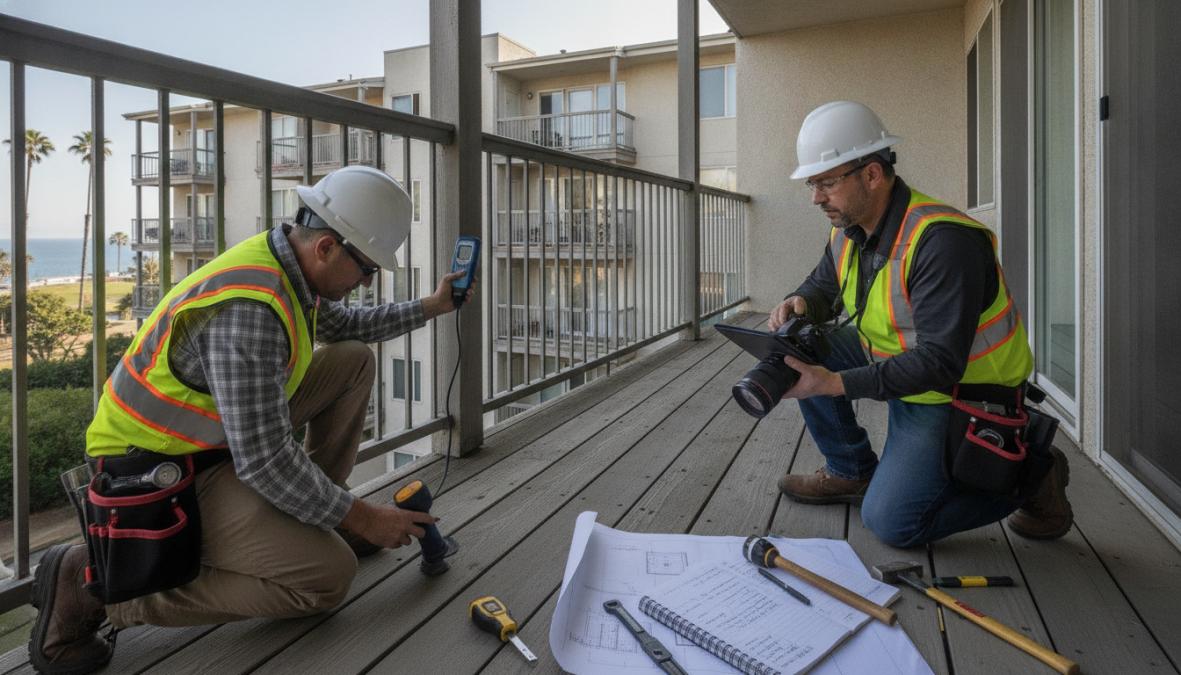
A licensed architect or structural engineer conducting an EEE inspection examines wood for dry rot and termite damage using specialized tools. They check fastener corrosion, testing bolts and brackets for strength. They evaluate waterproofing and sealants, which are often the first line of defense against water intrusion that leads to wood decay. The inspection also includes load-bearing capacity assessment by reviewing original construction documents, testing fastener strength, or calculating load paths.
According to California Residential Code requirements for exterior elevated elements, inspectors must document their findings in a standardized report format that includes photographs, specific location descriptions, severity ratings, and recommendations for repair or further evaluation.
Many building owners attempt informal inspections or hire general contractors instead of licensed professionals. This is a compliance violation. Only a licensed architect or structural engineer can produce a report that satisfies SB 326 or [SB 721](/sb-721-inspection-timeline-owners-2026-guide/) requirements.
HOA Compliance SB 326: Mandatory Inspection and Reporting
Inspection Report Requirements
The inspection report is your building’s legal record of structural condition. It must be detailed enough to defend you in court if a claim arises and must comply with specific statutory requirements.
A compliant report must include the inspector’s name, license number, and signature; the property address and inspection date; a description of each Exterior Elevated Element inspected, including its location and current condition; and a classification of each element as "Good Condition," "Fair Condition," or "Poor Condition." Elements in Poor Condition or presenting a Safety Hazard must be flagged with specific repair recommendations. The report should include photographs showing the location and condition of each element.
Documentation and Record Retention
Your building’s governing body must retain the inspection report for at least 18 years. The report must be provided to unit owners within 30 days of completion. Maintain records of any repairs completed, the contractor who performed them, the cost, and the completion date.
Create a dedicated folder for all inspection reports, repair invoices, and correspondence related to EEE compliance. This single organized file becomes your primary defense if your building ever faces a claim.
SB 721 Deadlines: Critical Compliance Dates for Condominiums
Initial Inspection Deadlines
For buildings subject to SB 326, the initial inspection deadline was January 1, 2020. For buildings constructed after January 1, 2008, the SB 721 initial inspection deadline was January 1, 2025. If your building missed this deadline, you are now in violation and should schedule an inspection immediately.
Periodic Inspection Schedule
After the initial inspection, SB 721 requires re-inspections on a schedule based on condition:
- Good Condition: Re-inspection every nine years
- Fair Condition: Re-inspection every six years
- Poor Condition or Safety Hazard: Immediate repair and re-inspection after repairs are completed
A building that had a SB 326 inspection in 2019 and was found in Good Condition would normally be due for re-inspection in 2028 under SB 326’s nine-year cycle. However, if any repairs were made, the six-year cycle kicks in, making the building due for re-inspection in 2025.
Balcony Inspection Report Requirements: Documentation Standards
What Must Be Included in Reports
A compliant inspection report must be a professional document that can withstand legal scrutiny. The report must include the inspector’s professional credentials, inspection date, property address, and a detailed description of each Exterior Elevated Element examined. For each element, the report must state its location, dimensions, and current condition, describe any defects found including type and severity, and include a condition rating with specific recommendations for repair or further evaluation.
Licensed Professional Requirements
Only a licensed architect or structural engineer can conduct an SB 326 or SB 721 inspection. The inspector must be licensed in California, with their license number appearing on the report along with their signature. When selecting an inspector, verify their license through the California Department of Consumer Affairs.
Consequences of Non-Compliance and Liability Mitigation
Fines, Penalties, and Legal Exposure
Non-compliance carries multiple consequences. Local building departments can issue citations for failure to conduct required inspections, ranging from hundreds to thousands of dollars per violation. More serious is liability exposure: if someone is injured on a balcony or deck that your building failed to inspect, your building could be liable for medical costs, pain and suffering, and potentially punitive damages.
The liability exposure exists even if your building wasn’t legally required to comply. If a balcony collapses and injures someone, a plaintiff’s attorney will argue that your building should have conducted an inspection regardless of legal requirements.
Insurance and Liability Protection
The best liability protection is compliance. A building that has current inspection reports, documented repairs, and a clear maintenance plan is far less attractive to a plaintiff’s attorney than one with missing inspections or ignored repair recommendations.
Insurance companies recognize this. Buildings that maintain current SB 326 and SB 721 compliance often receive better insurance rates and broader coverage. Keep copies of inspection reports, repair contracts, invoices, and completion photos. Keep records of HOA board meetings where compliance was discussed and notices sent to unit owners about inspection findings.
According to California Association of Realtors guidance on property liability and disclosure, properties with documented compliance histories and clear maintenance records sell more quickly and at higher prices than those with compliance questions.
Compliance isn’t just about [avoiding fines](/avoiding-fines-balcony-non-compliance-sb326-sb721/), it’s about protecting your building’s value, your insurance coverage, and your personal liability as a board member or property manager.
Choosing Between SB 326 and SB 721 Compliance
The question isn’t which law to follow, it’s understanding that SB 721 supersedes SB 326 for most properties. If your building has three or more residential units, SB 721 applies. If your building was constructed before January 1, 2008, SB 326 also applies, but SB 721’s requirements take precedence where they conflict.
Assume SB 721 applies to your building unless you’re certain it doesn’t. The cost of proactive compliance, typically a few thousand dollars for an inspection, is far less than the cost of emergency repairs, liability claims, or fines for non-compliance. Building owners who treat SB 326 and SB 721 compliance as a routine maintenance requirement rather than an optional task protect their residents and their assets.
Your building’s safety and legal compliance depend on understanding which requirements apply to you and meeting deadlines consistently. If you’re uncertain whether your property is fully compliant with SB 326 and SB 721, consult with a licensed architect or structural engineer who can review your building’s construction date, unit count, and structure type to determine your compliance obligations and conduct a comprehensive inspection.
Frequently Asked Questions
What is the main difference between SB 326 and SB 721?
SB 326 applies specifically to condominiums and common interest developments with three or more units built before January 1, 2008. SB 721 expanded these requirements to include all residential buildings with three or more units, regardless of age or type, and broadened the definition of Exterior Elevated Elements (EEE) to include balconies, decks, stairs, and other load-bearing components. SB 721 also introduced more stringent inspection frequencies and reporting standards.
Which buildings are subject to SB 326 vs SB 721 for condominiums?
SB 326 applies to condominiums and common interest developments with three or more units constructed before January 1, 2008. SB 721 applies to all residential buildings with three or more units (including multi-family rental properties and newer condominiums), making it broader in scope. If your condominium was built after January 1, 2008, you likely fall under SB 721 rather than SB 326. Always verify your property's construction date and structure type to determine which law applies.
What are the inspection requirements under SB 721 deadlines for my condominium?
Initial inspections under SB 721 must be completed by January 1, 2025, for buildings constructed before January 1, 2008, and by January 1, 2025, for newer buildings. After the initial inspection, periodic inspections are required every six years for buildings in good condition, or every three years if deficiencies are found. All inspections must be conducted by a licensed architect or structural engineer and documented according to California Building Code standards.
What are Exterior Elevated Elements (EEE) and why do they matter?
Exterior Elevated Elements (EEE) include balconies, decks, exterior stairs, and other structural components that extend from a building and are supported by load-bearing systems. These elements are vulnerable to water intrusion, dry rot, termite damage, and structural failure, which can create serious safety hazards for residents. SB 721 requires thorough inspection of EEE to identify defects early, preventing catastrophic failures and protecting building occupants from injury or death.
What happens if my HOA doesn't comply with SB 326 or SB 721?
Non-compliance can result in significant fines, legal liability, and personal liability for board members. If an accident or injury occurs due to neglected maintenance of balconies or EEE, your HOA and its board members may face lawsuits, insurance denial, and substantial financial penalties. Additionally, failure to maintain required inspection records can result in regulatory enforcement actions from the California Department of Consumer Affairs. Compliance protects both residents and the organization's financial stability.