Dr Balcony Alternatives for Multifamily: 2026 Guide
Compare balcony inspection alternatives to Dr Balcony for multifamily properties. Find inspectors, software, and services for SB-721 compliance.
Table of Contents
- Why Property Managers Seek Balcony Inspection Alternatives
- SB-721 Inspection Requirements and Compliance Deadlines
- How to Choose a Balcony Inspector for Your Property
- Inspection Software Platforms as Alternatives
- Drone-Based and Advanced Inspection Technologies
- Exterior Elevated Elements Inspection Cost Considerations
- Specialized Consulting and Repair Services
- Selecting the Right Balcony Inspection Solution for Your Building
Last Updated: August 14, 2026
Why Property Managers Seek Balcony Inspection Alternatives
Property managers overseeing multifamily buildings must choose a balcony inspection solution that fits their compliance needs and budget. The answer depends on building size, structural type, timeline, and available capital. Some prefer software platforms that simplify workflows across portfolios. Others need specialized consulting expertise to interpret complex structural findings. Still others use drone-based technology to reduce safety risks during facade assessment.
The stakes are real. A 2015 Berkeley balcony collapse killed six people, and a 2021 Malibu incident reinforced how quickly deterioration becomes catastrophic. Your choice of inspection partner directly affects resident safety, legal liability, and long-term capital planning.
Delaying balcony inspections exposes your property to regulatory fines, potential liability lawsuits, and emergency repair costs that dwarf the price of proactive assessment.
SB-721 Inspection Requirements and Compliance Deadlines
Senate Bill 721 and Senate Bill 326 establish mandatory inspection requirements for Exterior Elevated Elements (EEE) on multifamily properties with three or more units. SB-721 specifically governs structures with four or more stories and requires inspection of balconies, decks, stairways, and other load-bearing exterior components.
The compliance timeline is strict. Properties must complete their initial inspection by the deadline specified in the statute based on construction date. Missing these deadlines triggers administrative penalties and increases exposure to negligence claims if an accident occurs.
California Department of Consumer Affairs guidance on balcony safety regulations provides the official framework. Your inspector must document findings in a detailed report that identifies deficiencies, assigns severity ratings, and recommends corrective actions.
Property managers often underestimate how long inspections take and how disruptive they can be to residents. A thorough examination requires access to individual units, common areas, and structural cavities. Planning ahead prevents last-minute rushes that compromise quality.
SB-721 and SB-326 compliance is not optional. Your inspection timeline should account for scheduling delays, potential repair recommendations, and the time needed to complete remediation before the next inspection cycle begins.
How to Choose a Balcony Inspector for Your Property
Selecting the right balcony inspector requires evaluating credentials, experience with your building type, inspection methodology, and cost structure. The cheapest option is rarely the best. A thorough inspection costs more upfront but identifies problems early, preventing expensive emergency repairs and resident injuries.
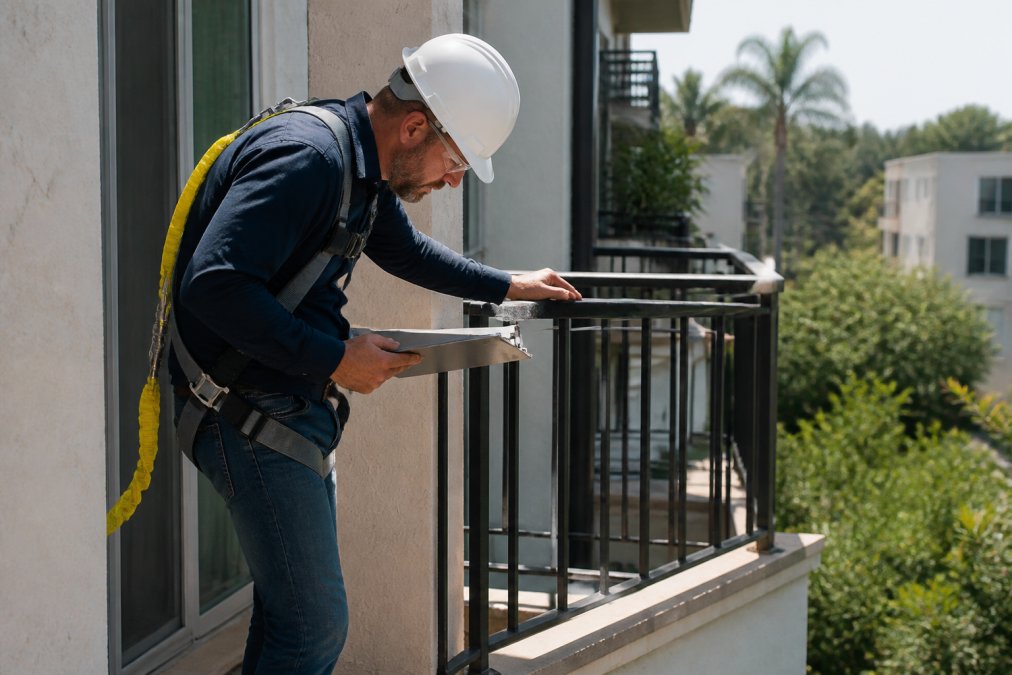
Licensed professionals matter. California law requires that inspections be performed by or under the supervision of a licensed structural engineer or architect. Verify credentials directly with the California Department of Consumer Affairs. An inspector with decades of construction experience brings pattern recognition that newer inspectors lack, spotting early warning signs of deterioration before problems become critical.
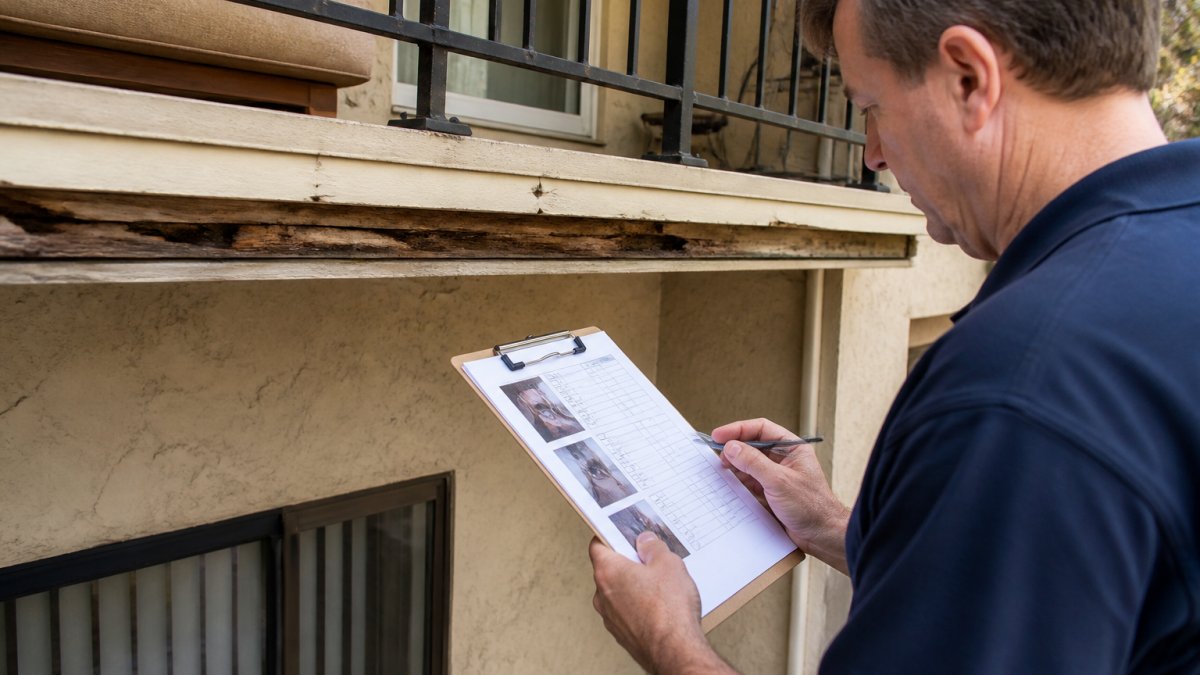
Ask about inspection methodology. Do they use thermal imaging to detect moisture intrusion? Do they extract samples for laboratory testing? Do they document findings with high-resolution photography? A comprehensive inspection goes beyond visual assessment to identify hidden damage inside walls and structural cavities where water damage and dry rot develop.
Request references from similar properties. How many multifamily buildings have they inspected? Have they worked with buildings your size and construction type? A firm experienced with wood-frame structures may lack expertise in concrete construction.
Understand their reporting process. A good inspection report clearly categorizes deficiencies by severity, provides photographs of each issue, explains the underlying cause, and recommends specific repairs with estimated timelines.
Cost transparency matters. Ask for a detailed quote that breaks down inspection fees, report preparation, and additional services. A typical inspection for a mid-size multifamily building requires serious investment, but you should know exactly what you’re paying for.
| Selection Criteria | What to Look For | Why It Matters |
|---|---|---|
| Licensing | California-licensed structural engineer or architect | Ensures legal compliance and professional accountability |
| Experience | 10+ years with multifamily, similar building type | Catches subtle signs of deterioration that newer inspectors miss |
| Methodology | Thermal imaging, sampling, high-res photography | Identifies hidden damage that visual inspection alone cannot detect |
| References | Previous work on comparable properties | Demonstrates track record and familiarity with your building’s structural challenges |
| Reporting | Clear documentation with photos and severity ratings | Provides guidance for repairs and defensibility in regulatory review |
| Pricing | Written estimate with itemized breakdown | Prevents surprise costs and allows budget planning |
Inspection Software Platforms as Alternatives
Software platforms offer an alternative to traditional on-site inspection services. Rather than hiring an external firm, these tools help property managers standardize and scale inspection workflows across portfolios. They’re particularly valuable if you manage multiple buildings and need consistent documentation.
Property Inspect and SnapInspect for Portfolio Management
Property Inspect and SnapInspect serve property managers who need to simplify inspections across many units and buildings. Both platforms use mobile-first design, allowing inspectors to document findings on tablets or smartphones in real time.
Property Inspect manages over 12,000 doors across its user base, indicating significant adoption by large operators. The platform captures inspections, generates reports, and tracks corrective actions consistently across entire portfolios. Mobile and offline capability means inspectors can work anywhere, even in buildings with poor connectivity.
SnapInspect emphasizes speed, claiming to reduce inspection time by up to 75% compared to manual processes. Real-time interactive dashboards let you monitor inspection progress and identify patterns across your portfolio. For property managers juggling multiple buildings, this visibility is invaluable.
Both platforms operate on subscription models with pricing that scales to portfolio size. These platforms require your team to conduct inspections or hire local inspectors to use the software. You’re not outsourcing the inspection itself; you’re standardizing the process.
Use inspection software when you manage multiple properties and need consistency across your portfolio. The real value is in standardized documentation and portfolio-wide visibility, not in replacing specialized structural expertise.
Scribeware for California-Specific EEE Reporting
Scribeware is reporting software specifically customized for California’s SB-721 and SB-326 requirements. Rather than a general inspection platform, it focuses on the exact compliance format regulators expect. The software generates detailed balcony inspection reports that align with California’s statutory requirements and prompts you to document all required elements: structural condition, waterproofing integrity, load-bearing capacity assessments, and recommended corrective actions.
Scribeware is designed for home inspectors and property managers in California. For California properties, it removes ambiguity about report formatting and ensures you’re documenting everything regulators require. Like other software solutions, it requires you to have someone conduct the actual inspection.
Drone-Based and Advanced Inspection Technologies
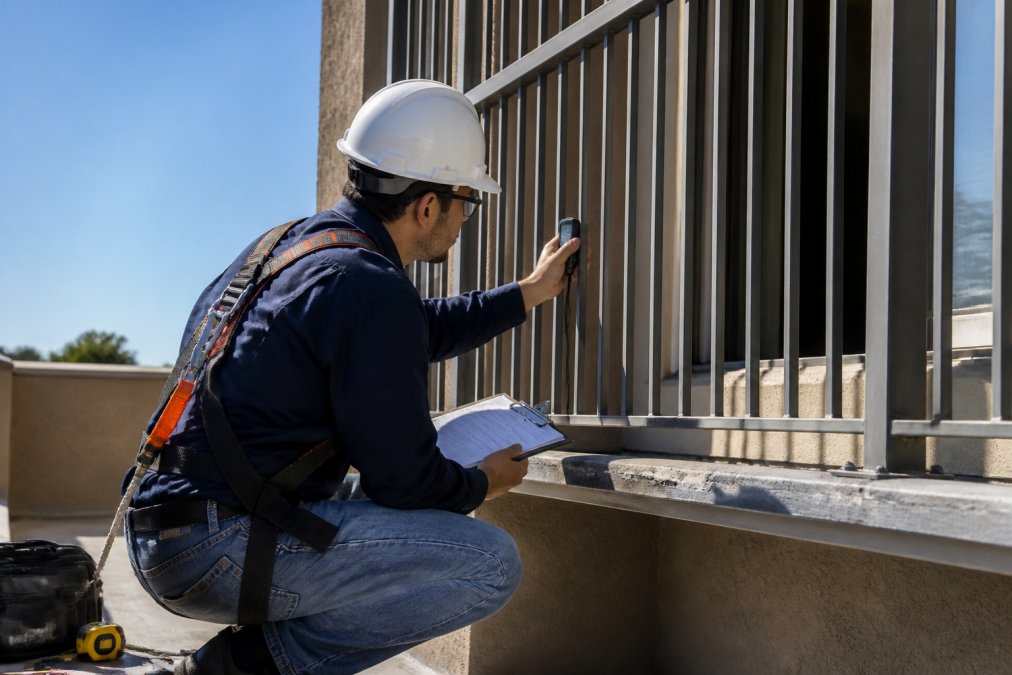
Drone technology and artificial intelligence are transforming how property managers assess building facades and exterior elements. These approaches reduce safety risks by minimizing the need for inspectors to work at height while capturing high-resolution imagery and 3D data that reveal defects human eyes might miss.
Pointivo and Hammer Missions for Facade Assessment
Pointivo uses drones to capture facade imagery and AI analysis to detect deficiencies automatically. The system generates 3D models that allow 360-degree visual inspection from the ground. This is particularly valuable for high-rise buildings where traditional scaffolding or lift access becomes expensive and dangerous.
Hammer Missions offers similar drone-based inspection with AI-powered analysis and thermal inspections that detect moisture intrusion and heat loss. Automated flight planning means the drone can navigate complex building geometries without manual piloting. The software generates 2D, 3D, and 4D deliverables, including time-series data showing how conditions change.
Both platforms require drone hardware and operator expertise. The advantage is reduced safety risk and faster assessment of large facades. The limitation is that drones cannot access interior spaces or inspect structural cavities where hidden damage develops. They’re best used alongside traditional inspections, not as complete replacements.
Large multifamily buildings with extensive facades where traditional scaffolding access is expensive or dangerous. Drone inspection provides rapid facade assessment and early detection of weathering, cracks, and moisture damage.
Exterior Elevated Elements Inspection Cost Considerations
Understanding inspection costs helps you budget appropriately and evaluate competing proposals. Inspection fees vary based on building size, structural complexity, accessibility, and assessment scope. A small 12-unit wood-frame building costs less to inspect than a 200-unit concrete high-rise with complex facade systems.
When evaluating proposals, ask what’s included in the inspection fee. Does it cover only visual assessment, or does it include sampling, testing, and laboratory analysis? Are travel costs, equipment rental, and scheduling coordination included?
[California Building Standards Commission guidance on inspection(/multi-unit-balcony-safety-compliance-tips/) scope and documentation | bsc.ca.gov] clarifies what inspections must cover. Compare the inspection cost against potential repair costs. A thorough inspection that costs several thousand dollars might identify problems early, preventing repair costs exceeding $100,000. Budget for follow-up inspections on a regular cycle to prevent surprise costs from derailing your budget.
Specialized Consulting and Repair Services
Beyond software platforms and drone technology, specialized consulting firms and repair contractors offer comprehensive solutions that combine assessment with remediation planning and execution.
Building Envelope Consulting and Structural Engineering
Firms like Salas O’Brien provide building envelope consulting services that go beyond inspection. They diagnose failures, recommend improvements, and guide long-term asset protection. Building envelope consulting addresses moisture resistance, structural soundness, energy efficiency, and durability. Structural engineering firms bring specialized expertise in load-bearing analysis, material science, and failure mechanisms.
These services are typically project-based. A simple consultation might cost a few thousand dollars. A comprehensive structural analysis of a large building could exceed tens of thousands.
Full-Service Restoration and Repair Contractors
Firms like TRG Construction and Urban Complex GC offer end-to-end balcony and stair tower restoration. Rather than simply identifying problems, they manage the entire repair process from engineering review through installation. This integrated approach reduces coordination complexity and ensures repairs meet current building codes.
The advantage of full-service contractors is that one entity manages the entire project, reducing miscommunication risk. Repair costs vary dramatically based on deterioration extent. Minor repairs might cost $10,000 to $30,000. Extensive structural replacement on a large building can exceed $500,000. Early inspection saves enormous repair costs.
Selecting the Right Balcony Inspection Solution for Your Building
Your choice depends on building size, structural type, timeline, and available budget.
For small buildings (under 50 units) with straightforward structures: A traditional inspection by a licensed professional is usually best. Apex Balcony specializes in this scenario, with licensed inspectors who identify early signs of structural failure and provide clear guidance on necessary repairs.
For large portfolios (100+ units across multiple buildings): Inspection software like Property Inspect or SnapInspect makes sense. Standardized documentation and portfolio-wide visibility justify the software investment.
For buildings with complex or inaccessible facades: Drone-based inspection through Pointivo or Hammer Missions reduces safety risks and accelerates assessment.
For buildings with significant deterioration requiring repair planning: Building envelope consulting or full-service restoration contractors help you develop a strategic repair plan aligned with your long-term capital budget.
Most property managers benefit from a hybrid approach: traditional inspection to identify problems, software to organize findings and track repairs, and specialized consulting when repairs are complex.
National Association of Home Inspectors standards for exterior element assessment provides additional guidance on inspection best practices.
The bottom line: your inspection choice directly affects resident safety and liability exposure. Invest in thorough, professional assessment conducted by licensed experts who understand California’s regulatory requirements and your building’s specific structural challenges.
Property managers across California face intense pressure to balance compliance costs with tight budgets. The right inspection partner removes that pressure by providing clarity on what repairs are actually needed. Apex Balcony helps building owners and HOAs protect their residents and assets by ensuring all balconies, decks, and stairways meet essential safety standards. Our team of licensed inspectors brings decades of construction and design experience to every assessment. Book an inspection with Apex Balcony and get a clear path to compliance and resident safety.
Frequently Asked Questions
What is the difference between SB-721 and SB-326 inspections?
SB-326 applies to multifamily properties with three or more units built before January 1, 2008, and requires inspection of exterior elevated elements (balconies, decks, stairways) by January 1, 2025. SB-721 extends these requirements to newer properties and buildings with two or more units. Both laws mandate structural integrity assessment, waterproofing evaluation, and load-bearing capacity verification. The inspection timeline and scope depend on your building's age and unit count, so verify which applies to your property with a licensed inspector.
How do I find a qualified balcony inspector for my multifamily property?
Look for licensed structural engineers, contractors, or inspectors with specific experience in California exterior elevated elements (EEE) inspections. Verify they understand SB-721 and SB-326 requirements, carry liability insurance, and can provide references from similar multifamily projects. Ask about their process for identifying dry rot, termite damage, moisture intrusion, and structural deficiencies. Request a sample inspection report to confirm it meets regulatory standards. For small buildings (12 units or fewer), confirm they work at your property size rather than focusing only on large HOAs.
What should I expect to pay for an exterior elevated elements inspection?
Inspection costs vary based on building size, number of balconies, structural complexity, and inspector expertise. Factors affecting cost include whether your building is wood-frame or concrete, the extent of visible damage, and accessibility. Software-based inspection platforms (Property Inspect, SnapInspect) typically charge subscription fees and work best for managing multiple properties. Traditional licensed inspector fees depend on the scope and building characteristics. Contact inspection providers directly for a quote tailored to your property; many offer free initial consultations to assess your building's needs.
What happens if I don't comply with SB-721 or SB-326 inspection deadlines?
Non-compliance can result in significant liability exposure, fines from local building departments, and potential lawsuits if injuries occur. Property owners face legal responsibility if balcony failures cause resident injuries or deaths. Insurance claims may be denied if inspections were not completed on schedule. The 2015 Berkeley balcony collapse and 2021 Malibu incident demonstrate the serious consequences of deferred structural assessments. Completing inspections on time protects residents, establishes a clear repair timeline, and demonstrates due diligence to regulators and insurers.
Can I use inspection software instead of hiring a licensed professional?
Inspection software (Property Inspect, SnapInspect, Scribeware) streamlines data collection and report generation but does not replace the need for a licensed structural engineer or qualified inspector to assess structural integrity. These platforms help manage inspection workflows, track compliance across portfolios, and standardize reporting formats. However, California law requires qualified professionals to conduct the actual inspection, evaluate load-bearing capacity, and certify findings. Use software to organize and track inspection data, but hire licensed professionals to perform the technical assessment and sign off on compliance.