Emergency Balcony Repairs for HOAs: A Compliance Guide
Emergency balcony repairs for HOAs require fast action and legal compliance. Learn SB 326 vs SB 721, inspection requirements, and repair protocols.
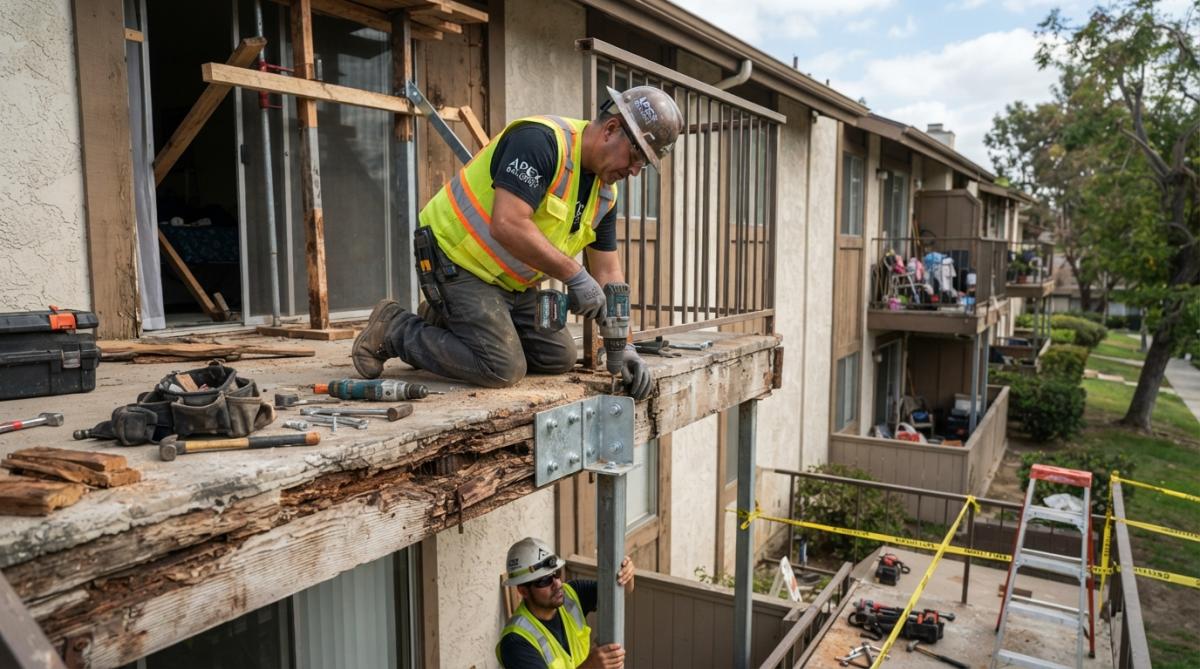
Table of Contents
- What Qualifies as an Emergency Balcony Repair for HOAs
- SB 326 Compliance for HOAs and Emergency Situations
- Emergency Repair Protocols HOA Boards Must Follow
- HOA Balcony Repair Responsibility: Legal Obligations
- HOA Emergency Reserve Funds for Balcony Repairs
- Inspection and Reporting Requirements for Emergency Repairs
- Consequences of Delaying Emergency Balcony Repairs
- Conclusion
Last Updated: July 28, 2026
What Qualifies as an Emergency Balcony Repair for HOAs
Emergency balcony repairs address structural defects posing immediate risk to resident safety or violating California building codes. The 2015 Berkeley balcony collapse that killed six residents remains a stark reminder of what happens when HOAs delay addressing structural problems. This guide covers what qualifies as an emergency, when to act, and how to protect your residents and your board’s liability.
Signs of Immediate Structural Failure
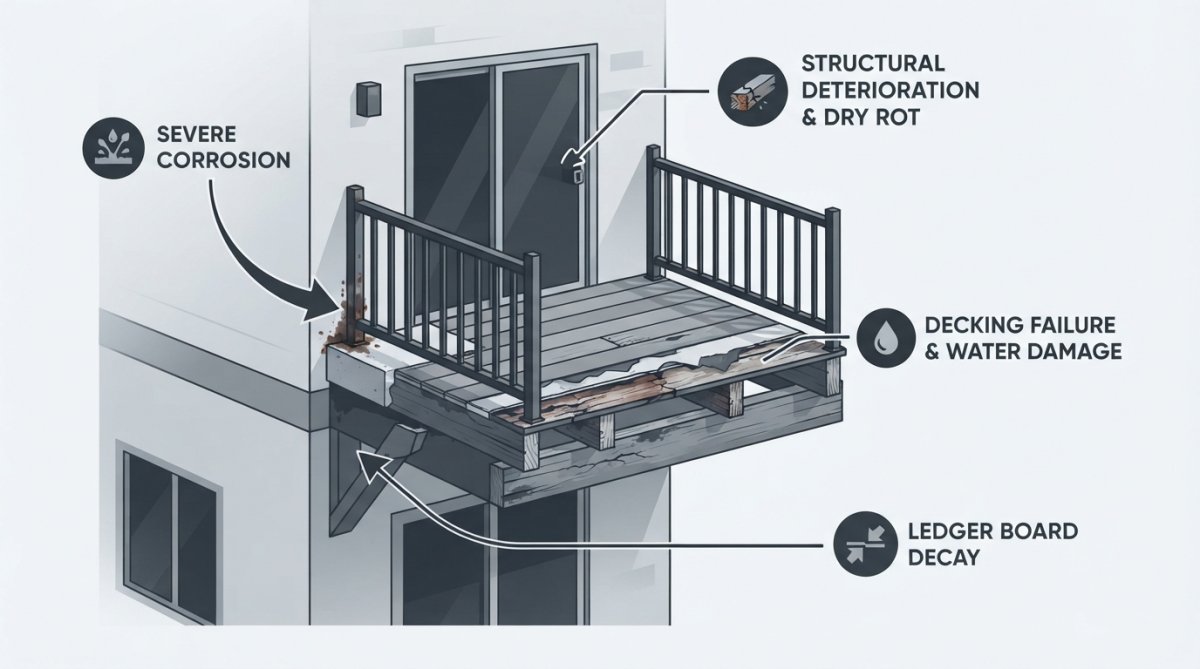
Visible dry rot, water damage penetrating the building envelope, and corrosion of load-bearing components are structural emergencies. Residents seeing daylight through railing gaps, cracking or spalling deck surfaces, and significant rust on metal fasteners are red flags. Load-bearing element failures are most dangerous, if a balcony ledger board is pulling away from the building or support posts are visibly deteriorating, the entire structure could fail without warning. Water damage is particularly insidious because it works from the inside out; by the time visible damage appears, rot or corrosion may be far more extensive than surfaces suggest.
When to Close Off Elevated Exterior Elements
The moment you identify a potential structural defect, you have a legal and moral obligation to prevent resident access. Rope off the balcony, post warning notices, and document everything. California Civil Code requires that HOAs maintain common areas in safe condition. Allowing residents to use a defective balcony after discovering the problem opens your board to liability far beyond repair costs.
Allowing residents to use a balcony after discovering defects can result in personal injury lawsuits, regulatory fines, and board member personal liability. Document the date you discovered the issue and the date you restricted access. This timeline is critical evidence if a legal challenge arises.
SB 326 Compliance for HOAs and Emergency Situations
SB 326 applies to condominium projects and common interest developments built before January 1, 2018, requiring periodic inspection of elevated exterior elements with strict compliance timelines. If your building is subject to SB 326 and you discover a defect during normal operations, you must treat it as an emergency regardless of inspection cycles.
Inspection Frequency and Deadline Requirements
Under SB 326, HOAs must inspect buildings at least once every nine years. If a defect poses immediate safety threat, it must be addressed immediately or the area must be closed off. An emergency discovery resets these timelines, you must notify the board, notify residents, engage a qualified inspector or structural engineer, and begin remediation.
According to California Civil Code Section 5551 guidance, boards must document all communication regarding identified defects and repair timelines. This documentation is your primary defense if a resident is injured or regulators audit your compliance.
Create a defect log tracking the date each issue was discovered, who discovered it, what action was taken, and when repairs were completed or scheduled. This simple document is invaluable evidence of your board’s diligence.
SB 326 vs. SB 721: Which Law Applies to Your Emergency
SB 721 applies to buildings constructed on or after January 1, 2018, with similar inspection requirements but different timelines. SB 326 covers older properties; SB 721 covers newer ones. Both laws require immediate action on defects posing safety threats.
| Requirement | SB 326 | SB 721 |
|---|---|---|
| Applies to | Pre-2018 construction | 2018+ construction |
| Inspection frequency | Every 9 years | Every 6 years initially, then 9 years |
| Emergency timeline | Immediate or closure | Immediate or closure |
| Qualified inspectors | Structural engineer, architect, civil engineer | Same requirements |
| Report filing | To board and residents | To board and residents |
Don’t get caught up in which statute applies to your building. Focus on the core requirement: if there’s a safety threat, close it off immediately and get a professional assessment within days, not weeks.
Emergency Repair Protocols HOA Boards Must Follow
The moment a resident reports a structural defect or your maintenance team discovers one, your board enters emergency mode.
Immediate Steps When a Balcony Defect Is Discovered
First: secure the area by roping off the balcony, posting warning signs, and preventing resident access. Document the date, time, and nature of the defect with photos. Second: notify your board president and property manager immediately. Third: contact a qualified structural engineer or architect within 24 hours. Fourth: notify residents in writing that the area is closed and an assessment is underway. Fifth: follow up with your insurance carrier to report the potential claim.
This sequence takes less than a day to complete. Document every action: names of people contacted, dates and times of contact, and what was communicated. This paper trail protects your board if a resident later claims they weren’t notified or if a regulator questions your response time.
Engaging Licensed Professionals for Assessment
California law requires that balcony inspections be performed by a structural engineer, licensed architect, or civil engineer with appropriate experience. You cannot use a general contractor or property manager. The professional must be licensed in California and have demonstrated expertise in building envelope and structural issues.
When you contact a professional, be specific about the defect. Describe what you’ve observed, provide photos, and explain when it was discovered. Ask about availability and turnaround time for a written report. Most qualified engineers can provide preliminary assessment within days and detailed reports within two weeks. Expect to budget between $1,500 and $5,000 for an emergency assessment depending on building size and complexity.
HOA Balcony Repair Responsibility: Legal Obligations
HOA balcony repair responsibility is non-negotiable under California law. Your board has a fiduciary duty to maintain common areas in safe condition, including elevated exterior elements, regardless of how they’re classified in your CC&Rs. The law supersedes private agreements when public safety is at stake.
Common Interest Development Liability
A common interest development is any residential property with shared common areas and an HOA responsible for maintenance. Balconies are common areas unless exclusively attached to a single unit with explicit CC&R assignment to that unit owner. Even then, the HOA retains liability for structural integrity and safety code compliance.
California courts have consistently held that HOAs cannot escape liability for common area defects by delegating responsibility to residents. If a balcony collapses and injures someone, the injured party will sue the HOA, board members, property manager, and potentially the structural engineer. Your board’s best defense is demonstrating that you acted with urgency and competence the moment you became aware of a defect.
Board members can face personal liability if the board fails to act on known defects. Your personal homeowner’s insurance does not cover this exposure. Many boards carry directors and officers liability insurance specifically to protect against this risk.
Liability Protection Through Proper Documentation
The single most effective liability protection is documentation. When you discover a defect, document it. When you notify the board, document it. When you engage a professional, document it. When you receive the assessment report, document your board’s response. When you schedule repairs, document the timeline and scope of work. When repairs are completed, document the final inspection and sign-off.
This documentation demonstrates to regulators that your board acted in good faith and with appropriate urgency. It protects individual board members by showing they voted to address the issue promptly. Keep all documents, emails, photos, inspection reports, repair bids, contracts, and completion certificates in a centralized file accessible to your property manager and board president.
According to California Department of Consumer Affairs guidance on HOA responsibilities, boards that maintain detailed records of maintenance decisions and safety assessments are significantly less likely to face regulatory action or litigation.
HOA Emergency Reserve Funds for Balcony Repairs
Emergency balcony repairs can cost anywhere from $10,000 for minor structural work to $500,000 or more for comprehensive remediation. Most HOAs don’t have this level of cash on hand, which is why reserve planning is critical.
Cost Estimation and Budget Planning
The cost of emergency repairs depends on the scope of the defect. Small dry rot areas might cost $5,000 to $15,000. Complete balcony replacement for a multi-unit building could cost $200,000 to $500,000. Before you can budget, you need a professional assessment. The structural engineer’s report will identify the scope of work required and often provide repair cost estimates.
Once you have the scope and estimate, your board has several options: fund the repair from existing reserves, conduct a special assessment, or phase repairs over multiple years. Most boards choose a combination: use available reserves to address the most critical safety issues immediately, then fund the remainder through a special assessment or multi-year plan. Transparency is key, residents need to understand why the repair is necessary, what it will cost, and how the board plans to fund it.
Special Assessments vs. Reserve Fund Allocation
A special assessment is a one-time charge to residents to fund a specific repair. A reserve fund allocation is money already collected through regular dues and held for future maintenance. If your reserve study shows full funding, you may cover emergency repairs without assessment. If reserves are underfunded, you’ll likely need to assess residents.
Before proposing a special assessment, check your CC&Rs and state law. California law requires that HOAs provide residents with specific information about any proposed special assessment, including the reason, total cost, and amount per unit. Communicate early and often about the defect, safety implications, repair timeline, cost estimates, and funding options.
Request a reserve study update specifically focused on balcony and elevated exterior element maintenance. This gives your board a baseline for planning and helps justify special assessments to residents and regulators.
Inspection and Reporting Requirements for Emergency Repairs
California law requires that all balcony inspections be documented in a written report provided to the board and residents.
Who Is Qualified to Perform Emergency Inspections
A structural engineer, licensed architect, or civil engineer with appropriate experience can perform the inspection. The professional must be licensed in California and have demonstrated expertise in building envelope issues, waterproofing, and structural assessment. When you contact potential inspectors, ask about their background, experience with residential buildings, balcony assessments, and familiarity with your building’s construction type and SB 326/SB 721 compliance.
The inspector assesses the current condition of elevated exterior elements, identifies defects, estimates severity, and recommends repairs. They should provide enough detail that a contractor can develop a repair plan based on their findings.
Documentation Standards and Compliance Records
The inspection report must include property identification, inspection date, scope of inspection, and inspector’s qualifications. It must describe each defect found, including location, apparent cause, and estimated severity, with photos or visual documentation of significant defects. For emergency situations, the report should clearly state whether the defect poses immediate safety threat.
Keep the inspection report in your permanent file. Provide a copy to residents as required by law. Attach it to board meeting minutes. The report is the foundation document for everything that follows.
According to California Homeowner Association Law requirements for inspection documentation, boards must retain all inspection reports and related correspondence for at least seven years.
Consequences of Delaying Emergency Balcony Repairs
The consequences of delaying emergency repairs extend far beyond repair costs. Boards that fail to act quickly face regulatory penalties, resident lawsuits, and in the worst cases, criminal liability.
Non-Compliance Penalties and Legal Exposure
If your board fails to comply with SB 326 or SB 721 inspection and repair requirements, the California Department of Consumer Affairs can impose fines reaching $500 to $1,000 per day for continued non-compliance. Residents can file complaints with local building departments or the state attorney general’s office, triggering investigations and enforcement actions.
More immediately, residents can sue the HOA for breach of fiduciary duty. If a resident is injured on a defective balcony that the board knew about but failed to repair, the HOA is liable for damages including medical expenses, lost wages, pain and suffering, and punitive damages if the board’s conduct was particularly egregious. Individual board members can also face personal liability.
Resident Safety and Liability Risk
The most serious consequence of delay is resident injury or death. A balcony collapse can cause multiple injuries or fatalities. Beyond catastrophic events, smaller injuries accumulate, a resident slips on deteriorated surface, another is hit by falling debris, a child’s arm goes through a gap in the railing. Each incident creates liability and could have been prevented if the board had acted on known defects.
The risk multiplies if your board received complaints about a defect and failed to act. A resident who reported a loose railing six months ago, whose complaint was ignored, and who is now injured on that railing, faces a much stronger lawsuit than one where the defect was recently discovered and immediately addressed.
Emergency balcony repairs for HOAs are not optional. They’re a legal requirement and fundamental responsibility of board membership. The moment you discover a structural defect in an elevated exterior element, close off the area immediately, engage a qualified professional within 24 hours, and move toward remediation with urgency. Apex Balcony provides professional inspections that identify structural defects early, helping your board avoid emergency situations altogether. Our licensed inspectors deliver detailed reports that document defects, assess severity, and recommend repairs, giving your board the clarity and credibility needed to act decisively. Book an inspection today and protect your residents and your board from the liability exposure that comes with delay.
Frequently Asked Questions
Who is responsible for emergency balcony repairs in an HOA?
HOA boards are typically responsible for repairs to common area balconies and elevated exterior elements under California Civil Code. The HOA must maintain these structures in a safe, habitable condition. Individual unit owners may be responsible only if the balcony is exclusive to their unit and designated as owner-maintained in the governing documents. Consult your CC&Rs and engage a licensed professional to clarify responsibility for your specific property.
What is the difference between SB 326 and SB 721 for emergency balcony repairs?
SB 326 applies to condominiums and common interest developments with three or more units built before January 1, 2020, requiring visual inspections of elevated exterior elements every nine years. SB 721 applies to residential buildings with six or more units built before January 1, 2008, with stricter inspection timelines. Both mandate periodic inspections and remediation of defects like waterproofing failures and load-bearing damage. Your emergency repair obligations depend on which law governs your property.
How should an HOA fund emergency balcony repairs?
HOAs can fund emergency repairs through existing reserve funds, special assessments, or a combination of both. A reserve study helps project future costs and guide budgeting. For true emergencies requiring immediate closure of balconies, boards may need to levy a special assessment to cover costs quickly. Consult your reserve study and financial advisor to determine the most appropriate funding mechanism while protecting the HOA's financial stability.
What steps should an HOA take immediately after discovering a balcony defect?
First, restrict resident access to the affected balcony or elevated exterior element to prevent injury. Second, notify residents and document the discovery in writing. Third, engage a licensed structural engineer, architect, or civil engineer to perform a visual inspection and assessment. Fourth, obtain a detailed inspection report documenting the defect, its severity, and recommended remediation. Finally, develop a timeline for repairs and communicate the plan to residents. Prompt action protects resident safety and demonstrates compliance with California Civil Code obligations.