7 Signs of Dry Rot in Wooden Balcony Structures
Identify 7 warning signs of dry rot in wooden balcony structures, from soft wood to dark patches. Learn how to spot decay early and protect your property.
Last Updated: October 24, 2026
Quick Summary
Signs of dry rot in wooden balcony structures include soft or spongy timber, dark patches and discoloration, visible white fungal strands, peeling paint, warping and shrinkage, cracks and splits, and water stains. Dry rot thrives at just 20-30% moisture content and can compromise an entire balcony’s safety within months, spreading invisibly inside the wood before surface damage appears.
- Dry rot spreads rapidly at 20-30% moisture content and can compromise an entire balcony within months
- White or cream-colored fungal strands (mycelium) indicate active decay advancing rapidly across the wood
- Professional inspection is the only way to confirm dry rot and assess structural safety; home tests reveal surface conditions only
- Address the moisture source first when repairing dry rot, or decay will return
- Extensive decay deeper than 1/2 inch or affecting multiple boards requires full replacement, not patching
Table of Contents
- What Is Dry Rot and Why It Threatens Wooden Balconies
- How to Identify Wood Rot: The Seven Critical Warning Signs
- Dry Rot vs. Wet Rot: Understanding the Difference
- Balcony Structural Inspection: Safe Testing Methods
- What Causes Dry Rot and How Moisture Drives Decay
- Wood Rot Repair Options and When to Act
- Schedule Your Professional Balcony Inspection
- Frequently Asked Questions
What Is Dry Rot and Why It Threatens Wooden Balconies
Dry rot is a fungal decay that destroys wood’s structural integrity and can compromise an entire balcony’s safety within months.
Wooden balconies are exposed to weather on all sides, and rain, snow, and humidity breed fungal spores.
At Apex Balcony, we’ve helped building owners catch dry rot before it becomes a safety crisis. These seven warning signs are what our licensed inspectors look for first.
How to Identify Wood Rot: The Seven Critical Warning Signs
These seven signs indicate active decay that requires professional assessment and repair.
Soft, Spongy, or Crumbling Timber
Press a finger or flathead screwdriver gently into the wood. Healthy timber resists pressure; dry rot feels soft and spongy, like compressed cork or damp cardboard, and may crumble under light pressure.
The fungus breaks down the wood’s cellular structure from inside, leaving a brittle shell. By the time wood feels spongy, decay has spread deep into the structure and load-bearing capacity is compromised.
Dark Patches and Discoloration
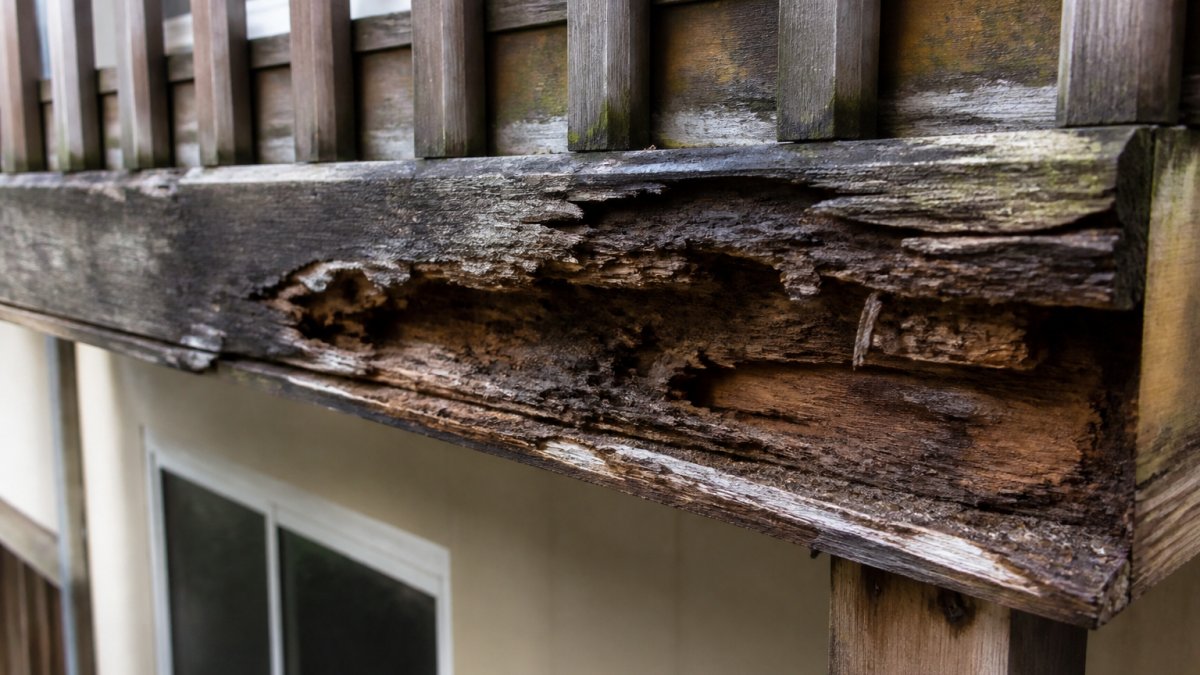
Look for irregular dark brown, gray, or black patches, streaks or blotches across deck boards, support posts, or railings, often accompanied by darkened wood grain.
The fungus produces pigments that stain the wood as it feeds. Unlike water stains, dry rot discoloration persists and spreads, meaning decay has likely penetrated beyond the surface layer.
Visible Fungal Growth and White Strands
Dry rot produces white or cream-colored fungal strands called mycelium, often along joints, seams, or end grain, looking like fine cotton or webbing across the wood.
Visible mycelium confirms active decay. It spreads aggressively, traveling across gaps and even concrete to colonize new wood, so white fungal growth means decay is advancing rapidly.
Peeling Paint and Failing Coatings
Premature peeling or bubbling indicates moisture problems beneath the surface. Look for paint that cracks, blisters, or peels in large sections; the wood underneath may feel damp or soft.
Peeling coatings expose wood to moisture, while active dry rot pushes moisture outward and causes coatings to fail from inside, a vicious cycle. If your paint is failing, have the underlying wood inspected.
Warping, Shrinkage, and Curled Edges
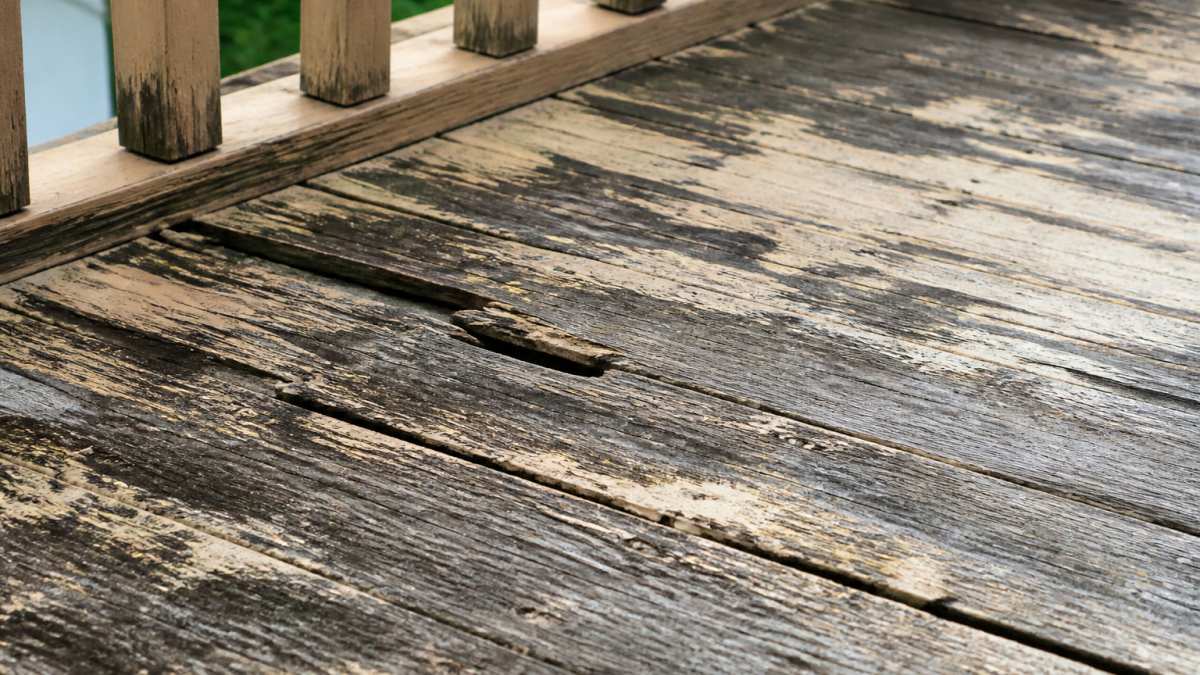
Dry rot causes uneven shrinkage: deck boards warp, cup, or curl, and posts twist or lean as the fungus destroys the cellular structure that gives wood its strength and form.
Warping is a structural red flag, the wood is no longer bearing weight evenly. Curled edges and twisted posts mean decay has visibly deformed the timber and require immediate professional assessment.
Cracks, Splits, and Structural Gaps
Dry rot makes wood brittle and prone to cracking. Look for splits along the grain, especially at joints where boards meet posts.
Cracks let moisture penetrate deeper, accelerating decay, and reduce the cross-sectional area of load-bearing members. Gaps between boards or between a board and its support indicate shrinkage from decay.
Water Stains and Moisture Exposure
Water stains are light or dark marks where water repeatedly contacts the wood, along bottom edges of boards, around fasteners, or at joints where water collects.
Water stains pinpoint where water enters and sits, the exact locations where dry rot begins. Addressing moisture exposure stops decay before it starts.
These seven signs indicate active decay that requires professional assessment and repair.
| Warning Sign | What to Look For | What It Indicates |
|---|---|---|
| Soft, Spongy, or Crumbling Timber | Wood feels like compressed cork or damp cardboard under pressure | Fungus has broken down cellular structure; load-bearing capacity compromised |
| Dark Patches and Discoloration | Irregular dark brown, gray, or black streaks or blotches | Decay has penetrated beyond the surface layer |
| Visible Fungal Growth and White Strands | White or cream-colored mycelium along joints, seams, or end grain | Active decay advancing rapidly across the wood |
| Peeling Paint and Failing Coatings | Paint that cracks, blisters, or peels in large sections | Moisture problems beneath the surface; wood underneath may be soft |
| Warping, Shrinkage, and Curled Edges | Deck boards warp, cup, curl; posts twist or lean | Fungus has destroyed cellular structure; structural red flag |
| Cracks, Splits, and Structural Gaps | Splits along the grain, especially at joints | Decay makes wood brittle; moisture penetrates deeper |
| Water Stains and Moisture Exposure | Light or dark marks where water repeatedly contacts wood | Pinpoints where water enters and sits; where dry rot begins |
Dry Rot vs. Wet Rot: Understanding the Difference
Both destroy wood, but they develop differently and require different responses.
Wet rot requires constant moisture (above 50%) and stays localized, producing dark, slimy decay without visible fungal strands.
The key difference: dry rot is aggressive and spreads fast; wet rot is slower and stays put.
Both require repair, but dry rot demands faster action, it can compromise an entire balcony in months, while wet rot usually progresses more slowly.
Balcony Structural Inspection: Safe Testing Methods
Professional inspection is the only way to confirm dry rot and assess structural safety, but you can perform preliminary non-destructive checks yourself, provided you understand their limits.
No home test can establish that a balcony is safe to use. If you see sagging, movement, or severe decay, stop using the balcony and arrange an urgent professional assessment.
A Balcony-Specific Inspection Checklist
General deck and home inspection advice misses the components that make balconies different. Work through this checklist systematically, from the walking surface down to the connections that hold the balcony to the building.
Decking and walking surface
- Walk the full surface and note any springy, soft, or uneven boards.
- Check board ends and cut edges, where end grain absorbs water fastest.
- Look for dark patches, white strands, or paint failure along board seams.
Joists and framing
- Inspect joists from below where accessible; look for sagging, splitting, and fungal growth.
- Probe the top edge of joists near the ledger and at bearing points.
Ledger connections
- The ledger is where the balcony attaches to the building, the highest-consequence area on the structure.
- Look for rusted or loose fasteners, water staining, and decay around bolt holes.
- Check flashing above the ledger; failed flashing is a common moisture entry point.
Posts and columns
- Check the base of each post, where water collects and where decay often starts.
- Look for twisting, leaning, or splitting along the grain.
- Confirm posts are not sitting directly in soil or standing water.
Railings and guardrails
- Test railings for wobble; a loose railing can indicate decay at the attachment points.
- Inspect the bottom rail and post bases for softness and staining.
Underside and concealed areas
- Look up at the underside of the balcony for staining, fungal growth, and drips.
- Check where the balcony meets the wall and any enclosed soffit areas.
Safe, Non-Destructive Tests and Their Limits
The screwdriver test: Press a flathead screwdriver gently into suspect wood.
Visual inspection: Walk the entire balcony surface and check the checklist areas above.
Moisture meter testing: A moisture meter measures wood moisture content.
Tap test: Tap the wood with a hammer. Solid wood sounds hollow. Decayed wood sounds dull or flat.
These tests reveal surface and near-surface conditions only. Dry rot often spreads deep inside the wood long before surface signs appear. A board that passes the screwdriver test may still have significant internal decay, and a screwdriver test cannot establish structural safety.
Learn how to identify dry rot in wooden balcony supports with visual signs and testing methods that complements the inspection process. For a comprehensive preparation checklist before professional assessment, explore our inspection preparation guide.
This is why professional inspection matters.
What Causes Dry Rot and How Moisture Drives Decay
Dry rot begins with moisture. Even though it’s called “dry” rot, the fungus requires moisture to establish itself.
Common moisture sources in balconies include:
- Blocked or failed drainage systems that trap water on the surface
- Cracks in sealant or coatings that allow water to penetrate
- Condensation from temperature differences between inside and outside
Moisture creates the conditions for fungal spores to germinate.
The fungus spreads through mycelium, the white strands you may see. These strands can travel across gaps, concrete, and even metal to reach new wood.
Wood Rot Repair Options and When to Act
Once dry rot is confirmed, you face a critical decision: repair or replace. The scope of decay determines your options, but so does the location of the damage and the condition of connected members.
Immediate Safety Actions
If you see movement, sagging, or severe decay, act before you plan repairs:
- Keep people and pets off the balcony.
- Do not store heavy items on the structure.
- Restrict access with a barrier or locked door if the balcony serves a rental unit.
A balcony that moves underfoot or visibly sags may be close to failure. Do not test it by walking on it repeatedly.
Repair Scope and Decision Criteria
Surface decay (less than 1/4 inch deep): Limited repair is possible. Remove the decayed wood, treat with fungicide, and seal the area. This works only for small, localized areas where the surrounding wood is sound.
Moderate decay (1/4 to 1/2 inch deep): Partial board replacement may be cost-effective. Remove the affected section, treat the remaining wood, and install a new section using rot-resistant materials.
Extensive decay (deeper than 1/2 inch, multiple boards, or structural members): Full replacement is necessary. Patching extensive decay is a temporary fix that will fail. Structural members bearing weight must be replaced, not repaired.
Connected members and waterproofing: Decay rarely stops at the board you can see.
Explore repair alternatives to full replacement, giving you options when dry rot damage is discovered. Compare wood alternatives for balcony repairs if replacement is your path forward.
Fix the Moisture Source First
Repairing decay without correcting the moisture source invites a repeat.
Address waterproofing as a preventative measure against the moisture that causes dry rot in wooden balconies.
The timeline matters. Small decay caught early may be repairable.
Professional assessment determines which option applies to your situation. Don’t guess. A licensed inspector can tell you exactly what needs to happen and why.
Schedule Your Professional Balcony Inspection
Identifying signs of dry rot in wooden balcony structures is the first step toward safety and compliance.
Professional inspection is your insurance policy. Licensed inspectors detect decay you cannot see, assess structural integrity, and provide a clear repair plan.
Apex Balcony specializes in identifying early signs of structural failure in wooden balconies, decks, and stairways. Our licensed inspectors have decades of combined construction and design experience.
If you’ve noticed any of the seven warning signs above, or if your balcony hasn’t been inspected in over a year, contact us for a professional assessment. Early detection saves money, prevents accidents, and keeps your property safe.
Frequently Asked Questions
What does dry rot look like on a wooden balcony?
Dry rot appears as dark, discolored patches on wood, often with a silvery or white fungal growth visible on the surface. Affected timber becomes soft and spongy when pressed, and the wood may crack or split along the grain. Paint typically peels or bubbles above rotted areas. The decay often spreads from joints, seams, and end grain where moisture accumulates. Early detection requires a close visual inspection of deck boards, railings, and support posts.
How do you tell if balcony wood is rotten or just weathered?
Weathered wood appears gray or silvery but remains structurally sound and hard when pressed. Rotted wood is soft, spongy, or crumbly to the touch, and a screwdriver pressed into it will sink in easily. Rot also shows dark staining, fungal growth, or a musty odor, whereas weathering does not. If the wood yields under pressure or splinters easily, decay is present. Weathering affects the surface; rot compromises the interior structure and load-bearing capacity.
What causes dry rot in wooden balcony structures?
Dry rot is caused by fungal growth that feeds on wood cellulose in the presence of moisture, poor ventilation, and warm temperatures. Common sources include water infiltration from failed coatings, standing water on deck surfaces, blocked drainage, and exposure to rain and snow. Balconies are especially vulnerable because they experience constant moisture exposure and are often built with wood that lacks adequate protection. Once established, the fungus spreads rapidly through wood fibers and can damage load-bearing members, creating serious safety risks.
Is a wooden balcony with dry rot safe to use?
A balcony with active dry rot poses a genuine safety hazard and should be treated as restricted access until a professional inspection confirms structural integrity. Dry rot weakens wood from the inside, reducing its load-bearing capacity and increasing the risk of collapse. Even if the balcony appears stable, hidden decay in support posts, ledger boards, or joists can fail suddenly under weight. California property owners are legally required to maintain balconies in safe condition under SB 721 and SB 326. Professional inspection and repair are essential before the balcony is used again.
Don’t wait for visible failure. The balconies that collapse are the ones that weren’t inspected in time. Get a professional assessment today and know exactly what you’re dealing with.