Structural Engineer for Balcony Inspection: 2026 Guide
Need a structural engineer for balcony inspection? Learn costs, what inspectors check, California laws, and how to hire. Book your inspection today.
Table of Contents
- Why You Need a Structural Engineer for Balcony Inspection
- Balcony Safety Regulations Every California Owner Must Know
- Warning Signs of Balcony Structural Damage to Watch For
- What to Expect in a Structural Engineer Balcony Report
- Balcony Inspection Cost: What to Budget in California
- ADU and Elevated Deck Inspections: A Specialized Need
- Step-by-Step Checklist for Hiring a Structural Engineer for Balcony Inspection
- Conclusion
Last Updated: June 10, 2026
Balcony collapses remain one of the most preventable structural failures in California, yet they continue to occur because owners delay professional evaluation. Hiring a structural engineer for balcony inspection is the single most effective step a property owner can take to identify hidden deterioration before it becomes catastrophic. The properties that avoid costly emergencies are the ones that schedule inspections proactively, not reactively.
A balcony inspection is not the same as a general home inspection. Most home inspectors are not licensed professional engineers (PE) and cannot perform the structural analysis or sign off on the engineering calculations that California law mandates under SB 326 and SB 721, which impose specific compliance deadlines and require inspections by licensed professionals.
Why You Need a Structural Engineer for Balcony Inspection
Deferred balcony maintenance is not a cost-saving strategy. It is a liability transfer to future residents, owners, and emergency responders.
A balcony that looks fine from street level can harbor concealed wood rot, corroded steel connections, or compromised load-bearing walls beneath a fresh coat of paint. Visual checks by untrained observers miss these failure modes entirely. California’s building codes now reflect this reality: state legislation explicitly requires that inspections of elevated exterior elements be conducted by licensed structural engineers or architects with relevant experience.
What a Licensed PE Actually Evaluates
A professional engineer conducting a structural engineer for balcony inspection examines far more than surface condition. The evaluation covers:
- Structural calculations: Verifying the balcony’s design load capacity against current California building standards
- Load-bearing connections: Steel connections, ledger attachments, and post bases where failure is most common
- Waterproofing and drainage: Failures here cause the hidden wood rot that leads to sudden collapse
- Foundation and support conditions: Whether the structure transferring balcony loads to the building is performing as designed
- Shoring needs: Whether temporary support is required during repairs
- Geotechnical factors: Soil movement or settlement affecting elevated structures on hillside properties
The engineer produces structural calculations and a written report usable for obtaining building permits for required repairs.
How Balcony Inspections Differ from General Home Inspections
A general home inspector follows a visual checklist. A licensed PE performs a structural analysis. Only a licensed structural engineer can certify that a balcony meets California building standards, sign construction documents, and provide the engineering documentation required by local building departments for permit approval. For balcony compliance under SB 326 or SB 721, home inspectors are not a substitute.
Balcony Safety Regulations Every California Owner Must Know
California leads the country in elevated exterior element legislation, and non-compliance exposes building owners and HOAs to civil liability and regulatory penalties.
According to California Legislative Information on SB 326 and SB 721, both laws establish mandatory inspection timelines and specify the qualifications of inspectors who can certify compliance.
SB 326 Requirements for HOAs and Condominiums
SB 326 applies to common interest developments, primarily condominium associations governed by HOAs. It requires inspection of all elevated exterior elements, including balconies, decks, stairways, and walkways, more than six feet above ground and supported by wood or wood-based products. Inspections must be performed by a licensed structural engineer or architect. The first deadline was January 1, 2025, with subsequent inspections every nine years.
HOAs that rely on general contractors or home inspectors to satisfy SB 326 requirements are not in compliance. Only a licensed structural engineer or architect can certify these inspections under the law. Non-compliant associations face civil liability if a failure occurs.
SB 721 Requirements for Multifamily Rental Properties
SB 721 covers multifamily rental buildings with three or more units. Requirements parallel SB 326 but apply to landlords rather than HOAs. Inspections must be completed by a licensed structural engineer, architect, or contractor with specific experience in elevated exterior elements. The initial deadline was January 1, 2025. Properties that have not yet completed inspections should treat this as an urgent compliance matter.
California Seismic Retrofit and Building Code Compliance
California’s seismic environment adds complexity that most other states don’t face. Balconies attached to older buildings may not meet current seismic retrofitting requirements, particularly in high-seismic zones across the Bay Area, Los Angeles, and San Diego. A structural engineer for balcony inspection must evaluate whether existing connections and framing meet current seismic design standards, often requiring review of original blueprints and comparison against California building standards.
As documented in California Seismic Safety Commission guidance on retrofit requirements, older wood-frame buildings with soft-story conditions are among the highest-risk structures in the state.
Warning Signs of Balcony Structural Damage to Watch For
Most balcony failures don’t happen without warning. The problem is that warnings are often misread or ignored.
Surface-Level vs. Hidden Structural Failure
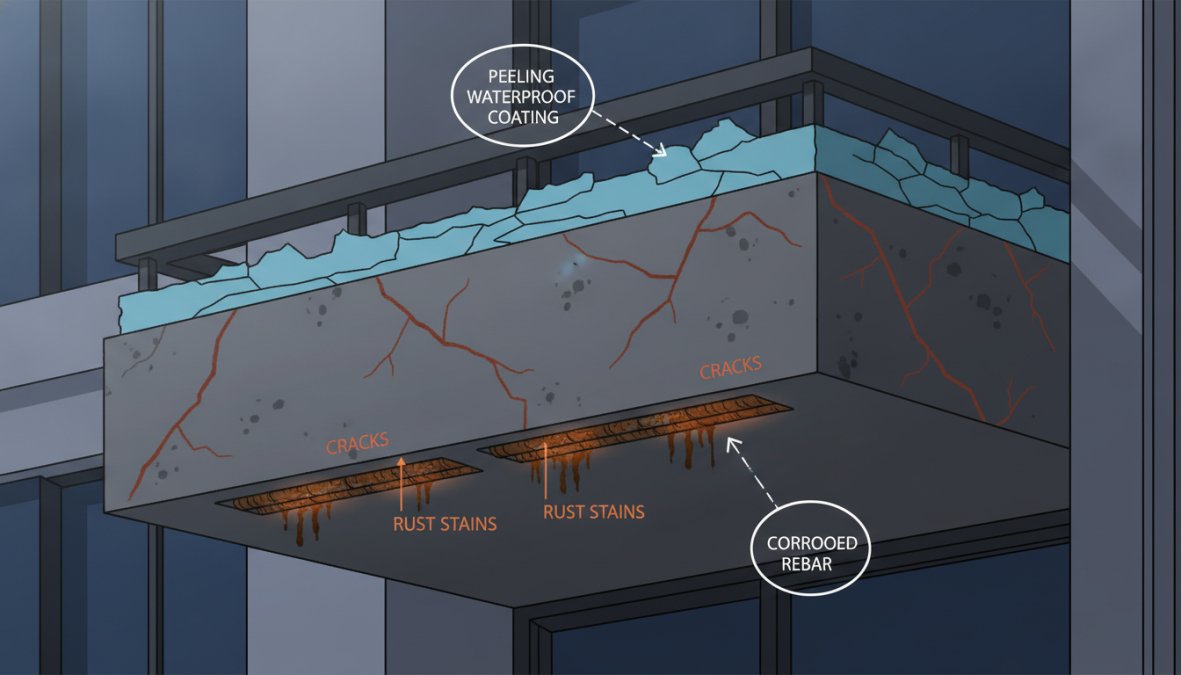
Surface-level warning signs are visible to any observer:
- Cracking or spalling concrete on the deck surface
- Rust staining, indicating corroded rebar or steel connections beneath
- Peeling or bubbling waterproof coating
- Standing water after rain (drainage failure)
- Loose or wobbly railings
- Visible gaps between the balcony and the building facade
Hidden structural failure is the more dangerous category. Wood rot behind cladding, corroded ledger bolts concealed by flashing, and deteriorated sheathing beneath tile finishes produce no visible surface signal until the structure is near failure. This is why a structural engineer for balcony inspection goes beyond visual assessment, using probing, moisture meters, and borescope cameras to evaluate concealed framing.
If you see rust staining on a concrete balcony, treat it as a structural alert, not a cosmetic issue. Rust staining means reinforcing steel inside the concrete is corroding and expanding, fracturing the concrete from within. By the time staining is visible on the surface, the internal damage is already significant.
A small breach in the deck membrane allows water into the framing, where wood rot and steel corrosion proceed year-round, invisible from outside. A balcony that passes a visual check can be structurally compromised within two or three years of undetected water intrusion.
What to Expect in a Structural Engineer Balcony Report
A structural engineer balcony report is a formal document that property owners, HOA boards, and local building departments use to assess compliance and plan repairs.
Key Sections of a Professional Inspection Report
A complete report from a licensed PE should include:
- Property and element identification: Address, unit numbers, and specific elements inspected
- Methodology: How the inspection was conducted, including any destructive or non-destructive testing
- Condition assessment: Element-by-element findings with photographs
- Structural analysis: Whether each element meets current load requirements and California building standards
- Deficiency classification: Items ranked by severity, from immediate safety hazards to deferred maintenance
- Recommendations: Specific repair scope with enough detail to obtain contractor bids
- Engineer’s stamp and signature: Required for permit applications
Reports lacking engineer stamps or providing only general recommendations are not adequate for SB 326 or SB 721 compliance.
How to Use the Report for Permits and Repairs
The structural engineer balcony report is the starting document for the repair process. Building departments require engineering documentation before issuing permits for structural balcony repairs. Property owners who skip the engineering report and hire contractors directly often discover mid-project that the building department requires engineering sign-off anyway, adding cost and delay. Starting with a licensed PE’s inspection eliminates that friction.
Balcony Inspection Cost: What to Budget in California
Balcony inspection cost varies based on property type, size, and complexity. The factors that drive pricing are consistent and predictable.
Factors That Affect Inspection Pricing
| Factor | Lower Cost | Higher Cost |
|---|---|---|
| Property type | Single-family home | Large multifamily complex |
| Number of elements | 1-2 balconies | 20+ balconies, decks, stairways |
| Access difficulty | Ground-level access available | Requires scaffolding or lift |
| Report complexity | Standard condition report | Full structural calculations required |
| Location | Inland areas | Coastal or high-seismic zones |
| Urgency | Standard scheduling | Emergency inspection |
The cost of a professional inspection is a fraction of the cost of emergency repairs following a failure, which typically involve structural repair, insurance claims, and potential litigation.
Cost of Ignoring Structural Issues vs. Early Intervention
Early intervention is almost always more economical. A minor waterproofing repair caught during a routine inspection costs a fraction of full structural rehabilitation after years of hidden water damage. Inspection cost plus early repair cost is consistently lower than deferred repair cost plus liability exposure.
According to Insurance Information Institute guidance on property liability, property owners who can demonstrate proactive inspection and maintenance records are in a materially stronger position in liability claims than those who cannot.
The balcony inspection cost should be evaluated against the full cost of non-compliance: deferred repair expenses, regulatory penalties, and civil liability in the event of a failure. Framed correctly, inspection is not an expense but a risk management investment.
ADU and Elevated Deck Inspections: A Specialized Need
Accessory dwelling units (ADUs) represent one of the fastest-growing segments of California’s housing stock, and many incorporate elevated decks, exterior stairways, and second-floor balconies, creating a specialized inspection need that general home inspectors are not equipped to address.
ADU design frequently involves tight site constraints, non-standard framing configurations, and connections to existing structures not originally engineered for added load. A structural engineer must evaluate not just the new elevated elements but also the existing structure’s capacity to support them. California’s ADU permitting process requires structural calculations and construction documents stamped by a licensed PE for any elevated exterior elements.
The Apex Balcony team has specific experience with elevated deck and stairway inspections on ADU structures across California, including assessments of ledger connections to existing buildings and compliance with current California building standards for new construction attached to older structures.
Step-by-Step Checklist for Hiring a Structural Engineer for Balcony Inspection
The hiring process is straightforward when you know what to verify. Most property owners make the mistake of selecting based on price alone, without confirming the credentials California law actually requires.
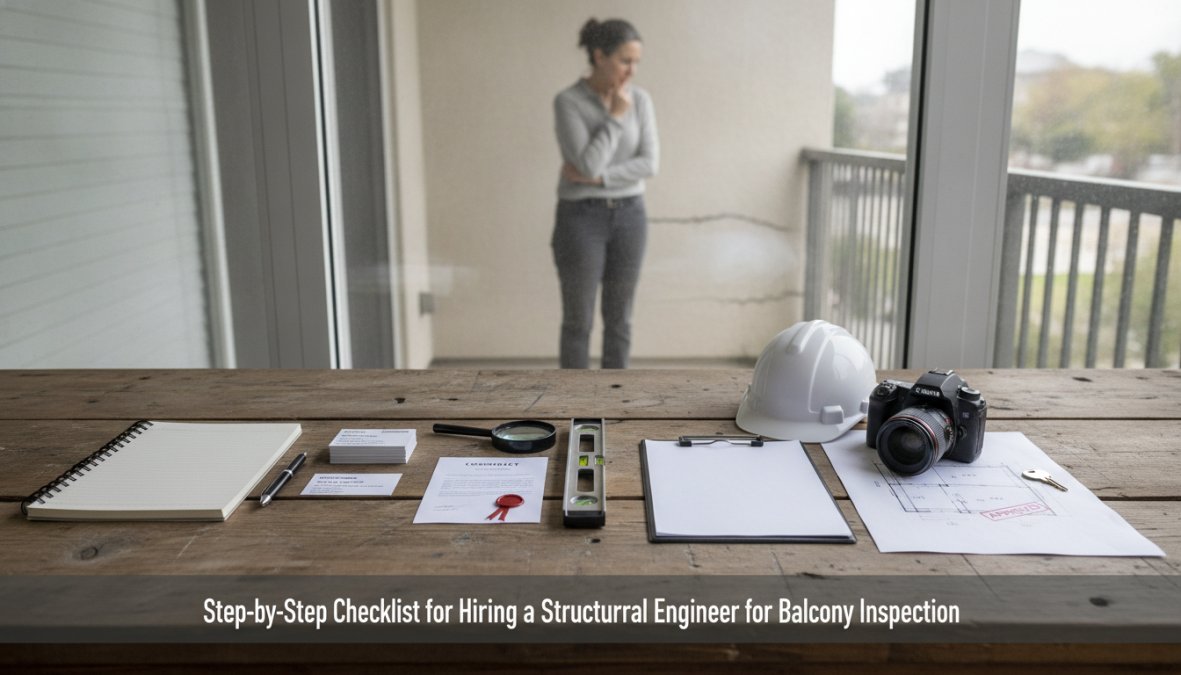
Use this checklist before booking any inspection:
- Verify the engineer holds an active California PE license through the California Board for Professional Engineers and Land Surveyors license lookup
- Confirm the engineer has specific experience with elevated exterior elements, not just general civil engineering
- Ask whether the report will include an engineer’s stamp, required for permit applications
- Confirm the scope covers all elements required under SB 326 or SB 721 for your property type
- Request a sample report to evaluate the level of detail provided
- Confirm the timeline: when will the report be delivered after inspection?
- Ask whether the engineer can provide repair specifications if deficiencies are found
- Verify the engineer carries professional liability (errors and omissions) insurance
- Confirm pricing includes all elements or clarify what additional elements cost
- Ask whether the engineer has experience with local building department requirements in your jurisdiction
Questions to Ask Before You Book
“Does your report satisfy SB 326 or SB 721 requirements?” Any engineer who hesitates on this answer is not the right choice for a compliance inspection.
“Will you perform probing or non-destructive testing on concealed framing?” Visual-only inspections miss the hidden deterioration that causes failures. A thorough inspection requires some access to concealed conditions.
“Can you provide structural calculations if our building department requires them?” Some jurisdictions require engineering calculations as part of the permit application for repairs. Confirm upfront whether this is included or billed separately.
“How many similar properties have you inspected in California?” Experience with California-specific seismic retrofitting requirements and local building department processes is not transferable from other states.
Balcony safety compliance in California is not a paperwork exercise. It is a genuine structural safety obligation that requires qualified professionals and documented engineering analysis. Apex Balcony provides licensed inspection services specifically designed for California’s SB 326 and SB 721 requirements, with decades of combined construction and design experience applied to every elevated exterior element assessment. Our team identifies early signs of structural failure that visual inspections miss and delivers reports that satisfy building department requirements for permit applications. Book an inspection with Apex Balcony and get the engineering documentation your property needs to stay compliant and protect the people who use it.
Frequently Asked Questions
How much does a structural engineer charge for a balcony inspection?
Balcony inspection costs in California typically vary based on property size, number of elevated elements, and the complexity of the structural analysis required. A single-unit residential inspection generally costs less than a multi-unit building inspection under SB 721 or SB 326. Additional fees may apply for written structural calculations, construction documents, or follow-up assessments. Getting multiple quotes from licensed professional engineers (PEs) is advisable to ensure competitive and transparent pricing.
What does a structural engineer look for during a balcony inspection?
During a structural engineer balcony inspection, the PE evaluates load-bearing connections, ledger boards, joists, posts, and railings for signs of rot, corrosion, or deterioration. They assess structural integrity, waterproofing failure, concrete spalling, and any compromised steel connections. The engineer also checks compliance with California building standards, reviews foundation support conditions, and identifies any safety hazards that could lead to structural failure. The findings are documented in a formal structural engineer balcony report.
How often should balconies be inspected for structural integrity?
Under California’s SB 326, HOA-governed condominium balconies must be inspected every nine years. SB 721 requires multifamily rental properties with three or more units to complete inspections by January 1, 2025, and every six years thereafter. Beyond legal requirements, property owners should consider scheduling a structural engineer for balcony inspection after any significant weather event, visible signs of balcony structural damage, or before listing a property for sale.
Do I need a structural engineer to inspect my balcony before selling my home?
While not always legally mandated for single-family home sales, having a structural engineer for balcony inspection before listing can prevent costly surprises during escrow. Buyers increasingly request proof of structural integrity, especially in California where seismic retrofitting and balcony safety regulations are closely scrutinized. A clean structural engineer balcony report can strengthen your listing, reduce liability, and demonstrate compliance with California building codes to prospective buyers and their inspectors.
What are the signs of structural failure in a balcony?
Key signs of balcony structural damage include visible cracks in concrete or stucco, rust staining indicating corroded rebar or steel connections, soft or spongy decking surfaces, sagging or uneven floors, loose or wobbly railings, water stains on ceilings below the balcony, and gaps between the balcony and the main structure. Any of these warning signs warrant an immediate structural engineer for balcony inspection to assess whether rehabilitation, shoring, or full replacement is required.