How to Choose a Balcony Inspection Company
Learn how to choose a balcony inspection company: vetting questions, cost factors, checklist items, and report standards for SB 326 and SB 721 compliance.
Last Updated: October 23, 2026
Quick Summary
To choose a balcony inspection company, first confirm which statute governs your building (SB 326 for condo associations, SB 721 for multifamily rentals), then verify the inspector holds a license as an architect, civil engineer, structural engineer, or credentialed building contractor. Ask for a sample report, proof of insurance, and written confirmation of the statute before you sign.
- SB 326 covers condo associations; SB 721 covers multifamily rentals with three or more dwelling units.
- Verify each inspector’s license number through the state licensing board before shortlisting anyone.
- Require general and professional liability insurance naming your association as an additional insured.
- Ask how the inspector examines the underside of cantilevered balconies and documents hidden connections.
- A compliant report carries the inspector’s stamp, license number, dates, and photographs of every defect.
Table of Contents
- Start With the Legal Requirements for Balcony Inspections
- Who Is Qualified to Perform a Balcony Inspection
- Balcony Inspector Questions to Ask Before You Sign
- What a Balcony Inspection Checklist Should Cover
- Balcony Inspection Cost: What Drives the Quote
- What a Balcony Inspection Report Must Contain
- After the Inspection: Remediation, Permits, and Insurance
- Conclusion
- Frequently Asked Questions
Start With the Legal Requirements for Balcony Inspections
Choosing a balcony inspection company starts with knowing which law governs your building.
Balcony inspection is the process of examining elevated exterior elements, including balconies, decks, stairways, and walkways, for structural defects that could lead to collapse.
The stakes are not theoretical. The 2015 Berkeley balcony collapse that killed six people and the 2021 Malibu collapse both reshaped how regulators treat elevated exterior elements.
Which Law Applies to Your Building: SB 326 vs. SB 721
The dividing line is building type, not size alone. SB 326 applies to condominium associations and other multi-unit residential associations. SB 721 applies to multifamily rental buildings with three or more dwelling units.
For a direct, side-by-side breakdown of obligations under each statute, read our comparison of SB 326 vs. SB 721 requirements. Confirm the classification with your legal counsel before you solicit bids.
Who Is Qualified to Perform a Balcony Inspection
Only a licensed architect, civil engineer, structural engineer, or building contractor with the right credentials can perform a statutory balcony inspection in California.
Ask for the license number and verify it through the state licensing board before you shortlist anyone. That document protects no one.
What most guides miss is the difference between a visual inspection and invasive testing.
The statute names the professions that can perform a statutory balcony inspection, and the inspection type determines how far the examination goes.
| Item | Value | Note |
|---|---|---|
| Licensed architect | Qualifies to inspect | Named specifically in the statute |
| Civil engineer | Qualifies to inspect | Named specifically in the statute |
| Structural engineer | Qualifies to inspect | Named specifically in the statute |
| Building contractor with right credentials | Qualifies to inspect | Credentials must be verified |
| General handyman with a ladder | Does not qualify | No matter how many balconies walked |
| Visual inspection | Covers what is visible and reachable | No opening of the building envelope |
| Invasive testing | May open stucco or flashing | Checks water intrusion, dry rot, corrosion |
Balcony Inspector Questions to Ask Before You Sign
The right questions separate a qualified inspector from a fast quote. Ask them in the same order every time, and treat vague answers as a disqualifier. A firm that cannot tell you which statute applies to your building before you hire it is guessing.
A Vetting Checklist for Inspectors
Use this as a scoring sheet, not a wish list. A candidate that fails any starred item should be removed from the shortlist regardless of price.
- * License number provided and verified through the state licensing board’s public lookup
- * Written confirmation of which statute applies to your building (SB 326 vs. SB 721) and why
- * Certificate of insurance showing both general liability and professional liability (errors and omissions), with your association named as an additional insured
How to Interview Each Candidate
Do not email the checklist and accept written answers alone. A 20-minute call reveals more than a proposal packet. Work through these questions in order and note whether the answers are specific or rehearsed.
- “Which statute governs my building, and what is the filing deadline?” A qualified inspector answers within a minute and explains the building-type distinction. Hesitation here is the single strongest warning sign.
- “Walk me through how you inspect the underside of a cantilevered balcony.” Listen for access method, probe locations, and how the inspector documents connections that are hidden behind finishes. An answer that stays at the railing level is a template answer.
- “When would you recommend invasive testing, and who pays for it?” The inspector should describe the trigger conditions (water staining, soft wood at probe points, corrosion at hangers) and whether testing is inside or outside the base fee.
- “Who signs and stamps the report?” The name on the proposal should match the name on the stamp. Subcontracted engineering is common, but you should know about it before you sign.
- “What does your report look like when a defect is ambiguous?” Ask for the exact language. “Monitor” without a timeline or trigger is not a finding.
- “What happens if the building department rejects the report?” A firm that stands behind its deliverable will describe a correction process at no additional fee.
Red Flags in a Proposal
- A quote issued without a site visit or a building-plans review
- A per-unit price that is identical across radically different building types
- No named inspector, or a sales contact who cannot answer technical questions
For a fuller walkthrough of verifying credentials and insurance, use our guide on how to choose a qualified balcony inspector. The checklist above is the short version; that page covers what each credential actually proves.
Skipping the insurance question is the most common and most expensive mistake. If an inspector misses a defect and someone is later injured, an uninsured firm may leave your association holding the liability. Ask for the certificate before the contract, not after.
What a Balcony Inspection Checklist Should Cover
A proper inspection covers every elevated exterior element, not just the visible deck surface.
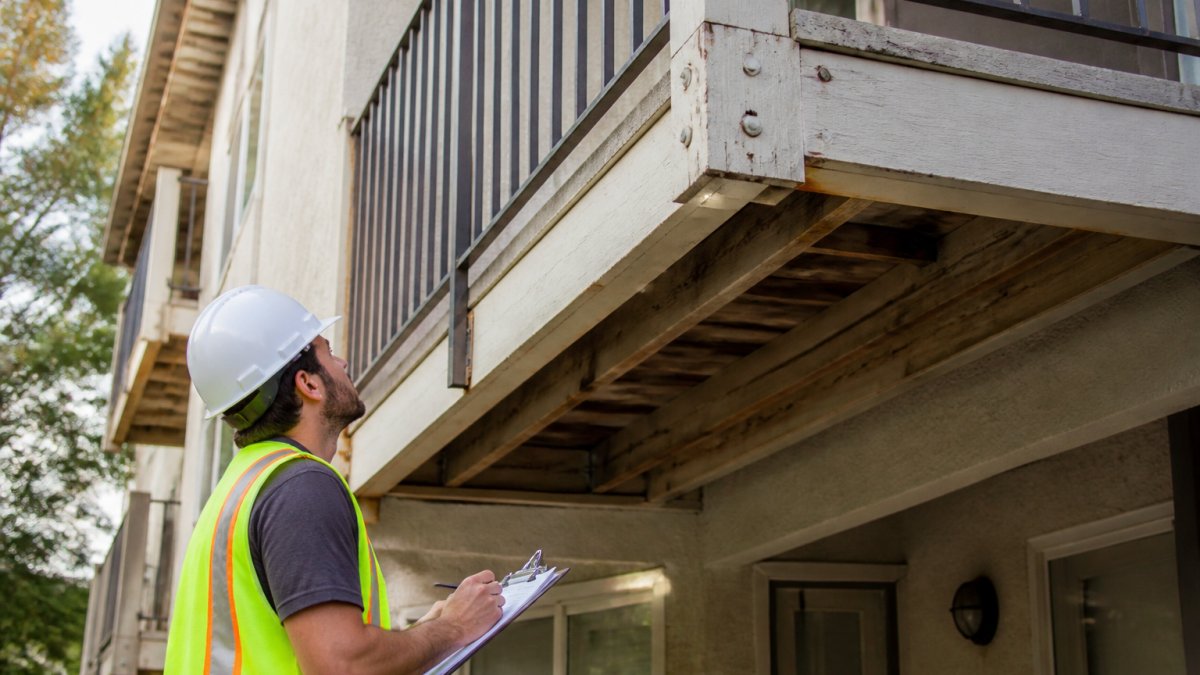
A common mistake is hiring a firm that photographs the railing and stops there. The failure points are usually underneath: corroded joist hangers, rotted ledger boards, and failed flashing that lets water sit against framing for years.
Balcony Inspection Cost: What Drives the Quote
Balcony inspection pricing depends on building size, the number of elevated elements, access difficulty, and whether invasive testing is required. A single-story walkway building with six units is a different job from a four-story complex with forty balconies and limited ladder access.
We do not publish flat fees, and we would be wary of any firm that does. For a fuller cost breakdown, see our guide to SB 326 inspection cost.
Ask whether the fee includes a follow-up site visit after repairs. Some firms charge a second full inspection to confirm remediation was done correctly. Knowing that before you sign prevents a surprise line item mid-project.
What a Balcony Inspection Report Must Contain
A compliant report identifies each inspected element, describes its condition, flags any safety hazard, and states whether repair or further testing is needed.
The report is the document your building department, insurer, and attorney will read. Vague language like “monitor condition” without specifics will not survive scrutiny.
Detailed requirements for the deliverable, including deadlines and inspector qualifications, are covered in our guide to balcony inspection report requirements.
After the Inspection: Remediation, Permits, and Insurance
Findings are the beginning of the work, not the end. The gap between a report and a completed repair is where most boards lose time and money, and most guides stop at the inspection. This section covers the three things that happen next: sequencing the repairs, confirming permits, and protecting insurance coverage.
From Report to Remediation Plan
A report lists findings; a remediation plan sequences them. The board’s job is to convert one into the other before soliciting repair bids. A workable plan does four things:
- Sorts findings by safety priority. Immediate hazards (loose guardrails, corroded connections at load-bearing points) get temporary measures first, even before permanent repairs are designed.
- Groups repairs by trade and access. Scaffolding, stucco removal, and waterproofing are separate scopes; bundling them into one bid usually lowers the total cost and the number of site mobilizations.
- Sets a design threshold. Findings that involve structural connections typically need an engineer’s repair detail before a contractor can bid. Findings limited to surface wear may not.
- Maps to the reserve fund and assessment calendar. A repair that exceeds the reserve balance forces an assessment or a loan, and that decision has a lead time the board must build into the compliance schedule.
A common pattern is for the inspection firm to offer repair design or construction as a separate engagement. That can be efficient, but confirm the scope is separately priced and that the board retains the right to bid the work to other contractors. Ask each inspection candidate up front whether they perform repairs and how they handle that conflict.
Permits and Building Department Review
Structural repairs to balconies, stairways, and their connections usually require a building permit and inspection by the local building department. The permit process runs on its own timeline, separate from the statutory inspection deadline, and the two are easy to conflate.
Ask the repair contractor, not the inspector, which permits apply and who pulls them. A contractor who proposes to start structural work without a permit is a liability, not a bargain.
Insurance Implications of the Report
Carriers increasingly ask for proof of inspection compliance at renewal and at claim time. A missed statutory deadline can affect coverage or premiums when a loss occurs, and the effect can follow a property for years.
Before the board files the report, confirm with the association’s insurance broker how the carrier wants to receive it and whether any findings trigger a disclosure obligation. Our overview of the insurance implications of SB 326 non-compliance explains how a missed deadline can follow a property for years.
Ask the inspection firm whether they will provide a short cover letter summarizing compliance status for the carrier. Some will; some charge for it. Knowing before you sign prevents a scramble at renewal.
The cheapest inspection is the one that produces a report your insurer and building department accept without a second opinion. Price the deliverable, not the site visit.
Conclusion
The hardest part of this process is not finding an inspector. It is finding one whose report holds up when a building department, an insurer, or a plaintiff’s attorney reads it closely.
Our licensed inspectors bring decades of combined construction and design experience to every site, we specialize in SB 326 and SB 721 compliance, and we inspect all elevated exterior elements, including balconies, decks, and stairways.
Book an inspection with Apex Balcony and get a report your board can act on with confidence.
Frequently Asked Questions
What qualifications should a balcony inspection company have?
Under SB 326 and SB 721, inspections must be performed by a licensed architect, civil or structural engineer, or a building contractor holding the appropriate license. Ask for the individual inspector’s license number, not just the firm’s, and confirm it is active with the state licensing board. Also ask whether the company carries errors and omissions coverage and general liability insurance, and request a sample report so you can see the depth of documentation before you commit.
How much does a balcony inspection cost, and what changes the price?
Balcony inspection cost depends on the number of elevated exterior elements, building height and access difficulty, the percentage of units sampled, and whether invasive testing is required. A 12-unit building with simple access sits at the low end; a large condominium association with many decks and stairways sits higher. Ask each firm to itemize what the quote includes, especially report delivery, photo documentation, and any follow-up visit, so you are comparing the same scope rather than the same headline number.
How do I compare balcony inspection quotes from different companies?
Line up the quotes against the same scope: number of balconies, decks, and stairways inspected, sample size, invasive versus non-invasive methods, photo documentation, report format, and turnaround time. A quote that is thousands lower often inspects fewer units or skips destructive testing. Ask each firm what they would do if they found dry rot, corrosion, or water intrusion at a load-bearing connection, and confirm the report will be signed and sealed by a licensed professional who can stand behind it in a building department review.
What happens if the inspection misses something and a problem is found later?
Ask about professional liability coverage before you hire anyone. A signed report from a licensed architect, civil engineer, or structural engineer carries professional accountability, and errors and omissions insurance is what responds if a defect is missed. Request a certificate of insurance naming your association or ownership entity, and confirm the inspector who signs the report is the one who actually performed the visual inspection. Keep the report on file: it is your record of compliance and your defense in a liability dispute.
Sources and further reading: California Legislature SB 326 and SB 721 statutory text, California Department of Consumer Affairs license verification, U.S. Consumer Product Safety Commission outdoor structural safety guidance