How to File SB 721 Inspection Report: 2026 Guide
File SB 721 inspection report: Learn how to file your SB 721 inspection report by January 2026. Step-by-step filing process, submission requirements, and.
Table of Contents
- What is SB 721 and Why Filing Your Inspection Report Matters
- Understanding Exterior Elevated Elements (EEE) Subject to SB 721
- SB 721 Inspector Qualifications: Who Can Perform Your Inspection
- Step-by-Step: How to File SB 721 Inspection Report With Your Local Jurisdiction
- SB 721 Repair Timeline: Understanding Your Compliance Deadlines
- SB 721 Non-Compliance Penalties: What Happens If You Miss Filing
- Common Mistakes to Avoid When Filing Your SB 721 Report
- Cost Estimation and Budgeting for SB 721 Compliance
Last Updated: July 13, 2026
What is SB 721 and Why Filing Your Inspection Report Matters
SB 721, the Building Standards Administrative Code, requires inspections of exterior elevated elements (EEE) on multi-family residential buildings. Property owners must file completed inspection reports with their local building department by January 1, 2026. This isn’t optional, missing the deadline triggers penalties and legal liability. Many properties remain non-compliant because owners don’t understand the filing mechanics, and requirements vary by jurisdiction.
The single biggest mistake property owners make is assuming their inspector will handle the filing. The property owner is responsible for submitting the report to the building department. Mark this task on your calendar now.
Understanding Exterior Elevated Elements (EEE) Subject to SB 721
Your inspection report focuses exclusively on exterior elevated elements: balconies, decks, stairs, walkways, and other elevated structures extending beyond the building envelope. Not every outdoor feature is subject to SB 721, roof-mounted equipment, ground-level patios, and interior common areas are excluded.
Common EEE Components
The following elements must be evaluated:
- Balconies and decks – railings, fasteners, waterproofing membranes, and structural connections
- Exterior stairs and landings – treads, risers, handrails, and attachment points
- Walkways and elevated platforms – any pedestrian surface elevated more than 30 inches above grade
- Guardrails and safety railings – load-bearing capacity and proper installation
- Waterproofing systems – membranes, sealants, and drainage on elevated surfaces
- Structural supports – posts, beams, and connections bearing weight
- Fasteners and hardware – bolts, anchors, and mechanical connections showing corrosion or failure
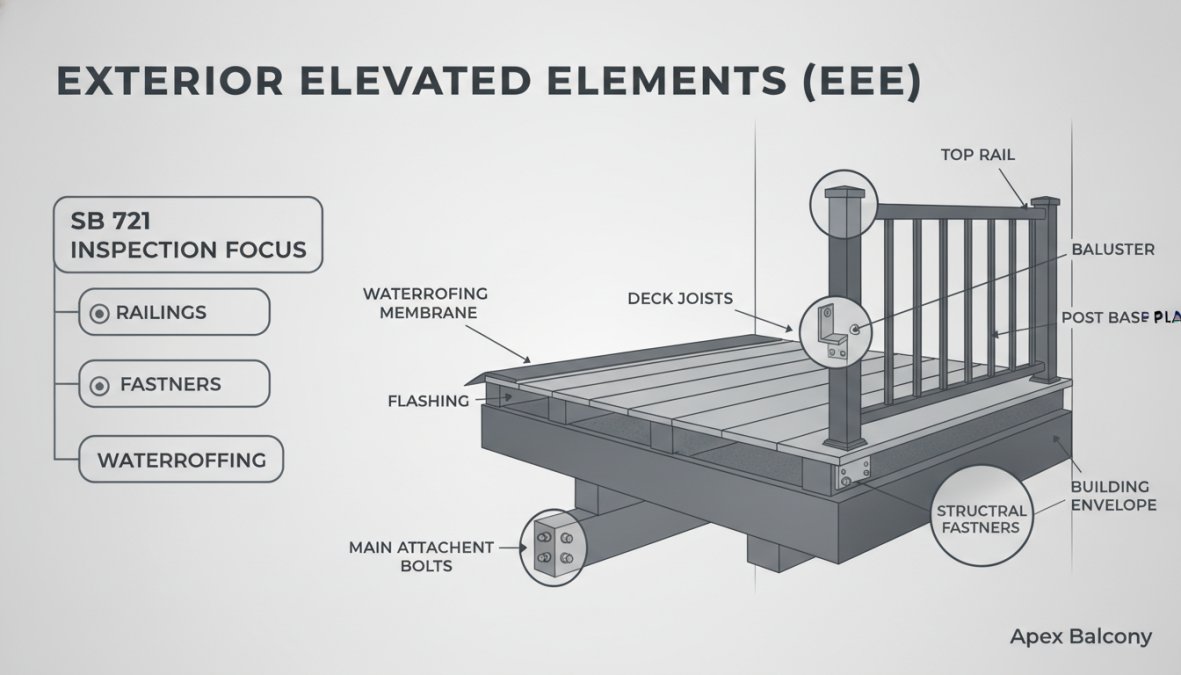
Each component is assessed for structural integrity, waterproofing effectiveness, and code compliance with condition ratings of "Good," "Fair," or "Poor." Your filing submission must include this detailed breakdown.
SB 721 doesn’t require you to fix every deficiency immediately. It requires you to identify deficiencies, report them accurately, and establish a repair timeline.
SB 721 Inspector Qualifications: Who Can Perform Your Inspection
Not every contractor can legally perform an SB 721 inspection. California law requires inspections be conducted by a licensed professional. Filing a report prepared by an unqualified inspector will be rejected.
Qualified inspectors must hold one of these licenses:
- Structural engineer – Professional Engineer (PE) license with structural engineering specialization
- Architect – Licensed architect with building envelope and structural assessment experience
- Building inspector – City or county-certified building inspector with relevant experience
- Licensed contractor – General or specialty contractor with documented balcony inspection experience
The inspector must carry errors and omissions insurance and verify credentials to the building department upon request.
Checklist for Hiring a Qualified Professional
- Verify the inspector holds an active California PE, architect, or contractor license
- Request the license number and confirm it’s current through the California Department of Consumer Affairs
- Ask for examples of previous SB 721 inspection reports they’ve filed
- Confirm they carry errors and omissions insurance with minimum coverage limits
- Verify they understand your city’s filing requirements and submission format
- Request a written scope of work listing all EEE components they will evaluate
- Confirm the inspection fee and whether it includes filing submission
- Ask about timeline for report completion
- Verify they provide a detailed written report with condition ratings and photos
- Confirm they will note any immediate hazards requiring emergency repair notification
Step-by-Step: How to File SB 721 Inspection Report With Your Local Jurisdiction
Filing involves four distinct steps completed in order.
Step 1: Obtain Your Completed Inspection Report
The inspection report must include:
- Inspector’s name, license number, and contact information
- Property address and assessor parcel number (APN)
- Date of inspection and methodology
- Detailed condition assessment of each EEE component with photographs
- Structural integrity findings and waterproofing condition ratings
- List of any immediate hazards requiring emergency repair
- Service life projections for major components
- Repair or maintenance recommendations
The report must be on the inspector’s letterhead and signed by the licensed professional. Some jurisdictions require notarization.
Step 2: Verify Report Compliance Requirements
Before submitting, confirm your inspection report meets your city’s filing requirements. Building departments vary significantly.
Report format: Some jurisdictions accept PDF submissions; others require printed copies or original hard copies with wet signatures.
Specific forms: Many California cities have adopted standardized SB 721 inspection report forms. Check your city’s building department website or contact the permit counter to download the required form.
Supporting documentation: Some jurisdictions require photographs of each EEE component or a site plan showing the location of all elevated elements.
Immediate hazard notification: If the inspection identifies immediate hazards, you may be required to notify the building department separately before filing the full report.
Contact your local building department’s permit counter and ask: "What are the filing requirements for SB 721 inspection reports?"
Filing an incomplete report will be rejected. A single missing page or unsigned section means the entire submission will be returned. Call ahead to confirm requirements.
Step 3: Submit to Your Local Building Department
Electronic submission (most common):
- Log into your city’s permit portal or building department website
- Locate the SB 721 inspection report submission form or upload portal
- Enter the property address and assessor parcel number
- Attach the inspection report PDF and required supporting documents
- Submit and note the confirmation number
- You’ll typically receive email confirmation within 1-3 business days
In-person submission:
- Print two copies of the inspection report
- Visit the building department’s permit counter during business hours
- Request the SB 721 inspection report submission form
- Complete the form with your property information
- Submit both copies and the form together
- Request a stamped received copy and note the date
Mail submission:
- Print two copies of the inspection report
- Complete the city’s SB 721 submission form
- Mail via certified mail with return receipt
- Call the building department 5-7 business days later to confirm receipt
Step 4: Document Submission and Retain Records
Create a submission file including:
- Proof of submission (email confirmation, stamped received copy, or certified mail receipt)
- Copy of the inspection report you filed
- Copy of the city’s submission form
- Confirmation of filing date and any reference number assigned
- Notes on any immediate hazards and your repair timeline
Keep this file for the entire six-year inspection cycle.
| Step | Action | Timeline | Proof Needed |
|---|---|---|---|
| 1 | Hire qualified inspector and complete inspection | 2-4 weeks | Signed inspection report |
| 2 | Verify city’s filing requirements | 1-2 days | City submission checklist or form |
| 3 | Submit report to building department | Same day or within 1 week | Email confirmation or stamped receipt |
| 4 | Document and file submission proof | Same day | Submission confirmation with date |
SB 721 Repair Timeline: Understanding Your Compliance Deadlines
Filing your inspection report is the first step. The law establishes specific deadlines for addressing deficiencies.
January 1, 2026 Initial Inspection Deadline
All exterior elevated elements in multi-family residential buildings must be inspected and reported by January 1, 2026. The inspection doesn’t require repairs to be completed immediately, but you must document conditions and establish a repair plan.
If the inspection identifies an immediate hazard (structural failure, railing collapse risk, or waterproofing failure creating safety risk), you must notify the building department and address it within 15-30 days depending on severity.
Six-Year Inspection Cycle and Re-filing Requirements
After your initial filing, you must repeat the inspection every six years:
- By January 1, 2026: Initial inspection and filing required
- By January 1, 2032: Second inspection and re-filing required
- By January 1, 2038: Third inspection and re-filing required
Between inspections, you’re responsible for maintaining EEE in the documented condition. The building department may conduct follow-up inspections to verify repairs were completed.
SB 721 Non-Compliance Penalties: What Happens If You Miss Filing
Missing the January 1, 2026 deadline triggers escalating penalties.
Initial non-compliance (first 30 days): Building departments send a notice of violation. You have 30 days to file and come into compliance.
Continued non-compliance (30-90 days): Civil penalties typically range from several hundred to several thousand dollars per month.
Enforcement action (90+ days): The building department may pursue legal action, place holds on building permits, or require court-ordered repairs.
Liability exposure: Non-compliance creates personal liability. If a resident is injured due to a deficiency that should have been identified in an SB 721 inspection, the property owner may face civil liability for negligence.
The cost of filing an inspection report is far less than non-compliance penalties, legal action, or injury liability.
Common Mistakes to Avoid When Filing Your SB 721 Report
Mistake 1: Submitting an incomplete report. Reports lacking photographs, condition assessments, or the inspector’s signature are returned. Verify completeness before filing.
Mistake 2: Using an unqualified inspector. If your inspector doesn’t hold a valid PE, architect, or contractor license, the report will be rejected.
Mistake 3: Missing the city-specific submission form. Many jurisdictions have adopted their own SB 721 forms. Submitting a generic report when a form is required results in rejection.
Mistake 4: Failing to identify immediate hazards. Notify the building department separately and immediately if the inspection identifies immediate hazards.
Mistake 5: Not retaining proof of submission. Without documentation proving you filed by the deadline, you have no defense against non-compliance claims.
Mistake 6: Assuming your property manager will handle it. Verify that filing has been completed with the building department.
Mistake 7: Delaying repair work indefinitely. If deficiencies are identified, establish and follow a repair timeline. Building departments track compliance.
Property owners often believe they have until January 1, 2026 to start the inspection process. You actually need to start now. Inspectors are booked months in advance.
Cost Estimation and Budgeting for SB 721 Compliance
Inspection costs typically range based on property size and complexity. A small apartment complex with 20-30 units costs several thousand dollars; larger properties can exceed this significantly. Costs depend on:
- Number of units and EEE components
- Property condition and accessibility
- Whether previously inspected (re-inspections are often less expensive)
- Inspector’s experience level and local market rates
Report preparation costs are usually included in the inspection fee.
Filing costs are minimal for electronic submissions. In-person or mail submissions may require staff time or certified postage.
Repair costs depend entirely on inspection findings. Budget for repairs based on the report, not as an upfront cost.
Timeline for budgeting:
- Start the inspection process immediately if you haven’t already
- Budget for inspection costs within 60-90 days
- Plan repair costs based on inspection findings
- Establish a repair schedule complying with building department requirements
- Budget for re-inspection in six years
Missing the SB 721 filing deadline creates legal and financial risk that compounds over time. Act now: hire a qualified inspector, complete the inspection, and file the report with your local building department before the January 1, 2026 deadline.
Frequently Asked Questions
Do I need to submit my SB 721 report to the city?
Yes. Property owners must file their SB 721 inspection report with their local building department by the deadline specified in your jurisdiction. Submission to the building department is a legal requirement for compliance. Contact your local code enforcement office to confirm the exact submission process and required documentation for your specific city or county.
Who is qualified to perform an SB 721 inspection?
SB 721 inspections must be conducted by licensed professionals including structural engineers, licensed contractors, or other qualified inspectors as defined by California building code. Your inspector should have specific experience with exterior elevated elements (EEE) assessment, waterproofing evaluation, and structural integrity testing. Verify credentials and ask about their experience with similar multi-family housing projects before hiring.
What happens if I miss the SB 721 inspection deadline?
Missing the SB 721 filing deadline can result in non-compliance penalties imposed by your local building department, including fines and potential legal action. Code enforcement may issue citations and require immediate corrective action. Delays can also complicate future property transactions and insurance coverage. Prioritize filing before your jurisdiction's deadline to avoid penalties and maintain resident safety.
How often must I file an updated SB 721 inspection report?
SB 721 requires inspection and filing every six years as part of the ongoing compliance cycle. After your initial inspection by January 1, 2026, you must schedule subsequent inspections at six-year intervals. Maintain detailed maintenance records between inspections and report any immediate hazards to your building department without delay to ensure continuous compliance.