California Building Code Balcony Standards: A 2026 Compliance Guide
Master California balcony standards under SB 721 and SB 326. Learn railing heights, load requirements, waterproofing rules, and inspection cycles. Ensure.
Table of Contents
- California Building Code Balcony Standards: What Property Owners Must Know
- SB 721 Balcony Inspection Requirements and Timelines
- California Balcony Railing Height Code and Safety Specifications
- Balcony Load Bearing Capacity Requirements Under CBC
- Balcony Waterproofing Standards California: Preventing Structural Failure
- Property Owner Maintenance Checklist and Compliance Steps
- Cost Estimates and Insurance Implications of Non-Compliance
- Common Mistakes Property Owners Make with Balcony Code Compliance
California Building Code Balcony Standards: A 2026 Compliance Guide
Last Updated: July 5, 2026
Property owners across California must ensure their balconies meet the california building code balcony standards established by SB 721 and SB 326. These landmark laws transformed how buildings maintain elevated exterior elements, and non-compliance carries serious legal and safety consequences. This guide cuts through the complexity and shows you what actually matters for your property.
A single structural failure can result in catastrophic injuries, massive liability exposure, and immediate code enforcement actions. Most importantly, insurance companies increasingly deny claims when injuries occur on non-compliant balconies, leaving you personally liable for damages that can reach into the millions.
SB 721 and SB 326: The Laws That Changed Balcony Safety
SB 721, enacted in 2018, requires owners of multi-family residential buildings with three or more units to conduct structural inspections of all balconies and exterior elevated elements every six years. SB 326, which followed in 2020, extended these requirements to single-family homes and duplexes, closing a critical gap in the original legislation.
What makes these laws different is their enforcement mechanism. Property owners cannot simply repair balconies when problems appear; they must proactively inspect on a fixed schedule. Failure to comply results in code enforcement citations, potential fines, and liability if someone is injured on a non-compliant balcony.
[SB 721 and SB 326](/sb-326-vs-sb-721-differences/) shifted balcony safety from reactive repairs to mandatory preventive inspections. Owners who haven’t inspected since 2020 may already be out of compliance.
Why Compliance Matters: Liability and Safety
Non-compliance creates two distinct problems: immediate physical danger and long-term financial exposure.
Balconies deteriorate invisibly. Dry rot spreads through structural members without obvious external signs. Corrosion weakens fasteners and connections. Water penetrates behind waterproofing membranes and causes hidden damage. Regular inspections catch these problems before someone falls through a railing or a section of decking collapses.
Property owners who fail to maintain compliant inspection records face escalating consequences. Code enforcement agencies issue citations with fines exceeding $1,000 per day for non-compliant properties. More significantly, if someone is injured on a non-compliant balcony, the property owner’s insurance may deny the claim, leaving you personally responsible for damages.
Insurance companies routinely deny claims for injuries on non-compliant balconies. A single accident could expose you to personal liability in the millions.
Compliance also protects your property value. Buyers and lenders increasingly request proof of current balcony inspections before closing.
SB 721 Balcony Inspection Requirements and Timelines
SB 721 requires inspections every six years for multi-family buildings. The inspection clock started on January 1, 2019, for most buildings. Properties inspected in 2019 are due again in 2025; those inspected in 2020 are due in 2026.
Any structural repair or replacement of an exterior elevated element restarts the six-year clock. A building that underwent balcony repairs in 2023 won’t be due for another inspection until 2029.
SB 326 applies to single-family homes and duplexes with a different timeline. These properties must complete an initial inspection by January 1, 2025. After that initial inspection, the six-year cycle begins.
Inspection Frequency and Deadlines
The inspection frequency is non-negotiable: every six years for buildings with current compliance status. Several situations can change this timeline:
- Newly constructed buildings: First inspection due six years after completion
- Buildings with recent repairs: Six-year clock restarts from the date of the last structural work
- Buildings with failed inspections: May require re-inspection within 12 months if deficiencies are found
- Buildings under code enforcement: Inspection frequency may increase at the discretion of the local building department
Tracking these deadlines is essential. A single missed inspection can trigger code enforcement action.
Who Must Conduct Inspections
California law specifies that inspections must be performed by one of three qualified professionals:
- Structural engineers licensed by the California Board for Professional Engineers
- Architects licensed by the California Architects Board
- Contractors holding a current California contractor’s license in a relevant category
The inspector must have experience with building structures and must follow the inspection protocols outlined in Chapter 7A of the California Building Code. Many property owners hire structural engineers for these inspections, though experienced contractors often charge less and still deliver compliant inspections.
Call ahead and ask inspectors how many balcony inspections they’ve completed. Those with 50+ inspections under their belt will spot problems that less experienced inspectors miss.
California Balcony Railing Height Code and Safety Specifications
The california building code balcony standards specify exact requirements for railing height and construction.
Minimum Height Requirements
Balcony railings must be a minimum of 42 inches high, measured from the finished floor surface to the top of the railing. Older buildings often have railings that are 36 inches or less, which violates current code. Height measurement must account for the finished floor, not the structural deck. If your balcony has been re-finished or had new decking installed, the measurement point may have changed.
Baluster Spacing and Load Resistance
Railings must prevent passage of a 4-inch sphere between balusters, preventing small children from getting stuck or falling through gaps. The railing system itself must resist a horizontal load of 200 pounds applied at any point along the top rail.
For wood railings, the most common failure point is where the railing attaches to the balcony structure. Fasteners corrode, wood splits around bolts, and connections loosen over time. Metal railings fail when welds crack or fasteners rust through. These failures are invisible until an inspector applies the load test.
Balcony Load Bearing Capacity Requirements Under CBC
Balconies must support specific minimum loads defined in the California Building Code.
Uniform Live Load Standards and PSF Ratings
Residential balconies must support a uniform live load of 40 pounds per square foot (PSF). A 10-foot by 10-foot balcony (100 square feet) must therefore support a total live load of 4,000 pounds. This load rating accounts for normal occupancy and does not account for unusual conditions like snow loads, which are addressed separately depending on your climate zone.
Many older balconies were built to lower load standards. A balcony that met 1980s code may only support 20 or 30 PSF, creating a compliance problem that requires structural reinforcement or replacement.
Structural Integrity Testing Methods
Inspectors verify load capacity through visual assessment and, in some cases, load testing. A visual inspection examines structural members for signs of deterioration, corrosion, or damage that would reduce capacity, including rust on steel members, cracks in concrete or welds, soft spots in wood indicating rot, separation between structural members and connections, and water staining.
In cases where visual inspection suggests potential problems, more detailed testing may be needed, such as ultrasonic thickness testing of steel members, core sampling of concrete, or moisture testing of wood.
Balcony Waterproofing Standards California: Preventing Structural Failure
Waterproofing is perhaps the single most important factor in balcony longevity. Water causes rust in steel, rot in wood, and deterioration in concrete.
Slope, Drainage, and Moisture Barriers
Balcony decks must slope a minimum of 1/4 inch per foot toward drain points to prevent pooling. Drainage must be designed to handle the water that flows down the slope, typically through drain pipes or channels that direct water away from the building structure.
Beneath the deck surface, a moisture barrier (typically a membrane or flashing) must prevent water from reaching the structural members below. This barrier is critical because water can wick up into wood or seep into cracks in concrete, causing damage that’s invisible from above.
Common Signs of Waterproofing Failure
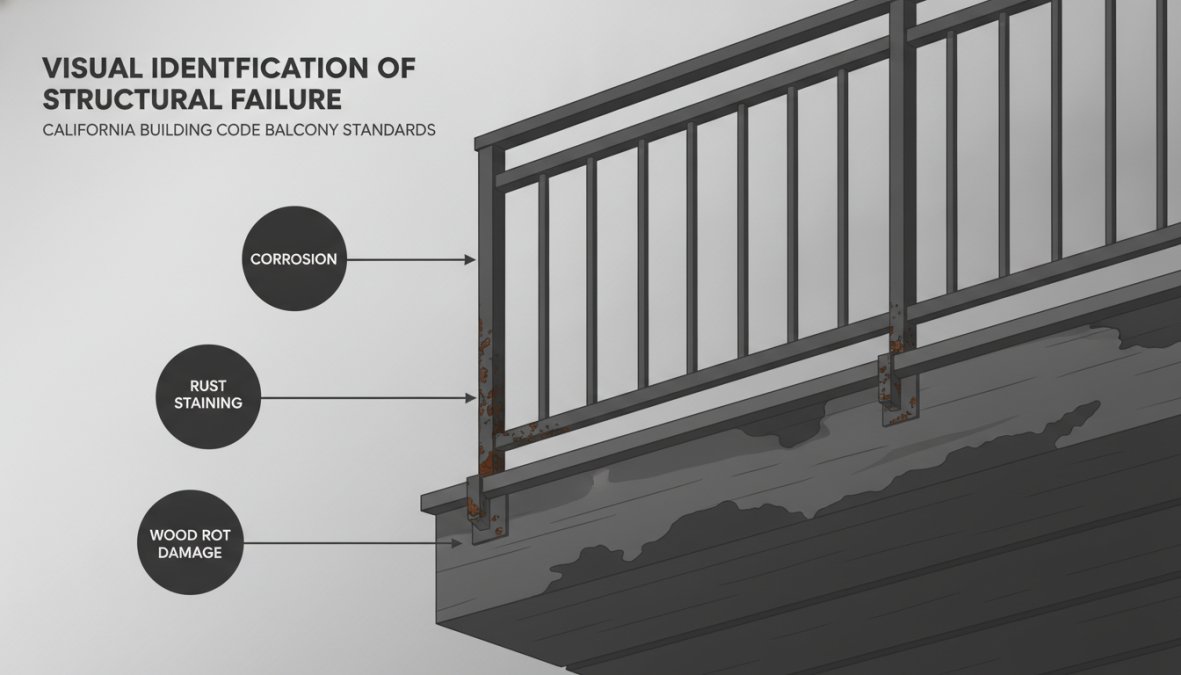
Water staining or discoloration on the underside of the balcony indicates that water is passing through the deck surface. Soft spots or spongy areas in wood decking indicate rot, requiring immediate attention. Rust staining on steel members or fasteners indicates corrosion that can spread quickly. Separation between the deck and the building structure can indicate that water has caused swelling or deterioration of the underlying structure.
Property Owner Maintenance Checklist and Compliance Steps
While professional inspections happen every six years, property owners should walk their balconies at least annually to look for obvious problems.
Annual Inspection Checklist for Property Owners
- Check for visible rust or corrosion on railings, fasteners, or structural members
- Look for soft spots, sponginess, or discoloration in wood decking
- Verify that the deck slopes toward drain points (water should not pool)
- Check that drain openings are clear of debris
- Look for cracks in concrete decks or gaps between deck boards
- Verify that railings are secure and don’t move when pushed
- Check for mold, mildew, or water staining on the underside (if accessible)
- Look for separation between the deck and the building structure
- Check that baluster spacing hasn’t widened
- Look for evidence of past repairs or patching that may be failing
Any of these conditions warrant a call to your inspector or a structural engineer. Documentation is equally important, keep records of every inspection, repair, and maintenance action. When you sell the property or refinance, buyers and lenders will request this documentation.
Visual Identification of Structural Failure
Recognizing the visual signs of structural problems is essential. Some failures are obvious; others require knowing what to look for. Rust staining that appears suddenly or spreads quickly indicates active corrosion. Soft spots in wood decking that grow larger month to month indicate advancing rot. Cracks in concrete that widen or new cracks that appear suggest structural movement or deterioration.
Movement is always a red flag. If a railing moves when you push on it, if deck boards flex excessively, or if you notice new gaps opening between structural members, do not use the balcony and contact your inspector immediately.
Cost Estimates and Insurance Implications of Non-Compliance
Understanding the financial impact of compliance and non-compliance helps property owners make informed decisions about maintenance budgets.
Typical Inspection and Repair Costs
A professional balcony inspection typically costs between $500 and $2,000 per property, depending on the number of balconies and the building’s complexity. Repairs vary dramatically based on what the inspection finds. Minor issues might cost $1,000 to $5,000. Moderate problems typically run $10,000 to $30,000. Major structural work can exceed $50,000 for a single balcony.
The cost of doing nothing is often much higher. A balcony that fails catastrophically can result in injuries, lawsuits, and replacement costs that dwarf the cost of preventive maintenance.
Insurance and Liability Exposure
Insurance policies typically include exclusions for injuries that occur due to code violations or deferred maintenance. If someone is injured on a non-compliant balcony, the insurance company can deny the claim based on these exclusions, leaving the property owner personally liable for medical costs, lost wages, and pain and suffering damages.
Courts have upheld insurance denials in numerous cases where property owners failed to maintain code compliance. A single serious injury can result in damages exceeding $1 million. Without insurance coverage, the property owner is responsible for paying this amount from personal assets.
Common Mistakes Property Owners Make with Balcony Code Compliance
The first mistake is assuming that a balcony that looks fine is fine. Professional inspectors have the training and tools to identify hidden problems that are invisible to the untrained eye.
The second mistake is confusing inspection deadlines. The six-year clock is strict, and missing a deadline by even a month triggers code enforcement.
The third mistake is hiring the wrong inspector. Not all contractors or engineers have experience with balcony inspections. Hiring an experienced balcony inspection specialist ensures that your property receives a thorough, accurate assessment.
The fourth mistake is delaying repairs. Small problems grow into large ones. Repairs are almost always cheaper when done promptly.
The fifth mistake is not documenting compliance. When you sell the property or refinance, you cannot prove compliance without records, creating problems with title companies and lenders.
Balcony safety isn’t optional in California; it’s a legal requirement with serious consequences for non-compliance. The california building code balcony standards exist because balcony failures have caused injuries and deaths. Staying compliant protects your residents, your property value, and your personal finances.
If your property is due for an inspection or if you’re uncertain about your compliance status, contact a licensed inspector. Comprehensive inspections that meet all SB 721 and SB 326 requirements deliver clear, actionable reports that guide your repair decisions. Book an inspection today and get your property back into compliance.
Frequently Asked Questions
What are the California building code requirements for balcony railings?
California Building Code (CBC) Chapter 7A mandates balcony railings must be at least 42 inches high from the floor surface. Balusters must be spaced no more than 4 inches apart to prevent child entrapment. Railings must resist a 200-pound horizontal force without deflecting more than 1 inch. These standards apply to all residential and commercial balconies to ensure safety and prevent falls.
What is SB 721 and how does it affect balcony inspections?
SB 721 requires apartment buildings with three or more units to conduct mandatory balcony inspections and waterproofing assessments. Properties must complete initial inspections by January 1, 2025, with follow-up inspections every six years. Licensed structural engineers or architects must perform inspections. Non-compliance can result in fines and legal liability if a balcony failure injures residents. This law applies to Exterior Elevated Elements (EEE) including balconies, decks, and stairs.
Are there specific waterproofing requirements for balconies in California?
Yes, California balcony waterproofing standards require proper slope (minimum 1/8 inch per foot), effective drainage systems, and protective membranes to prevent water intrusion. Balconies must direct water away from the building structure. Failure to maintain proper waterproofing leads to dry rot, corrosion of reinforcing steel, and structural compromise. Regular maintenance and inspection of waterproofing systems are critical to prevent costly damage and safety hazards.
What are typical costs for balcony compliance inspections in California?
Balcony inspection costs typically range from $500 to $2,500 per property depending on building size, complexity, and number of units. Multi-unit buildings may pay $1,000-$5,000 for comprehensive structural assessments. Repairs identified during inspections can cost significantly more, waterproofing repairs average $5,000-$15,000, while structural repairs may exceed $20,000. Insurance premiums may increase if non-compliance is discovered, making early inspection a cost-effective investment.