Balcony Repair Cost Estimation Guide for California Owners
Balcony repair cost estimation guide for CA property owners. Learn inspection fees, repair pricing, and SB 721 compliance steps. Book your inspection.
Table of Contents
- Why This Balcony Repair Cost Estimation Guide Starts With Compliance
- Signs of Balcony Structural Damage You Should Never Ignore
- Balcony Inspection Cost: What to Expect Before You Budget Repairs
- Concrete Balcony Repair Price Per Square Foot: A Realistic Breakdown
- Balcony Waterproofing Cost and Why It Belongs in Every Repair Budget
- Post-Inspection Remediation Workflow: From Report to Completed Repair
- Insurance Implications and Liability Exposure for Non-Compliant Properties
- Your Balcony Repair Cost Estimation Guide: Compliance Calendar and Next Steps
Last Updated: June 16, 2026
California property owners face a compliance deadline with real financial and legal consequences. Having a reliable balcony repair cost estimation guide before you start budgeting is the difference between a manageable project and a budget crisis. Most owners underestimate repair costs because they start with contractor quotes before understanding what the inspection report actually requires. This guide from Apex Balcony walks you through every cost variable, compliance requirement, and remediation step so you can plan with confidence.
Your inspection findings directly determine your repair scope, which determines your cost. Treating them as separate conversations leads to budget surprises that derail projects and expose property owners to liability.
Why This Balcony Repair Cost Estimation Guide Starts With Compliance
California’s balcony inspection laws are the foundation of any repair budget. Skipping them doesn’t save money; it creates larger liability exposure down the line.
Understanding SB 721 and SB 326: What California Law Requires
Senate Bill 721 applies to multi-family dwellings with three or more units not governed by an HOA, targeting rental properties. Senate Bill 326 applies to common interest developments governed by an HOA, including condominiums. Both laws mandate periodic inspections of load-bearing components to identify structural failure risks before they become tragedies.
California passed these laws in direct response to balcony collapses that resulted in fatalities. Non-compliance isn’t a paperwork issue, it’s a negligence per se exposure that can void insurance coverage and trigger personal liability for building owners and HOA board members alike.
According to California Legislative Information on SB 721, the law requires initial inspections to be completed and sets a recurring inspection cycle to maintain ongoing compliance.
Property owners who miss their compliance deadline don’t just face fines. Under California law, a documented failure to inspect can be used as evidence of negligence per se in personal injury litigation, removing the standard burden of proof from a plaintiff’s case.
What Are Exterior Elevated Elements (EEEs) and Why They Matter for Budgeting
Exterior Elevated Elements (EEEs) are load-bearing structures attached to a building that extend beyond the exterior walls, are designed for human occupancy or use, and are elevated more than six feet above the ground. This covers balconies, decks, stairways, walkways, and their associated railings and waterproofing systems.
Inspectors examine the full structural assembly, ledger connections, joists, posts, beams, waterproofing membranes, and walking surface, not just the deck surface. A property with 20 units and two balconies per unit has 40 EEEs to inspect and potentially repair, making it a fundamentally different budget exercise than a single-family renovation.
Signs of Balcony Structural Damage You Should Never Ignore
The most expensive repairs are the ones that were visible for years before anyone acted. Structural damage announces itself through a predictable set of visual warnings.
Visual Red Flags: Stucco Discoloration, Rotted Wood, and More
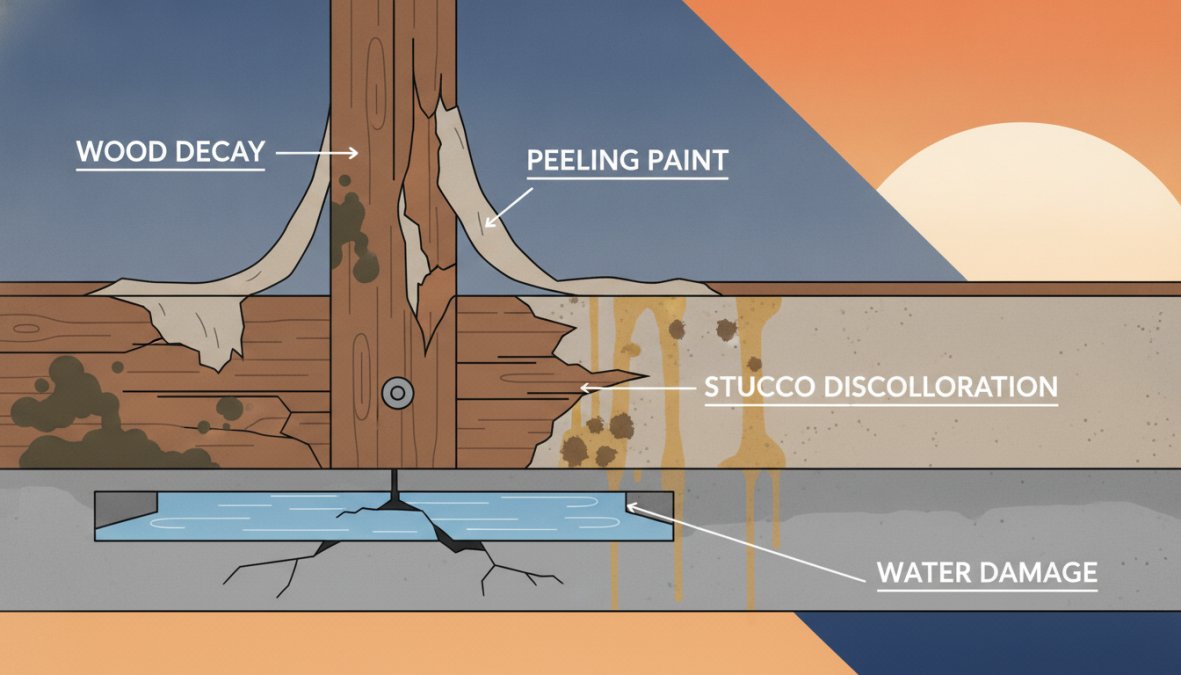
Stucco discoloration is one of the earliest and most commonly missed warning signs. Water intrusion creates visible staining, rust-colored streaks or dark patches, and by the time you can see it, the wood beneath may already show decay.
Other warning signs that should trigger immediate inspection:
- Soft or spongy spots when walking on the deck surface
- Visible gaps between the ledger board and the building’s exterior wall
- Rust staining around fasteners or railing posts
- Peeling or bubbling deck coatings, indicating waterproofing failure
- Rotted wood at joist ends, particularly where they meet the ledger
- Cracked or spalling concrete on elevated concrete decks
- Sagging or uneven walking surfaces
(/balcony-structural-failure-warning-signs/) You Should Never Ignore]
A small membrane breach can saturate framing members within a single rainy season. What starts as a surface coating repair becomes a full structural replacement if the owner waits.
When to Escalate: Safety Hazards That Demand Immediate Action
Safety hazards requiring immediate action include visible deflection or bounce in the deck surface, any movement in the railing assembly when force is applied, visible separation of structural connections, and any inspector finding that designates the element unsafe for human occupancy.
Under California building code, an inspector who identifies an immediate safety hazard must notify the local enforcement agency, and the structure must be taken out of service until repairs are completed and re-inspected. Emergency remediation is consistently more expensive than planned repair work because contractors must mobilize quickly and material lead times cannot be managed in advance.
Balcony Inspection Cost: What to Expect Before You Budget Repairs
Inspection cost is the first line item in any repair budget, and it varies more than most property managers expect.
Inspector Qualifications and Requirements Under California Law
California law requires EEE inspectors to be a licensed architect, licensed structural engineer, licensed general contractor with specific experience, or an associate operating under a licensed professional’s supervision. Inspector qualification affects cost: a licensed structural engineer commands a higher rate than a general contractor inspector, but their findings carry more weight in court and with insurers. For properties with complex structural concerns or prior damage history, the premium is worth it.
Request a sample inspection report from any inspector you’re evaluating before you hire them. A well-structured report clearly separates cosmetic findings from structural findings, identifies immediate hazards, and provides specific remediation recommendations. Vague reports create ambiguous repair scopes, which drives up contractor bids.
Inspection Frequency, Deadlines, and the Sampling Methodology (15% Rule)
SB 721 requires inspections every six years; SB 326 requires inspections every nine years. Initial compliance deadlines have already passed for many properties, meaning owners who haven’t completed their first inspection are already out of compliance.
The 15% sampling methodology allows inspectors to examine at least 15% of each EEE type, selected to represent the range of conditions across the property. The critical budget implication: if the sample reveals significant problems, the inspector has discretion to expand scope. A property where 15% of sampled balconies show rotted wood may end up with 100% inspected and repaired. Budget for the worst-case scenario, not the minimum sample.
As documented in California Department of Housing and Community Development guidance, the inspection and reporting requirements are designed to create a documented record of structural condition over time.
Concrete Balcony Repair Price Per Square Foot: A Realistic Breakdown
Concrete balcony repair price per square foot varies significantly based on damage severity, access conditions, and local labor markets. What follows is a realistic framework, not a guaranteed quote.
Cost Tiers by Damage Severity: Minor, Moderate, and Structural Failure
Use this table as a starting framework when building your initial repair budget estimate. Actual costs depend on contractor, location, and site-specific conditions.
| Damage Tier | Typical Scope | Relative Cost Range | Urgency |
|---|---|---|---|
| Minor | Surface coating, sealant replacement | Lowest | Planned maintenance cycle |
| Moderate | Waterproofing membrane, partial framing | Moderate | Within 90-180 days |
| Structural | Full framing replacement, ledger repair | Highest | Immediate to 30 days |
| Emergency | Out-of-service hazard, full rebuild | Premium | Immediate mobilization |
Minor damage covers failed deck coatings, minor cracking, or sealant deterioration, primarily a balcony waterproofing cost exercise addressable during routine maintenance. Moderate damage involves membrane failure with water intrusion into the structural assembly, requiring partial framing replacement and full membrane reinstallation. Structural failure means full joist replacement, ledger repair or replacement, and post and beam work, concrete balcony repair at this level involves saw-cutting, shoring, demolition, and reconstruction, and the cost per square foot reflects that complexity.
Never let a contractor begin structural repair work without pulling the required building permits. Unpermitted structural repairs create title issues, void insurance claims, and can require full demolition and re-inspection at the owner’s expense.
Balcony Waterproofing Cost and Why It Belongs in Every Repair Budget
Balcony waterproofing cost is not an optional line item; it is the single most important preventive investment in an elevated structure’s lifecycle.
Every balcony repair that involves opening the deck surface must include a complete waterproofing system replacement, not a patch. Partial repairs fail at the transitions between old and new membrane, typically within one to three rainy seasons, resulting in a second project that costs more than doing it correctly the first time.
A complete waterproofing system includes the base membrane, flashing at all penetrations and transitions, a protection board or wear surface, and compatible sealants at all terminations. The walking surface goes on top of this system and is separate from the waterproofing assembly itself.
According to Building Enclosure Consulting resources on waterproofing best practices, proper detailing at transitions and penetrations is the most critical factor in waterproofing system longevity. Properties that treat waterproofing as an afterthought consistently return to the repair cycle within five years; those that treat it as the primary scope item see significantly longer intervals between major repair events.
Post-Inspection Remediation Workflow: From Report to Completed Repair
The inspection report is not the end of the process. For most property managers, it’s the beginning of the hard work.
Reporting, Documentation, and Record Keeping Requirements
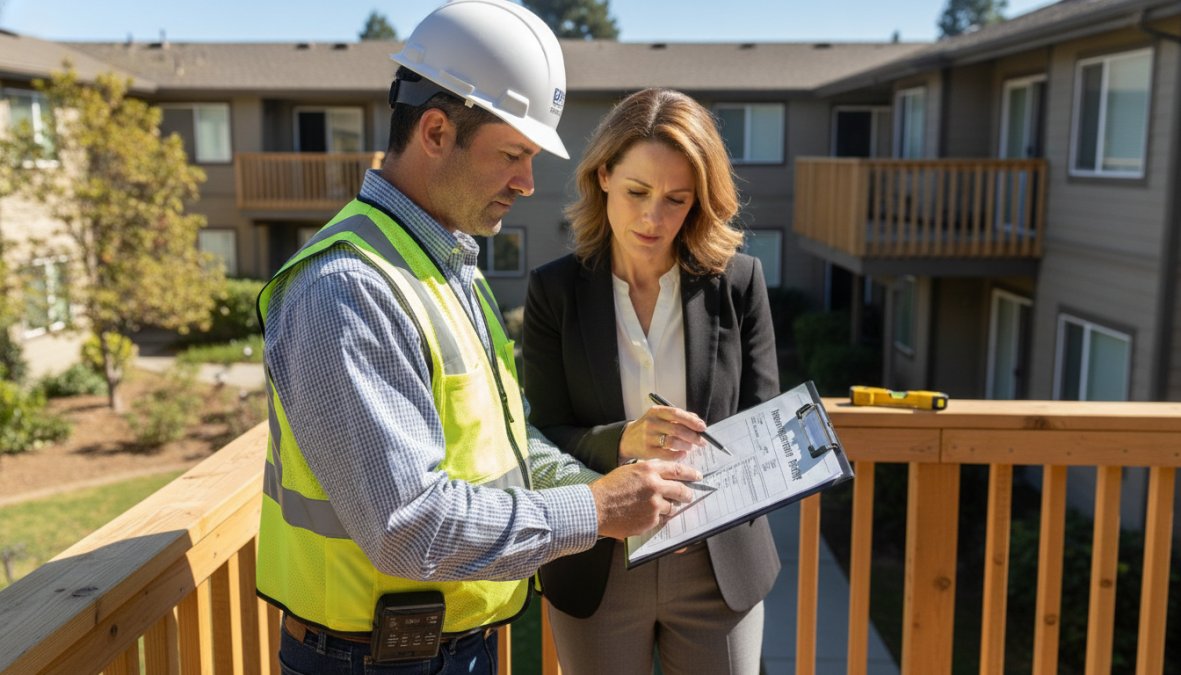
The post-inspection remediation workflow is a defined sequence of steps that takes a property from inspection findings to completed, documented repair. Here’s the process Apex Balcony recommends:
- Receive and review the inspection report. Separate findings into three categories: immediate hazards requiring out-of-service designation, structural findings requiring permitted repair, and maintenance findings addressable through routine work orders.
- Notify residents of any out-of-service designations. California law requires prompt notification. Document the method and date.
- Engage a licensed contractor for scope development. Require bids from at least three contractors that reference specific report findings by section number to prevent scope ambiguity.
- Pull required building permits. Structural repairs to EEEs require permits in all California jurisdictions and create an official record of repair.
- Complete repairs with inspections at required stages. Most jurisdictions require a framing inspection before waterproofing installation and a final inspection before the walking surface is reinstalled.
- Obtain final inspection sign-off and maintain records. SB 721 requires records to be available to the local enforcement agency on request.
- Schedule the next inspection cycle. Set a calendar reminder for the six-year or nine-year reinspection deadline from the date of completed repair documentation.
Owners who cannot produce inspection records when requested face compliance findings that trigger the full inspection and repair cycle, regardless of the actual condition of their structures.
Insurance Implications and Liability Exposure for Non-Compliant Properties
Most commercial property and general liability policies contain exclusions for known hazardous conditions. An uninspected balcony with visible signs of damage can be characterized as a known hazard, giving an insurer a strong basis to deny coverage for any balcony-related claim, leaving the property owner to face litigation costs without insurance protection.
Liability exposure extends beyond insurance. Under California law, a property owner aware of a safety hazard who fails to remediate it faces potential punitive damages in addition to compensatory damages. The negligence per se doctrine means a plaintiff does not need to prove the owner was unreasonable; the statutory violation itself establishes the breach of duty. Treat SB 721 and SB 326 compliance as a condition of property ownership, properties with current, documented inspection histories are substantially better positioned in both litigation and insurance renewals.
As noted in California Department of Real Estate guidance on property disclosure obligations, structural condition disclosures are a legal requirement in property transactions, and undisclosed known defects create post-sale liability for sellers.
Your Balcony Repair Cost Estimation Guide: Compliance Calendar and Next Steps
Use this checklist to assess where your property stands today.
Compliance Readiness Checklist:
- Identify whether your property is governed by SB 721 (rental) or SB 326 (HOA)
- Confirm whether your initial inspection has been completed and documented
- Calculate your next reinspection deadline (six years for SB 721, nine years for SB 326)
- Review your most recent inspection report for open findings
- Confirm that all immediate hazard findings have been remediated and documented
- Verify that building permits were pulled and closed for all structural repairs
- Confirm that waterproofing was replaced as part of any structural repair scope
- Ensure inspection and repair records are stored in a retrievable format
- Notify your insurer of completed inspections and remediation work
- Set calendar reminders for your next inspection cycle deadline
The real cost of non-compliance is never just the fine or the repair, it’s the emergency mobilization premium, the insurance gap, the litigation exposure, and the reputational damage with residents and prospective tenants. A well-managed balcony repair cost estimation process, starting with inspection and ending with documented record keeping, is the most cost-effective risk management tool available to California property owners. For properties that haven’t completed their initial inspection, the time to act is now.
California’s SB 721 and SB 326 compliance requirements create a clear obligation for property owners, but navigating the inspection-to-repair workflow without expert guidance leads to missed deadlines, budget overruns, and avoidable liability. Apex Balcony provides licensed inspectors with decades of combined construction and design experience, specialized expertise in California balcony law compliance, and comprehensive inspection of all exterior elevated elements including balconies, decks, and stairways. Get started with Apex Balcony and leave your next inspection cycle with a clear report, a documented compliance record, and a repair budget you can actually trust.
Frequently Asked Questions
How much does it cost to repair a balcony in California?
Balcony repair costs in California vary widely depending on damage severity, materials, and balcony size. Minor cosmetic repairs may run a few hundred dollars, while moderate structural work involving wood-based products or waterproofing membranes can range from $1,000 to $5,000 per unit. Severe structural failure requiring full replacement of load-bearing components can exceed $10,000 per balcony. Getting a professional inspection first is the most reliable way to produce an accurate balcony repair cost estimation before committing to any contractor.
What factors influence the cost of balcony repairs?
Key factors include the extent of wood decay or water intrusion, the type of walking surface and load-bearing components involved, whether waterproofing must be replaced, and local labor rates. Multi-family dwelling properties with many exterior elevated elements face higher aggregate costs. Compliance with California building code under SB 721 or SB 326 may also require specific materials or licensed professionals, which affects pricing. Catching damage early through routine inspection significantly reduces overall repair costs.
Is balcony repair covered by homeowners or building insurance?
Coverage depends on your policy and the cause of damage. Insurance may cover sudden structural failure caused by a covered peril, but policies typically exclude damage resulting from long-term neglect, deferred maintenance, or gradual water intrusion. HOA boards and property management companies that fail to comply with SB 721 or SB 326 inspection requirements may face negligence per se claims, which can complicate or void coverage. Reviewing your policy with an insurance professional before and after an inspection is strongly recommended.
How do I know if my balcony needs structural repair?
Common signs of balcony structural damage include stucco discoloration, rotted wood, soft or spongy walking surfaces, visible cracks in concrete, rust staining, and loose or corroded fasteners. Any of these can indicate water intrusion affecting load-bearing components. Under SB 721 and SB 326, a certified inspector, such as a licensed architect, structural engineer, or qualified general contractor, must formally evaluate exterior elevated elements on a set inspection cycle. Do not rely solely on visual checks for a compliance determination.
How long does a typical balcony repair take?
Simple cosmetic repairs or minor waterproofing work can be completed in one to three days per balcony. Moderate structural repairs involving replacement of wood-based products or decking membranes typically take one to two weeks per unit. Full structural replacement of exterior elevated elements with significant load-bearing damage may take several weeks, especially when California building code permits are required. Building in adequate lead time after your inspection report is received is essential for meeting SB 721 and SB 326 compliance deadlines.
What is the balcony inspection cost for a multi-family building?
Balcony inspection cost for multi-family dwellings varies based on the number of exterior elevated elements, building size, and the qualifications of the inspector. A statistically significant sample, at minimum 15% of each type of EEE, must be inspected under SB 721. Larger buildings with more units will naturally incur higher inspection fees. Investing in a thorough inspection by a certified inspector upfront is far less costly than the liability exposure, fines, and emergency repair costs that result from non-compliance.