SB 326 Compliance: A 2026 Guide for HOAs
SB 326 compliance guide for HOAs: inspection requirements, deadlines, qualified inspectors, and repair workflows. Ensure legal compliance today.
Table of Contents
- What Is SB 326 and Why SB 326 Compliance Matters
- Exterior Elevated Elements (EEE) Defined
- SB 326 Inspection Requirements and Frequency
- SB 326 vs. SB 721: Key Differences Explained
- Compliance Deadlines and Reporting Requirements
- HOA Balcony Repair Liability and Risk Management
- Remediation and Repair Workflow for SB 326 Compliance
- Getting Started: Your SB 326 Compliance Checklist
SB 326 Compliance: A 2026 Guide for HOAs
Last Updated: July 6, 2026
California property owners face a critical deadline. SB 326 compliance requirements have transformed how residential buildings manage elevated exterior elements, and non-compliance carries significant liability risks. This guide walks you through every aspect of SB 326 compliance, from understanding what the law requires to budgeting for repairs and managing your inspection cycle.
What Is SB 326 and Why SB 326 Compliance Matters
Senate Bill 326, codified in California Civil Code Section 5551, established mandatory inspection and maintenance requirements for exterior elevated elements in residential buildings. The law applies to condominium associations, planned communities, and other common interest developments with three or more units. It’s a legal mandate with real consequences for boards that fail to comply.
Between 2015 and 2020, several high-profile balcony collapses in California prompted legislators to act. SB 326 was the response, a framework requiring buildings to identify structural problems before they become emergencies.
California Civil Code Section 5551 requirements outlines specific obligations for property owners and HOA boards. The law requires documented inspection, professional assessment, and a clear remediation plan for any findings.
For HOA boards, this means three core responsibilities: (1) hiring qualified inspectors to evaluate all exterior elevated elements on a defined cycle, (2) documenting all findings in a formal report, and (3) communicating results to unit owners and maintaining records for at least nine years.
Boards that skip or delay inspections expose themselves to dual liability: both regulatory penalties AND civil lawsuits if a structural failure occurs. Insurance coverage may not apply if the board failed to conduct mandated inspections.
Buildings Subject to Inspection Under SB 326
SB 326 applies to common interest developments, condominiums, planned communities, and similar HOA-governed properties with three or more residential units. Single-family homes and small two-unit buildings are exempt.
The critical threshold is common ownership of exterior elevated elements. If the building has balconies, decks, stairways, or similar structures that are common property (owned by the HOA, not individual units), SB 326 applies.
Buildings constructed before January 1, 2018 are subject to the full inspection and reporting cycle. According to California Department of Consumer Affairs guidance on SB 326 compliance, the law covers multi-family residential buildings with shared balconies or decks, condominiums with common area exterior structures, planned communities with HOA-maintained elevated elements, and master-planned developments with shared stairways or walkways.
Buildings subject to SB 721 requirements (another California law covering residential condominiums) may have overlapping obligations. Both laws focus on structural safety but apply to different building types and have different inspection cycles.
If your building has any doubt about whether it’s covered, consult with your property management company or legal counsel. Misclassifying your building as exempt when it’s actually subject to SB 326 is a common compliance mistake.
Exterior Elevated Elements (EEE) Defined
Exterior Elevated Elements, abbreviated as EEE, are the specific structures that SB 326 requires you to inspect. Understanding what qualifies as an EEE is essential for compliance.
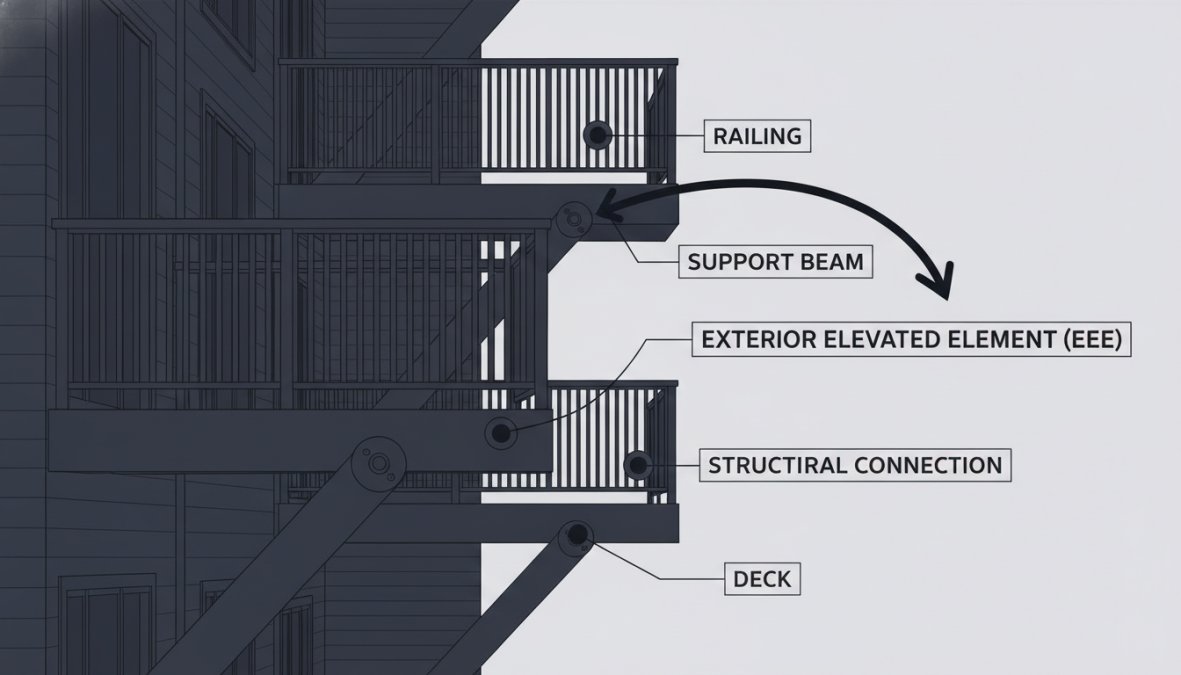
The law defines EEE broadly to include any exterior structure elevated above ground level and part of the building envelope. This includes balconies and decks (railings, flooring, and support structures), exterior stairs and landings, walkways and bridges, porches and stoops, and attached canopies and overhangs with load-bearing connections.
The definition excludes ground-level patios, landscaping features, and minor architectural elements. The key distinction is whether the structure is elevated, part of the building envelope, and could pose a safety risk if it fails.
Walk your building perimeter with a camera and photograph every elevated structure. That list becomes your inspection scope.
EEE inspection focuses on identifying three primary failure modes: dry rot or wood decay, corrosion of metal fasteners and connections, and structural damage from weather exposure, impact, or settlement.
SB 326 Inspection Requirements and Frequency
California law requires that all exterior elevated elements be inspected on a nine-year cycle, with the first inspection due by January 1, 2025 for buildings constructed before January 1, 2018. The inspection must be comprehensive and visual, documenting the condition of railings, fasteners, flooring, support structures, waterproofing, and connections.
The 9-Year Inspection Cycle
Once your building completes its first inspection, subsequent inspections are due every nine years from the date of the initial inspection.
| Inspection Event | Deadline | Action Required |
|---|---|---|
| Initial inspection (pre-2018 buildings) | January 1, 2025 | Hire inspector, complete inspection, file report |
| Second inspection | 9 years after initial | Repeat full inspection and reporting |
| Third inspection | 18 years after initial | Repeat full inspection and reporting |
| Ongoing cycle | Every 9 years | Continue inspections indefinitely |
The nine-year interval is based on the typical lifecycle of exterior materials and fasteners in California’s climate. However, boards should conduct informal visual checks annually or after severe weather events to catch new problems early.
Who Is Qualified to Perform SB 326 Inspections
The law requires that findings be documented by someone with professional expertise to identify structural deficiencies. This means a licensed architect, structural engineer, or professional engineer with relevant experience in residential construction and exterior structures.
The inspector’s report becomes part of your legal compliance record. If a deficiency is missed and later causes injury, that report could be scrutinized in court. Hiring a qualified, experienced inspector is a liability safeguard, not a cost to minimize.
Boards that hire unqualified inspectors to save money often face re-inspection requirements when their reports are challenged. The cost of a second inspection far exceeds the savings from the first one.
SB 326 vs. SB 721: Key Differences Explained
California has two major balcony safety laws. SB 721 (passed in 2018) applies to residential condominiums and has different requirements than SB 326. Understanding the distinction is critical because your building might be subject to one, both, or neither.
| Aspect | SB 326 | SB 721 |
|---|---|---|
| Applies to | Common interest developments (HOAs, planned communities) | Residential condominiums only |
| Inspection cycle | Every 9 years | Every 6 years (more frequent) |
| First inspection deadline | January 1, 2025 | January 1, 2019 (already passed) |
| Qualified inspector | Architect, engineer, or licensed professional | Architect or engineer (more restrictive) |
| Repair timeline | No mandated timeline; case-by-case assessment | Repairs must begin within 180 days of report |
The key practical difference: SB 721 buildings must begin repairs within 180 days of the inspection report, while SB 326 allows more flexibility. SB 721 also requires inspections every six years instead of nine.
Many buildings are subject to BOTH laws if they’re residential condominiums with HOA governance. In those cases, you follow the more stringent requirements. Clarify your building’s classification with your property management company and legal counsel.
Compliance Deadlines and Reporting Requirements
If your building was constructed before January 1, 2018 and hasn’t completed its first SB 326 inspection, you’re technically non-compliant as of January 1, 2025.
The immediate action steps are:
- Hire a qualified inspector immediately
- Schedule the inspection (typically 2-4 weeks depending on building size)
- Receive and review the inspection report
- File the report with your local jurisdiction
- Communicate findings to unit owners
The inspection itself takes one to three days depending on building size and complexity.
Record-Keeping and Documentation
Once you have your inspection report, you must maintain it for at least nine years. Maintain records in a centralized location accessible to the board and property management, including the original inspection report with all findings and photographs, any supplemental inspections, documentation of all repairs completed, board meeting minutes discussing findings and repair decisions, and communications sent to unit owners.
Digital storage with backup copies is strongly recommended.
HOA Balcony Repair Liability and Risk Management
An inspection report identifies deficiencies, but it doesn’t automatically obligate you to repair everything immediately. SB 326 requires that you document findings and develop a remediation plan, but the law gives boards some discretion in timing repairs based on severity and financial capacity.
However, if you identify a critical structural deficiency and delay repairs, you’re knowingly exposing residents to risk. The safest approach is to categorize deficiencies by severity:
- Critical (safety hazard): Repair immediately. Examples include loose railings, severe wood rot affecting load-bearing elements, and corroded fasteners creating instability.
- Major (significant deterioration): Repair within 12 months. Examples include moderate wood decay, waterproofing failures, and cosmetic rust on fasteners.
- Minor (cosmetic or early-stage): Include in next planned maintenance cycle. Examples include paint failure, minor caulking gaps, and surface-level discoloration.
Insurance Implications and Coverage
Your HOA’s general liability insurance typically covers property damage and bodily injury claims. However, many policies have exclusions for defects that were known but not repaired. If an inspection identified a hazard and the board failed to address it, the insurance company may deny a claim.
Review your insurance policy for coverage limits for balcony/deck repairs, exclusions for "known defects," requirements to report inspection findings to the insurer, and whether the policy covers legal defense costs for SB 326-related claims.
Proactively reporting findings to your insurer demonstrates that you’re managing risk responsibly. Some insurers offer discounts or improved coverage terms for buildings that maintain active SB 326 compliance programs.
The cost of repairing a deficiency is always less than the cost of defending a lawsuit after a failure causes injury.
Remediation and Repair Workflow for SB 326 Compliance
Once your inspection identifies deficiencies, you need a clear process for moving from identification to completion. The standard workflow is:
- Receive and review the inspection report
- Obtain repair estimates from 2-3 qualified contractors
- Prioritize by severity and cost
- Develop a remediation plan with timeline and budget
- Approve repairs and assign responsibility
- Execute repairs and oversee work
- Document completion with invoices, photos, and certifications
- Update your inspection records
This process typically takes 3-6 months from inspection report to completion.
Budgeting and Reserve Study Integration
SB 326 compliance costs should be incorporated into your reserve study, the financial analysis that determines how much the HOA needs to save annually for future capital repairs. A typical balcony repair can range from $2,000 to $50,000 per unit depending on scope. For a 50-unit building, major balcony repairs might total $500,000 or more.
Work with your reserve study professional to estimate the cost of addressing identified deficiencies, project when future inspections will occur, determine the annual funding needed, and evaluate whether current reserve contributions are adequate.
Getting Started: Your SB 326 Compliance Checklist
If your building hasn’t completed its first SB 326 inspection, here’s your action plan:
- Confirm your building is subject to SB 326 (constructed pre-1/1/2018, has exterior elevated elements)
- Clarify whether SB 721 also applies
- Research qualified inspectors with residential balcony experience
- Request proposals from 2-3 inspectors
- Schedule inspection within the next 60 days
- Prepare building access and notify residents
- Receive and review the inspection report
- Obtain repair estimates for identified deficiencies
- Develop a prioritized remediation plan
- Communicate findings and repair plans to unit owners
- Execute repairs according to priority and timeline
- Document all repairs with photos and certifications
- File inspection report and repair documentation
- Schedule your next inspection for nine years from the initial inspection date
SB 326 compliance isn’t optional, and it’s not as complicated as many boards fear. The process is straightforward: inspect, document, prioritize, repair, and record. The challenge is getting started and staying organized throughout the cycle.
Book an inspection today and take the first step toward protecting your residents and your organization.
Frequently Asked Questions
What is SB 326 and which properties must comply?
SB 326 is California law requiring inspections of exterior elevated elements (balconies, decks, stairways) on Common Interest Developments. Multi-family residential buildings with three or more units must comply. The law mandates visual inspections by licensed architects or structural engineers to identify safety hazards like dry rot, corrosion, and structural defects. Non-compliance exposes HOAs to significant liability and legal penalties.
What are exterior elevated elements (EEE) under SB 326?
Exterior elevated elements include balconies, decks, stairs, and other load-bearing structures attached to buildings. EEE must support live loads safely and maintain waterproofing to prevent water intrusion. Common failure points include corroded fasteners, deteriorated wood, failed waterproofing membranes, and cracked concrete. Regular visual inspections identify these defects early, preventing costly emergency repairs and protecting resident safety.
How often must SB 326 inspections occur and what are the deadlines?
SB 326 requires inspections on a 9-year cycle. Buildings must schedule their first inspection by January 1, 2025, or nine years after the most recent inspection. Subsequent inspections follow the same 9-year interval. Failure to meet compliance deadlines can result in fines and liability. HOAs should schedule inspections well in advance with qualified inspectors to avoid rushed assessments and ensure thorough evaluation of all elevated exterior elements.
How does SB 326 differ from SB 721, and which applies to my building?
SB 721 applies to buildings with three or more units built before January 1, 2018, and requires inspections by January 1, 2025. SB 326 applies to buildings with three or more units built on or after January 1, 2018, and requires inspections by January 1, 2025. Both laws mandate visual inspections of exterior elevated elements by licensed professionals. Determine your building's construction date to identify which law governs compliance obligations and deadlines.
What should be included in an SB 326 inspection report and how do I budget for repairs?
Inspection reports must document all visual findings, identify safety hazards, and recommend remediation. Detailed reports include photographs, structural assessments, and timelines for repairs. For budgeting, integrate inspection findings into your reserve study to forecast repair costs over the 9-year cycle. Prioritize critical safety defects immediately; schedule non-urgent repairs strategically. Work with property management and a structural engineer to develop a realistic remediation timeline and cost estimate that protects both residents and the HOA's financial health.