How to Schedule SB 721 Inspection: Step-by-Step Guide
Learn how to schedule SB 721 inspection for your California property. Step-by-step workflow, timelines, and compliance requirements. Start today.

Table of Contents
- Understanding SB 721 and Your Inspection Obligation
- Step-by-Step: How to Schedule SB 721 Inspection
- SB 721 Inspector Qualifications: What to Look For
- What Components Must Be Inspected During Your SB 721 Assessment
- SB 721 Repair Timeline: Understanding Post-Inspection Obligations
- Tenant Notification Templates and Communication Best Practices
- Post-Inspection Filing and Compliance Documentation
- Common Mistakes to Avoid When Scheduling SB 721 Inspections
Last Updated: June 28, 2026
Understanding SB 721 and Your Inspection Obligation
California’s SB 721 law requires property owners of multi-family buildings to conduct regular inspections of exterior elevated elements (EEE), primarily balconies, decks, and similar structures, to ensure structural safety. With a structured approach, you can complete scheduling efficiently while maintaining compliance and avoiding escalating penalties.
What is SB 721 and Who Must Comply
SB 721 mandates that owners of residential buildings with three or more units inspect all exterior elevated elements for structural integrity. This applies to apartment complexes, condominiums, townhouse developments, and any multi-family property with balconies, decks, elevated walkways, or similar load-bearing components. A qualified inspector, typically a licensed architect or structural engineer, must visually assess these elements and identify hazardous conditions.
Who must comply: apartment building owners, condominium associations, mixed-use buildings with residential units, and manufactured housing communities with elevated structures. Renters and single-family homeowners are not subject to SB 721.
Critical Deadlines: January 1, 2025 and Beyond
The first compliance deadline was January 1, 2025. Buildings that did not complete their initial inspection by that date must do so immediately to avoid penalties. Properties that completed their first inspection must now schedule their second cycle, typically due within 6 years of the initial assessment.
The inspection cycle works as follows:
- Initial inspection: Must be completed by January 1, 2025 (or immediately if not yet done)
- Subsequent inspections: Due every 6 years for buildings with no significant defects; more frequently if hazardous conditions are found
- Re-inspections after repairs: Required within 6 months of completing major structural repairs
Missing deadlines carries financial and legal consequences. Enforcement agencies in Los Angeles, San Diego, and San Francisco have begun issuing citations and fines to non-compliant property owners.
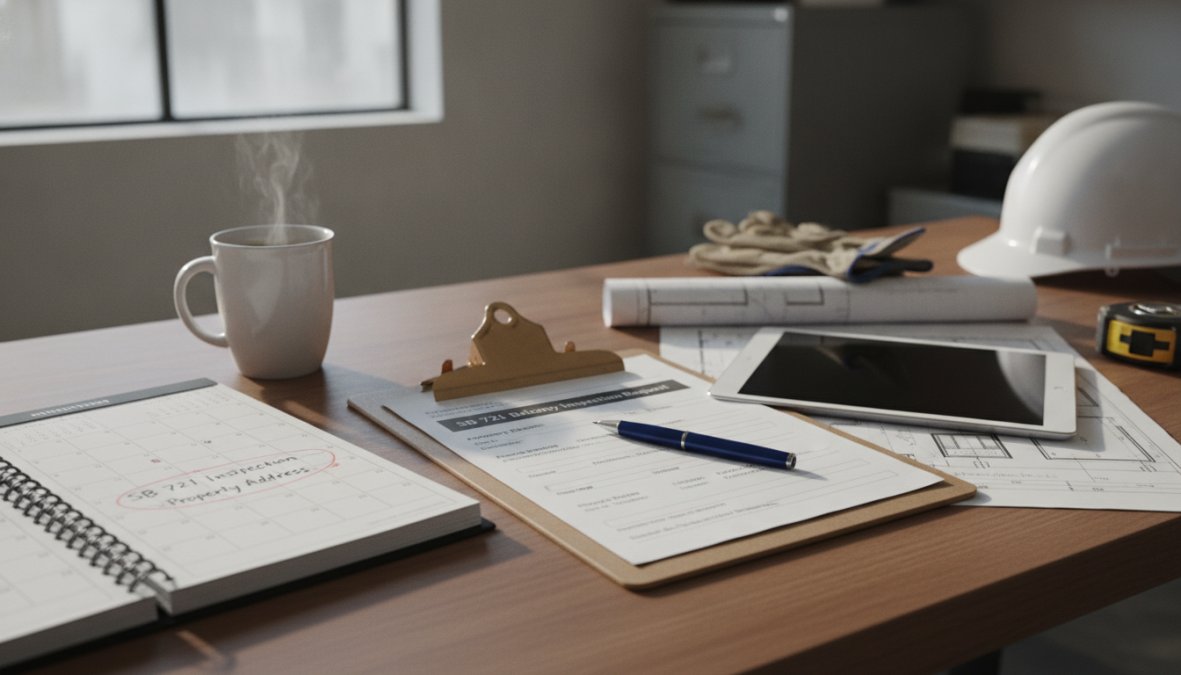
Step-by-Step: How to Schedule SB 721 Inspection
Step 1: Determine Your Building’s Inspection Cycle
Before contacting an inspector, determine where your building stands in the compliance timeline. Review your building’s inspection history by checking with your property management company, HOA, or building records for any original inspection report and completion date.
If you find a previous inspection report, note the completion date. Your next inspection is typically due six years later, unless the inspector identified hazardous conditions requiring an expedited cycle (usually within 12 to 24 months). If you cannot locate an inspection report, your building likely missed the January 1, 2025 deadline and your inspection is overdue.
Document your building’s status clearly:
- Date of last inspection (if completed)
- Date of next required inspection
- Any hazardous conditions identified
- Repairs completed since the last inspection
Keep a simple spreadsheet tracking your building’s inspection dates, inspector contact information, and report filing status. This prevents missed deadlines and provides clear documentation for enforcement agencies.
Step 2: Identify and Hire a Qualified Inspector
SB 721 inspections must be conducted by a licensed architect, structural engineer, or qualified professional with expertise in exterior elevated elements and California building codes.
When searching for an inspector, verify their credentials:
- Current California architectural or engineering license
- Specific experience with SB 721 and SB 326 inspections
- References from other multi-family property owners
- Insurance coverage (professional liability and general liability)
When contacting potential inspectors, ask about their experience, timeline from contact to completed report, whether they conduct invasive testing, fee structure, and scheduling availability.
Get quotes from at least two inspectors. Pricing varies widely depending on building size and complexity. A typical inspection for a 50-unit building might range from $2,000 to $5,000 for visual-only assessment, with invasive testing adding $1,000 to $3,000.
Hiring the cheapest inspector is a common mistake. An inexperienced inspector may miss structural issues that later become expensive liability problems. Choose an inspector with proven SB 721 experience.
Step 3: Notify Tenants and Schedule Access
Once you’ve selected your inspector, notify tenants that an inspection will occur. California law requires reasonable advance notice, typically 24 to 48 hours, before inspectors access private units or common areas.
Send a written notice to all tenants including the inspection date and time window, which areas will be inspected, the inspector’s name and company, contact information for questions, and a statement that this is a mandatory safety inspection. Send this notice at least 5 business days before the inspection.
Coordinate with your inspector on logistics: how many units they can inspect per day, whether they need keys to locked areas, and what tenants should do if they won’t be home. Document all tenant notifications and keep copies of notices sent with proof of delivery.
Step 4: Prepare Documentation and Maintenance Records
Before the inspection, gather all documentation related to your building’s balconies and exterior elevated elements: building permits and construction plans, previous inspection reports, records of repairs or maintenance performed, warranty information, and photos of any visible damage.
Organize this information chronologically and by location. Create a simple map or list showing the locations of all elevated exterior elements, including the number of individual balconies, common deck areas, elevated walkways, and roof access areas.
Organized documentation before the inspection speeds up the assessment and demonstrates to enforcement agencies that you take compliance seriously.
SB 721 Inspector Qualifications: What to Look For
Licensed Architect and Structural Engineer Requirements
California law specifies that SB 721 inspections must be performed by a licensed architect, structural engineer, or other qualified professional with expertise in building construction and safety.
A licensed architect must have a bachelor’s degree in architecture, minimum 3 years of work experience under a licensed architect, passage of the Architect Registration Examination (ARE), and current California architectural license.
A structural engineer must have a bachelor’s degree in civil or structural engineering, minimum 4 years of work experience in structural engineering, passage of the Professional Engineer (PE) exam, and current California PE license in structural engineering.
Both credentials are valid for SB 721 inspections. Verify licenses online through the California Department of Consumer Affairs. Never hire someone who cannot produce a valid license.
Experience with Elevated Exterior Elements
Beyond holding a valid license, the inspector should have specific experience assessing balconies, decks, and similar structures. Balcony failures often stem from water infiltration at connection points, not visible cracks. Ask potential inspectors about the number of SB 721 inspections they’ve personally conducted, whether they’ve identified structural failures, and if they can provide references from property owners or HOAs.
An experienced SB 721 inspector will have completed dozens of inspections and can speak knowledgeably about common failure patterns.
What Components Must Be Inspected During Your SB 721 Assessment
Balconies, Decks, and Load-Bearing Components
The SB 721 inspection focuses on exterior elevated elements including balconies and decks (framing, fastening systems, railings, flooring surfaces and drainage), load-bearing connections (where the balcony attaches to the main building, ledger boards and fasteners, flashing and waterproofing), and stairs and walkways (treads, risers, handrails, guardrails, and connection points).
The inspector documents the condition of each component using a standardized assessment form, noting whether components are in good condition, show minor wear, or exhibit hazardous conditions.
Waterproofing and Structural Integrity Checks
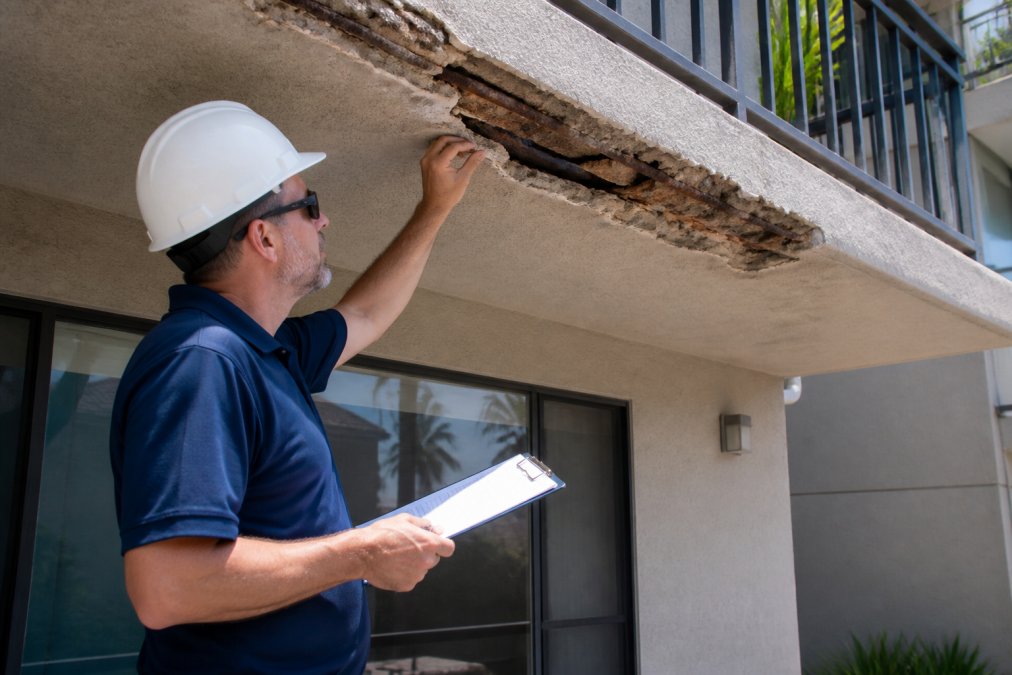
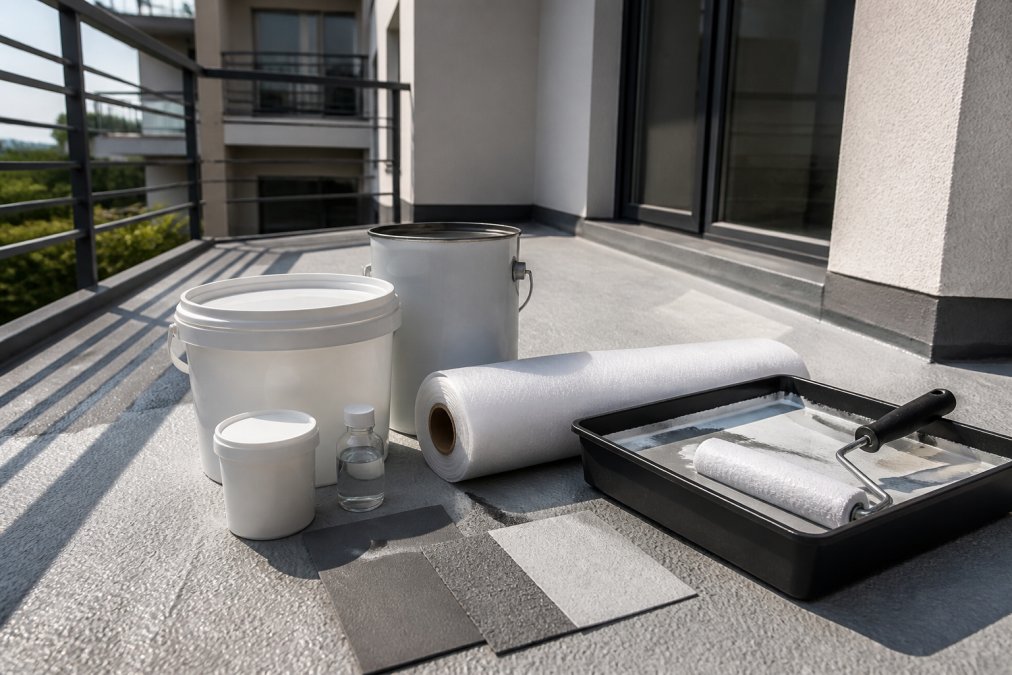
Water intrusion is the leading cause of balcony failure in California. Inspectors assess waterproofing condition (caulking and sealants, membrane integrity, drainage systems) and structural integrity (visual cracks, rust or corrosion, soft spots indicating rot, movement or deflection, and separation between components).
Inspectors may conduct invasive testing by opening sealed areas, using moisture meters, extracting fasteners, or drilling small holes to assess material condition. The inspector’s report categorizes findings as safe/good condition (no repairs needed), minor defects (repairs needed within 1-2 years), significant defects (repairs needed within 6-12 months), or hazardous conditions (immediate repair or closure required within 30 days).
SB 721 Repair Timeline: Understanding Post-Inspection Obligations
Emergency Repairs and Hazardous Conditions
If the inspection identifies hazardous conditions, such as a balcony showing signs of imminent failure, severe corrosion of critical fasteners, or structural cracks, the property owner must act immediately.
When a hazardous condition is identified, you must immediately notify the local enforcement agency, restrict access to the affected area, engage a contractor to begin repairs within 30 days, and provide progress updates to the enforcement agency.
Delaying repairs on a hazardous condition exposes you to personal liability. If a resident is injured on a known-hazardous balcony, your building’s insurance may deny the claim.
Standard Repair Deadlines and Compliance Reporting
For non-hazardous defects, repair timelines depend on severity: minor defects require 1-2 years to complete repairs, significant defects require 6-12 months, and hazardous conditions require 30 days to begin repairs with completion within 6 months.
After repairs are completed, schedule a follow-up inspection to verify work was done correctly. Once repairs are verified, file a compliance report with your local enforcement agency documenting the original inspection, repairs performed, completion date, and verification that the structure meets code requirements.
Tenant Notification Templates and Communication Best Practices
Pre-Inspection Notice (Sample Template)
NOTICE OF MANDATORY EXTERIOR SAFETY INSPECTION
Dear Valued Residents,
Your building is scheduled for a mandatory inspection of exterior elevated elements (balconies, decks, and railings) as required by California Senate Bill 721.
Inspection Details:
- Date: [DATE]
- Time: [TIME RANGE]
- Inspector: [NAME], [LICENSE TYPE] #[LICENSE NUMBER]
- Company: [COMPANY NAME]
What will be inspected:
All exterior balconies, decks, railings, and related structures for safety and structural integrity.
What to expect:
- Visual inspection of your private balcony or patio (if applicable)
- Inspection time per unit: approximately 15-30 minutes
- Inspector may use non-destructive testing tools
- No damage will result from the inspection
Access required:
If you have a private balcony, the inspector must access your unit. Please ensure someone is home, or contact your property manager to provide access.
Questions?
Contact [PROPERTY MANAGER NAME] at [PHONE] or [EMAIL].
This inspection is mandated by California law and is essential for resident safety.
Post-Inspection Communication (Sample Template)
INSPECTION RESULTS AND NEXT STEPS
Dear Residents,
The mandatory exterior safety inspection of your building has been completed. We want to update you on the results and explain what happens next.
Inspection Summary:
The inspection identified [BRIEF DESCRIPTION OF FINDINGS].
What this means:
[EXPLAIN IN PLAIN LANGUAGE whether repairs are needed and on what timeline.]
Next steps:
- We are evaluating repair options and will provide a detailed plan by [DATE]
- Repairs will be scheduled to minimize disruption to residents
- We will notify you of repair dates at least [NUMBER] days in advance
Your role:
During repairs, please allow contractors access to your unit as scheduled. If you have concerns about the repair plan, contact [PROPERTY MANAGER NAME] at [PHONE].
We take resident safety seriously and are committed to completing necessary repairs promptly.
Post-Inspection Filing and Compliance Documentation
Filing Your Safety Report with Enforcement Agencies
After your inspection is complete, file the inspector’s report with your local building department or code enforcement office. Filing requirements generally include the completed inspection report, proof that the inspection was conducted by a qualified professional, a summary of findings and identified defects, and your plan for addressing hazardous conditions or significant defects.
Some jurisdictions require online filing through a municipal portal, while others accept paper submissions. Filing deadlines vary: some jurisdictions require filing within 30 days of inspection completion, others allow up to 90 days. Check your local city or county website for specific requirements.
Maintaining Compliance Certificate and Records
After filing your inspection report and completing repairs, keep detailed records: original inspection report and all amendments, photos documenting the inspection and repairs, contractor invoices and completion certificates, follow-up inspection reports verifying repairs, and compliance filing confirmation from the enforcement agency.
Maintain these records for the full inspection cycle (typically 6 years). Create a simple tracking document:
| Element | Inspection Date | Next Due | Repairs Needed | Completion Date | Filed with Agency |
|---|---|---|---|---|---|
| Building A Balconies | 6/15/2026 | 6/15/2032 | Minor caulking | 8/30/2026 | 9/10/2026 |
| Building B Deck | 6/20/2026 | 6/20/2032 | None | N/A | 7/5/2026 |
| Common Walkway | 6/22/2026 | 6/22/2032 | Railing fasteners | 10/15/2026 | 11/1/2026 |
Common Mistakes to Avoid When Scheduling SB 721 Inspections
Mistake 1: Hiring an unqualified inspector. Many property managers contact general contractors who claim balcony experience but lack the required California architecture or engineering license. Always verify credentials before hiring.
Mistake 2: Delaying tenant notification. Giving tenants less than 48 hours notice creates access problems and complaints. Send notices at least 5 business days before the inspection.
Mistake 3: Ignoring hazardous condition findings. If the inspector identifies a hazardous condition, you cannot legally ignore it. Immediate action is required.
Mistake 4: Failing to file the inspection report. Many property owners complete the inspection but never file the report with their local enforcement agency. File the report within the required timeframe and keep proof of filing.
Mistake 5: Not scheduling follow-up inspections after repairs. After repairs are completed, a follow-up inspection is required to verify the work was done correctly.
Mistake 6: Assuming all inspectors charge the same fee. Inspector fees vary widely based on building size, location, and whether invasive testing is needed. Get multiple quotes, but don’t choose based on price alone.
Mistake 7: Missing the inspection deadline. If your building missed the January 1, 2025 deadline, your inspection is now overdue. Schedule your inspection immediately.
Scheduling an SB 721 inspection requires determining your inspection cycle, hiring a qualified inspector, notifying tenants, and filing your report. With a clear process, you can complete this compliance obligation efficiently and protect your residents.
Frequently Asked Questions
Who is qualified to perform an SB 721 inspection?
SB 721 inspections must be performed by a licensed architect or structural engineer with expertise in elevated exterior elements. These professionals assess balconies, decks, and other load-bearing components for structural integrity and waterproofing issues. When scheduling your SB 721 inspection, verify that your inspector holds current California licensure and has experience with multi-family residential buildings and building code compliance.
What is the deadline for my first SB 721 inspection?
The initial SB 721 inspection deadline is January 1, 2025, for most multi-family residential buildings with three or more units. However, some buildings may have different timelines based on when they were constructed. After your first inspection, you'll be assigned an inspection cycle (typically every 6 years) with subsequent deadlines. Missing this deadline can result in fines and penalties from enforcement agencies, so scheduling early is critical.
What happens if I miss the SB 721 inspection deadline?
Missing the SB 721 inspection deadline can result in significant fines and penalties from local enforcement agencies. Property owners may also face legal liability if structural failures occur in uninspected exterior elevated elements. Additionally, failure to comply can affect insurance coverage and property marketability. Scheduling your inspection well in advance of the January 1, 2025, deadline helps you avoid these consequences and ensures your residents' safety.
How long does an SB 721 inspection take and what should I expect?
A typical SB 721 inspection involves visual assessment and potentially invasive testing to evaluate structural integrity, waterproofing, and load-bearing components. The process generally takes one to three days depending on building size and complexity. Your qualified inspector will document findings in a detailed safety report. After inspection, you'll receive a compliance certificate and clear timeline for any necessary repairs, with emergency repairs required immediately and standard repairs following your SB 721 repair timeline guidelines.