How to Prioritize Building Repairs After an Audit
Rank building repairs after an audit by safety risk, structural impact and cost. Follow a clear method to turn findings into a phased plan.
Last Updated: November 10, 2026
Quick Summary
Prioritize building repairs by fixing safety-critical hazards first, then scoring remaining findings on likelihood, consequence, urgency, and cost. Convert each finding into a dated work order, group dependent tasks, and phase funding so that life-safety items are closed before cosmetic work.
- Fix safety-critical items such as loose railings, cracked balcony slabs, and exposed wiring before anything else.
- Score each finding 1 to 5 on life-safety risk, likelihood of failure, consequence, urgency, and repair cost.
- Any life-safety score of 5 moves the item to the immediate queue regardless of its total.
- Have a second reviewer spot-check the top ten scored items and record any changes in board minutes.
- Record every deferred repair with an interim control, an owner, and a next review date.
Table of Contents
- Start With Safety-Critical Findings
- Score Each Finding With a Risk Matrix
- Translate Audit Language Into Work Orders
- Build a Building Repair Priority List Template
- Sequence Repairs and Account for Dependencies
- Plan Budget-Constrained and Phased Repairs
- Turn Repairs Into a Preventive Maintenance Plan for Buildings
- Schedule Your Structural Inspection and Repair Review
- Frequently Asked Questions
Building audits often produce long lists of findings, and not every item deserves the same urgency. For California property owners and HOA boards, knowing how to prioritize building repairs after an audit can mean the difference between a safe, compliant property and one exposed to liability. The sequence below reflects a practical approach to the problem.
The core idea is simple: fix what can hurt someone first, then what causes further damage, then everything else. Most delays come from treating every finding as equal. This guide walks through a practical order of operations you can apply to any audit report.
Start With Safety-Critical Findings
Safety-critical findings come first, every time. Anything that could cause a fall, collapse, or electrical hazard moves to the top of the list before cosmetic or convenience items are considered.

Look for these issues first:
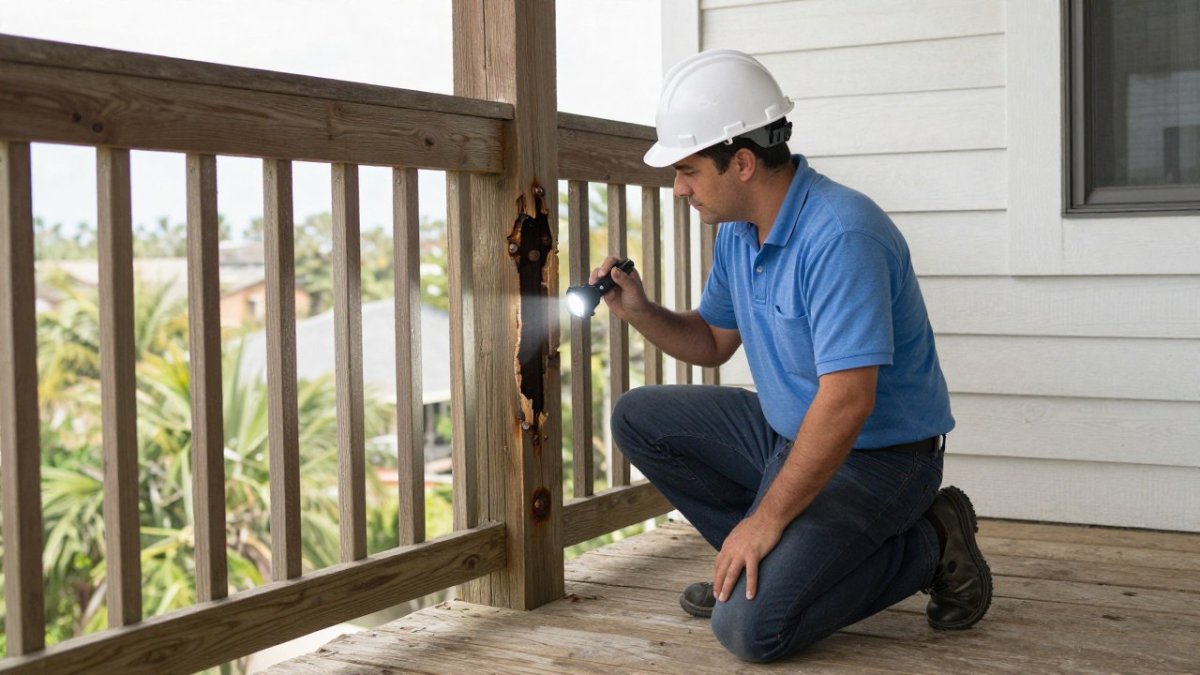
- Loose, corroded, or missing railings and guardrails
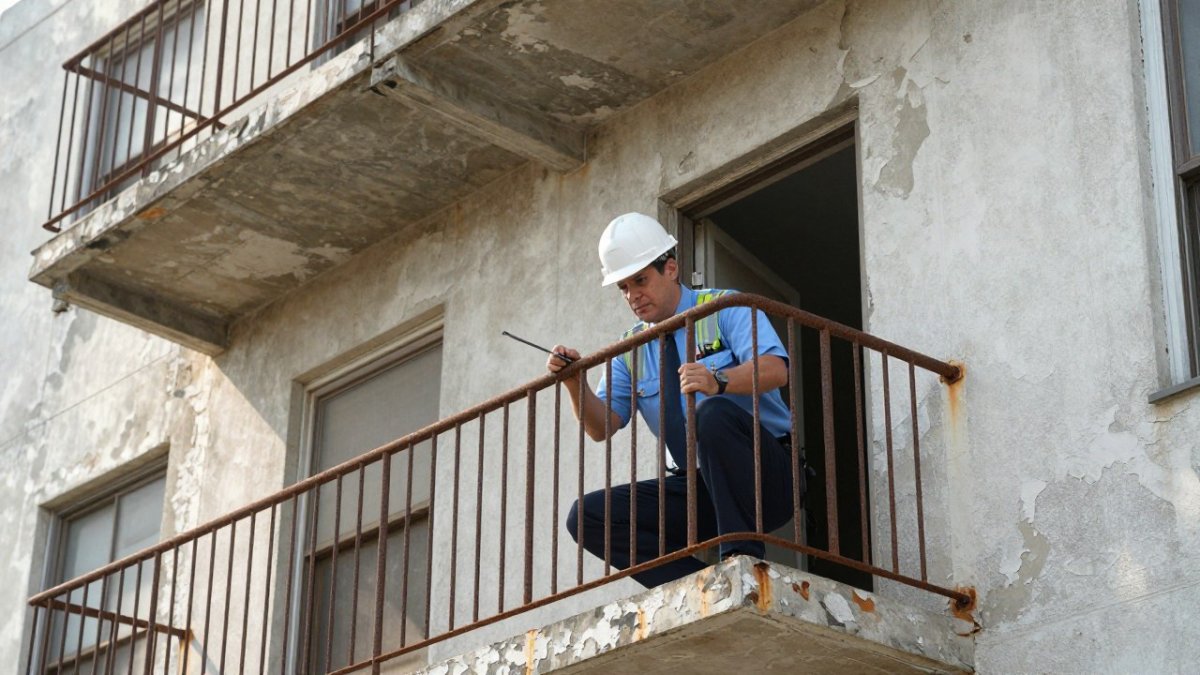
- Cracked or spalling concrete on balcony slabs and stair treads
- Deteriorated structural connections at balcony ledgers
- Exposed wiring or damaged lighting on exterior walkways
A common mistake is assigning these to a routine maintenance queue. Flag them for immediate action and document the date each hazard was reported.
Score Each Finding With a Risk Matrix
Once safety-critical items are isolated, the rest of the audit findings still need an order. A single gut-feel ranking tends to favor whatever is most visible, not whatever is most likely to fail or most costly to ignore. A five-factor scoring matrix makes the reasoning visible and repeatable.
Score each finding on five factors, using a 1-to-5 scale for each:
- Life-safety risk: How likely is a person to be hurt if this item is left as is? A cracked guardrail anchor scores high here regardless of its repair cost.
- Likelihood of failure: How close is the component to failing on its own?
- Consequence of failure: If it fails, what is the damage? Consider water intrusion into interior units, structural loss, loss of use of a balcony, or a code citation.
- Urgency: Does the item have a deadline set by a notice, an insurer requirement, or a condition that will worsen within a defined window? Score 5 only when the date is fixed.
- Repair cost and effort: Estimate the relative cost, not the exact figure, and score inversely, so that inexpensive fixes to high-risk items still rank well. Use a score of 5 for the cheapest option.
Weight life-safety risk so it can override the total. A practical rule is that any life-safety score of 5 moves the item to the immediate queue regardless of the sum.
For the remaining items, add the scores with a simple weighted total, for example life-safety and consequence counted double. Sort the results from highest to lowest. Items in the top band enter the next repair cycle, the middle band is scheduled within the year, and the bottom band goes to routine maintenance.
A short example shows how this works. A failed sealant joint at a balcony ledger might score 4 on likelihood, 4 on consequence, 3 on urgency, and 4 on cost, which puts it near the top. A peeling soffit paint job might score 2, 1, 1, and 2, which places it in the routine band even though it is visible to every resident.
Watch out: scores drift when different people assign them. Have one reviewer score every item and a second reviewer spot-check the top ten, then record any changes in the board minutes.
The five factors used to score each audit finding are summarised below.
| Factor | Scale | What it asks |
|---|---|---|
| Life-safety risk | 1-5 | How likely a person is to be hurt if left as is |
| Likelihood of failure | 1-5 | How close the component is to failing on its own |
| Consequence of failure | 1-5 | Damage if it fails: water intrusion, structural loss, citation |
| Urgency | 1-5 | Whether a fixed deadline from a notice or insurer applies |
| Repair cost and effort | 1-5 | Relative cost, scored inversely; 5 is the cheapest option |
Scale
Translate Audit Language Into Work Orders
Audit reports often use technical phrasing such as “moisture intrusion at penetrations” or “deteriorated sealant.” Those phrases are accurate but not actionable. Convert each finding into a work order that names the location, the required action, and the person responsible.
For example, “Sealant failure at deck-to-wall joint, Unit 4B” becomes: “Remove failed sealant at Unit 4B deck-to-wall joint, reapply approved sealant, assign to licensed waterproofing contractor, due in 30 days.”
Build a Building Repair Priority List Template
A written priority list keeps the board accountable. Use this template for each finding:
Finding: ____________________
Location: ____________________
Risk score (likelihood x consequence): ______
Category: Safety-critical / Structural / Preventive / Cosmetic
Assigned to: ____________________
Target completion date: ____________________
Approved budget: $____________________
Review the list at board meetings until every safety-critical item is closed.
Sequence Repairs and Account for Dependencies
Some repairs cannot happen until others are finished. Repainting a balcony soffit before fixing the water source wastes money. Sealing a joint before the surrounding concrete is repaired will fail early. Sequencing repairs around their dependencies also helps keep ongoing maintenance coordinated, a principle Champagne Strata can help you carry through to future work.
Before scheduling, check each item for dependencies:
- Does this repair depend on another repair being finished first?
- Will this work disturb anything already repaired?
- Does it require permits or inspection sign-off?
Group dependent tasks together so one contractor visit covers the full sequence.
Plan Budget-Constrained and Phased Repairs
Most associations cannot fund every item in an audit at once, and the gap between the total repair estimate and available reserves is often large. Check whether a deck or balcony item needs professional waterproofing before committing funds to a cheaper patch. The goal is not to fund everything but to make sure that the money goes to the right items first, and that every deferred item has a documented control while it waits.
Start by separating the findings into three groups based on the scoring from the risk matrix. Group one holds life-safety items and any finding with a fixed deadline. Group two holds structural and water-intrusion items that will worsen within a year. Group three holds preventive and cosmetic work.
Fund group one in full before committing money to the other groups. If group one alone exceeds available funds, the board has three options: a special assessment, a reserve draw authorized under the governing documents, or a short-term loan.
For items that must wait, use interim controls. A temporary closure of a balcony, a posted restriction on loading, or a more frequent inspection schedule can reduce risk until the repair is funded. Each control should have an owner, a trigger that forces escalation, and a review date. For example, a balcony with a cracked tread might be closed to furniture and visitors, inspected monthly, and escalated to a full repair if the crack grows past a measured length.
Phase the work so that each phase closes a complete risk category rather than spreading small amounts across many items. A phase that finishes all balcony guardrails is more useful than one that fixes a little of everything, because it removes a whole class of exposure.
Escalation decisions should be explicit. Define in advance the conditions that move a deferred item up the list, such as a new injury report, a change in the auditor’s rating, or a water test that shows active leakage. Document each escalation in the board minutes with the date and the reason.
Watch out: deferring a repair without a written interim control and a review date is the most common way a known hazard becomes a claim. Record every deferral with its control, owner, and next review date before the meeting closes.
Turn Repairs Into a Preventive Maintenance Plan for Buildings
Once the immediate list is cleared, convert the audit into an ongoing schedule. A preventive maintenance plan for buildings reduces the chance that the same findings return in five years.
Set recurring tasks such as annual balcony inspections, semi-annual sealant checks, and quarterly railing tightening. Assign each task an owner and a due date.
Schedule Your Structural Inspection and Repair Review
Repair priorities should be revisited after every completed phase and at least once a year. Consider scheduling a follow-up structural inspection to confirm that safety-critical items are closed and that no new hazards have developed.
If your audit has findings you are unsure how to rank, Apex Balcony can help you review inspection findings. Book inspection to get started, or learn how to read inspection report language before your next board meeting.
Frequently Asked Questions
What should a building repair priority list include?
A useful repair priority list records each audit finding with its location, a description in plain language, the safety or structural risk it poses, the likelihood of further damage if it is left alone, the estimated cost range, and the responsible party. Findings should be ranked so that safety-critical items appear first, followed by structural defects, water intrusion issues, building systems, and cosmetic work. Keep the list in a shared document so the board and property manager can update the status of each item as work is completed and verified.
How do you rank building repairs by urgency?
Rank repairs by asking two questions: how severe is the consequence if the item fails, and how quickly will it get worse? Items that threaten occupant safety or could cause a collapse, fall or fire rank highest. Next come defects that allow water or moisture into the structure, since these cause hidden damage that grows over time. Routine maintenance and cosmetic items rank lowest. Scoring each finding on a simple scale for severity and deterioration rate makes the ranking consistent across inspectors and board members.
How should an HOA budget for repairs identified in an audit?
Start by separating urgent safety work from items that can be scheduled over several budget cycles. Obtain itemized contractor estimates for the top-priority repairs, then compare them against reserve fund balances and any special assessment options. Phasing work by priority tier lets the association fund the most critical items first while spreading the remaining costs across future years. Document the reasoning for each phase so owners and auditors can see how the plan was set.
When should you do a structural audit of a building?
Property owners should confirm the current inspection requirements that apply to their building. Consult a licensed inspector or your local building department to determine the exact timing for your property.